- 288 pages
- English
- ePUB (mobile friendly)
- Available on iOS & Android
eBook - ePub
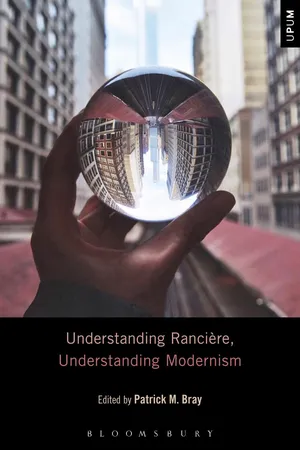
Understanding Rancière, Understanding Modernism
About this book
The contemporary philosopher Jacques Rancière has become over the last two decades one of the most influential voices in philosophy, political theory, and literary, art historical, and film criticism. His work reexamines the divisions that have defined our understanding of modernity, such as art and politics, representation and abstraction, and literature and philosophy. Working across these divisions, he engages the historical roots of modernism at the end of the eighteenth century, uncovering forgotten texts in the archive that trouble our notions of intellectual history. The contributors to Understanding Rancière, Understanding Modernism engage with the multiplicity of Rancière's thought through close readings of his texts, through comparative readings with other philosophers, and through an engagement with modernist works of art and literature. The final section of the volume includes an extended glossary of the most important terms used by Rancière, which will be a valuable resource for experts and students alike.
Information
Part One
Conceptualizing Rancière
1
The Hatred of Democracy and “The Democratic Torrent”: Rancière’s Micropolitics
Emily Apter
In the concluding pages of his 2005 broadside, The Hatred of Democracy [La haine de la démocratie], written during Chirac’s presidency and Sarkozy’s short stint as minister of finance, in the lead-up to the global financial crisis, Jacques Rancière would draw a parallel between “intellectuals today” and the authoritarian elites in Second Empire France who wage all-out war against “the democratic torrent”1:
To understand what democracy means is to hear the struggle that is at stake in the word: not simply the tones of anger and scorn with which it can be imbued but, more profoundly, the slippages and reversals of meaning that it authorizes, or that one authorizes oneself to make with regard to it. When, in the middle of the manifestations of heightening inequality, our intellectuals become indignant about the havoc wreaked by equality, they exploit a trick that is not new. Already in the nineteenth century, whether under the monarchie censitaire or under the authoritarian Empire, the elites of official France—of France reduced to two hundred thousand men, or subject to laws and decrees restricting individual and public liberties—were alarmed at the “democratic torrent” that prevailed in society. Banned in public life, they saw democracy triumphing in cheap fabrics, public transport, boating, open-air painting, the new behavior of young women, and the new turns of phrase of writers. However, they were not innovative in this regard either. The pairing of democracy viewed both as a rigid form of government and as a permissive form of society is the original mode in which the hatred of democracy was rationalized by Plato himself.2
Rancière identifies democracy with “a paradoxical condition of politics” associated with the “egalitarian contingency that underpins the inegalitarian contingency itself” (HD 94). One can take this formula literally as a reference to the suspicion and contempt of elites toward the leveling effects of mass culture and the widening of the franchise, but it really has to do with the supposition that democracy ungrounds itself by spreading democratization. For Rancière, micropolitical practices in the domains of art, leisure, and work furnish conditions of redistributed power even as they engender new forms of policing and censorship. Thus a process of making-equal is inseparable from inegalitarianism and vice versa: such paradoxes hold as the essence of “politics” in all its unexceptional guises.
The Hatred of Democracy makes scant reference to literature and unlike other works of Rancière (La parole muette. Essai sur les contradictions de la littérature (1998) [Mute Speech: Literature, Critical Theory, and Politics]; Le Partage du sensible: Esthétique et Politique (2000) [The Politics of Aesthetics]; Politique de la littérature (2007) [Politics of Literature]; Aisthesis. Scènes du régime esthétique de l’art (2011) [Aisthesis. Scenes from the Aesthetic Regime of Art]; and Le fil perdu (2014) [The Lost Thread]), it offers no concerted politics of the aesthetic. But there is one figure who surfaces as a literary point of reference in Rancière’s suggestive parallels between Second Empire society and neoliberal Europe in the early 2000s, and that is Hippolyte Taine. Those popular pastimes, leisure pursuits, and objects of consumption, those fleeting figures of a mass society that both offend and energize the conservative state, alluded to by Rancière, are in Taine tallied on the basis of an anthology of Second Empire attitudes and mores in the 1867 novel Notes sur Paris: Vie et opinions de Frédéric-Thomas Graindorge: “Pour un bon florilège de ces themes, voir Vie et opinions ...”3 Rancière footnotes this obscure work in a perfunctory yet intriguing way. Indeed, Taine’s novel works as a key to understanding the “democratic torrent,” to rethinking paradoxes of egalitarianism, to addressing the difficulty of defining what politics is (prior to or exceeding its naming by political institutions) or is not. (And for Rancière, as we know, politics is certainly not democracy, where democracy is the name for a presumptive legal equality valid only for those parts of the people who are counted.)4
Taine, in Rancière’s reading, elucidates the messy, hatable contents of democracy—which, in embodying a reckless adherence to “limitless growth,” ultimately brings about the recession of political space. As Rancière underscores in Hatred of Democracy:
The “government of anybody and everybody” is bound to attract the hatred of all those who are entitled to govern men by their birth, wealth, or science. Today it is bound to attract this hatred more radically than ever, since the social power of wealth no longer tolerates any restrictions on its limitless growth, and each day its mechanisms become more closely articulated to those of State action.... State power and the power of wealth tendentially unite in a sole expert management of monetary and population flows. Together they combine their efforts to reduce the spaces of politics. (94–95)
Rancière, in fact, never delivers the hypothetical piece he might have written on Taine’s Graindorge, one which might have approached the text as a sociology of obstructions to true democracy, as a study in the evacuated foundation of democracy, or as an exemplary document of the capitalization of social life and the curtailment of political space.5 But I will argue that Graindorge links the “democratic torrent” to Rancière’s aesthetics of milieu in ways that activate Taine’s own theory of milieu in its full philological development. In this way, activating Rancière’s scattered and parsimonious allusions to Taine, I find material for extending the reach of his own aisthetic politics.
Graindorge is a document of the “democratic torrent” which by and large failed to endear him to his readers. This comes through in an exchange with Sainte-Beuve. Taine had written him an anxious letter acknowledging his influence on this experiment in “moral physiology,” and requesting his frank assessment when the work came out in book form (it was originally published as a series of articles with illustrations by Isidore Planat in La Vie parisienne).6 Sainte-Beuve responded with fair warning that the book would not be well received because it was too judgmental and harsh in its depictions of social types. “Why, he asks, are you in such a hurry to translate your impressions into written notes, and these notes into laws?”7
Graindorge answers that question in its probe into the laws of the market at the dawn of a new era of finance capital. Perhaps even more than Balzac, Flaubert, or Marx, Taine devised a language for describing distribution networks of material artifacts and determinations of the market value of goods and social advantage. According to Jonathan Dewald, from Graindorge’s “sharp interest in contemporary material life” we learn
the cost of women’s dresses, their fabrics and colors, how marriage proposals were made and what went through the minds of the parties to them, how much income the different levels of Paris society required.... Graindorge’s opinions (in addition to appreciation for material comfort) also display a radical detachment from conventional moralities and a readiness to acknowledge the harsh realities of modern life. Notes sur Paris can be read as exemplifying the mode of intellectual life that the Magny group represented; one that combined engagement with contemporary social life, philosophical materialism, and freedom from institutional and pious moralizing.8
Taine, one could say, prefigured the theoretical moment in which we find ourselves now: one of philosophical materialism attuned to the financialization of everything. His literary experiment records how new forms of finance capital generate a milieu that permeates all modes of existence.
Graindorge is an uprooted Frenchman, educated in Britain and Germany, and enriched in America, where he made a fortune by investing in pork and oil and profiting from slave labor. His character is a mystery, and must be painstakingly reconstructed after his death through techniques of forensic autopsy.9 In this task, “Taine,” his eponymous executor, relies on one M. Marcelin (director of La Vie parisienne), who had “several views taken of the apartment of the deceased by a photographer in repute. By the aid of several portraits he had obtained the principal traits of the person and costume of M. Graindorge” (NP v). The photographic evidence turns up strange artifacts—a stuffed crocodile in the boudoir, a portrait of his black servant Sam—but they are mere trace-elements of eccentricities belied by the character’s bland self-presentation: “His phrases in themselves were mere statements of facts, dull, and very precise” (NP vii; emphasis in the original). Graindorge personifies matter-of-factness, facing his own death with practical equanimity: “The conclusion you omit to draw is, that it would be better for me if I were dead; that is my opinion too,” and applying the same attitude to social engineering (NP viii). One of his aims in coming to Paris is the creation of a matchmaking service modeled on the Bourse. “Is not marriage an affair? Is anything else considered in it but proper proportions? Are not these proportions values, capable of rise and fall, of valuation and tariff? Do we not say, a young girl of one hundred thousand francs? Are not life-situations, a handsome figure, a chance of promotion, articles of merchandise quoted at five, then, twenty, fifty thousand francs, deliverable only against equal value?” (NP 174). The business plan for a “universal matrimonial agency” (a kind of match.com, Facebook, and Grindr avant la lettre) is outlined in chapter XIV “A Proposition, New, and Suited to the Tendencies of Modern Civilization, Designed to Assure the Happiness of Households and to Establish on a Sound Basis a First-Class Institution Hitherto Left to Arbitrary Direction and to Chance” (NP 176, 169). Graindorge’s astuce is to fine-tune the marriage market by applying the financial instruments of data and risk management: “Each offer inscribed at the agency shall be accompanied by a demand, specifying approximately the amount of fortune, and the kind of position demanded in exchange” (NP 176). A photographic record that includes close-ups of teeth, feet, and hands, will accompany a complete dossier of “medical certificates, mortgage clearances, title-deeds, evidences of income and of property, legal attestations as to correct life and habits” (NP 177). Marriage prospects will be put up as investment opportunities, and buyers will be insured against the risk of shoddy goods by religious, educational, and legal authorities. Graindorge thus shifts the patrician model of intermarriage and fortune-consolidation into the speculative economy of stock trading and hedging. A prospect’s value will be adjusted for inflation and deflation according to political fluctuations: “A threat of war will send down the value of officers. The news of peace in America will raise the value of merchants. Each one, on opening his journal in the morning, will have the pleasure of finding his value inscribed, and quoted” (NP 179). Graindorge sees his proposal as the natural outgrowth of the positive sciences “extending everywhere unceasingly; everybody is now occupied with statistics, political economy, publicity, industrial, commercial and practical customs” (NP 180). What project, he reasons, “gives more guarantee to private interests, more publicity to commerce ... which creates at once more commercial men and more functionaries; which renders life at once more convenient and more mechanical; which brings man nearer to those stamped and quoted values, duly registered and circulating, to which he is striving to assimilate himself?” (NP 180). So certain is he of the venture that he declares himself willing to stake his own capital which, he wagers, will earn 10 percent more in interest than his salt pork or oil shares.
To ensure the success of his agency, Graindorge must learn the social networks of Paris, and here is where Tainian milieu theory takes hold as an inventory of Second Empire mores and social hierarchies. Spaces of leisure and populist socializing are scanned in shabby recycled couches, jostling bodies, dirty dancing, smells of gas and tobacco, heat and steam; cast-offs and clothing for hire. High-culture venues are similarly assess...
Table of contents
- Cover
- Half Title
- Series Information
- Title Page
- Contents
- Notes on Contributors
- Series Preface
- List of Abbreviations
- Introduction: Toward a New Aesthetic Theory
- Part One Conceptualizing Rancière
- Part Two Rancière and Aesthetics
- Part Three Glossary of Key Terms
- Part Four Interview with Jacques Rancière
- Index
- Copyright Page
Trusted by 375,005 students
Access to over 1.5 million titles for a fair monthly price.
Study more efficiently using our study tools.
Frequently asked questions
Yes, you can cancel anytime from the Subscription tab in your account settings on the Perlego website. Your subscription will stay active until the end of your current billing period. Learn how to cancel your subscription
No, books cannot be downloaded as external files, such as PDFs, for use outside of Perlego. However, you can download books within the Perlego app for offline reading on mobile or tablet. Learn how to download books offline
Perlego offers two plans: Essential and Complete
- Essential is ideal for learners and professionals who enjoy exploring a wide range of subjects. Access the Essential Library with 800,000+ trusted titles and best-sellers across business, personal growth, and the humanities. Includes unlimited reading time and Standard Read Aloud voice.
- Complete: Perfect for advanced learners and researchers needing full, unrestricted access. Unlock 1.5M+ books across hundreds of subjects, including academic and specialized titles. The Complete Plan also includes advanced features like Premium Read Aloud and Research Assistant.
We are an online textbook subscription service, where you can get access to an entire online library for less than the price of a single book per month. With over 1.5 million books across 990+ topics, we’ve got you covered! Learn about our mission
Look out for the read-aloud symbol on your next book to see if you can listen to it. The read-aloud tool reads text aloud for you, highlighting the text as it is being read. You can pause it, speed it up and slow it down. Learn more about Read Aloud
Yes! You can use the Perlego app on both iOS and Android devices to read anytime, anywhere — even offline. Perfect for commutes or when you’re on the go.
Please note we cannot support devices running on iOS 13 and Android 7 or earlier. Learn more about using the app
Please note we cannot support devices running on iOS 13 and Android 7 or earlier. Learn more about using the app
Yes, you can access Understanding Rancière, Understanding Modernism by Patrick M. Bray in PDF and/or ePUB format, as well as other popular books in Literature & French Literary Criticism. We have over 1.5 million books available in our catalogue for you to explore.