eBook - ePub
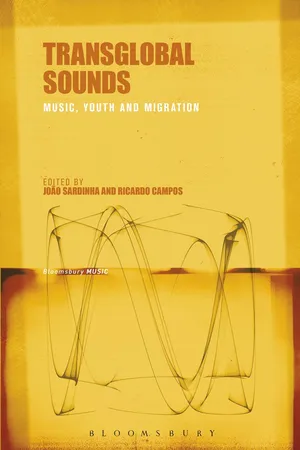
Transglobal Sounds
Music, Youth and Migration
- 248 pages
- English
- ePUB (mobile friendly)
- Available on iOS & Android
eBook - ePub
Transglobal Sounds
Music, Youth and Migration
About this book
Through a transnational, comparative and multi-level approach to the relationship between youth, migration, and music, the aesthetic intersections between the local and the global, and between agency and identity, are presented through case studies in this book. Transglobal Sounds contemplates migrant youth and the impact of music in diaspora settings and on the lives of individuals and collectives, engaging with broader questions of how new modes of identification are born out of the social, cultural, historical and political interfaces between youth, migration and music. Thus, through acts of mobility and environments lived in and in-between, this volume seeks to articulate between musical transnationalism and sense of place in exploring the complex relationship between music and young migrants and migrant descendant's everyday lives.
Information
PART ONE
Music, mobilities and processes of being
CHAPTER ONE
Afro-mandinga in Lisbon: Griots and the (en)chantment of the past
Introduction
In the last decades, the migration of Mandingo musicians from Guinea-Bissau to Lisbon has brought complexity to the local artistic scene. Having two primary performance circuits – them being the local Guinean community and association parties, on one hand, and the general public, via concerts in theatres, bars and festivals, on the other – these musicians play and promote what is known as afro-mandinga, a contemporary version of the more traditional djaliá (or jeliyá in Mandingo), the art form of Mandingo people (Becker 2009) composed of music, poetry and praise singing that tells the history and speaks of the values of the Mandingo (Dorsch 2002; Ebron 2002; Charry 2004; Hale 2007). Defined as bards, historians, poets, singers, musicians, actors, genealogists, diasporists, storytellers, mediators and spiritual guides (Dorsch 2002), the griots conceived djaliá during the Mande Empire of the thirteenth-century, a cultural component that still figures in Mandingo society today; a key component of social structure and safeguarding of this group’s history.1
This article sets out to observe a performance by young Guinea-Bissau musician Kimi Djabaté at the Lisboa Mistura Festival that took place at São Luiz Theatre in Lisbon on 5 December 2010. On that evening, Djabaté was the so-called ‘Guinea-Bissau revelation artist’. He was not the only griot to take part in the event. That afternoon, griots from Tabato, the same village where Kimi Djabaté was born, also performed in the theatre’s Winter Garden. My opting to analyse this emblematic event is due to the fact that it tells us about the systemic importance history and past traditions have on griot performances, now transmitted by a new generation of mobile musicians. The past orders the present, bringing significance to the presence of griots and their artistic and cultural scenes around the world.
Through Kimi Djabaté and his fellow countrymen’s performances on that day at the São Luiz Theatre, and through statements provided by key informants deriving from a fieldwork period carried out between 2009 and 2011,2 my aim is to observe how the past is transmitted by griot performances in order to bring significance and create a legitimate artistic space for these musicians, not only in Lisbon, but also in Guinea-Bissau. Via the way these musicians perceive their artistic practices, connected to historical issues and practices, my analysis will thus be rooted in the theorization of Mandingo transnationalism.
Mandingo transnationalism through time
De Bruijn and Van Dijk (1997) conceive Mandingo as an umbrella of different ethnic groups from an ‘original country’3 named Mande. Furthermore, Mamadou Diawara (1997) puts forth the existence of a Mande cultural area influenced by the old Mande (or Mali) Empire (thirteenth- to fifteenth-centuries), occupied by Mande speakers and other groups sharing similar social organizations. Historically connected to the Malian hinterland, the arrival of Mandingo groups to the Atlantic coast was due to the spread of the Mande Empire from the thirteenth-century onward.
Their arrival on the Atlantic coast imposed a new social order and a tripartite structural organization, on one hand, leading to a weakness of relations based in ethnicity, on the other, seeing the strengthening of relations among similar social groups (Wright 2010). The existence of ‘specialized groups’ (sometimes seen as castes or social classes) was, and still is, crucial to the functioning of Mande society due to their ability to provide important services to certain groups and individuals (Tamari 1991; Conrad and Frank 1995). In this context, Mande history is highlighted in griot songs and in this group’s ability to entertain, chanting the glories and honour of noble families.
Transnationalism is adopted in order to understand how people lived through Mande history (from the thirteenth-century until the present), for not only do griots accompany the conquests and the spreading of the Mande territory, their travelling and migration are key to the dissemination of their art and enrichment of knowledge. Griot’s transnational lives have allowed them to take back and forward narratives and songs that have become important spiritual pathways for society to follow, having become historically responsible for the creation of an imaginary and an ethos that serves as the background for individual and collective actions. Literature on Mandingo identity and social dynamics draws attention to travel and adventure in the construction of the imaginary. Nowadays, migration and diaspora are the two main elements that most contribute to the so-called ‘constructed imaginary’ (Johnson 2009).
Once settled in a new country, departure is never forgotten. Similar to other immigrants living in transnational contexts, griots articulate roots and trajectories (Salih 2003), building public spheres, and communal consciousness and mechanisms of solidarity. Supported by their roots and their own narratives of trajectories, they maintain their singularities in a transnational field that insists on homogenizing lives (Vertovec 2009). Transmigrants often construct new practices and social networks, connecting individuals to two or more societies at the same time (Basch et al. 1992). Using transnationalism to discuss life and people’s experiences, Basch et al. (1992) defend that transmigrants see themselves forced to confront, re-design and re-work different identities (national, ethnical or racial) in which religious identity can be included as well (Riccio 2001; Salih 2003; Mapril 2008).
As Basch and her colleagues (1992) further advance, understanding transmigrations is not only necessary in order to be conscious of economic dynamics, but of political processes as well. For the griots, Lisbon not only appears as a possibility to further their artistic careers, given that it’s a cheaper city to live-in in comparison to other European capitals, but also their choice is marked by the legacy of the colonial past that links Guinea-Bissau to Portugal. In this case, relations and connections made in colonial times continue in the post-colonial era (Sarró and Mapril 2011).
In Portugal, three waves of Guinean immigration have been identified. With this paper, focus is on those belonging to the third migration wave: people who left Guinea-Bissau at the onset of the 1998 civil war.4 Here we are in the presence of a wave that has changed the way Guineans connect to their homeland given that they have at their disposal greater means that permit the creation of a stronger transnational field. Through technological means and social networks, individuals are able to keep up with Guinean social, cultural, political and religious issues at a distance (Machado 1998, 2002; Quintino 2010).5 In the context of Lisbon, the gathering of Mandingo, Fulbe and Beafada individuals has strengthened community and Muslim associations.6 These organizations are important to my interlocutors given that they are a means of integration in Lisbon, making it possible for these artists to begin their artistic lives as well.
In conjunction to the above, it is also necessary to understand the interplay of ethnicity and religious identity. Johnson (2002, 2006) explores the conflation of those two dimensions to Mandingo people in Guinea-Bissau and how they are interwoven and complexified in diaspora, a space where Africa and Islam are built by dissonant discourses and practices. Mandingo identity must be understood by taking into consideration the interrelationship between ethnicity and religious identity. Griots are responsible for communicating and perpetuating this bond – narrating not only Mande history facts and the path of its founding father, Sunjata Keita, but also the path of Surakata, first griot of the Prophet Mohammed.
The immigration setting additionally adds another dimension to their ethnic identity. Besides the connection to the Mande World and to the idea of a Guinean national identity (where their ethnicity and religious identities are emphasized) at a distance, living in Europe also gives griots other possibilities to experience their identity and their art (as their connection to a Pan-African identity is amplified). Kiwan and Meinhof (2011) refer to transmigrant links as hubs made of multi-dimensions and multi-directions that create transcultural capital. Moreover, hub is a concept that, according to the authors, does not essentialize the artists because of their ethnic origins, but sees those as strategies and tools to describe the way the artists use valid resources from their homeland and their culture of origin in order to develop their art, and at the same time, launch themselves in the music industry.
This imported cultural capital, as Kiwan and Meinhof further suggest, reveals the connection of migrant artists and diaspora networks. It is as if they use diaspora as a platform to make themselves visible to a mainstream audience and its music industry. This cultural and translocal capital rises from local styles, rhythms, knowledge of landscapes, rituals and dialects from the artist’s homeland. Kiwan and Meinhof (2011) suggest that migration gives many rituals and songs an aura of tradition and authenticity. Singing and playing songs is understood as traditional because it seems to evocate what is ‘in the blood’ and also serves to define an individual. We can see griots in Europe through those lenses; nonetheless it is important not to miss the point that these individuals evocate their values and pass them along in diasporic settings (in this case, Lisbon). Their art is thus a part of their identity as it is a way of being in the world and a way of communicating outside their own society. It is in this context where we can see the rise and force of afro-mandinga, the contemporary version of the traditional djaliá.
As defended by Cole (2001), in the context of past–future tension, the present is where ‘new’ practices rise, configured inside transnationalism. Within these practices, music (and art in general) is a cultural reproduction medium of the people that is representative of their origins (Vertovec 2009). In Lisbon, many griots have been helped in their careers by immigrant networks and associative groups, often hired to work parties and celebrations. Outside these networks, they also look for a wider audience and perform at different places, such as world music festivals. In both contexts, artists are adopting the term afro-mandinga to rename the practice of djaliá, to mark the modern character of their music and ...
Table of contents
- Title
- Contents
- List of contributors
- Introduction: Transglobal Sounds João Sardinha and Ricardo Campos
- Part One Music, mobilities and processes of being
- 1 Afro-mandinga in Lisbon: Griots and the (en)chantment of the past Carolina Carret Höfs
- 2 From Coimbra to London: To live the punk dream ‘and meet my tribe’ Paula Guerra and Pedro Quintela
- Part Two Hybridism and aesthetic creativity
- 3 ‘More than pets of multiculturalism’: Diasporic hybridity in Icelandic popular music – the case of Retro Stefson Gestur Guðmundsson and Arnar Eggert Thoroddsen
- 4 Popular music and generational dynamics of immigration in ‘postcolonial Finland’ – the case of Ourvision Singing Contest 2009 Antti-Ville Kärjä
- 5 Nanyin and the Singaporean culture: The creation of intangible cultural heritage in Singapore and intergenerational contrasts Kaori Fushiki
- Part Three Identity politics and negotiations
- 6 Protest rap and young Afro-descendants in Portugal Ricardo Campos, Pedro Nunes and José Alberto Simões
- 7 Music: A tool for socio-political participation among descendants of immigrants in Buenos Aires and Bilbao? Natália Gavazzo, Sónia Pereira and Ana Estevens
- 8 ‘Ich fühle mich Deutsch’: Migrant descendants’ performance of integration through the Hamburg HipHop Academy Emily Joy Rothchild
- Part Four Connecting sounds and ancestral homelands
- 9 ‘Portugal dos Xutos’: Portuguese music in the lives of ‘returned’ descendants of Portuguese emigrants from Canada João Sardinha
- 10 Drawing a homeland on the staff: Music of Turkey in Berlin Pinar Güran Aydin
- Conclusion: Understanding acoustic performativities, youth subjectivities and mobile identities Anastasia Christou, João Sardinha and Ricardo Campos
- Index
- Copyright
Trusted by 375,005 students
Access to over 1.5 million titles for a fair monthly price.
Study more efficiently using our study tools.
Frequently asked questions
Yes, you can cancel anytime from the Subscription tab in your account settings on the Perlego website. Your subscription will stay active until the end of your current billing period. Learn how to cancel your subscription
No, books cannot be downloaded as external files, such as PDFs, for use outside of Perlego. However, you can download books within the Perlego app for offline reading on mobile or tablet. Learn how to download books offline
Perlego offers two plans: Essential and Complete
- Essential is ideal for learners and professionals who enjoy exploring a wide range of subjects. Access the Essential Library with 800,000+ trusted titles and best-sellers across business, personal growth, and the humanities. Includes unlimited reading time and Standard Read Aloud voice.
- Complete: Perfect for advanced learners and researchers needing full, unrestricted access. Unlock 1.5M+ books across hundreds of subjects, including academic and specialized titles. The Complete Plan also includes advanced features like Premium Read Aloud and Research Assistant.
We are an online textbook subscription service, where you can get access to an entire online library for less than the price of a single book per month. With over 1.5 million books across 990+ topics, we’ve got you covered! Learn about our mission
Look out for the read-aloud symbol on your next book to see if you can listen to it. The read-aloud tool reads text aloud for you, highlighting the text as it is being read. You can pause it, speed it up and slow it down. Learn more about Read Aloud
Yes! You can use the Perlego app on both iOS and Android devices to read anytime, anywhere — even offline. Perfect for commutes or when you’re on the go.
Please note we cannot support devices running on iOS 13 and Android 7 or earlier. Learn more about using the app
Please note we cannot support devices running on iOS 13 and Android 7 or earlier. Learn more about using the app
Yes, you can access Transglobal Sounds by João Sardinha, Ricardo Campos, João Sardinha,Ricardo Campos in PDF and/or ePUB format, as well as other popular books in Media & Performing Arts & Ethnomusicology. We have over 1.5 million books available in our catalogue for you to explore.