eBook - ePub
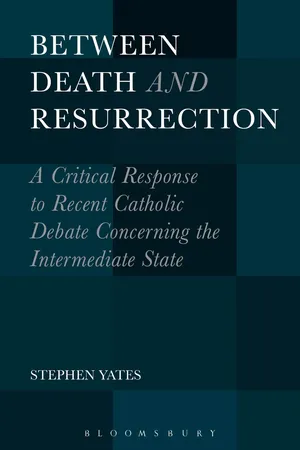
Between Death and Resurrection
A Critical Response to Recent Catholic Debate Concerning the Intermediate State
- 256 pages
- English
- ePUB (mobile friendly)
- Available on iOS & Android
eBook - ePub
Between Death and Resurrection
A Critical Response to Recent Catholic Debate Concerning the Intermediate State
About this book
Christians look with hope to the resurrection of the dead and the restoration of all things. But what of those who have already died? Do they also await these things, or have they in some sense already happened for them? Within the Catholic theological community, this question has traditionally been answered in terms of the disembodied souls of human beings awaiting bodily resurrection. Since the 1960s, Catholic theologians have proposed two alternatives: resurrection at death into the Last Day and the consummation of all things, or resurrection in death into an interim state in which the embodied dead await, with us, the final consummation of all things. This book critically examines the Scriptural, philosophical and theological reasons for these alternatives and, on the basis of this analysis, offers an account of the traditional schema which makes clear that in spite of these challenges it remains the preferable option.
Information
1
Recent Catholic Debate Concerning the Intermediate State
This book constitutes an examination of, and contribution to, a discussion conducted within the Catholic theological community since the 1960s concerning the proper understanding of the apparent interval between the death of individual human beings and the final consummation of all created things (typically referred to as the “intermediate state”).
This initial chapter undertakes an analysis of the arguments of a representative range of Catholic scholars who propose a variety of alternative eschatological models to the traditional schema of a postmortem phase of disembodiment preceding bodily resurrection, as well as the arguments of those who have responded critically to their proposals. The analysis makes clear those issues which are determinative for the debate and identifies in connection with each of these a number of “dialogical lacunae,” areas where the various parties in the debate have failed adequately to address points made by each other.
The traditional Catholic position on the intermediate state
According to the official teaching of the Catholic Church, the souls of human beings do not perish in death, but are immortal.1 After death, the soul comes before God immediately,2 to be judged for what he/she has done while in the body.3 Eternal retribution is received in one’s immortal soul at the very moment of one’s death, the soul entering heaven (immediately,4 or after a postmortem stage of purification5) or entering hell.6 The soul is reunited with its body at the final resurrection when Christ comes again for the last judgment.7 This will be the same body it bears in this life.8 Concerning the souls in purgatory, these can be helped,9 their suffering alleviated or relieved,10 by acts of intercession (suffragia) offered by living members of the church (such as the sacrifice of the Mass, prayers, alms, and various works of piety).11
It is the period between the death of the individual and the general resurrection, rather than the postmortem purification phase only, that is referred to by theologians as the intermediate (or interim) state. Prior to the Second Vatican General Council, the sententia communis of Catholic theologians would appear to have been that the subjects of this state are the animae separatae (the separated souls) of human beings whose continued existence guarantees the personal identity of those individuals resurrected on the last day.12
Although there does not seem to be an authoritative statement concerning why bodily resurrection should be deferred until the Parousia and the last judgment, the theological consensus has tended to emphasize the fittingness of such postponement given the effects of sin on various aspects of the created order. The deferral of resurrection is thus sometimes characterized as a penalty for original sin which “extending as it does to the whole of that nature in which all men are one, cannot be finally lifted from one without being lifted also from the others.”13 A different but complementary emphasis is sometimes evident. Thus, Roger Troisfontaines argues that since the body is the foundation of our relation to the material world, “it would only be fitting that we wait until the world … is cleansed and transformed into ‘a new heaven and a new earth’ before we are reunited with it, the basis of this new relation being nothing else than the glorified body.”14 The “fittingness” of this arrangement is explained by him in terms of St. Paul’s teaching that creation’s present slavery to corruption is an effect of human sin (Rom. 8:19-22).
Through sin we have abused or misused this world. As long as there are sinful men on earth, that is until the consummation of the world, the universe cannot be glorified … and we ourselves, former sinners, must wait with the cosmos before we can take up again our body.15
This traditional view thus constitutes what has been called a twofold phase eschatology16 consisting in (i) the eschatology of souls (souls coming immediately before God to be judged and also immediately receiving their eternal deserts) and (ii) the resurrection of all mankind, body and soul, for a general judgment of mankind (and, indeed, the cosmos) at Christ’s Parousia.17
Anthropological presuppositions of the traditional position
This teaching presupposes an anthropology of duality (man is both body and spiritual soul).18 This anthropology has been affirmed repeatedly in magisterial documents. Thus, the Fourth Lateran General Council (1215) teaches that the human creature is “composed of spirit and body,”19 and although its main concern was to defend the unity of the human being against the substantial dualism of John Olivi and the Franciscan “spirituals,”20 the General Council of Vienne (1311–1312) nevertheless assumes the spiritual nature of the human soul in its affirmation that the substance of the rational and intellectual soul is truly and of itself (per se) the form of the human body.21 Apostolici Regiminis, a bull of the Fifth Lateran General Council (1513), reaffirms this teaching, as well as authoritatively teaching the spiritual soul’s unity, individuality, and immortality22 against the Aristotelianism of Pietro Pomponazzi.23
In more recent times, Vatican I’s Dei Filius (1870) affirms that we are composed of both spirit and body.24 Pius XII’s encyclical letter Humani Generis (1950) insists, on the basis of this belief, that while the Catholic Church’s magisterium does not forbid the doctrine of evolution “in as far as it inquires into the origin of the human body as coming from pre-existent and living matter,”25 nevertheless faith requires one to hold that souls are immediately created by God.26 The Pastoral Constitution on the Church in the Modern World of the Second Vatican Council (Gaudium et Spes, 1965) likewise affirms our “dual” constitution (body and soul) as well as explicitly affirming both the soul’s spiritual nature and its immortality.27 Paul VI, in his Credo of the People of God (1968), included in the category of created, invisible things man’s “spiritual and immortal soul,” created directly by God.28 He also affirmed both death as the separation of soul from body and the general resurrection “when these souls will be reunited with their bodies.”29
Reaffirmations of the traditional position
In 1979, The Congregation for the Doctrine of the Faith (CDF), in a document entitled Letter on Certain Questions Concerning Eschatology took pains to reaffirm, explicitly or by implication, the main elements of traditional eschatological teaching, with a notable emphasis on the intermediate state, the duality of the human being, and the soul’s immortality.30 In 1992, the International Theological Commission (ITC) issued a paper entitled Some Current Questions in Eschatology, which was a “continuation and confirmation”31 of the CDF’s 1979 paper. This document specified the grounds in scripture, tradition, and the teachings of the magisterium for the traditional teaching in general and the elements being considered here in particular: the anthropology of duality, the intermediate state, and the eschatology of souls.32
In the same year as the ITC document, the anthropology of duality and the eschatology of souls were clearly reaffirmed in the Catechism of the Catholic Church. This authoritative document teaches the spiritual nature of man’s soul, a soul which is the form of the body, which is created immediately by God, is immortal, does not perish when it separates from the body at death, and which is to be reunited with the body at the final resurrection.33 In doing so, it cites the authoritative sources referred to above: Council of Vienne, Apostolici Regiminis, Humani Generis, Gaudium et Spes as well as Paul VI’s Credo of the People of God. The Catechism, in its sections on death and judgment, clearly presupposes the concept of the intermediate state as traditionally understood.34
Proposed alternatives to the traditional position
Since the Second Vatican Council (1962–1965), there have been a significant number of challenges from within the Catholic theological community to the particular doctrines here under discussion. The documents referred to ...
Table of contents
- Cover
- Halftitle Page
- Title Page
- Contents
- Acknowledgments
- List of Abbreviations
- 1. Recent Catholic Debate Concerning the Intermediate State
- 2. Sacred Scripture and the Intermediate State
- 3. The Postmortem State—Atemporal or Nonatemporal?
- 4. The Intermediate State—Maintaining Personal Identity Through Death and Immediate Resurrection
- 5. Philosophical and Theological Objections to the Traditional Schema Addressed
- Conclusion
- Bibliography
- Index
- Imprint
Trusted by 375,005 students
Access to over 1.5 million titles for a fair monthly price.
Study more efficiently using our study tools.
Frequently asked questions
Yes, you can cancel anytime from the Subscription tab in your account settings on the Perlego website. Your subscription will stay active until the end of your current billing period. Learn how to cancel your subscription
No, books cannot be downloaded as external files, such as PDFs, for use outside of Perlego. However, you can download books within the Perlego app for offline reading on mobile or tablet. Learn how to download books offline
Perlego offers two plans: Essential and Complete
- Essential is ideal for learners and professionals who enjoy exploring a wide range of subjects. Access the Essential Library with 800,000+ trusted titles and best-sellers across business, personal growth, and the humanities. Includes unlimited reading time and Standard Read Aloud voice.
- Complete: Perfect for advanced learners and researchers needing full, unrestricted access. Unlock 1.5M+ books across hundreds of subjects, including academic and specialized titles. The Complete Plan also includes advanced features like Premium Read Aloud and Research Assistant.
We are an online textbook subscription service, where you can get access to an entire online library for less than the price of a single book per month. With over 1.5 million books across 990+ topics, we’ve got you covered! Learn about our mission
Look out for the read-aloud symbol on your next book to see if you can listen to it. The read-aloud tool reads text aloud for you, highlighting the text as it is being read. You can pause it, speed it up and slow it down. Learn more about Read Aloud
Yes! You can use the Perlego app on both iOS and Android devices to read anytime, anywhere — even offline. Perfect for commutes or when you’re on the go.
Please note we cannot support devices running on iOS 13 and Android 7 or earlier. Learn more about using the app
Please note we cannot support devices running on iOS 13 and Android 7 or earlier. Learn more about using the app
Yes, you can access Between Death and Resurrection by Stephen Yates in PDF and/or ePUB format, as well as other popular books in Theology & Religion & Christian Theology. We have over 1.5 million books available in our catalogue for you to explore.