- 216 pages
- English
- ePUB (mobile friendly)
- Available on iOS & Android
eBook - ePub
About this book
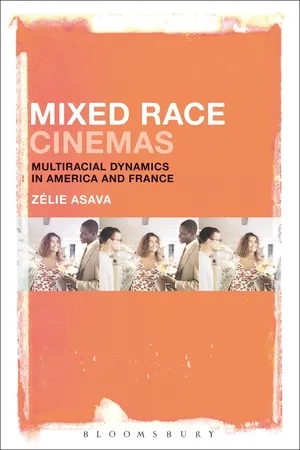
Using critical race theory and film studies to explore the interconnectedness between cinema and society, Zélie Asava traces the history of mixed-race representations in American and French filmmaking from early and silent cinema to the present day. Mixed Race Cinemas covers over a hundred years of filmmaking to chart the development of (black/white) mixed representations onscreen. With the 21st century being labelled the Mulatto Millennium, mixed bodies are more prevalent than ever in the public sphere, yet all too often they continue to be positioned as exotic, strange and otherworldly, according to 'tragic mulatto' tropes. This book evaluates the potential for moving beyond fixed racial binaries both onscreen and off by exploring actors and characters who embody the in-between. Through analyses of over 40 movies, and case studies of key films from the 1910s on, Mixed Race Cinemas illuminates landmark shifts in local and global cinema, exploring discourses of subjectivity, race, gender, sexuality and class. In doing so, it reveals the similarities and contrasts between American and French cinema in relation to recognising, visualising and constructing mixedness. Mixed Race Cinemas contextualizes and critiques raced and 'post-race' visual culture, using cinematic representations to illustrate changing definitions of mixed identity across different historical and geographical contexts.
Information
1
The Mixed Question
Language, representation and casting
Aisha D. Bastiaans discusses representation as a process which operates ‘in the absence or displaced presence, of racial and gendered subjects’ (2008: 232). Cinematic racialization is achieved through the repetition of certain codes, especially in the case of mixed characters who are not visibly raced as Other but must be marked as such. Gwendolyn Audrey Foster notes: ‘The [Hollywood] cinema is … the garment center of white fabrication’ (2003: 2). Cinema, along with other cultural products, reinforces the concept of race while at the same time highlighting its position as illusionary. J. E. Smyth notes that mixed protagonists in classical Hollywood Westerns Ramona (King, USA, 1936) and Call Her Savage (Dillon, USA, 1932) ‘simply dressed the part. Race was therefore something to be performed through costume, and is presented as an essentially unstable visual and historical construct’ (2008: 31). In Jezebel (Wyler, USA, 1938), costume becomes the primary signifier of race onscreen; Julie’s (Betty Davis) mixedness is signified in a scene where she wears white while singing with slave children. These films both deny and recognize the notion of race as visible, which Courtney (2005) identifies as a notion intensified by filmmakers and expressed through film and visual media technology. Shohat and Stam (1994) note that mixed-race and black representations are distorted by techniques such as shooting them in groups, at long distance, making them absent or decentred in the framing of scenes, and rarely individualizing them in the narrative through spoken lines. In this way, both visually and narratologically, film codes determine the non-white as inferior to whites who are shot alone and in close-up, present in most scenes and given large amounts of dialogue.
Although the contemporary industry is promoted as colour-blind, creating multicultural blockbusters like The Fast and The Furious (Cohen, USA/Germany, 2001), cinematic codes continue to reflect certain colour-conscious attitudes. Mary Beltràn reads this film as one of a series of ‘multiculti’ hybrid-genre action films which reflect ‘contemporary shifts in U.S. ethnic demographics and ethnic identity, while subtly reinforcing notions of white centrism that are the legacy of the urban action movie. … The new ethnically ambiguous protagonist embodies concerns regarding ethnicity and race-relations with respect to the nation’s burgeoning cultural creolization and multiethnic population’ (2005: 50).
While The Fast and The Furious presents a racially harmonious society on the surface (and is set in the first state to decriminalize miscegenation, with the third highest rate of interracial marriage), its narrative is infused with lawlessness and the breakdown of the normative family unit. The mixed hero (Diesel) is both a symbol of transculturalism – exhibiting a ‘cultural mastery’ over all ‘racialized’ worlds1 – and of the tragedy of multiculturalism. Jim Pines finds the contemporary colour-blind aesthetic perplexing:
Historically, it has been relatively straightforward identifying and analysing racist imagery in media portrayals. But it has been somewhat more difficult getting to grips with current trends. In particular it is hard to analyse the apparent contradictions between the stated aims and objectives that (some) media institutions evince on the one hand, and the obvious deficiencies or ‘failures’ that pertain on the ground. (http://www.channel4.com/life/microsites/R/racism/big_question/jim_pines.html
Despite the increased visibility of black/mixed agents onscreen, there is an ‘inability or unwillingness of writers and casting directors to utilize black actors in a much wider range of roles’ and this acts as ‘a major stumbling block for radical change’ (ibid.). For example, while no black actors were nominated for Academy Awards in 2015 or 2016, black-led box-office hits Creed (Coogler, USA, 2015) and Straight Outta Compton (Gray, USA, 2015) were recognized, receiving nominations for their white writers and co-stars. Both films are rooted in the all-too familiar tropes of ghettoized black masculinity and offer little innovation in terms of character studies.
S. Craig Watkins argues that Hollywood cinema ‘frames a highly particularised racial gaze – that is, a representational system that positions blacks as image and whites as the bearer of the image’ (1998: 154–5). He suggests that black filmmakers have the power to shift mixed/black representations from a passive to a dynamic position where such characters become active agents who frame the look. Therefore, as the industry becomes more diverse, it must also develop a new cinematic language. The work of Ava Duvernay, Steve McQueen, Rick Famuyiwa, Justin Simien, Biyi Bandele, Houda Benyamina, Sarah Bouyain, Alain Gomis, Amma Asante and Barry Jenkins may prove instructive as cinema evolves to meet these demands.
A 2006 study by the UCLA School of Law and UCLA Chicano Studies Research Centre found that Latino, black (/mixed), Asian-American and Native American actors have few acting opportunities available to them.2 The findings (based on a 2006 survey of casting announcements) found that 69 per cent of roles were reserved for white actors and another 8.5 per cent were open to white actors as well as non-white actors. Non-white actors were limited to between 0.5 per cent and about 8 per cent of the roles, depending on their racial background. Thus non-white actors are generally marginalized and cast according to race (e.g. black man as con/ex-con) and American cinema remains a white-centrist cinema. According to its analysis of major films in 2005, the UCLA study found that men were almost three times as likely as women to work in the first-billed lead role. Women made up 44 per cent of second-billed roles and 40 per cent of third-billed roles, but they were outnumbered by men in each category. Due to institutional sexism, filmmakers continued to privilege male characters and limit female roles. Therefore non-white female actors are the most marginalized within the system. For example, in her early career, mixed-race English actress Thandie Newton played a slave three times in American films, while Kenyan actress Lupita Nyong’o has to date, following her debut in 12 Years a Slave, only acted in major films as a CGI character. These cases highlight the lack of roles for young mixed/black female actors entering the industry and the need for greater change.
A 2016 report from the Media, Diversity & Social Change Initiative at the USC Annenberg School for Communication and Journalism showed that little has changed on screen or behind the camera regarding inequality in Hollywood.3 The figure for female speaking characters across the top 100 films from 2015 remained at 31.5 per cent, unchanged since 2007. Just 26.3 per cent of all film characters were from ethnic minorities. Of the top 100 films of 2015, forty-nine included no Asian/Asian-American characters and seventeen featured no black/African-American characters. Additionally, only three of the films featured a female ethnic minority co-/lead character. From a sample of 800 films, 5.5 per cent were directed by black/African-Americans and 2.8 per cent by Asian/Asian-Americans. Ethnic minority female directors accounted for 4.1 per cent (three were black/African-American and only one was Asian). The UCLA and USC studies demonstrate that the problems of inequality in Hollywood are pervasive and systemic.
Even films which appear to challenge dominant representations of identity ‘do not successfully confront the implicit whiteness of U.S. cinema’ (Scherr, 2008: 3) or, as Courtney wrote, challenge its ‘history of white vision’ (2005: 4). While some mixed actors, directors and films achieve isolated success, the industry always reverts to a normative discourse of ‘“whiteness” or “white vision” as the dominant film lens’ (Scherr, 2008: 11).4 For example, while Bridesmaids (Feig, USA, 2011) is superficially centred on a mixed-race woman (played by mixed actress Maya Rudolph) marrying her white fiancée, the film’s focus is actually on her white best friend (Kristen Wiig). And, while Django Unchained (Tarantino, USA, 2012) was marketed as a film about the adventures of a former slave (played by Jamie Foxx), the film’s focus is again on his white friend (Christophe Waltz). These works are sold as progressively multicultural, yet only use the mixed/black character as a foil for the white hero.
Hollywood remains highly criticized for its practice of ‘race-bending’, which is often more accurately described as ‘white-washing’. In recent years, white actors have been cast in roles originally written as Asian (The Last Airbender, Ghost in the Shell, 21, Doctor Strange, Edge of Tomorrow, Star Trek), Middle-Eastern (Prince of Persia: The Sands of Time, Batman Begins, Exodus: Gods and Kings, Noah), black (World Trade Centre, Stuck, Pay it Forward) or mixed-race (The Hunger Games, Aloha, Argo, The Martian). Yet Halle Berry has also played roles traditionally reserved for white women, for example as Jinx in Die Another Day, Tamahori5 (USA/UK, 2002); as Audrey Burke in Things We Lost in the Fire, a role written for a white woman.6 And, in the proposed Class Act – a film based on the true story of a white teacher who in 2000, at the behest of her pupils, ran for Congress – Berry was set to play Tierney Cahill, the protagonist.7 In recent years, black and mixed actors have taken starring (formerly white) roles in sci-fi/fantasy franchises Thor, Spider-man and Ironman. But while ‘race-bending’ may sometimes benefit non-white actors cast in white roles, the predominant effect has been to reduce the roles open to non-whites. Discriminating roles on the basis of race and sex violates Title VII of the U.S. Civil Rights Act of 1964, which prohibits employment discrimination. Nevertheless, the casting breakdowns prove that the cinema industry remains subject to racial and sexual discrimination. As Shohat and Stam note, fictional identities exist in the realm of the imagination and so casting can be seen as unimportant. But casting must be seen ‘in contingent terms, in relation to the role, the political and esthetic intention, and to the historical moment’ (1994: 191). The absence of realistic casting denies minoritarian groups adequate representation and reduces their voice in the public arena.
In addition to casting practices, mixed-race actors’ opportunities are further limited when white actors use racial ambiguity to claim authenticity in a wider selection of roles. For example, Angelina Jolie – who has long claimed Iroquois heritage – was cast as a mixed-race woman in A Mighty Heart (Winterbottom, USA, 2007). Concerns were raised about her ‘blacking up’ for the film, and many argued that the role should have gone to a mixed actress. Beltràn enquires: ‘Are we witnessing the beginning of a more racially egalitarian perspective or merely a bronzing of whiteness, repackaged to emphasize the aesthetic trappings of cultural creolization?’ (2005: 56). A similar trend in 1930s Hollywood – where white bodies began to appear more tanned and curvaceous – coincided with new opportunities for mixed actors to achieve visibility,8 so perhaps these contemporary shifts will contribute to broader beauty ideals and more access for non-white actors. Yet we can also argue that the contemporary interest in black beauty is merely another form of cultural appropriation. As mixed actress Amandla Stenberg noted in her 2015 viral video Don’t Cash Crop On My Cornrows, loving black culture and loving black people are distinct categories of experience.
In an era where so many white performers appropriate black culture, ‘blackface’ has become a hot topic. While generally considered politically incorrect, it is a tradition which has never fully left visual culture. ‘Blackface’ was a major element in American entertainment from the 1700s on. Black and white actors donned burnt cork – often accompanied by enlarged white lips – and acted the fool onstage and onscreen. The first commercially successful sound film The Jazz Singer (1927) features a ‘blackface’ performer, who loses his Jewish Otherness by performing minstrelsy onstage. As Rogin (1996) notes, following Ellison, by the end of the film he has been assimilated into American whiteness; through promoting the cultural production of segregationist racial politics, he is validated as an equal. The minstrel act that accompanied ‘blackface’ make-up – the performance of jolly stupidity – was also often read into the work of popular black actors. McDaniel’s ‘Mammy’ roles (read as depictions of the ‘happy slave’), Fetchit’s slow-witted servants, and even Poitier’s leading roles (read as the ‘magical/noble negro’ who aids whites), were thus decried by 1970s black film critics as extensions of this tradition.9 Lipsitz (1998) observes that following civil rights lobbying, the end of the studio system and the rise of the black dollar, the 1970s was a pivotal moment when black representations began to shift, yet ‘blackface’ continues to re-emerge in different formulations.
In a TV trailer for BBC 2’s White season (UK, 2008) – exploring race and racism in Britain – a white face was inked black implying the disappearance of whiteness in the multicultural era. In the reality TV show Black.White. (USA, 2006), white and black families, respectively, ‘blacked’ and ‘whited’ up for a week to experience life on the other side of the ‘colour line’. Other visualizations have been more conventional. In 2009, the talent show Hey Hey, It’s Saturday (Australia) featured an act performing a Jackson Five song in blackface, who seemed surprised when guest judge Robert Downey Jr expressed disgust. In the same year the 1960s-set Mad Men (USA) featured a ‘blackface’ performance. UK sketch shows Little Britain (2003–6), The League of Gentlemen (1999–2002), Bo’Selecta (2002–4), Da Ali G Show (2003–4), The Kevin Bishop Show (2008) and The Charlotte Church Show (2006) have all featured white actors ‘blacked’ up for comedic roles. The trend can also be seen in advertising; for example, in 2008 the Lynx ‘Darkman’ ad featured a chocolate man whose body parts were eaten by white women; in 2012 the Popchips ad featured Ashton Kutcher as a ‘brownface’ Indian caricature. ‘Blackface’ parodies such as Dave Chap...
Table of contents
- Cover
- Half-Title
- Dedication
- Title
- Contents
- Acknowledgements
- Introduction
- 1 The Mixed Question
- 2 Hollywood’s ‘Passing’ Narratives
- 3 The Limits of the Classic Hollywood ‘Tragic Mulatta’
- 4 Cultural Shifts: New Waves in Racial Representation
- 5 Transnational Families inDrôle de Félix
- Conclusion
- Bibliography
- Name Index
- Subject Index
- Copyright
Trusted by 375,005 students
Access to over 1.5 million titles for a fair monthly price.
Study more efficiently using our study tools.
Frequently asked questions
Yes, you can cancel anytime from the Subscription tab in your account settings on the Perlego website. Your subscription will stay active until the end of your current billing period. Learn how to cancel your subscription
No, books cannot be downloaded as external files, such as PDFs, for use outside of Perlego. However, you can download books within the Perlego app for offline reading on mobile or tablet. Learn how to download books offline
Perlego offers two plans: Essential and Complete
- Essential is ideal for learners and professionals who enjoy exploring a wide range of subjects. Access the Essential Library with 800,000+ trusted titles and best-sellers across business, personal growth, and the humanities. Includes unlimited reading time and Standard Read Aloud voice.
- Complete: Perfect for advanced learners and researchers needing full, unrestricted access. Unlock 1.5M+ books across hundreds of subjects, including academic and specialized titles. The Complete Plan also includes advanced features like Premium Read Aloud and Research Assistant.
We are an online textbook subscription service, where you can get access to an entire online library for less than the price of a single book per month. With over 1.5 million books across 990+ topics, we’ve got you covered! Learn about our mission
Look out for the read-aloud symbol on your next book to see if you can listen to it. The read-aloud tool reads text aloud for you, highlighting the text as it is being read. You can pause it, speed it up and slow it down. Learn more about Read Aloud
Yes! You can use the Perlego app on both iOS and Android devices to read anytime, anywhere — even offline. Perfect for commutes or when you’re on the go.
Please note we cannot support devices running on iOS 13 and Android 7 or earlier. Learn more about using the app
Please note we cannot support devices running on iOS 13 and Android 7 or earlier. Learn more about using the app
Yes, you can access Mixed Race Cinemas by Zélie Asava in PDF and/or ePUB format, as well as other popular books in Media & Performing Arts & Film History & Criticism. We have over 1.5 million books available in our catalogue for you to explore.