A member of the French New Wave group of filmmakers who first came to prominence at the end of the 1950s, Claude Chabrol has received the least amount of critical and scholarly attention, although he was the more prolific and commercially successful of them all. Jacob Leigh fills this lacuna by focusing on the last nine feature films of Chabrol's career, exploring his imagery, camerawork, use of sound and music, and performances, revealing the stylistic characteristics of his films while identifying the fundamental thematic issues that lie at the heart of his career-length exploration of the relationship between individuals and societies.
Key areas of focus includes Chabrol's careful depiction of upper-class settings in films such as La Cérémonie (1995), Merci pour le chocolat (2000) and La Fille coupée en deux (2007) and on what Robin Wood and Michael Walker call 'the beast in man' (1970), the quasi-sympathetic 'id-figures' of which Le Boucher's Popaul is the most celebrated. Chabrol's 'id-figures' inherit the traits of Shadow of a Doubt's Uncle Charlie, Rope's Brandon and Strangers on a Train's Bruno, all three of whom have characteristics of the Nietzsche-quoting psychopath familiar in crime fiction. Additionally, The Late Films of Claude Chabrol considers the influence on Chabrol of a range of significant writers, including Patrick Hamilton, Patricia Highsmith, Charlotte Armstrong and Ruth Rendell.
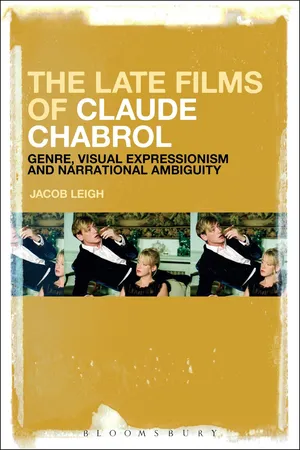
eBook - ePub
The Late Films of Claude Chabrol
Genre, Visual Expressionism and Narrational Ambiguity
- 208 pages
- English
- ePUB (mobile friendly)
- Available on iOS & Android
eBook - ePub
About this book
Information
1
La Cérémonie (1995): Diary of a Chambermaid
Of the nine films that form the basis of this study, La Cérémonie has received the most attention. The amount of work done on La Cérémonie testifies to the film’s success and its importance in Chabrol’s career. It includes Florence Jacobowitz’s article (1995) on class and distancing; Guy Austin’s (1999) chapter on authorship; Jean-Claude Polack’s (2001) psychoanalysis-inflected essay on the similarities between La Cérémonie and the Papin case, and the place of both within the French cultural imaginary; Susan J. Terrio’s essay (2003) on the film’s linking of class and food; Deborah Thomas’s (2005) essay on tonal disruption; Damien Armengol’s (2009) work on the adaptation of Ruth Rendell’s novels; and Marcia J. Citron’s (2010) discussion of the film’s use of Don Giovanni.1 The discussion of La Cérémonie that follows focuses on the film’s use of asserted symbolism, the film’s schematic opposition of an illiterate servant and a cultured bourgeois family, the contrasts made between the servant’s food and that of her employers’, the film’s construction of space as part of its division of the bourgeois house into the servant’s domain and the master’s, the use of the hall mirror to mark the boundary between domains and the use of Don Giovanni, adapted from Rendell’s source novel.
In Rendell’s Make Death Love Me, the hero, Alan Groombridge, goes with his new lover to see a Chabrol film at Notting Hill’s Gate Cinema. Rendell tells us that Alan thought it ‘very subtle’ (1980: 131), an acknowledgement of one artist by another. Fifteen years after Make Death Love Me, Chabrol adapted Rendell’s A Judgement in Stone (1977) into La Cérémonie, one of his most successful films. The surprise is that it took so long for Chabrol to adapt Rendell’s novels; in their political viewpoints and in their storytelling methods, they share much.2 Rendell’s left-leaning politics, expressed through her fiction, resembles Chabrol’s own politics, dramatized in his films.
In 1999, when Chabrol filmed Charlotte Armstrong’s The Chocolate Cobweb as Merci pour le chocolat, he and co-writer Caroline Eliacheff changed it so much that the film comes to resemble a Rendell story more than the Armstrong novel on which it is based. Despite adapting two of Armstrong’s novels (The Chocolate Cobweb and The Balloon Man, as La Rupture), Chabrol’s sensibility is closer to Rendell’s than Armstrong’s; Chabrol shares Rendell’s interest in encouraging empathy for killers shaped by circumstances. When an interviewer tells Chabrol that both his films and Rendell’s novels place more emphasis on psychology than mystery and suspense, Chabrol agrees:
Definitely. She knows what goes through people’s minds. At the same time, what’s pretty unusual is that she captures the impact of their social background, the way they earn a living, where they live and so on. All that can be totally fascinating, but there are very few thriller writers who are aware of it. (Chabrol 2004: 5)
La Cérémonie was a success; nine years later, Chabrol adapted another of Rendell’s books, The Bridesmaid.
As Chabrol’s remarks indicate, he and Rendell both use crime fiction to mount politicized critiques of social inequality. Nevertheless, Chabrol’s La Cérémonie differs from Rendell’s novel. One difference is the age of the murderers; the film’s murderers are younger than their equivalents in the novel. Novelist and filmmaker provide sufficient information to understand the killers, although the film includes less explicit explanation of their pasts than the novel. Chabrol and co-writer Caroline Eliacheff replace the novel’s long descriptions of Joan’s earlier life with hints that the disturbed postmistress Jeanne (Isabelle Huppert) has a dead daughter. Unlike the film’s Jeanne, the novel’s Joan is childless and yet to kill. The addition of Jeanne’s dead daughter creates a link between Jeanne and the illiterate servant Sophie (Sandrine Bonnaire).
The film implies that Jeanne and Sophie might both have killed people in the past: Jeanne may have killed her child (through negligence or by kicking her across the room); Sophie may have killed her father by starting a fire (the death is on purpose in the novel; she smothers him with a pillow). In the novel, Joan has had a disturbed youth, including working as a prostitute. She is now married and a born-again Christian, belonging to an obscure nonconformist sect, The Epiphany People. Chabrol and Eliacheff preserve the character’s madness, but make her religious activities more conventional; in the novel, she denounces sins (including her own) to anyone in earshot. Rendell’s Joan is forever shouting out improvised fire-and-brimstone sermons, whereas Chabrol’s Jeanne just collects and sorts old clothes for the Catholic Church. Yet the film’s version of the character is manic from the start, the opposite of the secretive Sophie, and Huppert’s agitated performance suggests the character’s potential for frenzy.
The toning down of Jeanne’s religious affiliations, the secularization of her madness, makes the character less alienating than she is in the book. Rendell describes Joan as a fifty-year-old woman who still dresses like the working prostitute she once was; Rendell also describes her relationship with her husband in some detail, whereas in the film she is unmarried. Overall, the film’s character is made more attractive. The same applies to Chabrol and Eliacheff’s conversion of Eunice into Sophie. Rendell’s servant is an overweight, sullen woman in her mid- to late forties who dresses in old-fashioned clothes. In the film, the attractive star Sandrine Bonnaire plays her. Furthermore, the film shows Sophie struggling to read, using a literacy book with a picture of a small boy making sounds and gestures that she tries to emulate. The scene ends with her failure; she hits the book and lays her head on it. This scene reveals Sophie at her most vulnerable and it marks the difference between the novel’s and the film’s presentation of the character. Unlike the novel, the film conveys her frustration; by associating her difficulties with those of a child, it generates compassion for her.
However, the film offers no explanation of how Sophie, a twenty-eight-year-old woman in 1995, has grown up illiterate. Rendell’s plausible explanation implies criticism of the British education system before the 1944 Education Act. Eunice was born around 1930 (she is in her mid- to late forties in the mid-1970s) and Rendell describes the disruption to Eunice’s education caused by the Second World War, when she was sent away from London during the Blitz:
After that Eunice attended school only sporadically. To this school or that school she went for weeks or sometimes months at a time, but in each new class she entered the other pupils were all far ahead of her. They had passed her by, and no teacher ever took the trouble to discover the fundamental gap in her acquirements, still less to remedy it. (Rendell 1994b: 31)
After staying away from school for much of the time, ‘a stratagem always connived at by her mother’ (1994b: 31), Eunice leaves school a month before her fourteenth birthday. In her discussion of Rendell’s novels, Susan Rowland contrasts the classic detective story with
Rendell’s citing of class as the social problem liable to provoke disorder rather than maintain social stability. For Rendell, traditional class structures do not regulate desire but instead collide with it, often leading to crimes where individual murderous impulses cannot be isolated from more general social oppressions. A Judgement in Stone, for example, is Rendell’s most sustained critique of a social role that golden age writers took for granted as unproblematic, the servant class. (2001: 41–2)
Eunice’s illiteracy isolates her from society so that no morality prevents her from smothering her father when his disability starts to irritate her; afterwards, she experiences no guilt or remorse. Rendell uses Eunice’s illiteracy as a form of sociopolitical critique, of the type that depicts criminals as uneducated and unsocialized victims. This was Huppert’s understanding of hers and Bonnaire’s characters: ‘They are victims . . . There’s no premeditation in their act’, although Bonnaire adds that because they shoot everyone twice, the second time from much closer, it indicates their desire to make sure the Lelièvres are dead (Klifa 1995: 125).
Chabrol says press commentary after the collapse of the Berlin Wall inspired him to adapt Rendell’s book into La Cérémonie:
The idea for the film, my desire to direct it in a manner that was a little Marxist, came after I read an article published in Le Figaro or somewhere, a little while after the fall of the Berlin Wall, which was entitled ‘The Fall of the Berlin Wall Spells the End of Class War’. It was an extraordinary phrase, because it could only have been written by someone who belonged to the upper class . . . It was that which provoked my desire to show what class struggle was. Ruth Rendell’s novel functioned perfectly. (Guérin and Jousse 1995: 28)
Chabrol adds: ‘I jokingly told Isabelle it was the last Marxist film. I’m not a Marxist so it’s amusing to make the last Marxist film when you’re not. I think it’s a bit political’ (Poncet 1995). When interviewers suggest that the upper-class family is ‘irreproachable’ Chabrol responds: ‘[it] is only attackable for its condition’ (Guérin and Jousse 1995: 28). The class is criticized, not individuals.3 However, the Lelièvres are smug and self-satisfied; in their dealings with Sophie, they convey privilege and an expectation of deference. They are reasonable people, but unsympathetic; as Terrio notes, Chabrol ‘undercuts the Lelièvres’ apparent lack of class snobbery’ (2003: 101). Georges (Jean-Pierre Cassel) and Mélinda (Virginie Ledoyen) are less sympathetic than Gilles (Valentin Merlet), whose adolescent rudeness lacks duplicity, and Catherine, whose fragility is made visible in Jacqueline Bisset’s performance.
At their first meeting, in the café, Catherine remains seated when she greets Sophie and overrules her interviewee’s refusal of a drink. She orders tea, but her brief interview gives Sophie no time to drink it. Catherine’s social slights stem from assumptions about power relations, but she also behaves as if Sophie’s demeanour intimidates her (Rendell describes her selling herself instead of interviewing a potential employee). Bisset’s performance conveys the character’s brittleness. She is an attractive, middle-aged woman (fifty when she made the film; Jean-Paul Cassel was twelve years older, the same ages as their equivalents in the novel), but she often appears uncomfortable. As Chabrol says of Bisset: ‘The fact that she has a light accent, that French is not her mother tongue, that she has shifts in intonation, gives a sort of fragility, of uncertainty which I liked’ (Berthomieu, Jeancolas and Vassé 1995: 12). Bisset’s Catherine exudes social anxiety, as if she overcompensates for some lack of confidence.4
Deborah Thomas notes Jeanne’s unconfirmed allegations about Catherine’s ‘disreputable past in Paris’ (2005: 171). The film avoids confirming whether Jeanne’s gossipy insinuations are true, but, as Thomas observes, the film indicates Catherine’s uneasiness; as an example, she points to Catherine’s comment to her son, Gilles ‘One can never really relax’. As Thomas notes, this, together with her heavy smoking, indicates a ‘nervous disposition, or at least an ongoing feeling of unease’: ‘In the scene leading up to the murder, she seems at odds with the rest of the family, and is the only one to be anxious and to suspect that something is wrong’ (2005: 171). One example of Catherine’s indecisiveness is her relationship with Gilles. After dinner, sitting with everyone, she stops him from smoking; when they are alone watching Les Noces rouges (Claude Chabrol, 1973) she offers him a cigarette. Gilles smiles: ‘Make up your mind.’ Catherine is unclear about where the boundaries lie between her and her son, and her and her servant, unsure of the attitude to adopt with either. Yet as she shares cigarettes with her son while watching television, Catherine is as relaxed as she ever appears. With no equivalent in the novel, this scene of mother and son parallels the scene of Georges and Mélinda discussing hunting and shotguns, both scenes suggesting internal loyalties within the family. Thomas also suggests as relevant the seating arrangements when the family watch the opera. Georges sits next to his daughter, Mélinda, and Catherine sits next to Gilles. As Thomas writes: ‘The scene of family unity is actually a scene of blood alliances within and at odds with the larger makeshift family’ (2005: 172).
Georges and Mélinda are more interfering and patronizing: Georges tries to get Sophie glasses and driving lessons, neither of which she wants; Mélinda tries to befriend her and, in doing so, discovers her illiteracy, triggering the final conflict. The decision to make the servant younger than she is in the novel means that Sophie was born on the same day as the daughter of the house. As a result, the film’s presentation of the two young women, one wealthy and the other illiterate, creates an unequivocal parallel; the shared birthday makes the depiction of their superficial relationship more ironic. Hence, the film indicates that Mélinda’s efforts to befriend the servant are one-dimensional. When Mélinda tries to relax with Sophie by offering her some tea, she still asks Sophie for the sugar and cups.5 Their interaction illustrates Mélinda’s assumptions about Sophie’s understanding of her subservient role. Without malice, Mélinda, like the rest of her family, conveys a sense of entitlement. Even when she restarts Jeanne’s car, her behaviour with the postmistress stirs up unspoken annoyance. When Mélinda asks Jeanne to try the engine, Jeanne walks around to the driver’s seat, lingering to look at the view. Mélinda watches her, puzzled, but Jeanne’s surliness is interpretable as resentment. Jeanne is proved right when Mélinda throws Jeanne’s oily handkerchief through the window. As Mélinda walks away, Jeanne calls out ‘Thanks again’, then tosses the handkerchief away. Youthful arrogance and class confidence merge in Melinda; for repeat viewers, the moment offers irony when Mélinda tell...
Table of contents
- Cover
- Half Title
- Title Page
- Contents
- Acknowledgements
- Introduction
- 1 La Cérémonie (1995): Diary of a Chambermaid
- 2 Rien ne va plus (1997): Preparation Meets Opportunity
- 3 Au Cœur du mensonge (1999): The Fabric of Vision
- 4 Merci pour le chocolat (2000): Cause and Effect
- 5 La Fleur du mal (2003): Keeping it in the Family
- 6 La Demoiselle d’honneur (2004): Criss-Cross, Motives and Murder
- 7 L’Ivresse du pouvoir (2006): Not Following the Rules of the Game
- 8 La Fille coupée en deux (2007): Killing the Beast
- 9 Bellamy (2009): More than Meets the Eye
- Conclusion
- Bibliography
- Index
- Copyright Page
Trusted by 375,005 students
Access to over 1.5 million titles for a fair monthly price.
Study more efficiently using our study tools.
Frequently asked questions
Yes, you can cancel anytime from the Subscription tab in your account settings on the Perlego website. Your subscription will stay active until the end of your current billing period. Learn how to cancel your subscription
No, books cannot be downloaded as external files, such as PDFs, for use outside of Perlego. However, you can download books within the Perlego app for offline reading on mobile or tablet. Learn how to download books offline
Perlego offers two plans: Essential and Complete
- Essential is ideal for learners and professionals who enjoy exploring a wide range of subjects. Access the Essential Library with 800,000+ trusted titles and best-sellers across business, personal growth, and the humanities. Includes unlimited reading time and Standard Read Aloud voice.
- Complete: Perfect for advanced learners and researchers needing full, unrestricted access. Unlock 1.5M+ books across hundreds of subjects, including academic and specialized titles. The Complete Plan also includes advanced features like Premium Read Aloud and Research Assistant.
We are an online textbook subscription service, where you can get access to an entire online library for less than the price of a single book per month. With over 1.5 million books across 990+ topics, we’ve got you covered! Learn about our mission
Look out for the read-aloud symbol on your next book to see if you can listen to it. The read-aloud tool reads text aloud for you, highlighting the text as it is being read. You can pause it, speed it up and slow it down. Learn more about Read Aloud
Yes! You can use the Perlego app on both iOS and Android devices to read anytime, anywhere — even offline. Perfect for commutes or when you’re on the go.
Please note we cannot support devices running on iOS 13 and Android 7 or earlier. Learn more about using the app
Please note we cannot support devices running on iOS 13 and Android 7 or earlier. Learn more about using the app
Yes, you can access The Late Films of Claude Chabrol by Jacob Leigh in PDF and/or ePUB format, as well as other popular books in Media & Performing Arts & Film & Video. We have over 1.5 million books available in our catalogue for you to explore.