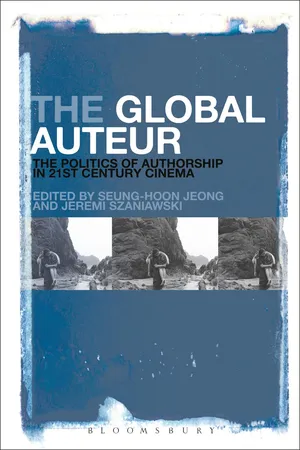
eBook - ePub
The Global Auteur
The Politics of Authorship in 21st Century Cinema
- 416 pages
- English
- ePUB (mobile friendly)
- Available on iOS & Android
eBook - ePub
The Global Auteur
The Politics of Authorship in 21st Century Cinema
About this book
Once heralded and defined by the likes of François Truffaut and Andrew Sarris as a romantic figure of aesthetic individualism, the auteur is reinvestigated here through a novel approach. Bringing established as well as emergent figures of world art cinema to the fore, The Global Auteur shows how politics and philosophy are present in the works of these important filmmakers. They can be still seen leading a fight that their glorious predecessors seemed to have abandoned in the face of global capitalism and the market economy. Yet, as the contributors show, a new world calls for a new cinema, and thus for new auteurs. Covering a range of global auteurs such as Lars von Trier, Lav Diaz, Lee Chang-dong and Abderrahmane Sissako, The Global Auteur provides a much-needed reassessment of the film auteur for the global age.
Information
1
The global author: Control, creative constraints, and performative self-contradiction
The author: Impossible and indispensable
There are many reasons why the concept of the auteur, as it applies to the film director, should not be carried over into the twenty-first century. First of all, because it has always been a contested notion, serving sometimes highly polemical and partisan agendas under unique historical circumstances (e.g. first in post-war Europe, then in 1970s Hollywood). Secondly, while it was strategically useful when helping film and cinema studies gain a foothold in the academy by modeling itself on literary studies and art history, this objective had been (over-)achieved by the mid-1980s, by which time the historical conditions of the original auteur theory (i.e. validating Hollywood’s popular art by employing high-culture criteria) also no longer applied. Throughout the 1980s and into the 1990s, film-, media-, and cultural-studies programs were eagerly inaugurated everywhere in higher education, in order to come to the rescue of humanities departments and to provide training for the ever-expanding “creative” media industries.
Cultural studies in particular had little need of the individual author, having shifted attention from creation and production to reception and spectatorship: works of art as well as of popular culture (which meant art cinema and the mainstream) were assumed to be social texts carrying ideologically encoded messages, and thus had larger systems, e.g. capitalism or patriarchy, as their “authors.” Such deconstructions (and “deaths”) of the author were theoretically supported by no less authoritative authors than Roland Barthes and Michel Foucault, who in turn provided models of analysis that supported close readings of specific texts without resorting to self-expression, intentionality, or individual moral and legal accountability.1
No doubt, there are even more pertinent philosophical reasons why authorship is such a vexing problem for a popular and collaborative art such as the cinema, and why it should be dropped from the list of important topics, quite apart from the industrial and capitalist context in which filmmaking has invariably taken place.2 None of these critiques are new nor have they been laid to rest,3 yet precisely because even art cinema has become thoroughly pervaded by market considerations, the author debate deserves another look. Given that the film director as author, and the author as auteur have survived even the most well-founded set of counter-arguments, one can only conclude that being philosophically problematic and conceptually vague merely reinforces the author’s indispensability, both as a reality and as a concept. In fact, more than ever, (film) authorship is taken for granted, filling an evident gap by fulfilling its “author-function” (Foucault), which at its most basic rests on the assumption that the work (the film) in question possesses a degree of coherence and purposiveness, which convention and the need for meaning like to attribute to a nameable instance and an origin—the author.4 This author-function was initially more important to film critics and scholars than to the directors themselves (many Hollywood veteran directors were baffled and amused, before they became flattered and intrigued by the French politique des auteurs). Responding to such disconnect between person and function, authorship was redefined as implicit and inferred, rather than expressive and embodied. The author, famously, became an “effect of the text,” a “necessary fiction,” a projection and over-identification by the enthusiastic cinephile, requiring one to carefully (and ontologically) separate John Ford from “John Ford”—the latter the sum of the narrative structures and stylistic effects that the critic was able to assemble around a body of work “signed” by a given director. Yet in subsequent decades, as the director as auteur increasingly became a fixture of the popular media’s general personality cult, the author began doing duty not only as the (imaginary or real) anchor for presumed, perceived, or projected coherence, but was actively deployed as a brand name and marketing tool, for the commercial film industry as well as in the realm of independent and art cinema.
Questions of access and control
Adding the word “global” to “author” reflects this shift of register which raises the stakes, and acknowledges that “global” applies to both Hollywood’s global reach and coverage, and to world cinema and transnational cinema—terms that have all but replaced the labels “art cinema” and “independent cinema” (where the author as both function and person survived the longest without being either contested critically or seen as tainted by commercialism). Globalizing auteurism is therefore the inevitable consequence of art cinema now being part of the market, and of the urgent need to re-situate the old debates in an enlarged context. Concerning the latter, however, I follow the lead of those writers who have narrowed the question of authorship in cinema down to the issue of control:
V. F. Perkins claims … that the “director’s authority is a matter not of total creation but of sufficient control” … Bordwell and Thompson suggest that “usually it is through the director’s control of the shooting and assembly phases that the film’s form and style crystallize.” … [Paisley] Livingston, who has argued that some studio films are singly authored, points to the “high degree of control” and “huge measure of authority” that some directors have …
(Meskin 2008, 22)
Control, of course, can be exercised in many different ways: organizational, financial, political, artistic, and intellectual, and many of these types of control are indeed involved in the making, marketing, distributing, and “owning” of a film. Not all of these forms of control need to fall to the same physical individual, or indeed any individual, given the abstract nature of some of the controlling forces and functions at work. I have elsewhere argued that contemporary Hollywood should be understood within such an extended, “reflexive,” authorial dynamic of providing “access for all” at the same time as “keeping control.” Which is to say, Hollywood sets out to make films that are formally and intellectually accessible to as wide as possible a range of audiences, diverse in language, race, religion, region, and nationality, all the while trying to control not only legal ownership and property rights and the platforms of distribution and exhibition, but also steering the scope of interpretations and forms of (fan-)appropriation thanks to a combination of (textual) structured ambiguity and (paratextual) feedback loops.5 By way of example, I examined the authorial persona of the director James Cameron and the narrative structure of his most successful film, Avatar (2009), arguing that both instantiate a convergence of these basically antagonistic forces of “access” and “control,” under the intensified conditions of a global market and an increasingly polarized political world (dis)order.6
One consequence to draw from this situation is that the author in the global context is both a construct and a person(ality). Being a locus of agency (control) as well as a focal point of projection (access), he/she is positioned at the intersection of a theoretical impossibility and a practical indispensability. A figure of contradiction as well as a construct, the global author exists within antagonistic forces, whose effects need not work against each other, but can be harnessed so as to re-energize rather than block the different levels of circulation in play. It aligns authorship with other aspects of globalization, where multiple variables are simultaneously interacting with each other, where traditional categories of linear cause-and-effect chains have opened up to recursive network effects, and where our idea of autonomy, i.e. single source, rational agency is complicated by models of distributed agency, contingency, and mutual interdependence. These “rhizomatic” tendencies are reinforced by electronic communication and the internet, whose architecture is the very site of simultaneous, multi-directional, reciprocal, recursive, and looped interactions.
Similarly “distributed,” antagonistic and yet interdependent forces are typical of today’s cinema as a whole, thriving as it does between ostensibly incompatible identities of big-screen spectacle, digital video disk, and download file, with viewers effortlessly switching between online viewing and visits to the local multiplex, and with the culture at large treating “the cinema” as part of the urban fabric and “the cinematic” as part of our collective memory and imaginary. In these contexts and definitions the author does not seem to be crucial to the system, being only one of the pieces of information and markers of recognition by which audiences identify a film as worthy of their attention.
More significant and symptomatic is the author’s place in that other network which competes with and complements global Hollywood: the film festival network. Its nodes are no longer merely in Europe (Cannes, Venice, Berlin, Rotterdam) but extend to North America (Toronto, New York, Sundance, Telluride), Africa (Ouagadougou), Latin America (Buenos Aires, Sao Paulo), and Asia (Busan, Hong Kong, Shanghai, Mumbai). As has been evident for some time, it is at these festivals that the auteur is the only universally recognized currency, yet this currency is stamped and certified at very few of the world’s many festivals, with Cannes (and France) still the decisive place for authenticating internationally recognized auteurs.
The idea that auteurs are constructs of the festivals merely underscores and makes more historically specific the point made earlier about the problematic status of cinematic authorship, insofar as the discursive construct auteur is now doubled by an institutional construct under the control of the film festival system. In another sense, however, calling respected directors of great films “constructs” is both counter-intuitive and demeaning, yet it can also become subversively productive, if it opens up a number of otherwise unrecognized contradictions, which filmmakers themselves have recognized as challenges and (sometimes welcome) opportunities—having to do with autonomy and forms of agency that turn the question of control inside out. This is what I intend to illustrate by introducing two distinct but complementary notions—that of creative constraint and of performative self-contradiction, which together outline potentially productive counter-strategies from within the system, rather than continuing to pursue (increasingly ineffective) oppositional stances from without.
On the face of it, the extraordinary dependency of most of the world’s non-Hollywood filmmakers on festivals for validation, recognition, and cultural capital makes a mockery of the term “independence.” Yet it is a reminder that the festivals’ increase in power does not sit easily on them either, since it contradicts the very purpose of the festivals, namely to celebrate film as art and to acknowledge the filmmaker as artist and auteur—all notions supposedly synonymous with autonomy. In other words, a dynamic of reciprocal dependencies is implicit in this relationship between auteur and festival, chief among these being that the festival, in order to fulfill its mission, has to encourage and even constrain the filmmaker to behave as if he/she was indeed a free agent and an autonomous artist, dedicated solely to expressing a uniquely personal vision, and thus to disavow the very pressures the festival has to impose. One such pressure, for instance, comes from the increasingly conflicted force field of schedules and dates, hierarchies, competition, and selection mechanisms into which the festival network places both the filmmakers and the festivals. With festivals being both portals and gatekeepers, both windows of attention and platforms for dissemination, a filmmaker has to plan and produce his/her film to fit the timetable of the respective festival, i.e. effectively making his/her film to measure, to order, and to schedule. In the case of established auteurs, the dilemma is aggravated by having to weigh loyalty against opportunity, when accepting a festival invitation: “What if I commit to Berlin in February and a month later, I hear that Cannes wants to show my film in May?” Festivals are in competition with each other over exclusive premieres, forcing filmmakers into yet another form of dependence.
Double occupancy, self-exoticism and “serving two masters”
Yet these examples may only scratch the surface of the kinds o...
Table of contents
- Title
- Contents
- Acknowledgments
- List of illustrations
- List of contributors
- Introduction Seung-hoon Jeong and Jeremi Szaniawski
- 1 The global author: Control, creative constraints, and performative self-contradiction Thomas Elsaesser
- 2 Abderrahmane Sissako: On the politics of African auteurs Rachel Gabara
- 3 Godard’s stereoscopic essay: Thinking in and with Adieu au langage Rick Warner
- 4 Michael Winterbottom: A self-effacing auteur? William Brown
- 5 Provocation and perversity: Lars von Trier’s cinematic anti-philosophy Robert Sinnerbrink
- 6 From political engagement to politics of abjection in Polish auteur cinema: The case of Wojtek Smarzowski Izabela Kalinowska
- 7 Of intruders (and guests): The films of Michael Haneke and Aleksey Balabanov Jeremi Szaniawski
- 8 Suffocating kinesis: The late films of Aleksey Gherman Fredric Jameson
- 9 Contemporary Romanian auteurs: Politics, irony, and reflexivity Dominique Nasta
- 10 Fatih Akin’s moral geometry Dudley Andrew
- 11 Richard Linklater’s post-nostalgia and the temporal logic of neoliberalism Dan Hassler-Forest
- 12 “Black in white”: Language, world-making, and the American contract in the cinema of Quentin Tarantino John Pitseys
- 13 Battle with history: Carlos Reygadas and the cinema of being Michael Cramer
- 14 The art of encounter and (self-)fabulation: Eduardo Coutinho’s cinema of bodies and words Consuelo Lins (trans. Leslie Damasceno)
- 15 Shareable cinema: The politics of Abbas Kiarostami Nico Baumbach
- 16 Migration and contemporary Indian cinema: A consideration of Anurag Kashyap and la politique des auteurs in the times of globalization Kaushik Bhaumik
- 17 Space and time in the land of the end of history Marco Grosoli
- 18 Revisiting Jia Zhangke: Individuality, subjectivity, and autonomy in contemporary Chinese independent cinema Victor Fan
- 19 Kurosawa Kiyoshi, dis/continuity, and the ghostly ethics of meaning and auteurship Aaron Gerow
- 20 A generational spectrum of global Korean auteurs: Political matrix and ethical potential Seung-hoon Jeong
- Index of names
- Index of terms
- Copyright
Trusted by 375,005 students
Access to over 1.5 million titles for a fair monthly price.
Study more efficiently using our study tools.
Frequently asked questions
Yes, you can cancel anytime from the Subscription tab in your account settings on the Perlego website. Your subscription will stay active until the end of your current billing period. Learn how to cancel your subscription
No, books cannot be downloaded as external files, such as PDFs, for use outside of Perlego. However, you can download books within the Perlego app for offline reading on mobile or tablet. Learn how to download books offline
Perlego offers two plans: Essential and Complete
- Essential is ideal for learners and professionals who enjoy exploring a wide range of subjects. Access the Essential Library with 800,000+ trusted titles and best-sellers across business, personal growth, and the humanities. Includes unlimited reading time and Standard Read Aloud voice.
- Complete: Perfect for advanced learners and researchers needing full, unrestricted access. Unlock 1.5M+ books across hundreds of subjects, including academic and specialized titles. The Complete Plan also includes advanced features like Premium Read Aloud and Research Assistant.
We are an online textbook subscription service, where you can get access to an entire online library for less than the price of a single book per month. With over 1.5 million books across 990+ topics, we’ve got you covered! Learn about our mission
Look out for the read-aloud symbol on your next book to see if you can listen to it. The read-aloud tool reads text aloud for you, highlighting the text as it is being read. You can pause it, speed it up and slow it down. Learn more about Read Aloud
Yes! You can use the Perlego app on both iOS and Android devices to read anytime, anywhere — even offline. Perfect for commutes or when you’re on the go.
Please note we cannot support devices running on iOS 13 and Android 7 or earlier. Learn more about using the app
Please note we cannot support devices running on iOS 13 and Android 7 or earlier. Learn more about using the app
Yes, you can access The Global Auteur by Seung-hoon Jeong, Jeremi Szaniawski, Seung-hoon Jeong,Jeremi Szaniawski in PDF and/or ePUB format, as well as other popular books in Media & Performing Arts & Film Direction & Production. We have over 1.5 million books available in our catalogue for you to explore.