Sissi's World offers a transdisciplinary approach to the study of the Habsburg Empress Elisabeth of Austria. It investigates the myths, legends, and representations across literature, art, film, and other media of one of the most popular, revered, and misunderstood female figures in European cultural history.
Sissi's World explores the cultural foundations for the endurance of the Sissi legends and the continuing fascination with the beautiful empress: a Bavarian duchess born in 1837, the longest-serving Austrian empress, and the queen of Hungary who died in 1898 at the hands of a crazed anarchist.
Despite the continuing fascination with "the beloved Sissi," the Habsburg empress, her impact, and legacy have received scant attention from scholars. This collection will go beyond the popular biographical accounts, recountings of her mythic beauty, and scattered studies of her well-known eccentricities to offer transdisciplinary cultural perspectives across art, film, fashion, history, literature, and media.
eBook - ePub
Sissi’s World
The Empress Elisabeth in Memory and Myth
- 408 pages
- English
- ePUB (mobile friendly)
- Available on iOS & Android
eBook - ePub
Sissi’s World
The Empress Elisabeth in Memory and Myth
About this book
Information
| One | Introduction: “Sissi”: The Convergence of Memory and Myth | |
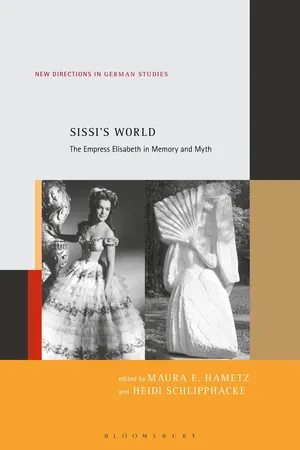
“The record of every human creature must contain both light and shadow,” wrote Count Egon Corti in the preface to Elizabeth, Empress of Austria, the hagiographic biography he wrote in 1934 under the title Elisabeth, “die seltsame Frau.” Trying to capture the character of the “uncommon” or “odd” woman, he referred to the equally hagiographical description by Elisabeth’s lady in waiting Countess Fürstenberg, who sought to explain Elisabeth’s elusive and alluring beauty, writing, “Neither chisel nor brush can depict her as she really was, or that something about her which had such power to attract and captivate, for it was a thing peculiar to herself. She will live on in legend, not in history …”1 And in the nearly 120 years since her death, this remark has proved prescient. The Empress Elisabeth has lived on in memory and in myth and has retained her status as a symbol of beauty, grace, elegance, royalty, tragedy, romance, and even kitsch around the world. This collection explores the contemporary fascination with the Habsburg Empress and seeks to investigate why the Empress’s popularity has endured and why her image continues to resonate across diverse cultures. In fact, the chisel, the brush, the screen, the web, and even modern cityscapes offer reminders of the iconic Sissi and the legend of the Empress Elisabeth. From the gaiety and naïve beauty of Sissi captured on the silver screen by Romy Schneider in the ever-popular Sissi films of the 1950s to the solidly material, white, and mysterious Sisi sculpted in stone by contemporary artist Ulrike Truger,2 the image of the Empress Elisabeth is both ubiquitous and ephemeral. Indeed, Sissi continues to be a cult figure inspiring “Sissimania” around the world.
The confusion and uncertainty surrounding the identity of the Empress even extends to debates over what she should be called. Sissi, the sobriquet used in this volume’s title Sissi’s World, is consciously chosen as an indication of the centrality of Ernst Marischka’s 1950s cinematic depiction of the Empress to the construction of contemporary memory and visions of Elisabeth. However, since the Habsburg Empress appears in different contexts, periods, and places under a variety of names, each important in its disciplinary, artistic, cultural, or geographic context, each of the authors who contributed to this collection has chosen an appellation for particular reasons. The Empress figures in a variety of guises, among them Elisabeth, Elizabeth, Erzsébet, Sisi, Sissi, and Xixi. Some authors are quite specific in their use of a particular designation, like Susanne Hochreiter, who uses “Sisi” to refer to the discursive figure and “Elisabeth” to refer to the historic figure. Others name her according to sources, context, or circumstances. Likewise, other royal names, have been left to the convention chosen by the contributor (for example, Franz Josef or Francis Joseph).
The variety, range, and sheer volume of popular representations of the Empress demonstrate the worldwide fascination with her and reveal the paradoxes of her life, recalling contradictory perceptions of her image and reputation after her death, as she is remembered and constructed as an historical figure and as a legend. Yet little scholarly work has been dedicated to exploring the ways in which the Habsburg Empress is remembered and imagined, embodied and disembodied, recalled, revered, and constructed. What might be termed “Sissimania,” the Sisi cult, or the Sisi phenomenon is evident even to the casual observer, but the study of its evolution and significance is nearly absent from scholarship. The articles collected in this volume explore the ways in which Sissi is remembered and represented and try to explain her relevance and longevity as a mythic, iconic figure in contemporary cultures around the world. A secondary impetus for the book, reflecting in particular the editors’ experiences and perspectives as Americans, is to ask why the Empress, who generates such intense emotions and is worshipped around the globe, does not appear to resonate in North American culture and why she remains little known in the United States, despite American audiences’ fascination with royals and the royal lifestyle. What, we ask, inoculates Americans against Sissimania?
Memory and Myth
The memory of Elisabeth springs from narratives about the Empress’s personal life as well as the mythical status of the Habsburg monarchy, in particular as represented in images of the emperor. Ancient Roman and early Christian traditions of veneration and mythic authority were cultivated from the consolidation of Habsburg imperial rule in the sixteenth century.3 The royal family also forms part of the national myth of the modern state of Austria, a “lieux de memoir,” a space mapped at the foundations of the nation that has been explored extensively by scholars since the publication of Pierre Nora’s seminal work on France.4 Emil Brix, Ernst Bruckmüller, and Hannes Stekel’s edited three-volume work Memoria Austriae, published in 2004 and 2005, sets the tone for these perceptions of the monarchy, particularly in the first volume on Austrian national identity dedicated to Men, Myth, and Times.5 Brix, Bruckmüller, and Stekel’s grounding of Habsburg images in this conception of national identity points to another reason for Elisabeth’s elusiveness in scholarship—the tendency to equate royalty with the power of male state authority. Admittedly, Elisabeth was the royal consort, and her claim to royal power lay in her marriage to the emperor; yet such a perspective is certainly based on the common association in the existing scholarship of men and maleness with political power. Elisabeth was the Empress and, as such, played a public role and faced considerable expectations to carry out the duties assigned to the ruling house. Yet she generally appears as merely a side note in historical accounts of the monarchy.6
The explanation for the veneration of and popular fascination with the Empress very likely resides in the interplay of myth and memory. She purportedly became involved in politics only once during the crisis with Hungary, but even this one presumed engagement has fed accounts of the Empress that underscore her feminine appeal. Narratives of the political vignette usually ground her ability to influence politics in her personal charisma.7 Memory (as holding a direct link to a past truth) and myth (as a distortion of the past) converge in the cultural work of “remembering” the Empress Elisabeth and identifying the source of her charisma.
On the surface, the concepts of memory and myth seem at odds with one another, but as Maurice Halbwachs argues in his seminal work On Collective Memory, all memory is collective—it is shaped and reinforced through the social framework in which the individual lives. In this sense, “[…] everything seems to indicate that the past is not preserved but is reconstructed on the basis of the present.”8 Charisma, too, relies on the collective and on notions of authority constructed around an individual. While Max Weber places charisma in the framework of a patriarchal structure, he insists that “charisma knows no formal and regulated appointment or dismissal.”9 To possess charisma, the individual must hold extraordinary personal qualities, but those qualities must likewise be validated by a group or community.10 So the question arises: how do we explain the phenomenon of Elisabeth, the particular combination of charisma and memory she embodies that has produced such a malleable and yet tenacious and ubiquitous Elisabeth myth?
It is a generally accepted idea in our post-postmodern age that temporal and spatial contingency are integral to the reshaping and reconstruction of collective memory, but this idea bears emphasizing in light of reflections on the repeated reconstruction of “Sissi” in diverse epochs and national and regional spaces. Halbwachs’s On Collective Memory, published in 1952, might very well have been influenced by Walter Benjamin’s “Theses on the Philosophy of History,” written in 1940 and published in France in 1947, a work highlighting Benjamin’s messianic understanding of history as a concept that is only made meaningful through a vivid encounter with the present. Benjamin’s critique of historicism is central to the analyses of reconstructions and appropriations of Elisabeth contained in this volume. As Benjamin writes, “To articulate the past historically does not mean to recognize the past ‘as it really was’ (Ranke). It means to seize hold of a memory as it flashes up in a moment of danger.”11 Benjamin implicates the historians who represent past events and figures as if they were eternal and unchanging, comprehensible to each culture and epoch without consideration of the constraints of the present. He draws a link between the contingency of history and “fashion,” which always has “a flair for the topical, no matter where it stirs in the thickets of long ago.”12
Memory, history, and the present meld in Benjamin’s reflections on our understanding of historical events and figures, and his conception of time reminds us to view multiple iterations of “Sissi” across temporal and geographical borders similarly as “costumes” evoking the past in order to capture the Zeitgeist of the present. The essays in this volume reveal the preponderance of the present in such diverse reincarnations of “Elisabetta,” the Sissi statue in Trieste’s Liberty Square, discussed by Maura Hametz and Borut Klabjan, and Karl Lagerfeld’s fashion homage to Elisabeth in the 2014 film Reincarnation, as explored by Carolin Maikler.13 Each cultural product borrows from the past in order to reflect on the present. Each harnesses collective memory to make “social usage,”14 as Roland Barthes writes about the function of myth, of Elisabeth and to legitimize the present, harkening back to tradition to cement new narratives in the cultural imaginary.
Clearly, memory and myth are intertwined, as Halbwachs points out, as each not only recollects but also distorts the past. This distortion, the product of a “wish to introduce greater coherence,” seeps into understandings of the past that are harnessed to create a harmonious present.15 Barthes’s understanding of myth also emphasizes the linkages between memory and myth, a point that is salient for our analysis of Sissi’s many afterlives. For Barthes, myth in the bourgeois world distorts but does not completely suppress its historical origins: “However paradoxical it may seem, myth hides nothing: its function is to distort, not make disappear.”16 Myth is “a type of speech […] a mode of signification, a form” that is “not defined by the object of its message, but by the way in which it utters this message.”17 The historical meaning is an “instantaneous reserve of history, a tamed richness” that can be called forth at will to produce an artificial naturalization of the object of representation.18
Barthes argues that myth in the bourgeois age represents history as Nature, and we are invited to read essentialism or a truth into the myth due to its recourse to a domesticated (impoverished) history.19 For example, for Barthes, the hair or full beard on the face of the popular Abbé Pierre, member of the French Resistance during the Nazi occupation of France, is linked in a complex relation of semiotics to the charitable characteristics of the historical figure Pierre who was seen as representing the soul of the nation; in this instance, History becomes Nature (hair/truth).20 In contrast to representations of evil beardless figures, Pierre and other venerated bearded priests are not just symbols of masculinity but also of a visceral naturalness, organically linked to the earth and to lived communities outside the confines of the Church.
Barth...
Table of contents
- Cover
- Halftitle Page
- Title Page
- Dedication Page
- Contents
- List of Illustrations
- Acknowledgements
- 1. Introduction: “Sissi”: The Convergence of Memory and Myth
- Part I: Memory
- Part II: Myth
- Notes on Contributors
- Index
- Imprint
Trusted by 375,005 students
Access to over 1.5 million titles for a fair monthly price.
Study more efficiently using our study tools.
Frequently asked questions
Yes, you can cancel anytime from the Subscription tab in your account settings on the Perlego website. Your subscription will stay active until the end of your current billing period. Learn how to cancel your subscription
No, books cannot be downloaded as external files, such as PDFs, for use outside of Perlego. However, you can download books within the Perlego app for offline reading on mobile or tablet. Learn how to download books offline
Perlego offers two plans: Essential and Complete
- Essential is ideal for learners and professionals who enjoy exploring a wide range of subjects. Access the Essential Library with 800,000+ trusted titles and best-sellers across business, personal growth, and the humanities. Includes unlimited reading time and Standard Read Aloud voice.
- Complete: Perfect for advanced learners and researchers needing full, unrestricted access. Unlock 1.5M+ books across hundreds of subjects, including academic and specialized titles. The Complete Plan also includes advanced features like Premium Read Aloud and Research Assistant.
We are an online textbook subscription service, where you can get access to an entire online library for less than the price of a single book per month. With over 1.5 million books across 990+ topics, we’ve got you covered! Learn about our mission
Look out for the read-aloud symbol on your next book to see if you can listen to it. The read-aloud tool reads text aloud for you, highlighting the text as it is being read. You can pause it, speed it up and slow it down. Learn more about Read Aloud
Yes! You can use the Perlego app on both iOS and Android devices to read anytime, anywhere — even offline. Perfect for commutes or when you’re on the go.
Please note we cannot support devices running on iOS 13 and Android 7 or earlier. Learn more about using the app
Please note we cannot support devices running on iOS 13 and Android 7 or earlier. Learn more about using the app
Yes, you can access Sissi’s World by Maura E. Hametz, Heidi Schlipphacke, Maura E. Hametz,Heidi Schlipphacke in PDF and/or ePUB format, as well as other popular books in Histoire & Histoire de l'Europe. We have over 1.5 million books available in our catalogue for you to explore.