As the figure of Wallace Stevens (1879-1955) becomes so entrenched in the Modernist canon that he serves as a major reference point for poets and critics alike, the time has come to investigate poetry and poetics after him. The ambiguity of the preposition is intentional: while after may refer neutrally to chronological sequence, it also implies ways of aesthetically modeling poetry on a predecessor. Likewise, the general heading of poetry and poetics allows the sixteen contributors to this volume to range far and wide in terms of poetics (from postwar formalists to poets associated with various strands of Postmodernism, Language poetry, even Confessional poetry), ethnic identities (with a diverse selection of poets of color), nationalities (including the Irish Nobel Laureate Seamus Heaney and several English poets), or language (sidestepping into French and Czech poetry).
Besides offering a rich harvest of concrete case studies, Poetry and Poetics after Wallace Stevens also reconsiders possibilities for talking about poetic influence. How can we define and refine the ways in which we establish links between earlier and later poems? At what level of abstraction do such links exist? What have we learned from debates about competing poetic eras and traditions? How is our understanding of an older writer reshaped by engaging with later ones? And what are we perhaps not paying attention to-aesthetically, but also politically, historically, thematically-when we relate contemporary poetry to someone as idiosyncratic as Stevens?
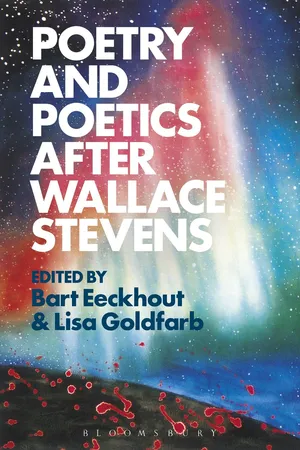
eBook - ePub
Poetry and Poetics after Wallace Stevens
- 240 pages
- English
- ePUB (mobile friendly)
- Available on iOS & Android
eBook - ePub
Poetry and Poetics after Wallace Stevens
About this book
Information
1
Introduction: After Stevens
For Wallace Stevens, writing to José Rodríguez Feo on January 22, 1948, the case was very simple: “You are wrong, by the way, in thinking that I read a lot of poetry. I don’t read a line. My state of mind about poetry makes me very susceptible and that is a danger in the sense that it would be so easy for me to pick up something unconsciously.” Stevens warned the young Cuban that “Most people read [poetry] listening for echoes because the echoes are familiar to them. They wade through it the way a boy wades through water, feeling with his toes for the bottom: the echoes are the bottom.” Having just denied reading other poets in order to avoid being influenced by them, Stevens laconically added he derived his habit from another poet: “This is something that I have learned to do from Yeats who was extremely persnickety about being himself. It is not so much that it is a way of being oneself as it is a way of defeating people who look only for echoes and influences” (L 575).
Such protestations are classic Stevens: they would have us believe that he did not read anybody else’s poetry so as to be able to compose, entirely for his private delight, on a blank slate. The protestations are also classic Modernist dogma, as the enlisting of W. B. Yeats further illustrates: to be a modern poet, to be fully an artist of the twentieth century, one had to insist on “making it new.” And the protestations are classic grist to Harold Bloom’s mill from the 1970s—those years when Bloom was steeped in Stevens’ writings and developed his theory of the “anxiety of influence” around them.
But maybe the wording in the letter to Rodríguez Feo is also, and even primarily, an illustration of Stevens’ defensiveness on a specific occasion. Perhaps the sentences were rhetorically inflected so as to keep the young aficionado from firing question after question triggered by his omnivorous reading—“you are becoming so literary that you ought to understand that life fights back,” Stevens tells him in the same letter (L 575). It may be that Stevens, on this occasion, just wanted to remind Rodríguez Feo of the need to keep a mental space open for personal experience and creativity—a space in which the young man could go for a swim of his own instead of remaining the boy wading through water. However this may be, the final sentence cited in our opening paragraph veers into hyperbole. Are we seriously to believe that Stevens wrote poetry out of animosity against those readers who love to connect poems with poems by imagining echoes and influences?
One thing Stevens’ letter does is to remind us, nevertheless, that influence studies in literary criticism had better retain a tentative, speculative, occasionally even experimental character. This does not diminish their appeal. In Stevens criticism, at least, such studies have a long pedigree: time and again, the poet has been discussed as engaging in a dialogue with his main nineteenth- and twentieth-century sources of inspiration, whether these be other poets (Wordsworth, Shelley, Keats, Tennyson, Whitman, Baudelaire, Valéry, Yeats, Williams, Moore), prose writers (Emerson, Nietzsche, Santayana, William James, Focillon), or painters (Cézanne, Picasso, Duchamp, Mondrian, Klee). What has been done far less systematically so far is to undertake an investigation into Stevens’ own influence on poets of later generations as well as on the development of poetics after him. To be sure, there have been a few focused inquiries—for instance, in special issues of The Wallace Stevens Journal devoted to the poet’s influence on Elizabeth Bishop, on Adrienne Rich and James Merrill, in one case even juxtaposing him with W. H. Auden (not much influence there).1 But the collection of sixteen chapters we are presenting here is the first to take a concerted look at the larger landscape of poetry and poetics after Stevens. It examines a great many lines that may be drawn between his verse and poetry from the second half of the twentieth century up to the present moment in 2015.
To illustrate the rich potential of this topic, we might explain very briefly how this book came about. In the wake of previous conferences on Stevens in which we were involved as organizers, in Oxford and New York, we decided to organize a small “workshop symposium” in Antwerp at the end of May 2014 with an eye to preparing another volume of critical essays.2 We proposed the topic of Stevens’ influence on later writers to a number of editorial board members of The Wallace Stevens Journal as well as a handful of European-based and/or up-and-coming poetry scholars with a strong knowledge of Stevens’ work. To our surprise, not only was the topic received with unanimous enthusiasm, but when paper titles started to pour in, they proved to be all about different case studies. We had worried especially about overlap between poets, and had never dreamed of the kind of diversity we are now able to put on display here. In fact, some of the usual suspects did not even make it into the discussion: Rich and Merrill, for instance, barely return in this book, and none of the chapters pursues in any substantial detail Stevens’ well-attested influence on Randall Jarrell, Richard Howard, Charles Tomlinson, Mark Strand, or Jorie Graham.
What we did receive as suggested topics ranged much further afield than what we had anticipated. We were expecting to see major poets included such as Elizabeth Bishop, John Ashbery, A. R. Ammons, and Robert Hass—and indeed got a separate case study on each. We were also aware of Stevens’ influence on a few writers working in traditions that are usually seen as incompatible with Stevens’ Modernism, like Sylvia Plath (forever dragging along the label of “Confessional” poet) and Susan Howe (too often reduced to being a “Language” poet), though we did not yet understand how rich these two cases were. What we were wholly unprepared for, though, was the breadth of scope we were to achieve through the additional proposals we received: the case of the formalists Richard Wilbur and Howard Nemerov; two similarly canonical poets, George Oppen and Louise Glück, who are almost invariably read outside of a Stevensian framework; a series of younger poets of color, including C. S. Giscombe, Thylias Moss, Terrance Hayes, and Olive Senior; the English poets Nicholas Moore, David Gascoyne, and Peter Redgrove; the Nobel Laureate Seamus Heaney; a Franco-Belgian contemporary of Stevens’, Henri Michaux; and, entirely out of left field (so to speak), the (non)response to Stevens in communist Czechoslovakia.
With such various conjunctions, it goes without saying that several contributors to this book have chosen to proceed in a questioning spirit. They also bring a lot of ambivalence to the table, allowing us to hear poetic dialogues in which later writers do not simply draw inspiration or sustenance from an old master, but frequently talk back, contesting and reshaping the Stevensian heritage to build altogether new kinds of poetics and let other voices be heard. Our contributors generally take care to resist the critical temptation Matt Miller warns against in a recent issue of The Wallace Stevens Journal devoted to the influence of Whitman on Stevens. As Miller complains, “influence studies are often a record of critical preconceptions, or as John Ernest brilliantly phrased it in an essay on Ashbery and William Bronk, ‘narratives of influence colonize individual poets and poems, assuming critical authority over them in the name of conceptual manifest destiny’” (47). Very little of this colonizing impulse or manifest destiny is on display in the present volume, we believe.
Before providing a brief summary of individual case studies, we would still like to mention some of the more theoretical questions that have animated our project. These were offered by way of invitation to contributors, not in an attempt to narrow down perspectives or methods. One question this book hopes to address is how critical work on Stevens might continue to be integrated in broader research and scholarship on modern and contemporary poetry. In particular, what insights into later poets do we obtain from having read and studied Stevens’ work, and what new insights into Stevens do we derive from reading poets coming after him? The ambiguity of the preposition in our title is intentional in this respect: although after may refer neutrally to chronological sequence, it also implies ways of aesthetically modeling poetry on a predecessor; indirectly, it even stages the question of what we are after, as critics, when we establish connections between poets, and thus stretches potentially into the future.
Besides offering a rich harvest of concrete case studies, our joint exploration also reconsiders some of the possibilities for talking about poetic “influence” in an era that no longer takes much interest in Bloom’s theory of Oedipal anxiety and that has turned what was originally intended as a challenging concept, “intertextuality,” into an easy shorthand for rather obvious literary allusions.3 How can we define and refine the ways in which we establish concrete textual links between Stevens’ poems and those written after him? Do we find any value in a claim such as Dana Gioia’s that Stevens was “the single most debilitating influence on contemporary American poetry of the 1980s and ’90s” (qtd. in Duemer 5–6)? How do we read the diverse forms of allusiveness in Dennis Barone and James Finnegan’s anthology, Visiting Wallace: Poems Inspired by the Life and Work of Wallace Stevens? What are we perhaps not paying attention to—aesthetically, but also politically, historically, thematically—when we relate later poetry to someone as idiosyncratic as Stevens? And how much are we still beholden to a typically Modernist poetics when we do so? These are some of our organizing questions.
We have decided to print the following case studies in a roughly chronological sequence, beginning with figures in midcentury, on both sides of the Atlantic, and gradually moving on to the beginning of the twenty-first century. A certain amount of mental flexibility is nevertheless required of our readers, since some chapters scan a terrain of several decades, at times involving a range of poets, while others are pinpointed more specifically—in one instance even sticking to the analysis of a single poem. A monograph would be able to streamline such materials and look for an overarching narrative, but we are convinced that this relative shortcoming is abundantly compensated for by the fact that no single critic could ever cast a net as wide as our collective efforts in this volume do, whether in terms of diversity of poets and poems analyzed or variety of critical methods used. The multiplication of expertise and pluralism of perspectives that we are able to offer seem to us this book’s greatest asset.
***
Now that Marjorie Perloff’s question “Pound/Stevens: Whose Era?” has run its course, we begin our case studies with Bonnie Costello’s proposal of an alternative question—at least, for the formalists on whom she wishes to focus her attention, Richard Wilbur and Howard Nemerov. For these two poets, the issue becomes rather “Frost or Stevens?” As Costello’s subtitle, “Servants of Two Masters,” moreover demonstrates, critical nuance is not always served by debates in either/or terms. Whereas Robert Frost was an obvious father figure for modern American formalists, and some of Stevens’ conceptual style and abstract qualities were just as obviously too radical for such writers, both Wilbur and Nemerov repeatedly acknowledged Stevens as a precursor, too. Costello beautifully defines the nature and extent of this influence across the two poets’ distinguished careers.
Our second case study refers to the same debate initiated by Perloff and takes a similarly extensive view as does Costello, but it crosses the Atlantic and engages with different kinds of poetics. Lee Jenkins investigates the resonance of Stevens’ work among English poets from midcentury onwards. She explains how several of these have turned to one of Stevens’ best-known poet’s poems, “The Idea of Order at Key West,” tilting its spatial and temporal axes in rewritings that have expanded the poem’s original horizon of reception. In England, Stevens’ poem has proved to be a popular resort for poets since 1942, when Nicholas Moore’s “Ideas of Disorder at Torquay” drafted it into the service of English Surrealism in a time of war. Jenkins also considers David Gascoyne’s “With a Cornet of Winkles,” Peter Redgrove’s “The Idea of Entropy at Maenporth Beach,” and two neo-Surrealist seaside postcards alluding to Stevens, identifying signal differences in these various transatlantic receptions of Stevens.
Bart Eeckhout returns us to American shores and adds a conceptual dimension to discussions in the book. He introduces his analysis of the underexplored mark Stevens left on Sylvia Plath by searching for a critical vocabulary that might be adequate to this pairing of poets. In particular, Eeckhout seeks to find a language for the combined phenomenon of stylistic assimilation and creative adaptation that is not well served by theories of allusion. To illustrate his point, he unpacks one poem from what is usually regarded as the second stage of Plath’s writing life, “Night Shift,” detailing a wealth of Stevensian features in it. We should be careful, Eeckhout cautions us, to distinguish among varieties of connection when we look at a later poet’s verse in relation to an earlier one’s. Such connections may be multidimensional, are often dispersed throughout texts, and do not necessarily want to attract the reader’s attention.
In Angus Cleghorn’s chapter, we move on to another major poet from around midcentury, Elizabeth Bishop, to consider the latter’s prosody in relation to the example set by Stevens. The chapter’s title, “Moving the ‘Moo’ from Stevensian Blank Verse,” derives from a comment Bishop made to Marianne Moore—that she disliked how Stevens could “make blank verse moo.” Cleghorn explores both Bishop’s high regard for Stevens and how she extends his blank verse in her poetry by means of casual asides and irregular, intricate rhythms. In this account of poetic history, Bishop contemporizes Stevens’ sound and language. To avoid retreading familiar ground, Cleghorn discusses verse that enacts lyrical innovations at different stages of her writing life, from “Cape Breton” to “Questions of Travel,” “The End of March,” and “Santarém.” Thus, we learn how Bishop gradually injects prose-like rhythms into a landscape that is often still Stevensian.
We continue to crisscross the Atlantic with Axel Nesme’s chapter on Henri Michaux, the first of two forays into continental Europe. In a 1950 letter to Bernard Heringman, Stevens mentions a friend who spent his whole life in Paris “avoid[ing] the Americans in order to see more of the French. Henri Michaux and Supervielle were among his friends, Michaux especially” (L 665). Nesme wonders how we might return to Stevens’ poetic theory to shed light on the emerging work of his younger contemporary Michaux. The American poet’s view that the “imagination loses vitality as it ceases to adhere to what is real” (CPP 645) proves to be notably relevant for Michaux’s typical phantasmagorias insofar as these derive from an effort to exhibit what Freud called “psychical reality.” In a work of prose poetry like Elsewhere, Michaux does not emulate the Surrealist association of ideas that, according to Stevens, generated an imbalance between reality and imagination. Instead, he produces “alternative universes whose very fictitiousness allows this psychical reality to emerge.”
Pursuing a concrete historical example of Stevens’ impact in Central Europe, Justin Quinn’s chapter addresses more political and cultural questions. In 1973, a selection of Stevens’ poems was published in Czech and made no impression on literary life in Czechoslovakia. Quinn explores why this was, casting light on the way poetry travels in translation, the effects of the Cold War on such travels, and what this tells us about historical notions of “American poetry.” His interest lies not in anything anecdotal but in the economy of Cold War literature as part of a larger system of cultural exchange. Quinn links the universalizing tendency in American poetry criticism of the Cold War—from Roy Harvey Pearce to Charles Altieri—to US foreign policy, suggesting that, despite their pretense of universal humanism, such studies are still historically conditioned. Rather than pulling such critics back into historical relativism, however, Quinn wishes to relate their approach to “a larger global ecology in which another ideology is pitted directly against it.”
In his contribution, George Lensing continues the conversation about the relation between aesthetics and politics as he addresses the work of Seamus Heaney. At first glance, Heaney and Stevens would seem to be worlds apart, yet Lensing manages to show how the Northern Irish poet’s response to the American Stevens took shape over the course of his writing life. Lensing analyzes the Nobel Laureate’s growing appreciation of Stevens’ work as well as the subtle mark it left on Heaney’s poems. In due course, Stevens came to represent “a compatible spirit congenial to [Heaney] as a political poet who prized aesthetic independence from partisan politics.” In one of the interviews collected six years before his death, Heaney referred to Stevens again and allied him with great poets of old age such as Yeats.
Starting with Edward Ragg’s chapter, we return to North America for the rest of our explorations. Ragg examines the overlooked affinities between the poetics of Stevens, on the one hand, and those of Oppen and Glück, on the other. He argues that “not only Glück’s, but even Oppen’s work is still being digested,” and that both poets’ relations to Stevens—though hardly obvious—prove to be compelling. On both a thematic and a stylistic level, Ragg is able to demonstrate that these poets “share repetitive, incantatory dictions combining phenomenological and ontological reflections in poems that foreground the primacy of the poem and poetry as creative forces.” Thus, the currents in which poetry after Stevens has been written take at times surprising turns. As not so noble riders, Oppen and Glück have traversed poetic terrains we are only beginning to map, “not least in the sound of words: their daring gestures as sonority, allusion, lineation, narration, and repetition.”
Al Filreis follows ...
Table of contents
- Cover
- Halftitle Page
- Title Page
- Contents
- Acknowledgments
- List of Illustrations
- List of Abbreviations
- 1. Introduction: After Stevens
- 2. Frost or Stevens? Servants of Two Masters
- 3. The Strands of Modernism: Stevens beside the Seaside
- 4. Hearing Stevens in Sylvia Plath
- 5. Moving the “Moo” from Stevensian Blank Verse: Elizabeth Bishop’s Use of Prose
- 6. Henri Michaux’s Elsewhere through the Lens of Stevens’ Poetic Theory
- 7. Stevens across the Iron Curtain
- 8. Stevens and Seamus Heaney
- 9. The Not So Noble Rider: Stevens, Oppen, Glück
- 10. The Stevens Wars
- 11. Stevens’ Musical Legacy: “The Huge, High Harmony”
- 12. “Ghostlier Demarcations, Keener Sounds”: Stevens, Susan Howe, and the Souls of the Labadie Tract
- 13. How John Ashbery Modified Stevens’ Uses of “As”
- 14. Silly to Be Serious: Lateness and the Question of Late Style in Stevens and A. R. Ammons
- 15. Unanticipated Readers
- 16. “This Song Is for My Foe”: Olive Senior and Terrance Hayes Rewrite Stevens
- 17. “The California Fruit of the Ideal”: Stevens and Robert Hass
- Notes on Contributors
- Index
- Imprint
Trusted by 375,005 students
Access to over 1.5 million titles for a fair monthly price.
Study more efficiently using our study tools.
Frequently asked questions
Yes, you can cancel anytime from the Subscription tab in your account settings on the Perlego website. Your subscription will stay active until the end of your current billing period. Learn how to cancel your subscription
No, books cannot be downloaded as external files, such as PDFs, for use outside of Perlego. However, you can download books within the Perlego app for offline reading on mobile or tablet. Learn how to download books offline
Perlego offers two plans: Essential and Complete
- Essential is ideal for learners and professionals who enjoy exploring a wide range of subjects. Access the Essential Library with 800,000+ trusted titles and best-sellers across business, personal growth, and the humanities. Includes unlimited reading time and Standard Read Aloud voice.
- Complete: Perfect for advanced learners and researchers needing full, unrestricted access. Unlock 1.5M+ books across hundreds of subjects, including academic and specialized titles. The Complete Plan also includes advanced features like Premium Read Aloud and Research Assistant.
We are an online textbook subscription service, where you can get access to an entire online library for less than the price of a single book per month. With over 1.5 million books across 990+ topics, we’ve got you covered! Learn about our mission
Look out for the read-aloud symbol on your next book to see if you can listen to it. The read-aloud tool reads text aloud for you, highlighting the text as it is being read. You can pause it, speed it up and slow it down. Learn more about Read Aloud
Yes! You can use the Perlego app on both iOS and Android devices to read anytime, anywhere — even offline. Perfect for commutes or when you’re on the go.
Please note we cannot support devices running on iOS 13 and Android 7 or earlier. Learn more about using the app
Please note we cannot support devices running on iOS 13 and Android 7 or earlier. Learn more about using the app
Yes, you can access Poetry and Poetics after Wallace Stevens by Bart Eeckhout, Lisa Goldfarb, Bart Eeckhout,Lisa Goldfarb in PDF and/or ePUB format, as well as other popular books in Literature & Literary Criticism in Poetry. We have over 1.5 million books available in our catalogue for you to explore.