This book examines the writing of David Foster Wallace, hailed as the voice of a generation on his death. Critics have identified horror of solipsism, obsession with sincerity and a corresponding ambivalence regarding postmodern irony, and detailed attention to contemporary culture as the central elements of Wallace's writing. Clare Hayes-Brady draws on the evolving discourses of Wallace studies, focusing on the unifying anti-teleology of his writing, arguing that that position is a fundamentally political response to the condition of neo-liberal America.
She argues that Wallace's work is most unified by its resistance to closure, which pervades the structural, narrative and stylistic elements of his writing. Taking a broadly thematic approach to the numerous types of 'failure', or lack of completion, visible throughout his work, the book offers a framework within which to read Wallace's work as a coherent whole, rather than split along the lines of fiction versus non-fiction, or pre- and post-Infinite Jest, two critical positions that have become dominant over the last five years. While demonstrating the centrality of 'failure', the book also explores Wallace's approach to sincere communication as a recurring response to what he saw as the inane, self-absorbed commodification of language and society, along with less explored themes such as gender, naming and heroism.
Situating Wallace as both a product of his time and an artist sui generis, Hayes-Brady details his abiding interest in philosophy, language and the struggle for an authentic self in late-twentieth-century America.
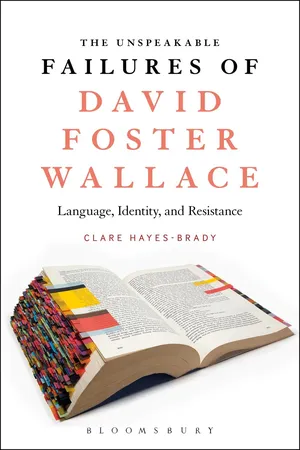
eBook - ePub
The Unspeakable Failures of David Foster Wallace
Language, Identity, and Resistance
- 208 pages
- English
- ePUB (mobile friendly)
- Available on iOS & Android
eBook - ePub
The Unspeakable Failures of David Foster Wallace
Language, Identity, and Resistance
About this book
Information
1
Introduction
In his 1990 review of David Markson’s novel Wittgenstein’s Mistress, considering a world in which the early philosophy of Ludwig Wittgenstein holds sway, David Foster Wallace suggests “rarely is our uncritical inheritance of early Wittgensteinian & Logical Positivist models so obvious as in our academic & aesthetic prejudice that successful fiction encloses rather than opens up, organizes facts rather than undermines them, diagnoses rather than genuflects” (BFN, 106, emphasis mine). This judgment reflects Wallace’s strong engagement with philosophy in his work, and the explicit connection between philosophical models and fictional achievement that this book explores. More importantly, it signals the central thread of Wallace’s project for literature: opening questions to consideration, dialogic rather than didactic, and strongly resisting the confinement of conventional structure.1 Although it has become commonplace to discuss Wallace as a complex bridging figure between postmodernism and what has emerged in its much-contested aftermath, in this tendency toward opening up Wallace seems to me to maintain a stronger link with postmodernist discourses—notwithstanding his explicit ambivalence about its value—than is usually implied in what is called post-postmodernist work. The writing of such peers as Franzen, Smith, and Powers, for example, tends more to incorporate the strategies of classical realism, especially in their movement toward “smaller scales and increased closure,” as Stephen Burn has argued.2 While I concur with the general determination that Wallace may indeed be termed a post-postmodernist writer, it is with the caveat that there is as much of the “postmodernist” as there is of the “post-”. Marshall Boswell suggests that Wallace may be seen as “a nervous member of some still-unnamed (and perhaps unnamable) third wave of modernism”;3 that nervousness, and his own persistent ambivalence about the “post” label in the singular (and presumably the plural), is significant to a consideration of his complex place in contemporary American literature and its legacy.4
Wallace and failure: A love story
The philosopher Richard Rorty held that the purpose of philosophy is not to find answers, but to keep the conversation going. In Wallace’s writing, the same perspective is visible. His persistent invocation of plurality, or “Both/And” systems, along with his resistance to teleological structures, infuses his writing with a sense of the necessity of continuation, and provides the thematic and structural (though necessarily negative) center of his creative output. The purpose of writing—which, as he pointed out regarding Markson, can also function as a literalization of philosophical theories—is not to find closure, but to resist it, to frame the possibilities of meaning, not to achieve, and so to close them. Failure, then, read as the absence of closure, is the primary positivity of Wallace’s writing. The unending journey westward that closes Girl with Curious Hair physically enacts the Rortian continuity of dialogue that I argue animates the structures of Wallace’s writing; it’s worth noting too that Wallace’s first novel The Broom of the System not only ends in mid-sentence, but ends by cutting off the very word “word,” reflexively invoking the absence of linguistic closure that has been problematized throughout the narrative.
It is perhaps somewhat disingenuous to call a book of this nature The Unspeakable Failures of David Foster Wallace. However, the term “failure” is carefully chosen, and refers to a range of attributes, including the many very real shortcomings in Wallace’s writing. Failure itself was a recurrent theme of the writing: Infinite Jest went under the working title of A Failed Entertainment because for Wallace “the book is structured as an entertainment that doesn’t work. Because what entertainment ultimately leads to, I think, is the movie Infinite Jest,” which implicitly positions entertainment (passive, unidirectional, fundamentally absent) in opposition to communication (active, transactional, grounded in but transcending absence).5 By this reckoning, then, failure marks the continuation of human thought, whereas success leads to atrophy of will and the inevitable choice of death by pleasure. By contrast, the central failure of the novel is ultimately a symbolically productive one: like the failure of communication I propose, the central absence of the novel becomes a repository of possibilities, not a univocal object but a play of potentialities. In this respect as well, Wallace seems to echo and extend Wittgenstein’s resistance to the idea of the perfect expression of anything, as explored in the question “what is a broom?,” evoked in the title of the first novel, as well as invoking later readings of Wittgenstein by Rorty and Cavell and picking up on the ideas of negative dialectics of Theodor Adorno.
In this respect also, the silenced central figure of Q, in Brief Interviews with Hideous Men, might similarly be reimagined as a locus of projection, rather than as a figure of proscription. Closure is repeatedly imagined as a kind of death, death as a kind of perfection—Hamlet’s “consummation,” perfect, static, and final. Karnicky argues that the film Infinite Jest, with its narcotic effect on the viewer, represents the “culmination of a movement towards stasis,” a stasis of pleasure that is literally deadly.6 Wallace’s foundational conception of communication as an unending process absolutely precludes its own success; success, after all, is an ending, closing off possibilities for further conversations. To close a story in the traditional sense is in some way to end a conversation, to offer the illusion of logic, linearity, and control, and to quit the grand project of keeping the conversation going, which offers a route out of the postmodernist trap of solipsism. Hence, Wallace’s resistance to endings becomes a central part of his creative process, in which the reader is and must continually be a coproducer of meaning. Wallace’s conception of a dynamic process of communication, which is explored more fully across several chapters of the book, incorporates the giving of the self to the process, the effortful involvement of the subject in the process of attempting to reach the other, to “leap over that wall” as he put it in an interview with Laura Miller.7
In this model of communication, the effort to reach the other must be sincere and full, but the process cannot be completed. It is not a process of incompletion, but rather an incomplete process, perhaps more connected with Aristotle’s idea of perfectibility than with any existing philosophy of communication as such. The sense of failure as a lack of, and resistance to, completion is central to this book’s reading of Wallace’s work as coherently plural, and is explored in each chapter as a generative force. The necessity of failure, the redemptive potential (never quite to be achieved) of love and free will, and the central importance of attention or engagement are thematically unpacked by attention to questions of gender and the body, vocal and structural instability, freedom, and philosophy. These investigations yield a vision of Wallace’s writing that approaches and retreats from the anti-teleology that marks his work, gesturing toward the coherence of nonclosure. Wallace himself identified this inclination to circling around a present absence as “tornadic”;8 it is in that annular centrality of absence and chaos that this book finds a dynamic coherence, shifting and re-emerging, permanently impermanent, changing with each iteration, each time failing again, each time perhaps failing a little better.
It is most useful to consider failure in Wallace’s work as occurring in three modes: abject, structural, and generative. Abject failure is the total failure of an attempt to communicate, as in the case of the “depressed person” from the short story of the same title, whose efforts to communicate with those around her are hampered by paralyzing self-absorption and inability to recognize other people as anything other than objects for her use. Structural failure is failure of the process of communication, usually caused by the absence of an element necessary to communication, such as the ability to speak. This kind of failure is characterized in Infinite Jest by Hal’s inability to form intelligible words. Similarly, Don Gately has spent the hundred or so pages leading to this point attempting to resist medication, but by the final passage he is unable to muster sufficient power of speech to say that he is an addict. “He kept trying to say addict [ . . . ] he gurgled and mooed, saying addict” (IJ, 973). Gately’s failure to communicate his status as addict, in fact, is integral to his survival on a conceptual level: the failure of communication here opens an interpretive gap. That failure is implicitly symbolized by the life-saving administration of pain medication (although it may result in a slide back into addiction). Gately’s survival, then, is associatively linked with the structural failure to communicate: his status as object of another subject’s will disrupts the solipsistic slide into the perfect closure of death.
The third kind, most important to our work here, is generative failure, which refers to the necessarily unfinished nature of communicative acts, and at its most powerful entails the simultaneous narrowing and strengthening of the gap between self and other, the isolation of the subject. While this gap would seem to be precisely the cause of the much-vaunted solipsistic trap that concerned Wallace, the concept of generative failure challenges that idea. In our inevitable failure to communicate successfully, due to the fundamental absence inherent in textuality (that is, the absence of the writer at the time of reading and vice versa), the fundamental unbridgeability of the gap between self and other is reinforced. That gap entails alterity, the nexus of subjectivity in the object of communication that cannot be reached by communicative intent, thereby rejecting the projective total consciousness that lurks at the heart of solipsistic fear: the sense that one’s own consciousness is responsible for the whole universe. Narcissistic and solipsistic traps are averted or deferred by recognition of an alternative locus of subjectivity, enacted in the failure of communication, where the necessary gap in interpretation opens the possibility of plural and unpredictable communicative outcomes. The clearest implications of this concept are for Wallace’s ideation of solipsism and narcissism, but iterations of generative failure are everywhere manifested in his writing at both narrative and structural levels as the failure to cohere. Importantly, the structural, narrative, and formal manifestations of this form of failure depend on the sincere effort to overcome them, rather than existing as a commodification of the concept of failure as a new form of success; they do not achieve what they set out for, but their shortcomings offer generative possibilities that would be precluded by their success.
For example, Lenore’s completion of her quest in Broom, although it would return her great-grandmother to her, would not allow her to inhabit her own subjectivity. Similarly, in “Order and Flux in Northampton,” Barry Dingle’s homunculus never achieves his telos, the love of Myrnaloy Trask, but his failure to do so allows Barry to convey the necessary separation of self and other. The myriad instances of failed communication—the depressed person, the couple in “Here and There,” the child in “Another Pioneer”—are tragic and frustrating, but invite the reader to consider why we fail to communicate, to get closer to clarity each time, knowing we will never quite reach it. This type of failure—choosing to fail again and better, choosing generative imperfection over encompassing perfection, breaking open rather than closing off—is the conceptual core of this book. While instances of both abject and structural failure are discussed as they arise, the recurrence of generative failure draws together the disparate elements of Wallace’s writing, offering a framework for the interpretation of his overarching creative project, which was to foster attention and engagement in his readers, or as he put it to “aggravate this sense of entrapment and loneliness and death in people.”9
In respect of these three modes of failure, and especially the concept of generative failure, the anti-idealism of Theodor Adorno’s Negative Dialectics, with its insistence on the primacy of the object rather than the subject, mirrors Wallace’s own troubled articulation of the relationship of self and other, and the potential subjection of that relationship to a solipsistic interrogation of the self. Rather than seeking to collapse that boundary, Wallace’s work depends on the persistence of alterity and the ongoing dynamic exchange between self and untouchable other for the relief of—but not solution to—postmodernist narcissism and the threat of solipsistic entrapment. In exploring Wallace’s encounters with questions of language and culture, and his later articulation of the pressing need to try to be an engaged citizen, it becomes clear that the process of communication is the central thread of Wallace’s work, a fundamentally political process, offering the potential liberation of the late-capitalist subject from the radical individualism that had overtaken the society within which Wallace found himself working, as dramatized throughout his work, from the corporatization of alienation in Broom to the exploitation of pain in “The Suffering Channel.” The process exculpates the reader from the search for certainty, and reinscribes the communicative process—always unfinished, always failing—within each reading, galvanizing readers to engage in this process as a way of challenging their own narcissism.
Adorno’s thinking also offers a way in which to read this outcome; in the con...
Table of contents
- Cover
- Half-Title
- Title
- Dedication
- Contents
- Preface
- Abbreviations
- 1 Introduction
- 2 “I’m a Man of My—” Wallace and the Incomplete
- 3 “It’s Just the Texture of the World I Live in”: Wallace and the World
- 4 The Book, the Broom, and the Ladder: Grounding Philosophy
- 5 “Something to Do with Love”: Writing and the Process of Communication
- 6 Narcissism, Alienation, and Commun(al)ity
- 7 Vocal Instability and Narrative Structure
- 8 “Personally I’m Neutral on the Menstruation Point”: Gender, Difference, and the Body
- Conclusion
- Bibliography
- Index
- Copyright
Trusted by 375,005 students
Access to over 1.5 million titles for a fair monthly price.
Study more efficiently using our study tools.
Frequently asked questions
Yes, you can cancel anytime from the Subscription tab in your account settings on the Perlego website. Your subscription will stay active until the end of your current billing period. Learn how to cancel your subscription
No, books cannot be downloaded as external files, such as PDFs, for use outside of Perlego. However, you can download books within the Perlego app for offline reading on mobile or tablet. Learn how to download books offline
Perlego offers two plans: Essential and Complete
- Essential is ideal for learners and professionals who enjoy exploring a wide range of subjects. Access the Essential Library with 800,000+ trusted titles and best-sellers across business, personal growth, and the humanities. Includes unlimited reading time and Standard Read Aloud voice.
- Complete: Perfect for advanced learners and researchers needing full, unrestricted access. Unlock 1.5M+ books across hundreds of subjects, including academic and specialized titles. The Complete Plan also includes advanced features like Premium Read Aloud and Research Assistant.
We are an online textbook subscription service, where you can get access to an entire online library for less than the price of a single book per month. With over 1.5 million books across 990+ topics, we’ve got you covered! Learn about our mission
Look out for the read-aloud symbol on your next book to see if you can listen to it. The read-aloud tool reads text aloud for you, highlighting the text as it is being read. You can pause it, speed it up and slow it down. Learn more about Read Aloud
Yes! You can use the Perlego app on both iOS and Android devices to read anytime, anywhere — even offline. Perfect for commutes or when you’re on the go.
Please note we cannot support devices running on iOS 13 and Android 7 or earlier. Learn more about using the app
Please note we cannot support devices running on iOS 13 and Android 7 or earlier. Learn more about using the app
Yes, you can access The Unspeakable Failures of David Foster Wallace by Clare Hayes-Brady in PDF and/or ePUB format, as well as other popular books in Literatura & Crítica literaria. We have over 1.5 million books available in our catalogue for you to explore.