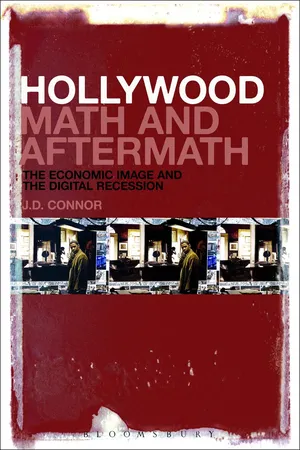
Money is Hollywood's great theme-but money laundered into something else, something more. Money can be given a particular occasion and career, as box office receipts, casino winnings, tax credits, stock prices, lotteries, inheritances. Or money can become number, and numbers can be anything: pixels, batting averages, votes, likes. Through explorations of all these and more, J.D. Connor's Hollywood Math and Aftermath provides a stimulating and original take on "the equation of pictures," the relationship between Hollywood and economics since the 1970s.
Touched off by an engagement with the work of Gilles Deleuze, Connor demonstrates the centrality of the economic image to Hollywood narrative. More than just a thematic study, this is a conceptual history of the industry that stretches from the dawn of the neoclassical era through the Great Recession and beyond. Along the way, Connor explores new concepts for cinema studies: precession and recession, pervasion and staking, ostension and deritualization.
Enlivened by a wealth of case studies-from The Big Short and The Wolf of Wall Street to Equity and Blackhat, from Moneyball to 12 Years a Slave, Titanic to Lost, The Exorcist to WALLE, Déjà Vu to Upstream Color, Contagion to The Untouchables, Ferris Bueller to Pacific Rim, The Avengers to The Village-Hollywood Math and Aftermath is a bravura portrait of the industry coming to terms with its own numerical underpinnings.
- 328 pages
- English
- ePUB (mobile friendly)
- Available on iOS & Android
eBook - ePub
About this book
Information
1
The economic image: Hollywood dataculture and the moneyball of Moneyball
The economic image
What makes the equation of pictures possible? Ordinarily, the question has a practical bearing, and the answer is money, a universal solvent of differences, differences that might reemerge as questions of labor, time, ideas, and so on. But when the answer to that question is number as such, the grand old debates of the philosophy of mathematics rush in. What makes equation as such possible?
For Hollywood, even asking the question invites suspicion. The turn away from practicality toward a pure abstraction or a pure materiality leads toward madness or conspiracy, and madness and conspiracy are the signs of money’s pervasive influence. Surprisingly, perhaps, Gilles Deleuze makes a similar point in Cinema 2: The Time-Image:
The cinema as art itself lives in a direct relation with a permanent plot [complot], an international conspiracy which conditions it from within, as the most intimate and most indispensable enemy. This conspiracy is that of money; what defines industrial art is not mechanical reproduction but the internalized relation with money. . . . Money is the obverse of all the images that the cinema shows and sets in place, so that films about money are already, if implicitly, films within the film or about the film.1
The eruption of economic critique where we would expect an argument about medium specificity is striking. In the midst of his taxonomy of images—a taxonomy that leans heavily on the semiotics of Charles Sanders Peirce and the philosophy of Henri Bergson—production context surprisingly returns. In the opening sentence of the cinema books, Deleuze had apparently cast aside history—“This study is not a history of cinema.” But just as quickly he reinstated the sorts of contingency and consistency out of which a cinema history might be made. Directors—and Deleuze’s cinema remains crucially a directors’ art—are artists but also thinkers. If they produce “rubbish” that is merely because they are “more vulnerable—it is infinitely easier to prevent them from doing their work” than other thinkers. Those concessions to the constraints of industrial artistry quickly take a back seat to the ramifying taxonomy. At the highest level, there are the movement-image, typical of classical Hollywood, and the time-image, typical of the global art cinemas of the postwar period. But there are also forerunners, subtypes, and complexes; perception-images (POV shots are examples), affection-images (think of a Dietrich closeup), action-images (a stagecoach in a landscape). Now, midway through the second volume, when the grand transition from movement-image to time-image is underway, the directors’ vulnerabilities return and are grounded in the limitations of money. It feels as though an earlier Deleuze, the writer of Anti-Oedipus, has suddenly taken over, and has knocked the argument and the type sideways. And so he will say, all in italics, “the cinema confronts its most internal presupposition, money, and the movement-image makes way for the time-image in one and the same operation .”2 Once it has been knocked off-kilter in this confrontation, film “endlessly relaunches” a “dissymmetrical” exchange: “The film is movement, but the film within the film is money, is time.”3
To be sure, Deleuze’s turn to economy is not as specific as Thompson’s turn to the ideology of casting, and it will take some patience to understand what importance it might hold for a study of contemporary Hollywood. Here, Deleuze invokes the basic Marxist equation, the “tricked, dissymmetrical exchange” of Money for Commodity for Money (M-C-M) as the ground or the analogue or both for the dissymmetrical exchange of the time-image. The principal alternative, again, is the movement-image, one built on equivalence, or, as Deleuze puts it here, C-M-C. But if the time-image is the dissymmetrical obverse of the symmetrical movement-image, it also seems to be the movement-image’s successor in a history of cinema. The equivalence of the movement-image “makes way” for the dissymmetry of the time-image; Hollywood gives way to Europe (and Japan, and elsewhere). The passage from the one to the other—the crisis of the movement-image—gives rise to (or seems to give rise to) a self-reflexivity, of “films within the film.” The crisis thus generates a kind of “special” image, a crystal-image, “giving image for money, giving time for images, converting time, the transparent side, and money, the opaque side, like a spinning top on its end.”4
Anne Friedberg describes this chapter as the “most promising and yet undeveloped section of the book.”5 Few critics have taken up this passage, or even the formal-financial transition it implies. David Rodowick, in a characteristically incisive footnote, explains the importance of the dissymmetry between time and money that comes with the advent of the time-image. Gone is the parallel between the fungibility of images and commodities. In place of that parallel, there is now only a “struggle between the image and capital to see who will be exhausted first.”6 For Jonathan Beller, the parallel between images and capital continues to operate, only the time-image amounts to a new “representational paradigm,” which accords with the shift “from monopoly to multinational capitalism.”7 For Beller, the changes in representational paradigm happen to cinema in general; there is no canon of films whose resistance to capitalist equivalence emerges from their access to direct images of time. In contrast, for Rodowick, time-images constitute a profound form of resistance to the economic order, even if the outcome of that struggle is up for grabs.
Rodowick and Beller, then, offer potentially incommensurable ways of understanding the critical transition in Deleuze’s writing on cinema. Deleuze locates that transition after the Second World War, but there is simply no way for the uneven and at least apparently historical shift from the movement-image to the time-image to occur in the postwar period if the crucial event or aspect of that shift is a confrontation with financial scarcity. Such a confrontation was baked into the movement-image from the moment the patent trust was busted. Indeed, Deleuze’s authority for the decisive effects of what we might call first-stage financialization on cinema is a lecture by Marcel L’Herbier delivered in 1926. Beller, then, takes Deleuze’s point to be, implicitly, that the time-image marks the emergence of a new accord between cinema and the mode of production. What appear to be strategies of resistance through formal innovation are, instead, further elaborations of the “representational paradigms” belonging to monopoly (movement-image) and multinational (time-image) capitalism. Beller saves Deleuze’s history by rejiggering his account of capital. For Rodowick, in contrast, the too-early arrival of the confrontation with money suggests the logical possibility of an earlier, forced disequivalence between time and money under the regime of the movement-image, emblematized not by a proto-time-image but by montage. Rodowick saves Deleuze’s history by rejiggering his notion of form. Neither manages (or, really, attempts) to save Deleuze’s account of the eruption of money as an event within the postwar history of film.
And what are we to do with Hollywood cinema in the wake of the transition to the time-image? Does it constitute a retrograde departure from the advanced cinema of the time-image, and can it amount to a historical deviation despite its overwhelming importance to the market and its global social reach? Perhaps the “operation” that both constitutes the confrontation with money and launches the time-image is something more like a material trope—a transition that happens within narrative and that is supported by a host of filmmaking practices that could be impinged upon by such a shift, but a transition that nevertheless retains the abstraction, formality, and iterability of a storytelling function.
If that is the case, it would explain why Deleuze’s apparently historical argument gives way to his assertion of disequivalence between the motion of the film and the eruption within those films of time. In other words, this apparently historical transition may operate materially or formally, depending upon one’s analysis of the relative predominance of industry or art within the contest for supremacy. When the confrontation with money occurs in the cinema that will be dominated by the time-image, that relationship is internalized in such a way that the results create the appearance of time liberated from the logic of equivalence and exchange, the logic of capital. Time is the transparent side; money, the opaque. In that case the Rodowickian struggle ensues. But for the cinema that remained within the movement-image—that is, for Hollywood—the challenge of money—that is, time—is one that is met through the assertion of symmetry. And for a cinema that confronts money within a realm of forced equivalence, money is no longer the opaque side of the crystal. Instead, the economic image replaces the crystal-image. Or, to put it in less grandiose terms, and to shift from criticism back to practice, if you make industrial art, you will find at different moments that the scale is tipped either toward the art or the industry. Whether and how you decide to right that balance is a calculation that has both aesthetic and economic aspects. The discourse both within and outside the film will find itself divided between those aspects, rippling along a faultline of a mutual allegorization. The economic image is the system’s epicenter.
On Deleuze’s account, films about money are films about film. “Analyzing the films where money plays an important role, we encounter as it were naturally, the theme of the film reflected in the film.” About-ness is the simplest allegory, the sort of thing that makes a heist movie like Ocean’s 11 (Soderbergh, Warner Bros., 2001) the projection of its own backstory, the display of its own process of assembly. But the converse of Deleuze’s point should be available as well, that is, that films about time are films about money—or that they might be, if that fundamental dissymmetry can be jerked back into a place of rough equivalence. This is, I will argue, what Déjà Vu does, and it is what I am saying the neoclassical Hollywood project amounted to. Faced with a cinema headed formally and materially along a schizoid trajectory, the great aesthetic undertaking of the major studios was to successfully revitalize the classical canons of balance, proportion, causality, and intention. As epigones of the classical studios, they inevitably performed this counter-operation at one remove, carrying within them the quasi-historical scar of their own reorigination.
The economic image displays the internalized relation of the film to money, to people and institutions, to the times and places—actual and virtual, literal and conventional—of its production, distribution, and exhibition. “Displays” here is meant to include as wide a range of modalities of presentation as possible: allegory, explicit reflection, metonymy, description, depiction, insinuation. In calling these “economic images” I want to stress not only the Deleuzian roots of the idea, but the difficulty of justifying the importance of those images within a project that is more properly historical. Reading Deleuze on the transition to the time-image, I find the necessary specifics lacking. In the case of the economic images I will highlight, the specifics seem overwhelming. It will not be a matter of sidestepping history for taxonomy but of attempting to refound history on these instances that make the equation of pictures possible.
Still, one might reasonably object that my emphasis on the historical-ish elements of Deleuze’s account is partial and that it too readily grounds a multifaceted transition in but one of its aspects. If the standard account of the time-image insists on two-sidedness, the two sides are not time and money but the time of the film’s presentation (its real time) and the time of the events it has captured (its virtual time). The shift from the movement-image to the time-image is properly formal and is founded on the gap, the interstice, between real and virtual. One emblem for that gap is the cut between two shots (or between an image and a sound). Here, Deleuze reaches for a kind of rigor he associates with mathematical abstraction. “Cinema and mathematics are the same here: sometimes the cut, so-called rational, forms part of one of the two sets which it separates (end of one or beginning of the other). This is the case with ‘classical’ cinema. Sometimes, as in modern cinema, the cut has become the interstice, it is irrational and does not form part of either set . . . a frontier which belongs to neither...
Table of contents
- Cover
- Half-Title
- Dedication
- Title
- Contents
- Acknowledgements
- Introduction: The equation of pictures
- 1 The economic image: Hollywood dataculture and the moneyball of Moneyball
- PART ONE Precession: Titanic: It’s all on the screen
- PART TWO Recession: Two trailers from the opening of the Obama era
- Bibliography
- Index
- Copyright
Trusted by 375,005 students
Access to over 1.5 million titles for a fair monthly price.
Study more efficiently using our study tools.
Frequently asked questions
Yes, you can cancel anytime from the Subscription tab in your account settings on the Perlego website. Your subscription will stay active until the end of your current billing period. Learn how to cancel your subscription
No, books cannot be downloaded as external files, such as PDFs, for use outside of Perlego. However, you can download books within the Perlego app for offline reading on mobile or tablet. Learn how to download books offline
Perlego offers two plans: Essential and Complete
- Essential is ideal for learners and professionals who enjoy exploring a wide range of subjects. Access the Essential Library with 800,000+ trusted titles and best-sellers across business, personal growth, and the humanities. Includes unlimited reading time and Standard Read Aloud voice.
- Complete: Perfect for advanced learners and researchers needing full, unrestricted access. Unlock 1.5M+ books across hundreds of subjects, including academic and specialized titles. The Complete Plan also includes advanced features like Premium Read Aloud and Research Assistant.
We are an online textbook subscription service, where you can get access to an entire online library for less than the price of a single book per month. With over 1.5 million books across 990+ topics, we’ve got you covered! Learn about our mission
Look out for the read-aloud symbol on your next book to see if you can listen to it. The read-aloud tool reads text aloud for you, highlighting the text as it is being read. You can pause it, speed it up and slow it down. Learn more about Read Aloud
Yes! You can use the Perlego app on both iOS and Android devices to read anytime, anywhere — even offline. Perfect for commutes or when you’re on the go.
Please note we cannot support devices running on iOS 13 and Android 7 or earlier. Learn more about using the app
Please note we cannot support devices running on iOS 13 and Android 7 or earlier. Learn more about using the app
Yes, you can access Hollywood Math and Aftermath by J.D. Connor in PDF and/or ePUB format, as well as other popular books in Media & Performing Arts & Entertainment Industry. We have over 1.5 million books available in our catalogue for you to explore.