Immersion is the new orthodoxy. Within the production, curation and critique of sound art, as well as within the broader fields of sound studies and auditory culture, the immersive is routinely celebrated as an experiential quality of sound, the value of which is inherent yet strengthened through dubious metaphysical oppositions to the visual. Yet even within the visual arts an acoustic condition grounded in Marshall McLuhan's metaphorical notion of acoustic space underwrites predispositions towards immersion. This broad conception of an acoustic condition in contemporary art identifies the envelopment of audiences and spectators who no longer perceive from a distance but immanently experience immersive artworks and environments.
Immanence and Immersion takes a critical approach to the figures of immersion and interiority describing an acoustic condition in contemporary art. It is argued that a price paid for this predisposition towards immersion is often the conceptual potency and efficacy of the work undertaken, resulting in arguments that compound the marginalisation and disempowerment of practices and discourses concerned with the sonic. The variously phenomenological, correlational and mystical positions that support the predominance of the immersive are subject to critique before suggesting that a stronger distinction between the often confused concepts of immersion and the immanence might serve as a means of breaking with the figure of immersion and the circle of interiority towards attaining greater conceptual potency and epistemological efficacy within the sonic arts.
- 216 pages
- English
- ePUB (mobile friendly)
- Available on iOS & Android
eBook - ePub
About this book
Information
1
Decentralization
Acoustic space has been extensively explored within electroacoustic music. This genre of music makes spectacular use of multi-channel surround sound systems to immerse listeners within an often acousmatic sound world that minimizes visual interference in order to foreground the auditory experience of sonic events and transformations. Within this compositional framework, gesture and particularly the movement of sound through space is figured as a fundamental part of what sound is. Sound is not a static object simply comprising frequency, phase and amplitude but a complex spatio-spectro-temporal vector. Denis Smalley states that ‘spatial perception is inextricably bound up with spectromorphological content’ and proposes the term ‘spatiomorphology’ to refer specifically to this aspect of sound (Smalley 1997, 122). Whether an electroacoustic performance uses four speakers on a single plane or four-hundred speakers arranged in all directions, the listener sits immersed within sound field conjured through an encircling loudspeaker array. While some systems will present a spherical arrangement that treats all directions as equal, some retain a frontal orientation wherein the majority of the loudspeakers are positioned in front of the audience. This latter arrangement permits a more convincing illusion of gestural continuity to the fore than the rear. Where this arrangement can be understood to privilege a frontal and perhaps ‘visual’ orientation of the listening subject, distinct arrangements are found where loudspeakers are distributed equally in a circle around the audience.
This latter arrangement is often seen in Francisco López’s performances. In many of López’s performances, loudspeakers are distributed equally in a circular pattern around an audience. At the centre of this audience is López, the artist, who occupies a privileged position or sweet spot enabling optimum performance and listening conditions. Between the artist and the loudspeakers sit the audience in a series of concentric circles mirroring propagating waves that move out towards the edge of the circle. The audience often sit blindfolded in order to maximize the acousmatic impact of the work wherein cause is obfuscated in order to produce a reduced or purely phenomenological experience.1 Here the arrangement of technical infrastructure aims to mirror that of sound itself – understood momentarily as a physical wave – not the frontal orientation of the listening subject, but the sound wave which radiates out in all directions from a causal centre that remains hidden from the listener. In the work of López as well as more ‘traditional’ or institutionalized forms of electroacoustic music the illusion of a continuous acoustic space is centred upon an ideal ‘sweet spot’, a point at which the illusion is most convincing and coherent.2 For spatiomorphological vectors to be accurately reproduced and understood, they must occur with reference to this centralized listening position within the loudspeaker array where the acousmatic illusion is most successful.3 Those seated away from this central sweet spot experience a less convincing illusion that diverges from the composer’s intentions.
Beyond the electroacoustic paradigm, anchored to a central listening position, many sound installation practices move away from the idealized centrality of the sweet spot that underpins the illusion of a continuous auditory space through which sonic gestures move. In installation practice acoustic space still describes an enveloping environment that immerses the listener, yet this immersion discards the notion of the sweet spot in becoming an acoustic space without centre. Accordingly the acoustic space of much installation practice comes closer to that presented by McLuhan as ‘a field of simultaneous relations without centre or periphery’ (McLuhan 2006, 49). To be without centre is to be without a sweet spot, yet the absence of a single centre upon which the illusions of acoustic space depend does not entail the absence of centres in general. Through the aesthetic sufficiency of immersion each listener becomes an individual centre, a point of origin in a Ptolemaic order. Divestment from a singular centre in installation practices leads to a proliferation of centres, each grounding an individual acoustic space through an ultimately auto-affective aesthetic sufficiency. The listener produces their own centre through the synthetic act of hearing. The spatiomorphological content of the work is thereby indeterminate in the sense that it is produced by the position and movement of the listener within space rather than the movement of sounds throughout the space.
Where the spatiomorphological content of electroacoustic music is determined by the movement of sounds through space, this space acts as an empty container, a pre-existing and ideal space through which sounds move. Contrasting with this pre-existing space is the space that the drones prevalent in much installation practice produce. Where these drones saturate acoustic space they produce a spatiality that cannot be said to pre-exist the sounds. The sounds do not move through space but produce space through the provision of sonic materials. The space these sounds produce often binds together sound, listener and the pre-existing installation environment – such as the gallery space – through the activation of sympathetic resonances that excite both organic and architectonic materials. Sound, listener and architecture are woven together within a space that emerges through the saturating presence of sound. Within this acoustic space which saturates and binds together architectonic, technological and organic bodies through sympathetic resonances, a further space may be hollowed out through acts of critical listening and differentiation. This production of acoustic space and any subsequent ‘burrowing’ through the exercise of audile technique do not presuppose an ideal and empty space through which sounds move. Where the production and saturation of space by sound presents a visceral and immersive spatiality that, through the force of the resonances established, may deprive the listener of the capacity for differentiation and decision through affective bombardment, the ability of listening to tune-out, identify, analyse and differentiate allows for the hollowing out of a space within which the listening subject might maintain its capacity for decision and differentiation.
Divestment from the sweet spot entails an initial decentralization in terms of both spatialization and authorial intent that consequently results in proliferating re-centralization around individual centres and listening events. Where the sweet spot entails a periphery that positions some listeners at the edge of the circle, the proliferation of individual centres within installation practices does away with both singular periphery and centre. Where the eradication of a singular centre does not entail the eradication of centres, the same is true for the periphery. Where distance from a sweet spot positions one towards the edge of a c ircle, in the absence of a singular centre this edge or periphery is defined by the limits of individual audition. This limit is in part defined through attention, training and listening, but also through the physiological conditions of hearing. Decentralization thereby becomes a process of reorienting attention so that it focuses not only on the intentional objects of auditory perception but also on the conditions of auditory perception, attending to itself through acousmatic and phenomenological reduction but to hearing itself through a further reduction. This latter process of decentralization, moving the listener towards the edge of audition, takes place in works which operate both beyond and at the limits or conditions of auditory experience.4
Practices drawing attention to the physiological and psychoacoustical conditions of hearing identify the limits of perception. In doing so they perform an exercise that can be considered equivalent to what Deleuze called transcendental empiricism, identifying the real rather than ideal conditions of possible experience. Furthermore, this identification of the limit of perception, often through a manipulation of psychoacoustical phenomena, poses the problem of what lies beyond, yet often without offering much in the way of answers. Experimentation with the conditions of sonic experience often constitutes a circumnavigation of the edge of the acoustic circle. The reality of sound, or the location of the sonorous real, is drawn into question as sonorous experience comes to refer to the synthetic products of a stratified auditory perception. Where it is equated with a perceptual limit identified by the physiological conditions of audition, the real refers not to the forms of an external reality – such as a car or ringing bell that might be heard to move through a pre-existing space – but to an affective, synthetic reality that lends to the apparent immateriality of sound a materiality by grounding it in the synthetic operations of the body.5
1.1 Get Out of the Defensive Position
Mark Fell’s work comprises electronic music, installation and curatorial practice. Most evident in Fell’s compositions is an exploration of synthetic sounds originating in popular forms of electronic music, including handclaps, bass drums and synth pads utilizing frequency modulation and additive synthesis in ways that often retain a timbral connection to House music. In its approach to time and rhythm, Fell’s compositional practice is far less familiar. We might use the term experimental yet Fell’s discomfort with this term’s association with institutional and rarefied forms of the avant-garde requires that we identify this experimentation as occurring within, yet at the fringes of, popular music. Where these sounds are subject to regular metre and linear structural development they become familiar, yet algorithmic approaches to their arrangement and modification sets them apart from easy recognition, while their repetition permits analytical attention to be addressed to the minutiae of their spectral composition. A similar sound palette is heard in Fell’s installation works, which often entail deconstructions of various illusions utilized in the production of electronic music, particularly by means of spatialization such as ambisonics, wave field synthesis and standard panning techniques. Exposure of illusions is also found in Fell’s occasional exploitation of psychoacoustical phenomena, as in Get Out of the Defensive Position(2014).
Get Out of the Defensive Position comprises a circle of eight loudspeakers positioned above a rotating circular platform. Set apart from these two circles are a subwoofer and strobe light directed towards the circle of speakers. Listeners stand upon the rotating circular platform while listening to a composition comprising a synthetic bass drum, a saxophone solo and a drone constructed from a series of Shepard tones. Through the use of a drone and a series of interrelated circles Get Out of the Defensive Position (Figure 1.1) can be understood to explore the limits of the circularity presumed proper to acoustic immersion. The listeners are undoubtedly immersed in sound within Get Out of the Defensive Position, yet as with many other works by Fell we can identify a number of counter-immersive exit strategies. Observing Fell’s staging and performance practice, we can identify a number of simple gestures that puncture the immersive sufficiency that his work might otherwise entail. The first of these is the consistent restraint of any visible enthusiasm for the work being performed: ‘Trying not to show enthusiasm is important for me. Even though I am enthusiastic about the music, I am actively trying not to prompt the audience to share my enthusiasm. They should decide for themselves’ (Samuels 2013). This emphasis upon decision cuts an opening within what Oliver Grau identifies as the ‘power of immersion to deprive the human subject of the right of decision’ (Grau 2003, 110). During performances Fell can often be seen wearing a backpack – a sign of immanent departure – and unplugging smoke machines that might enhance mystificatory atmospheres and occlude perspective. As Frances Morgan noted regarding a performance of Recursive Frame Analysis (2015) a laptop casually left on stage, the movement of speakers and lighting during performance and the general foregrounding of the process of production all function as anti-immersive gestures (Morgan 2015). While Fell’s works are often visceral, rich and saturated, there is always an exit point from the immersion, a minimal gesture towards distanciation.
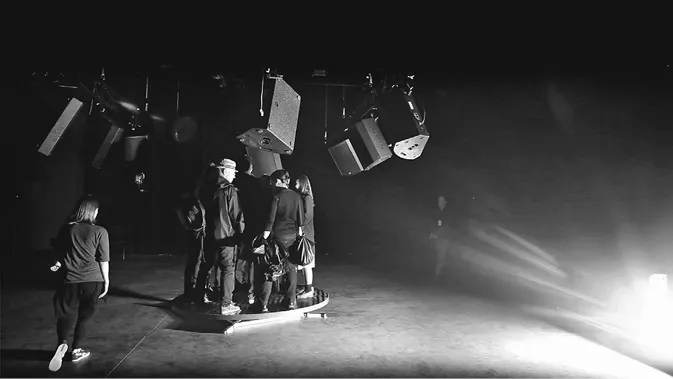
Figure 1.1 Mark Fell, Get Out of the Defensive Position (2014), video still, exhibited at Unsound Festival, Kraków. Used with permission.
Through a superimposition of scenographic, auditory and conceptual circles, Get Out of the Defensive Position presents a particularly immersive configuration of elements, the exit from which occurs through an identification of the limits and conditions of immersive circularity. Through this identification of limits the listening subject is moved from the centre of the immersive circle to its edges, taking a preliminary step towards an exit from what can be considered the most limiting aspects of immersive practice. The identification of a limit and condition entails an acknowledgement of the incompletion or insufficiency of the immersive circle as a delimitation of reality. The use of Shepard tones allows Get Out of the Defensive Position to play upon the psychoacoustic conditions of listening. The illusion of pitch circularity is created through the use of Shepard tones which are heard to ascend or descend continuously, without ever leaving the bandwidth ...
Table of contents
- Cover
- Half-Title
- Title
- Contents
- List of Figures
- List of Tables
- Preface
- Acknowledgements
- Introduction
- 1 Decentralization
- 2 Infraesthetics
- 3 Writing Out Sound
- 4 Immersive Phenomenology
- 5 Sonic Materialism
- 6 The Scientific Image
- 7 Repurposing Conceptualism
- 8 The Stratification of Immanence
- References
- Index
- Copyright
Trusted by 375,005 students
Access to over 1.5 million titles for a fair monthly price.
Study more efficiently using our study tools.
Frequently asked questions
Yes, you can cancel anytime from the Subscription tab in your account settings on the Perlego website. Your subscription will stay active until the end of your current billing period. Learn how to cancel your subscription
No, books cannot be downloaded as external files, such as PDFs, for use outside of Perlego. However, you can download books within the Perlego app for offline reading on mobile or tablet. Learn how to download books offline
Perlego offers two plans: Essential and Complete
- Essential is ideal for learners and professionals who enjoy exploring a wide range of subjects. Access the Essential Library with 800,000+ trusted titles and best-sellers across business, personal growth, and the humanities. Includes unlimited reading time and Standard Read Aloud voice.
- Complete: Perfect for advanced learners and researchers needing full, unrestricted access. Unlock 1.5M+ books across hundreds of subjects, including academic and specialized titles. The Complete Plan also includes advanced features like Premium Read Aloud and Research Assistant.
We are an online textbook subscription service, where you can get access to an entire online library for less than the price of a single book per month. With over 1.5 million books across 990+ topics, we’ve got you covered! Learn about our mission
Look out for the read-aloud symbol on your next book to see if you can listen to it. The read-aloud tool reads text aloud for you, highlighting the text as it is being read. You can pause it, speed it up and slow it down. Learn more about Read Aloud
Yes! You can use the Perlego app on both iOS and Android devices to read anytime, anywhere — even offline. Perfect for commutes or when you’re on the go.
Please note we cannot support devices running on iOS 13 and Android 7 or earlier. Learn more about using the app
Please note we cannot support devices running on iOS 13 and Android 7 or earlier. Learn more about using the app
Yes, you can access Immanence and Immersion by Will Schrimshaw in PDF and/or ePUB format, as well as other popular books in Media & Performing Arts & Music. We have over 1.5 million books available in our catalogue for you to explore.