- 224 pages
- English
- ePUB (mobile friendly)
- Available on iOS & Android
eBook - ePub
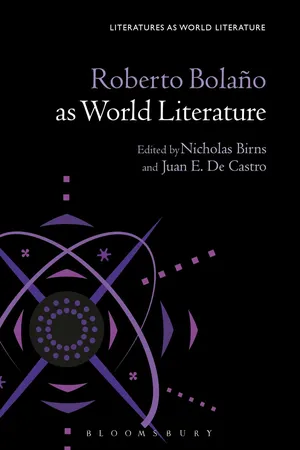
Roberto Bolaño as World Literature
About this book
Roberto Bolaño as World Literature provides an introduction to the Chilean novelist that highlights his connections with classic and contemporary masters of world literature and his investigation of topics of international interest, such as the rise of rightwing and neofascist movements during the last decades of the 20th century. But this anthology also shows how Roberto Bolaño's participation in world literature is informed in his experiences, identity, and, more generally, cultural location as a Chilean, Latin American and, more generally, Hispanic writer and man. This book provides a corrective to readings of his novels as exclusively "postmodern" or as unproblematically representative of Chilean or Latin American reality. Roberto Bolaño as World Literature thus helps readers to better understand such complex works as his monumental global five-part masterpiece 2666, his Chilean novels (Distant Star, By Night in Chile), and his Mexican narratives (Amulet, The Savage Detectives), among other works.
Information
PART ONE
Bolaño and
World History
World History
CHAPTER ONE
On Fascism, History, and
Evil in Roberto Bolaño
Evil in Roberto Bolaño
I
I do not write as a literary expert on Bolaño, rather the opposite, though I am one of his many readers. Nonetheless, like Bolaño, I am a student of the history of fascism. But I adopt a different perspective: that of the historian. Unlike Bolaño, I can only inquire into fascist formations as they actually existed and yet, having read hundreds, perhaps more correctly, thousands of fascist sources, I cannot avoid recognizing that Bolaño’s oeuvre provides us with major insights on fascism. As uncanny as it sounds, these are insights that no historian gives. Bolaño presents profound visions of fascism from within. He looks into fascism’s political violence in a deep, albeit vicarious, way that we historians have not, and perhaps will never be able to achieve. Bolaño, like Jorge Luis Borges before him, provides historiography with a window into the fascist phenomenon that, simply put, expands the historical perspective on fascism. At this point it should be important to note that most historians of fascism have ignored Bolaño’s writings, which is to say, they have ignored a major dimension of his entire work. This is my main point in this essay: Bolaño’s work frames fascism at the center of politics and literature. His work presents fascism as a historical event but also as an object with meaningful ramifications into the structural violence and inequalities of the present.
II
Reading Bolaño should be a must for historians of fascism. And yet Bolaño writes under a number of assumptions which are at different times intriguing, challenging, and also problematic for historiography. But first let me start with something that Juan De Castro suggests in his own contribution to this book which is the centrality of the ethico-political in Bolaño.1 I actually think that in Bolaño’s work the ethico-political appears as a displacement of the political, but it does so in a way that presents the literary act, and especially the literary inquiry into the limits and potentialities of fascism, as a kind of vicarious political participation against it. In other words, writing on fascism appears as the best political response to it. It is the actual, official politics, the politics of power as degraded by politicians of right and left that are problematic for Bolaño, not politics as such. Bolaño is not antipolitical but he sees formal politics as neglecting the real danger which is a dormant sort of fascism that for him never ceased to exist. This is a key issue for the Chilean writer. And it is an issue that is developed in his literary work. In fact, it has gone from a free-floating metaphor of violence, paranoia, and danger to an actual historical experience that frames the twentieth century. As Bolaño understands it this history goes from Hitler to Pinochet and from the Spanish Civil War to extreme violence against women in Mexico and many other places. This idea of fascism as a foundational trauma for Latin American history is remarkably present in his work Nazi Literature in the Americas and eventually, and especially so, in 2666 where fascism is the source of all present violence and suffering.
This idea of fascism as an event dually rooted in the 1930s and 1940s, but as also having its foundational role in and out of contemporary history, is present in Bolaño’s early work, but not so thoroughly integrated as it would later become. Thus, in his first works one can locate the bewildering fantasies of fascism that one can find in his early story “Mexican Manifesto” (1984) where, in the context of youthful sexual encounters in Mexico City’s public saunas, the narrator purportedly dissolves the differences between erotic discovery and the traumatic past of the Holocaust: “I felt like we were in a Nazi’s shower and they were going to gas us” (541). A similar allusion would return in The Savage Detectives as if the public bath belonged to “movies about Nazis” (120). Similarly, in his poem “Reunion” of the early 1990s, Bolaño juxtaposes an impossible fear and present danger of fascism in the midst of the intense sexual interaction between two poets.
Bolaño once cryptically referred to a persistent fantasy regarding the daily presence of the Nazi leader, as a “period of my life, thankfully behind me now” when he saw Adolf Hitler walking up and down the corridor of his house (“Dance Card” 217). In his earlier work, fascism seems not only out of context but also as a specter from the past. Fascism stands as a dual metaphor for what is ominously absent and also becomes indeterminate abject. Fascism is a diffuse, phantom presence, always prone to return in a way that involves death and desire as in his posthumous but early novel The Third Reich, finished in the 1980s. In that novel and notwithstanding the clear reference to Nazism title, fascism is part of a traumatic past and hovers over the war games that fascinate the main character. The same can be said about the traumatic fascist war of the Spanish past that recurrently intrudes into the night conversations of the character el Carajillo in The Skating Rink (1993), another novel from Bolaño’s earlier period.2 This diffuse presence of fascism changes, of course, with Nazi Literature in the Americas where Bolaño gives fascism a hemispheric context and a mostly Latin American crew of far-fetched set of characters.
From then on, Bolaño explicitly presents fascism, or rather the resistance against it, as the cause for active politics and literature. He criticizes conventional politics for ignoring the fact that fascism is constantly arising through violent political acts which are either explicitly fascist (skinheads and hooligans in Europe, military dictatorships in the Southern cone or Central America) or they are linked to its literary history.
On a more trans-historical level, and often without noting the change, Bolaño also suggests that acts of structural violence (i.e., femicides in Northern Mexico and elsewhere, mutilations of children in India and elsewhere) have non-linear fascist roots as well. But this is not all; Bolaño equates these ethico-political positions against actual/and or structural fascism with good literature. At the same time he does invert the terms of the equation. Bad literature stands for fascism and structural violence. Thus, at the center of Bolaño’s work, there is a preoccupation about fascism, which he would generally identify with bad literature and even the “scribblers” of the market-driven economies (in his view, bad literature includes writers like Isabel Allende, Arturo Pérez-Reverte, and many market-driven best-selling novels). In his understudied non-fiction writings Bolaño also addressed these issues. If fascism can be located in a specific set of historical events (the Second World War, Pinochet’s Chile, or Argentina’s Dirty War), it can also represent the forces of capitalism and, an important corollary for Bolaño’s view of the order of things, the fascist contamination of literature via neoliberalism. Bolaño remains close to George Orwell’s view that bad language produces bad politics. For Bolaño, Hitler can be equated with the worst commercial writers: the writers of cheap philosophy and self-help books. Their writing is not devoid of clarity and this betrays their problem. As a writer that is easily understood, the Fuhrer is then connected with best-selling literature.3 Here Bolaño collapses all historical distinctions and fascism appears as an indictment of past and present literature. It plays the role of a fantasy that provides full ethico-politico closure to his view of politics and literature.
III
Indeterminacy, or even phantasmatic apparitions of fascism, characterized Bolaño’s earlier work. From beginning to end, he understood fascism in the context of a more transcendental, more structural notion of evil, which cyclically repeats itself. Paradoxically, by decontextualizing the past and the present, Bolaño playfully illuminates the connections between fascism, neo-fascism, and post-fascism. In Nazi Literature, that vast vade mecum of fake fascist writers which he called a novel, Bolaño presents a Latin American Fourth Reich that constantly re-actualizes the Nazi fascist past in the Latin American post-fascist context.
In Nazi Literature, different characters work in their own way toward the creation of a Latin American Reich. But then, of course, the Fourth Argentine Reich is the name of the main publisher of most of the fictional writers analyzed in Nazi Literature in the Americas. This politics of naming, namely the idea of a Nazi Latin American future, to some extent defined by the Nazi past, has global and trans-contextual implications. This relation between Latin America and European fascism is sometimes in and out of history, and represents a key dimension of Bolaño’s own understanding of the role of fascism in his work.4
Nazi Literature presents American fascism as having a mimetic relation with that of Europe. But the relationship ultimately proposed is that fascism is not only the result of this literary transmission into the Americas, but also the outcome of the travels of Latin American to fascist Europe. Thus rather than mimesis, Bolaño presents European fascism as undergoing deep reformulations in Latin America.
In other words, the kind of Latin American fascism that emerges from Bolaño’s catalogue of fascist authors is very different from the “original.” These writers try to connect Latin America to what they believe is the next stage in human political evolution but more importantly, as the book progresses along, we finally understand the repression that took place in Latin America during the twentieth century. It seems as if Bolaño believes that the continuities between fascism and its Latin American aftermath trasnculturations are linear and conclusive.
Nazi Literature, as idiosyncratic as it is, also reads as a recycled adaptation of the typical writings of interwar antifascism. Fascists had no sense of ridicule. In order to make the readers recognize the poverty of fascist literature, Bolaño pushes the experiences recounted to their extreme, and tells their stories with irony and innuendo. This is the core of Bolaño’s antifascist project. As in Amalfitano’s ironic speech to the Italian neo-fascists, Bolaño’s wants his own literature to highlight the need to confront fascism with its miseries.5
Antifascist conceptualizations of fascism as bad writing are especially relevant to Bolaño’s notion of fascism as an emanation of pathology, sexual excess, and even sexual abnormality. How can historical insight emerge from these stereotypes? The answer is that in Nazi Literature, the constant repetition of these antifascist tropes lends itself to the idea of repetition as an endemic trait of fascism. This notion appears in, perhaps, the most ironic story in this manual of fake Nazi writers, which is the story of the Brazilian fascist Luiz Fontaine Da Souza. Did Bolaño know that this character reads as a fake version of the real Brazilian fascist Gustavo Barroso (1888–1957)? Barroso was the most important intellectual in the Brazilian fascist integralista movement of the 1930s. By 1932, when he penned his extravagant book O Centauro das Pampas, Barroso was already the author of fifty-one books. Some of the titles dealt with Latin American wars in Uruguay, Argentina, Brazil, and Paraguay: A guerra do Flôres (1929), A guerra de Rosas (1929), A guerra de Artigas (1939), A guerra do Vidéo (1939), A guerra do Lopez (1939).6
The idea of the fascist topic as repetition was clearly presented in Barroso. He was also the author of books like: O integralismo em marcha (Rio, 1933), O integralismo de norte a sul (Rio, 1934), and O integralismo e o mundo (Rio, 1936). Barroso was also a famous anti-Semite. In 1938, the Argentine fascists of the newspaper Crisol published Barroso's book: Roosevelt Is a Jew, where he dealt with the false statement advanced in the title. Above, all Barroso was known among Latin American fascists and antifascists for his delirious denunciations of alleged Jewish plots in Brazil. He was the author of the book Judaism, Masonry and Communism. The contents of the book were once again synthesized in the title. Barroso was also the editor of the Brazilian version of the Protocols of The Elders of Zion where he also dealt with such issues as Jewish “imperialism” and the secret “code of the anti-Christ.”7
In the six volumes of his Secret History of Brazil, Barroso attempted to demonstrate how Judaism was behind every bad thing that happened to the country.8
Note the similarities in topics between Fontaine’s The Jewish Problem in Brazil and Barroso’s most famous anti-Semitic books. Unlike Barroso who identified integralismo as the Brazilian reformulation of fascism, Bolaño’s Latin American fascists are blandly generic, they are not Chilean Nacistas, Argentine nacionalistas, or Brazillian integralistas but they appear as standard, supranational fascists. This is a clear “antinomy” of antifascism clearly reproduced in Bolaño’s work.9
A rabid anti-Semite, Barroso, unlike Fontaine, was never interned in a mental asylum. His books were published in English and French, including his Mythes, contes et légendes des Indiens; folk-lore brésilien (Paris, 1930).10 Among other things, he was a director of Brazil’s National Historical Museum, a member of Congress, president of the Brazilian Academy of Letters, and an insatiable preacher of fascist visions for Brazil and Latin America.
In an instance of wishful thinking, Bolaño proposes a less successful trajectory for his own Brazilian fascist. In Fontaine, fascism appears as the incremental outing of total madness. Or simply put, Bolaño suggests that fascists are crazy, they just don’t know it. Fontaine is constantly rewriting the history of philosophy in the world. This is done through the means of endless fascist refutation. We are told that Fontaine’s early work receives the admiration of his peers. However, after many repetitions, an endless tirade of refutations, even fascist critics eventually arrive to the conclusion that Fontaine’s critical oeuvre is the work of a schizophrenic. He is a fascist maniac. In his many works one finds the repetition of the same title with the only change being the inclusion of the name of a different philosopher: Voltaire, Diderot, Sartre, and many others. And every book is about 500–1000 pages long.
Some of the titles are: Refutation of Voltaire (640 pages, 1921); A Refutation of Diderot (530 pages, 1925), followed two years later by A Refutation of D'Alembert (590 pages, 1927); A Refutation of Montesquieu (620 pages, 1930); A Refutation of Rousseau (605 pages, 1932); “A Refutation of Hegel Followed by a Brief Refutation of Marx and Feuerbach” (635 pages, 1938).
This repetition is basically a rationale for psychotic ideas, and stands in opposition to reason, a quality that Bolaño identifies with both political Enlightenment and good literature. Fontaine’s rationale is a justification for fascist violence. In his manic refutations, Fontaine is defending fascism without accounting in any rational way for its political value. After amassing thousands of pages against the E...
Table of contents
- Cover
- Halftitle Page
- Title Page
- Contents
- List of Contributors
- Introduction: Fractured Masterpieces
- Part One: Bolaño and World History
- Part Two: Bolaño’s Literary Worlds
- Part Three: Bolaño’s Global Readers
- Index
- Imprint
Trusted by 375,005 students
Access to over 1.5 million titles for a fair monthly price.
Study more efficiently using our study tools.
Frequently asked questions
Yes, you can cancel anytime from the Subscription tab in your account settings on the Perlego website. Your subscription will stay active until the end of your current billing period. Learn how to cancel your subscription
No, books cannot be downloaded as external files, such as PDFs, for use outside of Perlego. However, you can download books within the Perlego app for offline reading on mobile or tablet. Learn how to download books offline
Perlego offers two plans: Essential and Complete
- Essential is ideal for learners and professionals who enjoy exploring a wide range of subjects. Access the Essential Library with 800,000+ trusted titles and best-sellers across business, personal growth, and the humanities. Includes unlimited reading time and Standard Read Aloud voice.
- Complete: Perfect for advanced learners and researchers needing full, unrestricted access. Unlock 1.5M+ books across hundreds of subjects, including academic and specialized titles. The Complete Plan also includes advanced features like Premium Read Aloud and Research Assistant.
We are an online textbook subscription service, where you can get access to an entire online library for less than the price of a single book per month. With over 1.5 million books across 990+ topics, we’ve got you covered! Learn about our mission
Look out for the read-aloud symbol on your next book to see if you can listen to it. The read-aloud tool reads text aloud for you, highlighting the text as it is being read. You can pause it, speed it up and slow it down. Learn more about Read Aloud
Yes! You can use the Perlego app on both iOS and Android devices to read anytime, anywhere — even offline. Perfect for commutes or when you’re on the go.
Please note we cannot support devices running on iOS 13 and Android 7 or earlier. Learn more about using the app
Please note we cannot support devices running on iOS 13 and Android 7 or earlier. Learn more about using the app
Yes, you can access Roberto Bolaño as World Literature by Nicholas Birns,Juan E. De Castro in PDF and/or ePUB format, as well as other popular books in Littérature & Critique littéraire de l'Amérique latine et des Caraïbes. We have over 1.5 million books available in our catalogue for you to explore.