eBook - ePub
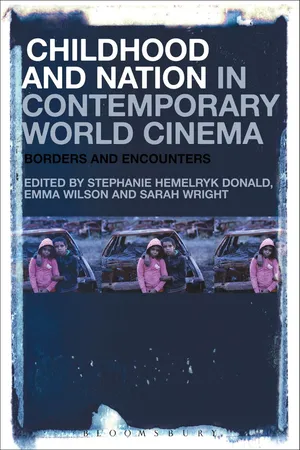
Childhood and Nation in Contemporary World Cinema
Borders and Encounters
- 296 pages
- English
- ePUB (mobile friendly)
- Available on iOS & Android
eBook - ePub
Childhood and Nation in Contemporary World Cinema
Borders and Encounters
About this book
The child has existed in cinema since the Lumière Brothers filmed their babies having messy meals in Lyons, but it is only quite recently that scholars have paid serious attention to her/his presence on screen. Scholarly discussion is now of the highest quality and of interest to anyone concerned not only with the extent to which adult cultural conversations invoke the figure of the child, but also to those interested in exploring how film cultures can shift questions of agency and experience in relation to subjectivity. Childhood and Nation in World Cinema recognizes that the range of films and scholarship is now sufficiently extensive to invoke the world cinema mantra of pluri-vocal and pluri-central attention and interpretation. At the same time, the importance of the child in figuring ideas of nationhood is an undiminished tic in adult cultural and social consciousness. Either the child on film provokes claims on the nation or the nation claims the child. Given the waning star of national film studies, and the widely held and serious concerns over the status of the nation as a meaningful cultural unit, the point here is not to assume some extraordinary pre-social geopolitical empathy of child and political entity. Rather, the present collection observes how and why and whether the cinematic child is indeed aligned to concepts of modern nationhood, to concerns of the State, and to geo-political organizational themes and precepts.
Information
Part One
Home and Away
1
‘A Bath, a Toilet and a Field’: Dreaming and Deprivation in Lynne Ramsay’s Ratcatcher
Vicky Lebeau
3. States Parties, in accordance with national conditions and within their means, shall take appropriate measures to assist parents and others responsible for the child to implement this right and shall in case of need provide material assistance and support programmes, particularly with regard to nutrition, clothing and housing.
Article 27, United Nations Convention on the Rights of the Child
So often supposed to be a privileged object of fellow feeling, the figure of the child has a privileged place in the discussion of global cinema (a notoriously elusive object) post-1990. The child’s ‘inherent right to life’, to survival and development, is one of the fundamental tenets of contemporary international society. Unanimously adopted by the United Nations General Assembly on 20 November 1989, the Convention on the Rights of the Child became international law less than one year later, making history as the most widely and quickly ratified treaty on human rights in the world. (As of January 2015, only the United States and South Sudan had failed to ratify the Convention.)1 In 2000, the UN General Assembly adopted two additional Optional Protocols on the involvement of children in armed conflict and the sale of children, child prostitution and child pornography. More recently, on 14 April 2014, a third Optional Protocol was adopted to allow children in those countries that ratify the Convention to bring complaints to the Committee on the Rights of the Child.2
Formally, then, the rights of the child appear to be uncontentious, a rare example of global consensus. But, as Karin Landgren, then chief of Child Protection for UNICEF, observed in 2005, many states ratifying the Convention entered reservations, either to particular articles or to the Convention as a whole, that were incompatible with its overall aims and objectives.3 At the end of 2005, for example, the Council on Foreign Relations estimated that around 300,000 child soldiers were involved worldwide in some thirty conflicts4; while impossible to quantify, it is estimated that tens of millions of children across the world are living on the streets (with up to 10 per cent of those children abandoned by, or fleeing from, their own families).5 In June 2014, the suspicion that there may be the remains of 796 babies in a septic tank in Tuam, County Galway, prompted John Dalhuisen, Europe and Central Asia programme director of Amnesty International, to call on the Irish Government for a thorough investigation ‘into how these children died and if ill treatment, neglect or other human rights abuses factored into their death’. (As Colm O’Gorman, executive director, Amnesty International Ireland, pointed out, the discovery had to be explored in relation to ongoing allegations of ill treatment of unmarried women and children in Irish institutions, often operated by the Catholic Church.)6 In Britain, the National Society for the Prevention of Cruelty to Children calculates that, on average, one child every week is killed at the hands of another person in England and Wales; in 67 per cent of cases, a parent is the principal suspect.7
‘Well-built houses for all’
There is no need for the right hon. Gentleman to impress upon me the need for building houses. I have experienced, in my own personal home life, the consequences of having to live in over-crowded houses as a direct consequence of neglect by Governments of the day.
Aneurin Bevan, 17 October 1945
There can be few British people unable to recognize what is or is not a council estate.8
Lynne Ramsay’s Ratcatcher is a film for our times. Set in the 1970s, released in the late 1990s, the film is at once a product of, and reflection on, contemporary British histories of childhood and class. Premiered at Cannes in April 1999, Ratcatcher helped to establish Ramsay’s reputation as, variously, a director of ‘new Scottish cinema’, a proponent of the ‘European art film’ and ‘one of the finest new talents in world cinema’. In other words, Ramsay was seen as a film-maker with a generative capacity to bring the national and local – Glasgow, the tenement, the bin strike: the stuff of British social realism in film and literature – into contact with themes, or forms, deemed more international – childhood, death, dreams, memory (the play with the surreal that turns Ratcatcher into such an extraordinary object on screen).9
To watch Ratcatcher at the time of writing – more than five years into the ‘austerity experiment’ initiated by the Conservative–Liberal Democrat Coalition in 2010 and four months into the first majority Conservative Government for eighteen years – is to watch a film finding its time.10 Or, to put the point a different way, it is to discover an object that can be used to reflect on the complex relations between housing and class, childhood and the social state, in contemporary Britain. Beginning with the death of a child, Ratcatcher takes on the tragedy of lives blighted, even destroyed, by homes and environments – young boys chase rats among the black plastic bags piled around the tenements, the mounting effects of a strike by the bin men; a young girl munches a jam sandwich perched on a pile of rubbish; the communal toilets become a space for teenage boys to explore and exploit a young woman’s lonely sexuality. In particular, the canal – a type of perverse pastoral – becomes the site of play and death, a threat to the community, especially to the children, living around it. Horribly, if playfully, shrouded by a net curtain in Ratcatcher’s opening sequence, Ryan drowns in the canal shortly afterwards in the course of a tussle with James Gillespie (that James, looking back, sees that Ryan is no longer to be seen in the water is how Ratcatcher secures James’s role, if not his fault, in Ryan’s death). Kenny, a boy who lives for his menagerie of small animals, is rescued, after falling to the canal, by James’s Da, a local hero for the remainder of the film. That both Kenny and Da subsequently develop a red and itchy rash (associated with Weil’s disease) across their faces and necks underlines the threat: children become ill, even die, in this environment, and adults can only sometimes save them.
Forged through the figure of the child, Ratcatcher is also grounded in the unique ‘social experiment’ that is (or was) British council housing. As Alison Ravetz has argued, ‘council housing was a significant part of twentieth-century working-class history’ in Britain. Its design, its allocation and its management – above all, now, its shortage – frame the everyday lives and cultures of working-class men, women and children in ways that remain to be understood.11 In particular, it is the peculiarly working-class experience of slum clearance and relocation to housing estates on the outskirts of major cities and towns across the country that helps to structure Ratcatcher’s uses of the child.12 If, as Andrew O’Hagan suggests, Ratcatcher is ‘the first [film] to put that amazing bit of life on screen’, it does so via a child’s (James Gillespie’s) question and his longing: ‘Ur we getting that big hoose wae a bath, a toilet and a field?’13
From the beginning to the end of Ratcatcher, the house from the council is a fragile promise. James’s question, his longing for the house that might become home to his family – Ma, Da and his two sisters, Ellen and Anne-Marie, all living in a tiny walk-up tenement – is, I want to suggest, a type of royal road to Ratcatcher’s reimagining of the genre of social realism and its engagement with the material and symbolic significance of post-war British housing policy. ‘I very consciously avoided straight social realism,’ Ramsay insists in interview with Lizzie Francke in 1999, marshalling the child, the ‘childlike’ and the ‘childish’ (her terms) as privileged means to intervene in the traditions of social realism in British cinema.14 At stake is not, or not only, the child’s point of view but the child as a figure on which the forces of environment and public policy, dream and cinema, converge in the form of an insistent question: ‘Ur we getting that big hoose wae a bath, a toilet and a field?’ ‘Is it about our new hoose that we’re getting?’ ‘Are we still getting the new hoose?’
Via that passion and pathos, Ratcatcher engages the structures of feeling, as well as the material realities, belonging to that ‘amazing bit of life’: the history of slum living, slum clearance and the dream, at once national and intimate, of a ‘home’. ‘A bath, a toilet and a field’: James’s roll call of amenities contains a condensed history of post-war British housing policy, its explicit commitments to a national housing programme as ‘essential, if not to the life, at any rate to the good life, of the community’ – or, in the words of Aneurin Bevan, the minister for health in the new Labour government of 1945, to the ‘full life’.15 Almost one in three of Britain’s twelve and a half million houses had been damaged during the Second World War, with 208,000 of those completely destroyed. This was a level of destruction that, combined with the increase in marriages and births in the immediate post-war years, would turn housing into a national ‘emergency’ – the word used by Bevan in the course of a heated Commons debate on the housing shortage on 17 October 1945.16 Issued by the Labour Party in 1945, Ellen Wilkinson’s Plan for Peace gave powerful voice to a conviction that there must be ‘a better way’ to protect the nation – its people, its futures – not, or not only, against the threat of war between nations but against the economic chaos, and the national divisiveness, of ‘Big Business’: ‘In the modern world full employment, industrial efficiency, social security and well-built houses for all can only be achieved if there is a plan.’17
‘Well-built houses for all’ remained a national political aspiration for some thirty years, albeit one shadowed by chronic overcrowding in derelict properties as well as by homelessness and political reservations (primarily from the Conservative Party) concerning the role of the state. In the wake of Bevan’s exemplary insistence on the need for the planning of housing – and, notably, on the quality and social mix of those houses: in 1948, Bevan removed the pre-war legislation that provided council housing only for ‘the working classes’ – the majority of local authority properties were built between 1945 and 1980 (with cross-party commitments on the need to increase council housing stock in ...
Table of contents
- Cover
- Half-Title
- Dedication
- Title
- Contents
- Illustrations
- Contributors
- Acknowledgements
- Introduction: Nation, Film, Child Stephanie Hemelryk Donald, Emma Wilson and Sarah Wright
- Part 1 Home and Away
- Part 2 Disappearance and Removal
- Part 3 Education and Serious Games
- Part 4 Performance
- Bibliography
- Filmography
- Index
- Copyright
Trusted by 375,005 students
Access to over 1.5 million titles for a fair monthly price.
Study more efficiently using our study tools.
Frequently asked questions
Yes, you can cancel anytime from the Subscription tab in your account settings on the Perlego website. Your subscription will stay active until the end of your current billing period. Learn how to cancel your subscription
No, books cannot be downloaded as external files, such as PDFs, for use outside of Perlego. However, you can download books within the Perlego app for offline reading on mobile or tablet. Learn how to download books offline
Perlego offers two plans: Essential and Complete
- Essential is ideal for learners and professionals who enjoy exploring a wide range of subjects. Access the Essential Library with 800,000+ trusted titles and best-sellers across business, personal growth, and the humanities. Includes unlimited reading time and Standard Read Aloud voice.
- Complete: Perfect for advanced learners and researchers needing full, unrestricted access. Unlock 1.5M+ books across hundreds of subjects, including academic and specialized titles. The Complete Plan also includes advanced features like Premium Read Aloud and Research Assistant.
We are an online textbook subscription service, where you can get access to an entire online library for less than the price of a single book per month. With over 1.5 million books across 990+ topics, we’ve got you covered! Learn about our mission
Look out for the read-aloud symbol on your next book to see if you can listen to it. The read-aloud tool reads text aloud for you, highlighting the text as it is being read. You can pause it, speed it up and slow it down. Learn more about Read Aloud
Yes! You can use the Perlego app on both iOS and Android devices to read anytime, anywhere — even offline. Perfect for commutes or when you’re on the go.
Please note we cannot support devices running on iOS 13 and Android 7 or earlier. Learn more about using the app
Please note we cannot support devices running on iOS 13 and Android 7 or earlier. Learn more about using the app
Yes, you can access Childhood and Nation in Contemporary World Cinema by Stephanie Hemelryk Donald, Emma Wilson, Sarah Wright, Stephanie Hemelryk Donald,Emma Wilson,Sarah Wright in PDF and/or ePUB format, as well as other popular books in Medios de comunicación y artes escénicas & Historia y crítica cinematográficas. We have over 1.5 million books available in our catalogue for you to explore.