From the 1970s onward, "exploitation cinema" as a concept has circulated inside and outside of East Asian nations and cultures in terms of aesthetics and marketing. However, crucial questions about how global networks of production and circulation alter the identity of an East Asian film as "mainstream" or as "exploitation" have yet to be addressed in a comprehensive way. Exploiting East Asian Cinemas serves as the first authoritative guide to the various ways in which contemporary cinema from and about East Asia has trafficked across the somewhat-elusive line between mainstream and exploitation.
Focusing on networks of circulation, distribution, and reception, this collection treats the exploitation cinemas of East Asia as mobile texts produced, consumed, and in many ways re-appropriated across national (and hemispheric) boundaries. As the processes of globalization have decoupled products from their nations of origin, transnational taste cultures have declared certain works as "art" or "trash," regardless of how those works are received within their native locales. By charting the routes of circulation of notable films from Japan, China, and South Korea, this anthology contributes to transnationally-accepted formulations of what constitutes "East Asian exploitation cinema."
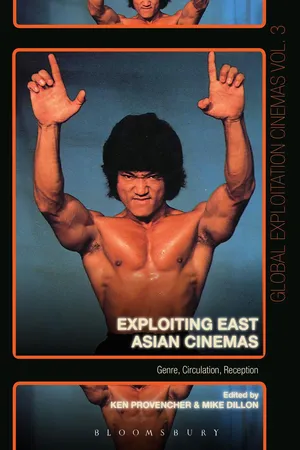
eBook - ePub
Exploiting East Asian Cinemas
Genre, Circulation, Reception
- 248 pages
- English
- ePUB (mobile friendly)
- Available on iOS & Android
eBook - ePub
Exploiting East Asian Cinemas
Genre, Circulation, Reception
About this book
Information
Part One
Genres without Borders
1
Steampunked Kung Fu: Technologized Modernity in Stephen Fung’s Tai Chi Films
Kenneth Chan
Introduction: Exploiting Kung Fu
Ang Lee’s Crouching Tiger, Hidden Dragon (臥虎藏龍, 2000) is one of those seminal works that have directed popular and critical attention to a cinematic genre, the wuxia pian (武俠片, Chinese martial arts film). Since its release, Lee’s film has generated in its wake a substantive revitalization of the genre in both Hollywood and Chinese transnational production networks, with filmmakers like Zhang Yimou, John Woo, Tsui Hark, Chen Kaige, Stephen Chow, Wong Kar-wai, Peter Chan, Feng Xiaogang, and, most recently, Hou Hsiao-hsien, all trying their hand at directing twenty-first century versions of the wuxia pian. But this interest in the genre also had a retrospective inflection, particularly in Chinese cinema studies over the past decade, as scholars turned their critical focus onto the wuxia pian’s history and aesthetic form.1 By foregrounding the historicity of the genre here, I am not only accentuating the long cultural tradition in Chinese cinematic history from which Lee’s film emerged, but also pointing to the genre’s historical entanglements with American cinema that have helped shape both cinemas’ developments. Of particular relevance to this book’s focus and to the topic of American exploitation cinema culture, “The martial arts film,” according to Randall Clark, “holds an unusual position in the history of exploitation films: it is the only major exploitation genre that first appeared overseas, and was later adopted by American filmmakers.”2 Of course, the questionable location of martial arts films within the category of exploitation cinema is a matter of historical and cultural perspective, considering how the wuxia pian occupies pride of place in mainstream cinematic culture for Chinese audiences across the globe. But, from the standpoint of American film history, it is understandable how the martial arts film has come to be associated with exploitation cinema, on account of the genre’s characteristics, conventions, and modes of consumption. Eric Schaefer characterizes the classical exploitation films from 1919 to 1959 as (1) having “‘forbidden’ topic[s],” (2) being “made cheaply, with extremely low production values,” (3) being “distributed independently,” and (4) being “generally exhibited in theaters not affiliated with the majors.”3 The martial arts film fits almost neatly into these definitional parameters, particularly in terms of the onscreen violence and the lower production budgets of the Hong Kong studios from the 1950s to the 1980s, for instance. Furthermore, cementing kung fu-films’ association with exploitation cinema is the fact that these films were often screened in grindhouse theaters alongside Blaxploitation and sexploitation films (except for a very brief moment in the 1970s when Chinese martial arts cinema dominated American mainstream box offices, a phenomenon David Desser describes as “the kung fu craze,” with Golden Harvest’s second Bruce Lee film Fist of Fury (精武門, 1972), another Golden Harvest title Deep Thrust: The Hand of Death (鐵掌旋風腿, 1972), and Shaw Brothers’ Five Fingers of Death (天下第一拳, 1972) occupying the top three chart positions in May 1973).4
By referencing the wuxia pian’s American connection to exploitation, I seek to map out some critical observations with which to frame one’s understanding of this post-Crouching Tiger, Hidden Dragon era of transnational Chinese co-productions of the wuxia genre. Within this framework, I can then situate my close reading of Hong Kong-based director Stephen Fung’s double feature, Tai Chi Zero and Tai Chi Hero (太極: 從零開始 and 太極2: 英雄崛起, both 2012), as a case study of recent Chinese filmmaking that engages in cross-cultural “exploitation” through the circuits of transnational cinemas.
As the editors of this book have shown, exploitation cinema is a complicated and much more fluid genre and practice to define. Going beyond the boundaries of the classical exploitation film in the United States, the genre and mode of exploitation cinema have evolved with the politics of culture. In the rationale for his extensive study of the classical exploitation form, Schaefer points out that “looking at the marginalized exploitation industry serves to direct our attention to the centrality that issues of sex, drug use, nudity, prostitution, and other ‘transgressive’ behaviors played in American society” and that these films “do not tell us as much about the Other as they do about the fears and anxieties of those who made and saw the movies.” The “exploitation film [also] functioned as an alternative to Hollywood while also shedding light on the mainstream motion picture business.”5 With the shift in cultural politics and social values, the taboo subjects central to the classical exploitation film have now become mainstream in Hollywood and global cinema. The graphic nudity and sex in R-rated movies, the violent imagery of torture porn, such as the Saw series of films, and the cinema of Quentin Tarantino6 are Hollywood examples that come quickly to mind. J-horror, Tartan Film’s “Asia Extreme” distribution label, the New French Extremity films, and Hong Kong Category III titles further illustrate how exploitation aesthetics and themes have entered the global mainstream.7 My goal here is not to pass moral judgment on these aspects of contemporary cinema, but instead to argue that cinema, as a technologized form of capitalist mass commodification, has the capacity to ingest and incorporate these “exploitative” elements into its structural propensity toward visual spectacle, especially in this age of digital CGI and summer blockbuster action flicks. In other words, the lines between exploitation and mainstream cinemas have blurred considerably, which only increases the diversification of visual cultures available today. This boundary-crossing process is, of course, further enabled by a transnational system of digital delivery and distribution.8 The American and global mainstreaming of the wuxia pian is part of this cinematic trend.
Exploitation cinema is also about the politics of power. The online Oxford dictionary defines the verb “exploit” as to “make full use of and derive benefit from” something or someone, which often assumes a derogatory valence where one is “use[d] . . . in an unfair or selfish way.”9 Obviously, exploitation film exploits its taboo subject matter in order to draw in audiences. However, the power dynamics of exploitation cinema do reveal themselves to be much more complex and ambiguous when questions become slightly more nuanced: What is the nature of the exploitation in the various forms of exploitation cinema? Have they shifted with history? Who exploits and who is exploited in these cinematic narratives? Is the power distribution homogenously divided between exploiter and exploited, or is the power differential fluid and slippery in its movement? Does exploitation transcend the diegetic to permeate the processes of filmmaking, distribution, and consumption? This exploitation power play is further complicated by the potential for the taboo, the transgressive, and the marginalized to be culturally and politically subversive, often in productive ways. As Schaefer observes, “There is often an impulse to see the marginal or transgressive as somehow more authentic than the mainstream, containing the power to subvert dominant systems and values. There can be no doubt that exploitation films presented what was the most sustained domestic challenge to Hollywood’s hegemony over aesthetics and content in the commercial cinema.”10 While one celebrates this potentiality, it is also crucial to realize that these shifts in power and agency are frequently ideologically and culturally conflicted. Or, to use Schaefer’s terminology about the genre, they are “complex and filled with contradictions.”11 An example of this contradiction is the Blaxploitation movement of the 1970s, where the subversive energies of racial empowerment initiated by the movement’s inaugurating film Sweet Sweetback’s Baadasssss Song (1971) were eventually co-opted into and reconfigured to serve Hollywood’s box office machinery.12
This example of Blaxploitation is significant in that it not only illustrates the gradual seepage of what is considered exploitation elements into the cinematic mainstream, but also marks Hollywood’s desire—spurred by a climate of multiculturalism—to appropriate and, sometimes, cannibalize minority and global cultures into its smorgasbord approach to box office domination. Crouching Tiger, Hidden Dragon and the revitalization of the wuxia pian constitute part of Hollywood’s exploitative strategy of transnational cinematic appeal in the new millennium. But what is also revealing here in the global reach of this strategy is that Hollywood’s hegemony now extends to co-production models within a network of Asian sites, capitalizing on new funding sources, multiple shooting locations, cheaper production labor, increased postproduction expertise, locally targeted marketing, and varied distribution patterns. These co-production models further confirm the increasingly complicated power dynamic at work in transnational cinemas, in that hegemony is no longer unidirectional or is purely antagonistic in a nationalistic sense—the rise of Mainland China as a modern, technologically sophisticated, capitalist powerhouse in the twenty-first century poses a colossal challenge to Hollywood’s global dominance. For Hollywood cannot ignore “a global Chinese audience that includes more moviegoers and more television households than the United States and Europe combined,” which Michael Curtin describes as a “vast and increasingly wealthy Global China market [that] . . . serve[s] as a foundation for emerging media conglomerates that could shake the very foundations of Hollywood’s century-long hegemony.”13 Hence, Hollywood’s desire to address the Chinese challenge and to tap into the huge Chinese market has incentivized collaborative alliances with Chinese entities in cinematic production and distribution, a strategy of turning a perceived global threat into a possible solution to a declining theatrical and DVD market in the United States. Warner Bros’ forays into Chinese co-production projects perfectly il lustrate this approach.14
The emergence of this robust Global China market has also bolstered an economically, technologically, artistically, and culturally confident Mainland Chinese film industry, which, over the past decade, has plunged headlong into big-budget co-production projects with not only Hollywood but also other East Asian and Southeast Asian partners. Many of the financially successful projects tend to fall into the wuxia, action, and/or fantasy categories, with some of these films even dominating and topping the Chinese and Asian box offices, while barely making a dent in...
Table of contents
- Cover
- Half-Title
- Series
- Title
- Contents
- List of Illustrations
- Acknowledgements
- Foreword Julian Stringer
- Notes on Text
- Editors’ Introduction
- Part 1 Genres without Borders
- Part 2 The Exploitation Marketplace
- Part 3 Exploitation, Art, and Politics
- Select Bibliography
- Notes on Contributors
- Index
- Copyright
Trusted by 375,005 students
Access to over 1.5 million titles for a fair monthly price.
Study more efficiently using our study tools.
Frequently asked questions
Yes, you can cancel anytime from the Subscription tab in your account settings on the Perlego website. Your subscription will stay active until the end of your current billing period. Learn how to cancel your subscription
No, books cannot be downloaded as external files, such as PDFs, for use outside of Perlego. However, you can download books within the Perlego app for offline reading on mobile or tablet. Learn how to download books offline
Perlego offers two plans: Essential and Complete
- Essential is ideal for learners and professionals who enjoy exploring a wide range of subjects. Access the Essential Library with 800,000+ trusted titles and best-sellers across business, personal growth, and the humanities. Includes unlimited reading time and Standard Read Aloud voice.
- Complete: Perfect for advanced learners and researchers needing full, unrestricted access. Unlock 1.5M+ books across hundreds of subjects, including academic and specialized titles. The Complete Plan also includes advanced features like Premium Read Aloud and Research Assistant.
We are an online textbook subscription service, where you can get access to an entire online library for less than the price of a single book per month. With over 1.5 million books across 990+ topics, we’ve got you covered! Learn about our mission
Look out for the read-aloud symbol on your next book to see if you can listen to it. The read-aloud tool reads text aloud for you, highlighting the text as it is being read. You can pause it, speed it up and slow it down. Learn more about Read Aloud
Yes! You can use the Perlego app on both iOS and Android devices to read anytime, anywhere — even offline. Perfect for commutes or when you’re on the go.
Please note we cannot support devices running on iOS 13 and Android 7 or earlier. Learn more about using the app
Please note we cannot support devices running on iOS 13 and Android 7 or earlier. Learn more about using the app
Yes, you can access Exploiting East Asian Cinemas by Ken Provencher, Mike Dillon, Ken Provencher,Mike Dillon in PDF and/or ePUB format, as well as other popular books in Media & Performing Arts & Asian Art. We have over 1.5 million books available in our catalogue for you to explore.