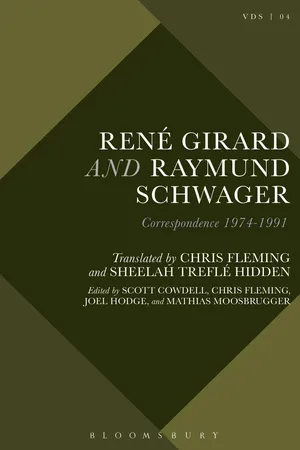
eBook - ePub
René Girard and Raymund Schwager
Correspondence 1974-1991
- 176 pages
- English
- ePUB (mobile friendly)
- Available on iOS & Android
eBook - ePub
René Girard and Raymund Schwager
Correspondence 1974-1991
About this book
The brilliant and ground-breaking mimetic theory of the French-American theorist René Girard (1923-2015)has gained wide-ranging recognition, yet its development has received less attention. This volume presents the important correspondence-conducted in French and as yet unpublished, let alone translated into English-between Girard and his major theological interlocutor Raymund Schwager SJ (1935-2004). It presents the personal relationship between two great thinkers that led to the development of a significant break-through in the humanities. In particular it reveals the theological development of Girard's thought in dialogue with Schwager, who was concerned to assist Girard in areas where he had little expertise and had encountered major criticism, such as the theological application of sacrifice. These issues in particular had placed major barriers to Girard's acceptance in theological circles. These letters reveal how Girard, with Schwager's help, entered the mainstream of theological debate.
Information
The Girard–Schwager Correspondence, 1974–1991
[Schwager] March 18, 19741
Dear Sir,
I discovered your book La violence et le sacré2 from reading the journal Esprit.3 I bought it immediately, and what I’ve read I’ve found to be admirable. I am certainly incapable of making a competent judgment on all passages, but I was greatly impressed overall and am very inclined to accept your theory.
As I am one of the editors of the revue Orientierung,4 I have introduced your book to our readers (18,000 subscribers in Switzerland, Germany, and Austria)5 and with the agreement of the journal Esprit, I have translated your reflections on Christianity.6 I am sending these two issues by separate mail.
Your reflections on the efficacy of Christianity are very much in line with my own thinking. This is perhaps why I was so well disposed to liking your book. If you have any other writings on Christianity, I would be most grateful if you would send them to me, including any reviews of your book. I have not found anything here.
I would be delighted if we could translate your book into German and I have already taken steps to find a publisher. But this is not easy, given that ethnology plays almost no current role in German thought. Marxism has triumphed for the moment. But I will do what I can.
With heartfelt thanks for what you have given me through your book.
Raymond Schwager
STANFORD UNIVERSITY7
April 8, 19748
Dear Sir,
Your letter found me here after quite some delay and gave me great pleasure. I am planning a book on the Old and the New Testaments,9 but for the moment, I am concentrating on a tighter reworking in English of the ethnological theory that underlies my work. By doing this, I hope to attract a larger audience and one that is less methodologically biased than French-speaking ethnologists. Perhaps I am wrong, but I have the impression that advancing a theory of ethnology is necessary for understanding my thesis concerning Christianity. Given, moreover, the prejudice and resistance that the whole thesis cannot but fail to provoke, in La v. et le s10 I wanted to present—and I am still looking for the right way to do it—the ethnological system as such. I think it should be possible to present it in so logical a fashion that it becomes impossible to deny.
I have no texts on Christianity that are really finished and presentable. I’ll be sure to send you those that I manage to finish.
As to reviews, there haven’t been a lot—although there are some. They are either very good or very bad. I haven’t got to hand the list—probably incomplete—that I collected. I’ll send it to you at the end of April, when I am back home for the weekend of [Saturday] the twenty-seventh.
I look forward to your translation of the text in Esprit.11 As I feel quite isolated, especially here in California, the interest that you are showing in my work is precious to me. I am very grateful for anything that you can do with La v. et le s.
With my thanks, and the hope of future contacts,
René Girard
Zürich, December 6, 1974
Dear Sir,
Months have passed since I received your letter from California. In the meantime, I have been trying to find a publisher for the translation of your book,12 but so far without success. Two publishers showed an interest, but eventually withdrew for financial reasons. Nevertheless, I continue to try, given that I am finding your book more and more important. If I have no success with the French text, the reformulation in English of your theory of ethnology may be more attractive. The German public is not used to the issues and theories of ethnology; that’s why the publishers don’t think that the book will sell.
I would be delighted to stay in contact with you. Academic output is enormous today, but books that bring something substantial to the great problems of our time are nevertheless rare. I consider yours to be among these rare works. I hope therefore that your thesis will one day be the subject of a great intellectual debate, both religious and political. Perhaps the groundwork for this has not yet been laid, but for my part, I will do my utmost to work toward this, with my very limited means.
If I have any success I will let you know; if in the meantime you finish a text, I would be very grateful if you would send me a copy.
With my very best wishes,
Raymond Schwager
State University of New York at Buffalo
December 18, 1974
Dear Sir,
Thank you very much for your letter, and for your efforts to find a publisher who’d be interested in a German translation of my book. The current economic situation is making these things so much more difficult.
In the event of your finding an opportunity somewhere, it may be possible to get some funding here from the university, which would not, of course, be sufficient to cover everything, but which could, however, be useful all the same—something in the order of a thousand dollars. I am not certain of this, but I think the chances would be good.
I will not be far from Zürich on January 24 and 25, as I will be speaking at the Centre Protestant d’ Etudes in Geneva, at no. 7 Rue Tabaran. If, by chance, you happen to be passing through Geneva, we could meet.
In any event, I will be back next summer in June and July in Paris and Avignon, and perhaps it will be possible to meet then.
Please accept, dear Sir, the assurance of my warmest regards.
René Girard
Zürich, April 7, 1975
Dear Sir,
My friend Josef Hug spoke to me of the paper that you read in Geneva, which he said made a strong impression on him. At the same time he told me that you will be in Avignon from June 15 until July 15. I would like to take this opportunity to meet and to discuss several issues. If nothing unexpected happens I can arrange to travel to Avignon in the first half of July, but I don’t yet know the exact day. Could you send me a word to let me know if you are more or less free at the beginning of July?
I am looking forward to meeting you in person.
All the best to you,
Raym...
Table of contents
- Raymund Schwager (L) and René Girard (R)
- Violence, Desire, and the Sacred
- Dedication
- Title
- Contents
- List of Contributors
- Editors’ Introduction
- Beautiful Minds in Dialogue Karin Peter and Nikolaus Wandinger
- Notes on the English Translation
- The Girard–Schwager Correspondence, 1974–1991
- Publications Cited in the Correspondence
- Who’s Who in the Correspondence
- Index
- Copyright
Trusted by 375,005 students
Access to over 1.5 million titles for a fair monthly price.
Study more efficiently using our study tools.
Frequently asked questions
Yes, you can cancel anytime from the Subscription tab in your account settings on the Perlego website. Your subscription will stay active until the end of your current billing period. Learn how to cancel your subscription
No, books cannot be downloaded as external files, such as PDFs, for use outside of Perlego. However, you can download books within the Perlego app for offline reading on mobile or tablet. Learn how to download books offline
Perlego offers two plans: Essential and Complete
- Essential is ideal for learners and professionals who enjoy exploring a wide range of subjects. Access the Essential Library with 800,000+ trusted titles and best-sellers across business, personal growth, and the humanities. Includes unlimited reading time and Standard Read Aloud voice.
- Complete: Perfect for advanced learners and researchers needing full, unrestricted access. Unlock 1.5M+ books across hundreds of subjects, including academic and specialized titles. The Complete Plan also includes advanced features like Premium Read Aloud and Research Assistant.
We are an online textbook subscription service, where you can get access to an entire online library for less than the price of a single book per month. With over 1.5 million books across 990+ topics, we’ve got you covered! Learn about our mission
Look out for the read-aloud symbol on your next book to see if you can listen to it. The read-aloud tool reads text aloud for you, highlighting the text as it is being read. You can pause it, speed it up and slow it down. Learn more about Read Aloud
Yes! You can use the Perlego app on both iOS and Android devices to read anytime, anywhere — even offline. Perfect for commutes or when you’re on the go.
Please note we cannot support devices running on iOS 13 and Android 7 or earlier. Learn more about using the app
Please note we cannot support devices running on iOS 13 and Android 7 or earlier. Learn more about using the app
Yes, you can access René Girard and Raymund Schwager by Scott Cowdell, Joel Hodge, Chris Fleming, Mathias Moosbrugger, Scott Cowdell,Joel Hodge,Chris Fleming,Mathias Moosbrugger, Sheelah Treflé Hidden,Chris Fleming in PDF and/or ePUB format, as well as other popular books in Theology & Religion & Christian Denominations. We have over 1.5 million books available in our catalogue for you to explore.