eBook - ePub
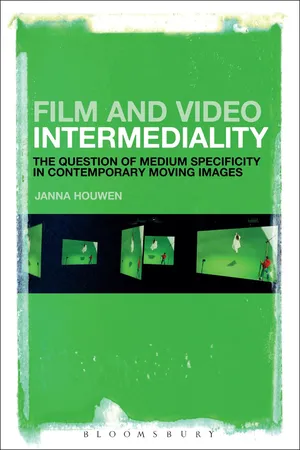
Film and Video Intermediality
The Question of Medium Specificity in Contemporary Moving Images
- 344 pages
- English
- ePUB (mobile friendly)
- Available on iOS & Android
eBook - ePub
Film and Video Intermediality
The Question of Medium Specificity in Contemporary Moving Images
About this book
In Film and Video Intermediality, Janna Houwen innovatively rewrites the concept of medium specificity in order to answer the questions "what is meant by video?" and "what is meant by film?" How are these two media (to be) understood? How can film and video be defined as distinct, specific media? In this era of mixed moving media, it is vital to ask these questions precisely and especially on the media of video and film. Mapping the specificity of film and video is indispensable in analyzing and understanding the many contemporary intermedial objects in which film and video are mixed or combined.
Information
PART I
THE REALITY EFFECT
INTRODUCTION: FROM REAL TO REEL IN BENNY’S VIDEO
Did you film that?
Mm-hmm.
What was it like, with the pig? I mean, have you ever seen a corpse before, for real?
No. You?
No.
It was only a pig. I once saw a program on TV about the special effects they use in actions films. All ketchup and plastic. Looks real though.1
Michael Haneke’s narrative fiction film Benny’s Video (1992) starts with moving video images. It is mainly because of their poor quality that the medium of these images can be discerned. Their texture is marked by the square grain which is typical of video images. The graininess of the surface is especially visible in dark areas of the images, where pixels have dropped out and have left small white squares and lines. Primary colors within the images, especially reds, look pale and unsaturated. Skin tones are covered with an unnatural faint blue shimmer.
Besides the fact that the image quality of the footage is low, it is rather poorly recorded as well. Clearly recorded with a handheld camera, the images shudder and shake. All camera movements in the unedited material are fast and abrupt, as are the zoom movements. The disorienting effect of these amateurish traits diminishes, though, when the camera zooms in on a pig that was first dragged out of a dark sty by a couple of people. Surrounded by a small crowd and a barking dog, the squealing animal is pushed to the ground. First its large bluish pink body fills the image frame, then the camera zooms in on the pig’s head, through which a bullet is shot with a gun for slaughtering cattle. Pale red blood starts to flow, while the pig starts to spasm.
These movements stop, however. The image of the dying pig is brought to a standstill, then partially rewound, and subsequently replayed in slow-motion. The scene ends with an abrupt change into “snow”—the noise of an untuned television. On the one hand, these actions affirm that the medium of the shown footage is video. They bring out typical formal features and technical possibilities of the medium, such as the possibility of pausing or rewinding a videotape on a VCR, and the characteristic horizontal flickering scan lines which cross the video image when those possibilities are used.
On the other hand, the operations of pausing, rewinding, and playing the videotape in slow motion indicate the fact that the videotape is actually embedded in another medium, namely film. The actions direct the spectator’s attention to the diegesis of Haneke’s narrative fiction film because they imply another spectator; someone who is looking at and controlling the movement of the video images at the same time. In other words, the manipulations and interruptions of the moving video point to a viewer who is using the remote control. This active spectator turns out to exist inside the world created by the narrative film which follows the video. The film’s fourteen-year-old protagonist named Benny is shown to repeatedly scrutinize the images of the dying pig by operating the remote control.
Because Benny’s actions with the remote control are both visible within the video scene and in the subsequent narrative film, they function as the most important link between the two parts—the video and the film. Moreover, as the pausing, rewinding, and slowing down of the moving video images already implicitly refer to a viewer/actor which the film will make explicit later on, they motivate and soften the abrupt transition between the shaky, coarse-grained, unedited video material and the filmed part which consists of steady shots and the smooth, well-edited images of a high-quality film production. Another aspect which relates the video segment to the narrative film is the fact that two of the people in the small crowd around the suffering pig are introduced later on in the film as Benny’s parents. What is more, Benny is not only shown to be the diegetic viewer of the video, he also turns out to be the producer of it. All in all, the bond between the video clip and the narrative film is tightened in many ways as the film proceeds. As it turns out, the moving images of the dying pig do not simply precede the cinematic narrative; they are embedded in the film’s diegesis.
However, although the transition from video images to film images is quite smooth because the relationship between the shown video material and the film story soon becomes clear, the switch from video to film does not come about entirely without a hitch. The transition remains complicated because the video recording and the narrative film each produce a reality effect, yet in a different way. In other words, the video and the film both evoke the impression that what they represent is reality, but the characteristics or strategies by which this impression is evoked are dissimilar. Put briefly, the video images produce the impression of showing reality through features which can best be characterized as flaws or imperfections, such as blurriness and color distortion. The reality effect of the film scenes, on the other hand, depends entirely on the flawlessness and seeming transparency of the material. What is more, the reality effects produced by the video and those of the film images give rise to a different sort and extent of belief. The viewer’s belief in the world shown by the video is, for instance, likely to be more profound than the viewer’s belief in the filmed world. In this part, I will further pinpoint the reality effects of film and video by looking into films and videos in which the two media are combined. Alongside Benny’s Video, the main corpus of investigation includes the film Family Viewing (Atom Egoyan 1987) and Battles of Troy (2005), a video documentary by Krassimir Terziev.
The apparent recurrence of the same two reality effects of video and film in a large number of works makes it reasonable to assume that the effects are related to the specificity of video and film. But how can an effect such as the reality effect exactly relate to a medium’s specificity, which I defined in the introduction as a layered structure which consists of a physical support and a number of conventions? How do the typical reality effects of film and video which recur in films and videos relate to specific technological possibilities and conventional applications of the two media? As will become clear below, answering this question will not only further delineate the specificity of film and video, but will also lead to a redefinition of the concept of medium specificity itself.
CHAPTER 1
REALITY EFFECTS: LITERATURE, FILM, AND VIDEO
In “The Reality Effect” (1982), Roland Barthes attempts to discover the significance of seemingly insignificant parts in realist novels; the useless details and superfluous descriptions to which structural analysis—“occupied as it is with separating out and systematizing the main articulations of narrative” (135)—can assign no functional value within the narrative. The detailed descriptions are insignificant in that they seem to be detached from the semiotic structure of the narrative. They do not, for instance, constitute an indication of characterization or atmosphere. Nor can they be said to have a classical rhetorical function, for the realist descriptions do not comply with the demands of plausibility and possibility which governed classical discourse.
To rush to the conclusion of Barthes’ text before discussing the argument leading up to it, the detailed descriptions produce a reality effect. These “residues of functional analyses” seem to “denote what is commonly called ‘concrete reality’ (casual movements, transitory attitudes, insignificant objects, redundant words)” (1982: 38). Instead of depicting the plausible, possible, and general (i.e. the vraisemblable), detailed descriptions in realist texts appear to give a naked account of what is or was. The apparent interest of realist narratives in referential reality—including all its particularities—seems to resist being given a meaning. First, the detailed descriptions do not mean anything; they do not stand for anything other than themselves, they just are. Secondly, they seem to resist meaning because, as Barthes explains, reference to concrete reality is brandished as a weapon against meaning by the ideology of our time, “as if there were some indisputable law that what is truly alive could not signify—and vice versa” (139).
In order to further examine the seeming resistance of realist texts to meaning, Barthes turns to Ferdinand de Saussure’s ideas on the sign. According to de Saussure, the category of the referent is not indispensable for the functioning of language; communication can occur through signifiers and signifieds alone. If language is to be studied effectively, de Saussure argues, the referents of signs can best be placed in brackets. With this idea in mind, Barthes notes that realist texts do not place such brackets at all. Instead, they seem to attempt to draw in the referent. As concrete details and descriptions in realist novels do not have a clear meaning or function within the structure of the narrative, they seem to be pure encounters between signifiers and referents. With that, the signified appears to be bypassed, or rather, to be expelled from the sign. Seem, that is, because such an encounter between signifier and referent at the expense of the signified would imply an impossible alteration of the sign. It is rather an illusion which is evoked by realist texts—the referential illusion, as Barthes calls it. The fact is that the details do not really denote reality directly, they rather signify reality by connotation. As Barthes explains:
The truth behind this illusion is this: eliminated from the realist utterance as a signified of denotation, the “real” slips back in as a signified of connotation; at the very moment these details are supposed to denote reality directly, all they do, tacitly, is signify it. Flaubert’s barometer, Michelet’s little door, say, in the last analysis, only this: we are the real. It is this category of the real, and not its various contents, which is being signified; in other words, the very absence of the signified, to the advantage of the referent, standing alone, becomes the true signifier of realism. A reality effect is produced, which is the basis for that unavowed “vraisemblance” which forms the aesthetic of all standard works of modernity.
1982: 16
Precisely because the insignificant details in realist texts evoke the referential illusion—the illusion that the signified is expelled from the sign and that signifiers collide with their referent—they signify the category of the real: “the absence of the signified, to the advantage of the referent […] becomes the true signifier of realism” (1982: 16). In other words, the insignificance of details becomes a signifier whose signified is the category of the real. This process is, however, marked by Barthes as the truth behind the referential illusion. The connotations “we are the real” or “this is reality” are not recognizable as signifieds, nor is the category of the real. Instead, realist texts seems to have hauled in the referent; to refer to referential reality directly. Reality thus seems to be denoted directly by realist texts while it is in fact signified.
Expanding “The Reality Effect”
In “The Reality Effect,” Roland Barthes focuses solely on literary texts. In order to gain understanding of the reality effects in—among others—Haneke’s film Benny’s Video with the help of Barthes’ ideas, it is necessary to consider how these ideas would function outside of the scope of literary texts alone. More specifically, how does Barthes’ theory apply to the media of film and video?1 Can the reality effect...
Table of contents
- Cover
- Half-Title Page
- Dedication
- Title Page
- Contents
- Introduction
- Part I: The Reality Effect
- Introduction: From Real to Reel in Benny’s Video
- 1 Reality Effects: Literature, Film, and Video
- 2 Devices in Video
- 3 Devices in Film
- 4 Sliding Scales
- 5 Medium Specificity and the Reality Effect
- 6 Interaction: Between Reality Effects
- Part II: (Dis)embodiment
- Introduction
- 7 Dispositif: An Expanded Layered Structure
- 8 (Dis)Embodying Dispositifs
- 9 Film’s Disembodying Dispositif: An Effect of an Effect
- 10 Other Views on Film Viewing
- 11 Surfaces and Screens: Video’s Embodying Dispositifs
- 12 In Between: Three Intermedial Installations
- Part III: Social Structures
- Introduction: Framing the Medium
- 13 The Medium, the Media, and the Social
- 14 Video: Flow and Feedback
- 15 Film: Private/Production
- 16 Electronic Diaries, Cinematic Stories
- Part IV: Violent Features
- Introduction
- 17 Objective Representation
- 18 The Production of Portable Objects
- 19 From Freezing to Touching
- 20 Surveillance
- 21 Voyeurism
- Conclusion
- Notes
- Bibliography
- List of Films and Videos
- Appendix: Film and Video Stills
- Index
- Copyright
Trusted by 375,005 students
Access to over 1.5 million titles for a fair monthly price.
Study more efficiently using our study tools.
Frequently asked questions
Yes, you can cancel anytime from the Subscription tab in your account settings on the Perlego website. Your subscription will stay active until the end of your current billing period. Learn how to cancel your subscription
No, books cannot be downloaded as external files, such as PDFs, for use outside of Perlego. However, you can download books within the Perlego app for offline reading on mobile or tablet. Learn how to download books offline
Perlego offers two plans: Essential and Complete
- Essential is ideal for learners and professionals who enjoy exploring a wide range of subjects. Access the Essential Library with 800,000+ trusted titles and best-sellers across business, personal growth, and the humanities. Includes unlimited reading time and Standard Read Aloud voice.
- Complete: Perfect for advanced learners and researchers needing full, unrestricted access. Unlock 1.5M+ books across hundreds of subjects, including academic and specialized titles. The Complete Plan also includes advanced features like Premium Read Aloud and Research Assistant.
We are an online textbook subscription service, where you can get access to an entire online library for less than the price of a single book per month. With over 1.5 million books across 990+ topics, we’ve got you covered! Learn about our mission
Look out for the read-aloud symbol on your next book to see if you can listen to it. The read-aloud tool reads text aloud for you, highlighting the text as it is being read. You can pause it, speed it up and slow it down. Learn more about Read Aloud
Yes! You can use the Perlego app on both iOS and Android devices to read anytime, anywhere — even offline. Perfect for commutes or when you’re on the go.
Please note we cannot support devices running on iOS 13 and Android 7 or earlier. Learn more about using the app
Please note we cannot support devices running on iOS 13 and Android 7 or earlier. Learn more about using the app
Yes, you can access Film and Video Intermediality by Janna Houwen in PDF and/or ePUB format, as well as other popular books in Media & Performing Arts & Film & Video. We have over 1.5 million books available in our catalogue for you to explore.