Compact Cinematics challenges the dominant understanding of cinema to focus on the various compact, short, miniature, pocket-sized forms of cinematics that have existed from even before its standardization in theatrical form, and in recent years have multiplied and proliferated, taking up an increasingly important part of our everyday multimedia environment.
Short films or micro-narratives, cinematic pieces or units re-assembled into image archives and looping themes, challenge the concepts that have traditionally been used to understand cinematic experience, like linear causality, sequentiality, and closure, and call attention to complex and modular forms of cinematic expression and perception. Such forms, in turn, seem to meet the requirements of digital convergence, which has pushed the development of more compact and mobile hardware for the display and use of audiovisual content on laptops, smartphones, and tablets. Meanwhile, contemporary economies of digital content acquisition, filing, and sharing equally require the shrinking of cinematic content for it to be recorded, played, projected, distributed, and installed with ease and speed. In this process, cinematic experience is shortened and condensed as well, so as to fit the late-capitalist attention economy.
The essays in this volume ask what this changed technical, socio-economic and political situation entails for the aesthetics and experience of contemporary cinematics, and call attention to different concepts, theories and tools at our disposal to analyze these changes.
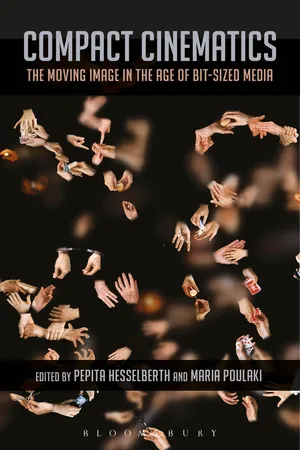
eBook - ePub
Compact Cinematics
The Moving Image in the Age of Bit-Sized Media
- 256 pages
- English
- ePUB (mobile friendly)
- Available on iOS & Android
eBook - ePub
Compact Cinematics
The Moving Image in the Age of Bit-Sized Media
About this book
Information
Part One
[Short]
Minimal Narratives
Minimal Narratives
1
Countdown to Zero: Compressing Cinema Time
Tom Gunning
A compressed history of cinematic time
Cinema is a time medium. It emerged at the end of the nineteenth century with Edison’s Kinetoscope, Lumière’s Cinématographe, Armat and Jenkins’s Vitascope—all machines that could visually record and replay events that take time. Edison’s phonograph, unveiled in 1877, offered the ability to replay not only sounds (voices, music) but also a moment of the past, inscribed and replayed with amazing fidelity. Edison’s patent caveat had announced that his Kinetoscope would “do for the eye what the phonograph did for the ear,” visually recording and replaying a passing moment. Both cinema and the phonograph preserved time, not simply in individual memory or through synecdochic souvenirs, but by creating a technical process that allowed a passing moment to be re-experienced.
But it was soon discovered that cinematically recorded time was also malleable. By means of cinema, time could be shaped and rearranged as well as preserved. For instance, Georges Méliès and other early filmmakers discovered the magical possibilities of the “substitution splice.” The filmstrip could be cut and spliced together so smoothly that the viewer would not notice the manipulation, producing the appearance of continuous time when the time of filming had actually been discontinuous. By cutting the filmstrip and manipulating action, Méliès could instantly transform a woman into a skeleton, a man into a woman, or make lunar extraterrestrials disappear in a puff of smoke (see Gunning 1989). Cutting together shots of continuous action in early chase films created a new synthetic flow of action across cuts that formed the basis of fictional filmic time (see Gunning 1984). Manipulating the rate of filming an event (the literal speed of the film passing through the camera) could speed up action in impossible ways. The 1901 Biograph film Star Theater used time-lapse cinematography (filming a few frames every day) to compress the floor-by-floor destruction of this New York City theater, which actually took about a month, into a film of about two minutes.
Viewers of the new phenomenon of the movies in the early twentieth century often saw them as an emblem of the heightened pace of modern life. Viewed with concern by social conservatives anxious over the psychological and physical effects this new lifestyle might bring, the new medium was denounced as nervous, over stimulated, and—most obviously—too fast. As Scott Curtis (2015) has shown, focusing his research on Germany before the First World War, these concerns were international and became an issue in countries undergoing industrialization and urbanization. Sociologists, such as Max Nordau in his influential 1892 book Degeneration (Entartung), warned that the tempo of modern life threatened not only health and peace of mind but the very foundations of traditional human culture. Nordau claimed that the frenzied demands of the modern urban environment and industrial work would create a new culture of hysteria and degeneration (Curtis 2015, 128). Such beliefs were widespread, and cinema was seen as the exemplar of this dangerous culture of speed and brevity. Curtis quotes a German social commentator warning specifically about the effects of the fast pace of cinema images: “The mere habituation to the darting, convulsive, twitching images of the flickering screen slowly and surely corrodes man’s mental and, ultimately, moral strength” (134).
During its second decade cinema moved from its initial fascination with the uncanny or magical effects that the manipulation of cinematic time could create, such as the time-lapse filming of Star Theater or the magical metamorphoses of trick films, toward more narrative forms. If new narrative genres seemed to corral cinema’s temporal possibilities into familiar patterns, nonetheless specifically cinematic temporal manipulation continued to play a key role. The cinema’s first psychological theorist, Hugo Münsterberg, in his 1916 book The Photoplay: A Psychological Study claimed that the narrative form of cinema reproduced the subjective processes of human psychology. Thus filmic time was not only malleable through technical manipulation of recording and editing; the relation it forged with viewers through cinematic conventions of narrative form also reshaped basic categories of human experience, including time. Münsterberg summarized his argument toward the end of this pioneering work of film theory:
The photoplay tells us the human story by overcoming the forms of the outer world, namely, space, time and causality, and by adjusting the events to the forms of the inner world, namely, attention, memory, imagination, and emotion. (Münsterberg 1916, 129)
Cinema’s mastery of time became channeled into narrative patterns, many of which had parallels in traditional narrative forms. Münsterberg showed how flashbacks portrayed memories, flash-forward anticipated future events, and vision scenes opened up the unspecified time of dreams or reveries. Narrative films especially employ devices of temporal compression, both through ellipsis and editing strategies that can accelerate the tempo of action. Through cinema, the flow of time can be shortened, squeezed, compressed.
Can avant-garde films deal with narrative time?
In a previous essay on the short form in cinema, I explored the intensity of time that brevity can create by breaking up or ignoring narrative patterns, seeking out precisely the defamiliarizing effects of noncontinuous time, including the ecstatic experience achieved by the films of Austrian experimental filmmaker Peter Kubelka, most of which last for less than ten minutes (Gunning 2015). Avant-garde alternatives to the feature-length films explored a variety of the nonnarrative temporal forms. Pioneer American avant-garde filmmaker Maya Deren in the 1950s made a famous opposition between the “vertical” form of the poetic film, which she claimed explores the resonance of a moment, and the “horizontal” attack of the dramatic film, which plays out situations in time. The horizontal approach employs a continuous sense of narrative causality and the synthetic processes of memory and anticipation, creating a temporal sense of unfolding action and suspense. In sharp contrast, the vertical dimension seeks to escape from linear temporal development, pursuing either an ascent or a plunge into realms of experience beyond ordinary time. Deren (1963) associates this escape from time with the realm of poetry and specifically with the poetic tradition of avant-garde cinema.
However, as useful as Deren’s schema can be in exploring the way that attitudes toward time define genres or modes of filmmaking, we should not assert that avant-garde cinema can never engage the action-based time of narrative. Russian Formalist critic Viktor Shklovsky offered a somewhat different understanding of the “poetic.” Shklovsky claims that poetic literature directs our attention to the role of language, its sound and associations, rather than simply transparently conveying information, which he sees as role of prose. From this perspective, avant-garde or poetic films focus viewers’ attention on cinematic form and conventions rather than simply narrating a coherent story (Shklovsky 1965, esp. 22–24). One can therefore conceive of an avant-garde film that would make narrative strategies and their use of suspenseful time visible, making narrative form an avant-garde theme by defamiliarizing it. A few avant-garde films have explored narrative form in this highly reflexive manner. If Kubelka’s films primarily explore liberation from the linear progression of time, other experimental films invoke—and transform—the almost demonic onrush of narrative progression. Such films invoke narrative temporality and yet direct our attention as viewers away from simply following the unfolding of a tale; instead these avant-garde films make us consider the way that narrative structures our sense of time.
The classical art of storytelling in the feature films labors to distract viewers from focusing on narrative mechanisms and become involved in the story rather than its forms. In contrast, certain experimental films expose these mechanisms, refusing to naturalize them by facilitating and satisfying our desire to follow a plot. Michael Snow’s 1967 film Wavelength with its relentless 45-minute zoom, and the scraps of a narrative it offers through the occurrence and discovery of an unexplained death, provides such a meditation on temporal protentions and retentions, as Annette Michelson’s famous essay on the film demonstrates (1971). A possibly dramatic incident takes place, but rather than focusing the viewer’s attention on it, the film’s dominant formal device, the ongoing progressive zoom, actually ignores it, moving past it serenely. Ken Jacob’s extraordinary 1978 film The Doctor’s Dream systematically reedits the footage of a conventional short narrative film from the 1940s or 1950s, rearranging its shots in a way that both breaks down its natural narrative progression and calls attention to the energies and conventions such a film story routinely employs (I discuss Jacobs’s film in Gunning 1981). As a complex engagement with the powers of narrative time, I want to discuss a recent avant-garde film by one of the most powerful current American avant-garde filmmakers, Lewis Klahr’s Two Minutes to Zero Trilogy. Klahr’s trilogy exposes and explores the role of narrative compression with a succession of three short films, closely related in imagery and theme. Each film becomes progressively shorter, as if moving to a final climax in which narrative compression explodes into—nothing.
Count down to zero
Klahr’s films frequently rework elements of popular and mass culture (cartoons, comic books, magazine illustrations, advertisements, textbooks, menus, family snapshots) into ambiguous, dream-like narratives. Although satire operates in Klahr’s films, it does not provide the master key. He is less interested in deflating or critiquing popular imagery than in re-imagining—sometimes even re-enchanting—this material. His collage films evoke the oneiric work of Max Ernst or Joseph Cornell, more than the social or political satires of John Heartfield or Stan Vanderbeek. Klahr’s films dwell upon the material and sensual aspects of this imagery (color, textures of wear, mysterious fragments) discovering moments of unintended formal abstraction and beauty. However, Klahr’s films provide other pleasures than these formal alternatives to narrative absorption. His collages also trigger highly associative scenarios, as viewers drift off in pursuit of stories and fantasies sparked by, yet not specifically narrated by, the images and their juxtaposition. Rather than ignoring narrative Klahr’s films engage it in an ambiguous and essentially? experimental manner.
The films that make up the Two Minute to Zero trilogy (2004) mine images from a 1950s comic book based on the television series 77 Sunset Strip. Re-mediation (to use Jay Bolter and Richard Grusin’s [1999] term for the way new media adapt and transform the material of previous media) here becomes dizzying, especially when one factors in the fact that the original television series itself recycled aspects of earlier noir and cop films, and the comic book adaptation added its own medium specificity. Klahr’s complete trilogy consists of three films of descending lengths. The first, entitled Two Days to Zero is approximately twenty-three minutes; the second, One Hour to Zero clocks in at eight-and-a-half minutes, while the concluding film, Two Minutes to Zero lasts just about a minute. One senses the material becoming compressed as in a vice, its progressive truncation creating a strange urgency and coming to a sudden climax. Klahr rapidly scans his handheld camera over the surface of the comic book pages, sometimes focusing on a fragment of a frame (the film rarely, if ever, shows the entirety of a comic book panel, offering, instead, a suite of disorientating close-ups and fragments). This mobile barrage of images seems to fulfill the early German film reformer’s nightmare quoted earlier of “darting, convulsive, twitching” film images that defy comprehension and perhaps even perception. Staccato, the film pulses on the screen, alternatively swishing and pausing with a manic energy that makes it nearly impossible to distinguish edited juxtapositions from those achieved through camera movement. The images are occasionally slightly out of focus, but more often appear sharply detailed, revealing the materiality of the comic book printing—its matrix of Benday dots, saturated and sometimes overlapping blocks of pure colors—and the often highly schematic drawing of recognizable iconic elements redolent with narrative associations: guns, cars, telephones, and especially gesturing hands and contorted faces.
One is very aware that these images are taken from a story whose full sense we are never given. We recognize genre icons of the urban crime drama, and depictions of its paradigmatic actions: violence, robbery, car chases, erotic come-ons, and likely betrayals. But it would be impossible in any of the three films to reconstruct the specifics of the underlying narrative with any degree of confidence. One could conceivably watch the images purely for their formal play: the richness of color; the odd, almost hieroglyphic rendering of objects; the humor with which clichés or emblems of American life in the fifties are displayed. In this way Klahr’s films might recall American Pop Art, most obviously the paintings of Roy Lichtenstein with their enlargement of comic strip images and looming Benday dots. Indeed, as he sweeps his handheld camera over these images, Klahr seems to reprocess Pop Art through the gestural practices of its stylistic predecessor, Abstract Expressionism.
But Klahr’s film possesses a dimension such paintings lack—that of temporality, essential to the compression of the short film experience. The images that the film remediates remain in a certain sense frozen: motionless drawings taken from a comic book. However, even the static images of the comic book genre portrayed action and motion through a variety of devices, including the layout of panels and the drawing of the figures themselves (for a discussion of comic book portrayal of motion see: Bukatman 2014). Klahr’s film literalizes (and in effect brings to life—animates) this potential motion with his quick cinematic pans and scans of the pages, which seem to be following the comic book’s continuous action with a handheld camera, rather than dividing up an immobile layout. These rapid juxtapositions create a jagged sense of rhythm—underscored in all the three films by the sound track. Paradoxically Klahr’s film, like Kubelka’s (albeit in a very different manner and tone), offers a meditation on cinematic motion precisely by undercutting or suspending the cinema’s common illusion of motion, while at the same time making us very aware of the film’s essential relation to movement through the rapid succession of individual frames.
Whereas in a brief abstract film like Schwechater (1958) Kubelka seeks the intensity of ecstasy and an escape from time’s demands modeled on cyclical natural a...
Table of contents
- Cover
- Half-Title
- Title
- Contents
- Acknowledgements
- About the Authors
- Introduction: Screen | Capture | Attention
- Part 1 [Short] Minimal Narratives
- Part 2 [Condensed] Polyphonic Archives
- Part 3 [Compressed] Pleasure & Productivity
- Part 4 [Miniature] Mobile Cinematics
- Part 5 [Compacted] Urban Ecologies
- Bibliography
- Index
- Copyright
Trusted by 375,005 students
Access to over 1.5 million titles for a fair monthly price.
Study more efficiently using our study tools.
Frequently asked questions
Yes, you can cancel anytime from the Subscription tab in your account settings on the Perlego website. Your subscription will stay active until the end of your current billing period. Learn how to cancel your subscription
No, books cannot be downloaded as external files, such as PDFs, for use outside of Perlego. However, you can download books within the Perlego app for offline reading on mobile or tablet. Learn how to download books offline
Perlego offers two plans: Essential and Complete
- Essential is ideal for learners and professionals who enjoy exploring a wide range of subjects. Access the Essential Library with 800,000+ trusted titles and best-sellers across business, personal growth, and the humanities. Includes unlimited reading time and Standard Read Aloud voice.
- Complete: Perfect for advanced learners and researchers needing full, unrestricted access. Unlock 1.5M+ books across hundreds of subjects, including academic and specialized titles. The Complete Plan also includes advanced features like Premium Read Aloud and Research Assistant.
We are an online textbook subscription service, where you can get access to an entire online library for less than the price of a single book per month. With over 1.5 million books across 990+ topics, we’ve got you covered! Learn about our mission
Look out for the read-aloud symbol on your next book to see if you can listen to it. The read-aloud tool reads text aloud for you, highlighting the text as it is being read. You can pause it, speed it up and slow it down. Learn more about Read Aloud
Yes! You can use the Perlego app on both iOS and Android devices to read anytime, anywhere — even offline. Perfect for commutes or when you’re on the go.
Please note we cannot support devices running on iOS 13 and Android 7 or earlier. Learn more about using the app
Please note we cannot support devices running on iOS 13 and Android 7 or earlier. Learn more about using the app
Yes, you can access Compact Cinematics by Pepita Hesselberth, Maria Poulaki, Pepita Hesselberth,Maria Poulaki in PDF and/or ePUB format, as well as other popular books in Media & Performing Arts & Film & Video. We have over 1.5 million books available in our catalogue for you to explore.