With strict guidelines on methodology and time frame -- films produced after September 2001, and a socio-semiotic theoretical framework -- Betty Kaklamanidou unpacks the problematic terms and ideas that go along with defining a new genre. Kaklamanidou considers a different sub-genre per chapter, placing each group of films in their socio-historical context to reach conclusions about the production of political films in millennial Hollywood. In shifting the terms of the debate, The "Disguised" Political Film in Contemporary Hollywood offers a fresh, new approach to the subject of the political film.
The political film is not a clearly delineated object but rather an elusive one and resistant to clear boundaries. So, what is a political film? Can The Hunger Games (2012) belong to the same category as Lincoln (2012)? Is Jarhead (2005) a political movie simply because it is set during the Gulf War but with no reference to the motives of the conflict and/or American and Arab relations, and thus in the same group of war films such as The Three Kings (1999), another narrative that focuses on the same military conflict but includes direct commentary to governmental and military strategies? Are historical films by definition political since the majority deals with significant events and/or people in a specific socio-cultural landscape?
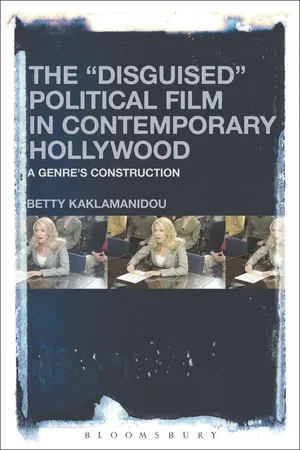
eBook - ePub
The "Disguised" Political Film in Contemporary Hollywood
A Genre's Construction
- 224 pages
- English
- ePUB (mobile friendly)
- Available on iOS & Android
eBook - ePub
About this book
Information
1
Introduction: The “Disguised” Political Film
After the first US presidential debate took place on the evening of October 3, 2012, a single word dominated the next day’s news reports on television, print and electronic media: the “narrative.” For instance, most commentators and analysts insisted that candidate Mitt Romney’s performance “changed the narrative” of the 2012 presidential campaign, while incumbent president Barack Obama appeared somewhat less authoritative.1 A review of media articles on the Clinton campaigns (in 1992 and 1996), the W. Bush campaigns (in 2000 and 2004), and even Obama’s 2008 campaign, does not yield any mention of “narrative,” opting instead for other words, such as “strategy of the campaign.”2 The word “narrative” means an account of two or more events and does not discriminate between real and fictional ones. However, I should stress that I take the view that narrative—the arrangement of events into a specific order—always involves a degree of fabrication and has connotations of fictionalization. Therefore, I found the media’s persistence in using the word “narrative” in 2012 a striking turn towards a media fictionalization of politics. This news narrativization was also a challenging way of moving away from the real political and social issues to viewing the campaign as a story with twists and turns, a story that is worth pursuing in an effort to attract the majority of viewers and/or readers, and a story worth watching with the same pathos and/or interest that one watches a film in a theater. At the same time, the word “narrative” used time after time as a descriptive noun to clarify a real and quite significant event further blurs the “boundaries between ‘factual’ knowledge and ‘fictive’ representation” and “challenges the truth status of all disciplinary knowledge” (Shepherd 2013: 10).
The year of the presidential election not only witnessed a great number of real campaign narratives but also the release of three dramatic political narratives based on real events and one political comedy. The satirical The Campaign was released in August, Argo in October, less than a month before the November 6 election, Lincoln on November 16, and Zero Dark Thirty in January 2013. Argo, Lincoln, and Zero Dark Thirty were nominated for a total of twenty-four Academy Awards (seven, twelve, and five respectively) and won six (three, two, and one respectively), with Argo claiming the Oscar for Best Picture of 2012. Of course, political films have always been produced by Hollywood and every single annual box office contains relevant titles despite the fact that their number is quite small and their packaging and labeling usually “denies any political intention” (Giglio 2014: 1). However, I claim that there is a link between the release of these political films and their time of production and consumption, and I would suggest that it was not simply a coincidence that 2012 saw the release of some of the most powerful political narratives in at least a decade while simultaneously witnessing a compelling presidential race. The first Obama victory in 2008 also coincided with several acclaimed politically-centered films, such as Vantage Point, Frost/Nixon, W., and Milk. An initial exploration of film titles reveals that since the election of Ronald Reagan in 1980, no other election year was accompanied by such prominent cinematic political narratives as 2012. Nevertheless, this observation leads to the obvious conclusion about an increase of political films during the Obama presidency. In fact, my research shows that it is not the number of films in production that has risen, but the number of acclaimed, lauded, and/or controversial political films that has risen gradually since 9/11, reaching an apogee in 2012.3
Cinema’s growing interest in politics is accompanied by an even more impressive number of political shows on American television for at least the last two decades. It could be argued that the phenomenal success of The West Wing (NBC, 1999–2006) allowed the television industry to invest in both political dramas and comedies towards the end of the 2000s, and especially in the 2010s, most of which are both critically acclaimed and popular among viewers. Today, both the networks as well as the cable channels and the internet streaming service Netflix produce television shows that take place in Washington DC, and/or focus on US policy. Shows such as 24 (Fox, 2001–10), Homeland (Showtime, 2011–present), Boss (Starz, 2011–12), Madam Secretary (CBS, 2014–present), House of Cards (Netflix, 2013–present), The Americans (FX, 2013–present), Veep (HBO, 2012–present), and The Brink (HBO, 2015) among others, offer a great variety of representations about the US government, issues of both domestic and foreign policy, as well as a host of subjects relevant to contemporary societal conflicts. They share, however, a dim view of politics and politicians, one that is fraught with corruption and intrigue while they also choose to center their narratives on mostly villainous characters, unlike their cinematic counterparts, which may underline the flaws of the political system but whose narrative protagonists are more often than not just, moral, and struggle to do the right thing. In the same vein, the rise of the political documentary in the new millennium (Bowling for Columbine [2002], The Fog of War [2003], Fahrenheit 9/11 [2004], The Corporation [2004], Sicko [2007], 2016: Obama’s America [2012]),4 and especially the controversy revolving around Michael Moore’s films, on the one hand strengthened the documentary as a genre and, on the other, helped new filmmakers to secure capital more easily from relevant companies, as the financial success of contemporary political documentaries proved that this thematic preoccupation was also viable economically. The popularity of millennial political TV narratives and documentaries notwithstanding, I choose to focus exclusively on cinema in this monograph in order to define and construct a genre with specific conventions, modes of production and exhibition that differ from television and documentary practices, to have the opportunity to examine my corpus more meticulously, and to avoid minimizing the importance of the aforementioned groups of texts, that I believe should be autonomously explored. That being said, I include observations regarding the influence of television and/or documentary on contemporary political texts in some of the following chapters, as a consequence of cross-fertilization between contemporary narratives, but I do not divert my attention from film.
The Hollywood narratives that focus on political issues in the new millennium, and the media and artistic attention most of these films garnered, is indicative of film’s continuing dual function as (a) a reflection, commentary, and/or critique of social events, and (b) a medium capable of foreseeing and/or assisting societal evolution. One could argue that politics has nothing to do with the fabricated nature of Hollywood film production whether or not its films are based on real events. However, as Sheldon S. Wolin (2004: 19) remarks, “imagination is also part of the political theorist’s efforts.” The author adds that since it can be impossible to directly observe societies, the theorist is compelled “to epitomize a society by abstracting certain phenomena and providing interconnections where none can be seen.” Thus, imagination becomes “the theorist’s means for understanding a world he can never ‘know’ in an intimate way,” and also “to transcend history” (Wolin 2004: 19) the same way; I would argue that film imagines worlds and goes beyond historical representations.
The subject of this monograph is the “disguised” political films produced by Hollywood, the dominant cinematic paradigm in the world in the new millennium. The epithet “disguised” that also appears in the title of the book is not accidental as the overwhelming majority of the film titles that I have already mentioned, as well as the rest that form the corpus of this study, have been marketed and distributed to theaters worldwide with no mention of the word “politics” or its derivatives. The corpus discussed in the next pages comprises mainly “action thrillers,” “historical dramas,” “action/adventures,” “biopics,” “comedies,” “spy comedies,” and “crime dramas.” I argue that these industry labels hide the fact that all the narratives belong to a political genre, a category that Hollywood is notorious for avoiding and is not interested in. That is why, I argue, this generic category can only exist as an abstraction, a theoretical construction, and not a widely acknowledged and/or used label. The aims of this study are, therefore, to define a political film genre based on a corpus of films produced and distributed between 2002 and 2012, group the films into subgenres, and analyze them. I believe that the data garnered from a ten-year period can assist in the compilation of a comprehensive corpus with a substantial number of films and can lead to valid conclusions. However, I would like to add that the last chapter also discusses some of the political narratives that were released in the 2013–15 period, to prove, on the one hand, the continuity of the genre and also verify the theoretical construction I am proposing in the next few pages.
The first step of every scientific endeavor is the demarcation of the object of study. However, the object of this book, namely political films, is not a clearly delineated object but rather an elusive one and resistant to clear boundaries. As Ian Scott puts it: “political films have never really had a working definition to speak of in any form” (Scott 2011: 14). Thus, the first part of the study endeavors to answer the following questions: What is a political film? Can The Hunger Games, 2012, belong to the same category as Lincoln, 2012? Is Jarhead, 2005, a political movie simply because it is set during the Gulf War but with no reference to the motives of the conflict and/or American and Arab relations, and thus in the same group of war films such as Three Kings, 1999, another narrative that focuses on the same military conflict but includes direct commentary on governmental and military strategies? Are historical films by definition political since their majority deals with significant events and/or people in a specific sociocultural landscape?
These are the questions that I set out to answer during my research in contemporary political cinematic narratives. It seems to me that the problems inherent in the effort to define and delineate a political film genre involve: (a) the term “politics”, and (b) the theory of genre or absence thereof in the literature which leads to an empirical and not theoretical effort to define appropriately a political film genre. I therefore first try to unpack the problematic terms and concepts discussing the relevant literature and I provide a theoretical framework deriving from sociosemiotics on which I base my definition of the political film genre.
Politics: Choosing a definition and a theory
The first observation made during the study of the relevant literature is that the term “politics”—which is crucial for a study that includes the derivative term “political”—is not clearly defined. “Politics” is invariably used to designate both the more inclusive and exclusive definitions of the term. It can designate exclusively the governmental activities of a specific geographical area (country/nation), the power relations between those individuals who hold positions of influence and the institutions that comprise the structure of the same area. The Aristotelian definition of politics as “the things concerning the polis,” Max Weber’s (1958) 1948 definition which sees politics as the allocation of a state’s (the evolution of the Ancient Greek polis) power between various groups of people, and Bernard Crick’s 1964 definition which designates politics as “the activity by which differing interests within a given unit of rule are conciliated by giving them a share in power in proportion to their importance to the welfare and the survival of the whole community” (Grant 2003), support the exclusive aspect of politics and limit its boundaries within a governmental and institutional structure.
On the other hand, during the late 1960s, “the personal is political” slogan of the second feminist wave blurred the lines between the public and the private spheres and drew “attention to the fact that power and advantage also characterize areas of life that are not usually thought of as political” (Chambers 2015, 267). Thus, “politics” became an inclusive term that could be used in every aspect of society (i.e., family politics, school politics). Harold Lasswell’s (1936) definition of politics as “who gets what, when, and how,” and David Easton’s (1965) definition that designates politics as “the authoritative allocation of values for a society,” as well as the more recent contribution by Jacques Rancière (2011, 3), who views politics as “the construction of a specific sphere of experience in which certain objects are posited as shared and certain subjects regarded as capable of designating these objects and of arguing about them,” can support the more inclusive reading of the term. The number of definitions may hinder my goal but, at the same time, points to the fact that “the field of politics is and has been […] a created one” (Wolin 2004: 5). Wolin observes that:
The designation of certain activities and arrangements as political, the characteristic way that we think about them, and the concepts we employ to communicate our observations and reactions—none of these are written into the nature of things but are the legacy accruing from the historical activity of political philosophers. (2004: 5)
Following this continuity, Wolin (2004: 7) defines politics as the ...
Table of contents
- Dedication
- Title
- Contents
- Acknowledgments
- 1 Introduction: The “Disguised” Political Film
- 2 Political Comedies
- 3 Political Thrillers and US Foreign Policy
- 4 Political History Dramas and US Domestic Policy
- 5 Political Films From Antiquity to the Twentieth Century
- 6 Behind the Scenes of the Disguised Political Film Genre
- 7 Epilogue: Beyond the Corpus
- Notes
- Bibliography
- Index
- Copyright
Trusted by 375,005 students
Access to over 1.5 million titles for a fair monthly price.
Study more efficiently using our study tools.
Frequently asked questions
Yes, you can cancel anytime from the Subscription tab in your account settings on the Perlego website. Your subscription will stay active until the end of your current billing period. Learn how to cancel your subscription
No, books cannot be downloaded as external files, such as PDFs, for use outside of Perlego. However, you can download books within the Perlego app for offline reading on mobile or tablet. Learn how to download books offline
Perlego offers two plans: Essential and Complete
- Essential is ideal for learners and professionals who enjoy exploring a wide range of subjects. Access the Essential Library with 800,000+ trusted titles and best-sellers across business, personal growth, and the humanities. Includes unlimited reading time and Standard Read Aloud voice.
- Complete: Perfect for advanced learners and researchers needing full, unrestricted access. Unlock 1.5M+ books across hundreds of subjects, including academic and specialized titles. The Complete Plan also includes advanced features like Premium Read Aloud and Research Assistant.
We are an online textbook subscription service, where you can get access to an entire online library for less than the price of a single book per month. With over 1.5 million books across 990+ topics, we’ve got you covered! Learn about our mission
Look out for the read-aloud symbol on your next book to see if you can listen to it. The read-aloud tool reads text aloud for you, highlighting the text as it is being read. You can pause it, speed it up and slow it down. Learn more about Read Aloud
Yes! You can use the Perlego app on both iOS and Android devices to read anytime, anywhere — even offline. Perfect for commutes or when you’re on the go.
Please note we cannot support devices running on iOS 13 and Android 7 or earlier. Learn more about using the app
Please note we cannot support devices running on iOS 13 and Android 7 or earlier. Learn more about using the app
Yes, you can access The "Disguised" Political Film in Contemporary Hollywood by Betty Kaklamanidou in PDF and/or ePUB format, as well as other popular books in Media & Performing Arts & Film History & Criticism. We have over 1.5 million books available in our catalogue for you to explore.