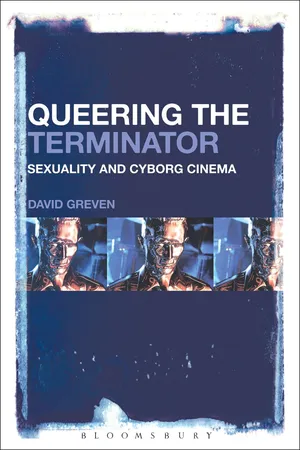
The Terminator film series is an unlikely site of queer affiliation. The entire premise revolves around both heterosexual intercourse and the woman's pregnancy and giving birth. It is precisely the Terminator's indifference to both that signifies it as an unimaginably inhuman monstrosity. Indeed, the films' overarching contention that humanity must be saved, rooted as it is in a particular story about pregnancy and birth that exclusively focuses on the heterosexual couple and the family, would appear to put it at odds with the political stances of contemporary queer theory. Yet, as this book argues, there is considerable queer interest in the Terminator mythos.
The films provide a framework for interpreting shifting gender codes and the emergence of queer sexuality over the period of three decades. Significantly, the series emerges in the Reagan 80s, which marked a decisive break with the sexual fluidity of the 70s. As a franchise and on the individual basis of each film, The Terminator series combines both radical and reactionary elements. Each film reflects the struggles over gender and sexuality specific to its release. At the same time, the series foregrounds the intersection of technology and gender that has become a definitive aspect of contemporary experience. A narrative organized around a conservative view of female sexuality and the family, the Terminator myth is nevertheless a richly suggestive narrative for queer theory and gender studies.
- 216 pages
- English
- ePUB (mobile friendly)
- Available on iOS & Android
eBook - ePub
About this book
Information
1
“John Connor, it is time”: Queer spectatorship and the primal scene
This chapter lays the theoretical groundwork for my general argument. First, considering the centrality of the heterosexual couple within the Terminator mythos, I discuss the film series in terms of Stanley Cavell’s writings on the screen couple, suggesting that we read the Terminator films, the first in particular, as comedies of remarriage. Second, I discuss two key Freudian concepts of particular significance to Terminator criticism: the Oedipus complex and the primal scene. Third, I consider the Terminator films in relation to the queer theorist Lee Edelman’s No Future, given that the films complexly intersect with his theory. The Terminator series foregrounds the markers of heteronormativity as Edelman identifies them (reproductive futurity and the Child), while providing a resistant reading of heteronormative ideology.
Call that the conjugal: Queering the couple
The first Terminator might productively be read as a version of what Stanley Cavell famously calls the “comedy of remarriage.” (In Pursuits of Happiness, he reads the screwball comedies of the 1930s and 1940s in this fashion.) For Cavell, the point of these films involves the couple’s mutual transformation. The man transforms through the “assault” of the woman’s emotional and sexual power. But more importantly, the man transforms the woman because he must “educate” her.1 The relevance of Cavell’s thesis to the Terminator mythos lies in the screwball couple’s particular relationship to time: having once been married, circumstances bring them together anew as if to encourage them to try things out once more. The single, unmarried heroine Sarah Connor and Kyle Reese, a soldier from the future who travels back in time to save her, meet for the first time in 1984, but, looked at from Kyle’s perspective, their meeting actually occurs many years after Kyle has fallen in love with her. John Connor, Sarah’s son and the Resistance leader of the dystopian machine-dominated future, gave Kyle, who will eventually become his father, a picture of Sarah that Kyle reverences. “I came across time for you, Sarah. I love you—I always have,” he tells her. Kyle, as critics have discussed, educates Sarah in the ways of dystopian lore and battle. One can also say that she educates him in the ways of being properly male, which is to say, functionally heterosexual. Vivian Sobchack observes that his sexual initiation at Sarah’s “beloved, loving, experienced, and maternal” hands “reproduces” him as both father and son. At the same time, it "nostalgically points backwards to an imaginary past. Displaced and disaffiliated from a history of patriarchal and capitalist motivations and practices which always already inform and adulterate bourgeois heterosexual relations,” Reese gains sexual potency while remaining spiritually pure.2
Cavell links his discussion of the woman’s role in the successful achievement of the comedy of remarriage to the American Transcendentalists Ralph Waldo Emerson and Henry David Thoreau:
It is not news for men to try, as Thoreau puts it, to walk in the direction of their dreams, to join the thoughts of day and night, of the public and private, to pursue happiness. Nor is its news that this will require a revolution, of the social or of the individual constitution, or both. What is news is the acknowledgement that a man and a woman might try it together and call that the conjugal [emphasis in the original]. (It is roughly what Emerson did call that; but then, as you would expect, he did not expect to find it between real men and women.) For this we would require a new creation of woman, call it the creation of a new woman; and what the problems of identification broached in these films seem to my mind to suggest is that this creation is a metaphysical enterprise, exacting a reconception of the world. How could it not? It is a new step in the creation of the human. The happiness in these comedies is honorable because they raise the right issues; they end in undermining and in madcap and in headaches because there is, as yet at least, no envisioned settlement for these issues.3
There is an obvious heterosexist bias here in that the relationship between the man and the woman is framed as “a new step in the creation of the human.” The heterosexism stems from the underlying, unspoken, but palpable view of the male-female relationship as grounded in and emblematic of nature itself, a secular version of the biblical myth of Adam and Eve, and at the same time of the heterosexual couple as representative of the human itself. Such views boast a centuries-long provenance; only the rise of queer visibility and the later and finally successful quest for gay marriage (in the United States and other nations, certainly not all) in the past two and a half decades have challenged the heterosexual model of “the human” beyond theoretical and activist positions in American academic discourses. Cavell’s treatment of these matters certainly illuminates Hollywood narrative film, given the centrality of the heterosexual couple to it (not only in the classical period). Nevertheless, one must push back against his theory’s deeply limiting assumptions not only about essential heterosexual intelligibility but also about the woman’s role in the heterosexual relationship, at least in representation. A longstanding argument, discussed by many, between Cavell and feminist film critics precedes many of these objections, most notably, Tania Modleski’s “Reply to Cavell” in Critical Inquiry and lengthier critique in Feminism without Women.4 (In the latter, Modleski, discussing Cavell’s treatments of femininity in the classical Hollywood woman’s film, locates Cavell prominently in a group of male critics who seek to “relocate the struggle of feminism against patriarchy to a place entirely within patriarchy and within the psyche of the patriarch himself.”5)
My critique of Cavell, while correspondent with the feminist one, is situated within queer theory and its opposition to heterosexism and heterosexual presumption.6 While not a critic that I consistently agree with by any means, chafing against his hard-line Foucauldianism as I do, Michael Warner offers a particularly relevant critique of heteronormative thinking in his introduction to the reader Fear of a Queer Planet. Here, he discusses the drawings done by Carl Sagan and his wife Linda, which were part of the materials in the Pioneer 10 spacecraft mission, the first spacecraft intended to fly by Jupiter, launched in 1972. Meant to represent human society, the Sagans’ drawings were intended to introduce alien civilizations to the people of Earth. Warner argues that “the NASA plates do not carry just any images of persons in their attempt to genericize humankind. They depict—if you share the imaging conventions of postwar U.S. culture—a man and a woman. They are not just sexually different: they are sexual difference itself. . . . a technological but benign Adam and Eve.” These representatives of the human race are also clearly marked as Caucasian. Heteronormative thinking, Warner adds, rarely strikes so bold a note. Rather, like “androcentrism, it clothes itself in goodwill and intelligence.” Queer theory builds on feminism, Warner notes, to establish that “basic conceptualizations . . . presuppose and reinforce a paradigmatically male position.”7
While I have personal affinity for Cavell’s romantic responsiveness to film and greatly admire his critical acumen, I must say that his thinking falls into some of the basic traps that Warner astutely outlines, particularly the view that the male and female couple represent human society itself and, more worrisomely still, the ways in which Cavell’s heteronormative paradigms, offered in genial, thoughtful, multivalent, welcoming rhetorical style, clothe themselves in “goodwill and intelligence.” I want to draw out two especially important constructs in the odd valences between Cavell and Warner here (or between Cavell and the Sagans): the idea of Adam and Eve as representative of the human and the role of the woman—the implications for femininity—in the vaunted male-female pair. Both of these ideas are submitted to analysis throughout the Terminator films, the first especially.
While the valuation of the heterosexual couple and the white heterosexual couple at that is surely problematic, the Terminator films undermine the couple through the complex, anguished temporal mechanics of the plot. I also believe that they do so by undermining conventional masculinity. For critics such as Vivian Sobchack, the vulnerability of characters such as Kyle Reese points to a conservative sentimentalization of the man’s action movie role. Constance Penley, echoing Sobchack, weighs in thusly: “Kyle is the virile, hardened fighter, barking orders to the terrified Sarah, but alternately he is presented as boyish, vulnerable, and considerably younger in appearance than her. His childishness is underscored by Sarah’s increasingly maternal affection for him,” signified by her bandaging of his wounds and by their love scene, in which she assumes the role of older, wiser sexual initiator. “Kyle is thus both the father of John Conner [sic] and, in his youth and inexperience, Sarah’s son, John Connor.” The film indulges in a fantasy of incest that can be at once “stated and dissimulated.”8 In my view, however, the films subversively explore the possibilities of male vulnerability.9 I elaborate on this point in Chapters 2 and 4; for now, let me establish that I do not concur with the broad range of Terminator critics in viewing male vulnerability as a conservative and opportunistic gesture. Rather, the films deroutinize normative expectations and prescribed gender roles for male characters in their sensitivity to a masculinity that wishes to relinquish its own authority.
Oedipal patterns
The Terminator movies foreground the family and its sexual politics. Inevitably, they recall Freud’s most famous concept, the Oedipus complex. Though quite familiar by now, his theory remains a crucial and complex idea, synthesizing both the dynamics of the family and the process, always a grueling one, of individuation. While other Freudian theories command attention, narcissism being a prominent example, the Oedipus complex still exerts influence as binding secular social myth. Drawing on classical mythology as he often did, Freud saw in Sophocles’ tragedy an apt metaphor for the paradoxical absurdities of socialization. The child’s murderous feelings toward the same-sex parent and amorous feelings for the opposite-sex parent are central components of the theory, but really only its best-known ones. Fantasizing that the father’s equally violent and jealous feelings toward him threaten his life, the child ingeniously adopts, internalizes, the father’s authoritarian role. No longer competing against but instead modeling himself after the father, the child has embarked on the crucial socializing process of identification.10 In psychoanalytic theory, identification allows child and father to be reconciled. It eradicates sexual desire for the father and fosters like-minded emulation and parity. Sticking with the patriarchal model Freud privileges, the son and father now both regard the mother as the second sex, the father’s property and the son’s model for future sexual conquests. Far from promulgating this model, Freud saw it as a brutal passage, a process so socially prevalent as to seem inevitable.
In The Psychic Life of Power, Judith Butler argues that oedipal identification is not a forfeiture of the original object of attachment (the father) but rather a “magical, a psychic form of preserving the object.” So preserved, “the lost object continues to haunt and inhabit the ego as one of its constitutive identifications.” This melancholic identification “averts the loss” of the original object “as a complete loss.”11 The Oedipus complex contains a repressed backstory, the child’s erotic fixation on the same-sex parent. The chief goal of the Oedipus complex is to destroy incestuous feeling. The prohibition on incest “presupposes the prohibition on homosexuality, for it presumes the heterosexualization of desire.”12
Through the Oedipus complex, Freud definitively explored the psychic turmoil of male subjectivity. With more questionable though not uninteresting results, he also used this paradigm to theorize female psychosexual development. In his 1925 essay “Some Psychical Consequences of the Anatomical Distinction Between the Sexes,” Freud posits that the chief distinction between the male and the female Oedipus complex is this: “Whereas in boys the Oedipus complex is destroyed by the castration complex, in girls it is made possible and led up to by the castration complex.”13 Narcissistically prizing his own genitals, the castration-fearing boy believes that his father has cut off his mother’s penis and will do the same thing to him. Castration terrors prove very valuable: they lead to the psychic process of identification. In this case, the male child, having competed against his father and feared his vengeful wrath, now identifies with him and hopes to emulate him. Identification eradicates the father’s threat through kinship, as Leo Bersani has persuasively argued.14 Given that the mother is the original erotic object for both boys and girls, Freud asks, “How does it happen that girls abandon it [the mother-object] and instead take their father as object?” The girl identifies with her mother, but in a much more embattled and ambivalent way than the boy identifies with his father. Castration fears shatter the boy’s Oedipus complex, but they trigger the girl’s.
I rehearse these Freudian paradigms because I believe that, however one feels about them, they provide a useful guide to the labyrinth of patterns in gendered and sexual socialization within Western culture and its forms of representation. The Terminator films take the Oedipus complex seriously. Hence their sexual conservatism but also their resistant, uncanny power at times. Freud establishes that the so-called negative Oedipus complexes, such as homosexuality and masochism, thwart and undermine normative oedipal development. Other Freudian theories, such as narcissism, demand attention as alternatives to the stronghold of Oedipus; indeed, feminist theorists have found potential value in the surprising agency Freud affords the narcissistic woman. The Terminator films follow suit, undermining their oedipal structures with queer desire and feminist autonomy. Each of the films grapples with the most iconic image of the Oedipus complex, the intergenerational battle between father and son, providing distinct approaches to this iconography. But the role of the mother, particularly the phallic mother, is paramount in them as well.
Primal scenes: Freud, heterosexuality, and sexual spectatorship
In her well-known essay “Time Travel, Primal Scene, and Critical Dystopia,” Constance Penley establishes Freud’s theory of the primal scene as crucial to critical studies of the Terminator films. Their central device of time-travel, for Penley, links them to Freud’s theory. “The desire represented in the time travel story, of both witnessing one’s own conception and being one’s own mother and father, is similar to the primal scene fantasy, in which one can be both observer and one of the ...
Table of contents
- Cover
- Half-Title
- Dedication
- Title
- Epigraph
- Contents
- List of Illustrations
- Acknowledgements
- Introduction: Everything you always wanted to know about desire, but were afraid to ask a Terminator
- 1 “John Connor, it is time”: Queer spectatorship and the primal scene
- 2 “It’s just him—and me”: The Terminator
- 3 Cyborg masochism and homo-fascism: Terminator 2: Judgment Day
- 4 Falling behind: Terminator 3: Rise of the Machines
- 5 Facing the father: Terminator Salvation
- 6 Magnetic Connections: Terminator Genisys
- Epilogue: Notes on Terminator: The Sarah Connor Chronicles
- Notes
- Bibliography
- Index
- Copyright
Trusted by 375,005 students
Access to over 1.5 million titles for a fair monthly price.
Study more efficiently using our study tools.
Frequently asked questions
Yes, you can cancel anytime from the Subscription tab in your account settings on the Perlego website. Your subscription will stay active until the end of your current billing period. Learn how to cancel your subscription
No, books cannot be downloaded as external files, such as PDFs, for use outside of Perlego. However, you can download books within the Perlego app for offline reading on mobile or tablet. Learn how to download books offline
Perlego offers two plans: Essential and Complete
- Essential is ideal for learners and professionals who enjoy exploring a wide range of subjects. Access the Essential Library with 800,000+ trusted titles and best-sellers across business, personal growth, and the humanities. Includes unlimited reading time and Standard Read Aloud voice.
- Complete: Perfect for advanced learners and researchers needing full, unrestricted access. Unlock 1.5M+ books across hundreds of subjects, including academic and specialized titles. The Complete Plan also includes advanced features like Premium Read Aloud and Research Assistant.
We are an online textbook subscription service, where you can get access to an entire online library for less than the price of a single book per month. With over 1.5 million books across 990+ topics, we’ve got you covered! Learn about our mission
Look out for the read-aloud symbol on your next book to see if you can listen to it. The read-aloud tool reads text aloud for you, highlighting the text as it is being read. You can pause it, speed it up and slow it down. Learn more about Read Aloud
Yes! You can use the Perlego app on both iOS and Android devices to read anytime, anywhere — even offline. Perfect for commutes or when you’re on the go.
Please note we cannot support devices running on iOS 13 and Android 7 or earlier. Learn more about using the app
Please note we cannot support devices running on iOS 13 and Android 7 or earlier. Learn more about using the app
Yes, you can access Queering The Terminator by David Greven in PDF and/or ePUB format, as well as other popular books in Media & Performing Arts & Film History & Criticism. We have over 1.5 million books available in our catalogue for you to explore.