- 240 pages
- English
- ePUB (mobile friendly)
- Available on iOS & Android
eBook - ePub
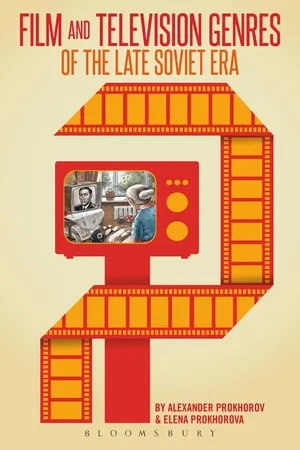
Film and Television Genres of the Late Soviet Era
About this book
Most histories of Soviet cinema portray the 1970s as a period of stagnation with the gradual decline of the film industry. This book, however, examines Soviet film and television of the era as mature industries articulating diverse cultural values via new genre models. During the 1970s, Soviet cinema and television developed a parallel system of genres where television texts celebrated conservative consensus while films manifested symptoms of ideological and social crises. The book examines the genres of state-sponsored epic films, police procedural, comedy and melodrama, and outlines how television gradually emerged as the major form of Russo-Soviet popular culture. Through close analysis of well-known film classics of the period as well as less familiar films and television series, this groundbreaking work helps to deconstruct the myth of this era as a time of cultural and economic stagnation and also helps us to understand the persistence of this myth in the collective memory of Putin-era Russia. This monograph is the first book-length English-language study of film and television genres of the late Soviet era.
Information
1
Prestige Productions: Epic Film as a Tool of Hard and Soft Power during the Cold War
It seems that only among our people exists the proverb: “Company in distress makes troubles less (literally “When it’s collective, even death is beautiful-” EP and AP). How so? Death is horror. Not really. What is “collective”? It means death for one of your own, for thy folk or, in modern language, for your Fatherland. This is the source of our patriotism. From here comes the mass patriotism in times of military conflicts and wars, even self-sacrifice in peaceful times. From here [derives] our sense of camaraderie, our family values.
Vladimir Putin. Television dialogue with the nation. 17 April 20141
Syntax and semantics of the genre
This chapter traces the production and distribution history of the late-Soviet state’s most privileged genre: prestige films. These films occupied a special place in the Soviet film industry: they were under the direct patronage of the Soviet state and were designed to legitimate its charismatic power. Dealing with ideologically and politically important themes, they showcased the Soviet film industry at international film festivals and enjoyed preferential financing conditions. There were two major types of such productions: epic war films (Liberation, Soldiers of Freedom, The Most Important Assignment, Front without Flanks, Front beyond the Frontline, Front beyond the Enemy Lines, Victory) and big-budget historical epics and adaptations of literary classics (War and Peace, Waterloo, Red Bells, The Steppe, Boris Godunov).2 We claim that these films constitute a distinct genre of late-Soviet cinema because they share a number of syntactic features, as well as the state’s direct participation at every stage of their production, release, distribution, marketing, and critical responses. In fact, the state is the ultimate author of these pictures. While their epic style and high budget resemble those of many commercial blockbusters, the main raison d’être of their production was to serve as public relations vehicles for the state and its agendas.
Stalinist cinema favored big-budget epic productions that sacralized state power and, by the 1940s, just Stalin; it did not concern itself with recovering costs or making a profit. Among the most notorious examples of such pictures is Mikhail Chiaureli’s epic film Fall of Berlin (Padenie Berlina 1949), about Stalin’s winning the Great Patriotic War3 and defeating not only Hitler but also the scheming Allies. The film’s portrayal of Stalin as a demigod and the film’s grand style provided the representational model for Brezhnev-era cinematic epics.
After Stalin’s death, Fall of Berlin and similar films were denounced for their promotion of the cult of personality and lack of authenticity. In the 1950s and early 1960s, many Soviet filmmakers were influenced by European neorealist aesthetics. The opening of the country to the global economy and film culture stimulated a dialogue and a competition with Western cinema, especially with Hollywood. As media historian Kristin Roth-Ey points out, the Soviet cultural model positioned itself as global by definition—“a safe house for the world’s best” (2011, 4). One outcome of the policy of peaceful co-existence and cultural exchange with the West introduced in the mid-1950s was that Soviet culture after Stalin found itself in open competition on its own terrain (2011, 9).
In his discussion of the epic film as a genre Robert Burgoyne contends that the “tension between the evolving global context of film production and reception and the particular provenance of the epic as an expression of national mythology and aspirations creates what Bakhtin calls a double voice” (2011, 2). In other words, Burgoyne argues that the epic film often aspires to use national narratives “for the collectivities that are not framed by nation” (2011, 6). In our discussion of the prestige epic film we draw on cultural historian Nancy Condee’s claim that Soviet cinema differs from European national cinemas in its lack of a strong national tradition (2009, 18–19). Instead, by the Stalin era, Soviet cinema became an art form of supranational imperial collectivity, with ethnic Russian male protagonists appearing in Soviet epics as the vanguard of the new supranational community.
The gradual opening of Soviet society after Stalin’s death changed the ideological priorities and gave rise to the genre of the prestige production. This type of film was still in the business of sacralizing power and mythologizing Soviet history, but it also had to be commercially successful, ideally both at home and in international distribution, as part of the Cold War rivalry with the West. As scholars Tony Shaw and Denise Youngblood argue, this rivalry between the two superpowers was mostly about the USSR’s catching up with the US advances in technology and adapting Western-style generic models to Soviet ideology. The Soviet film industry “had to prove their system worked, and then to persuade others to follow it” (2010, 218). Soviet cultural producers, in other words, developed prestige productions in response to Hollywood blockbusters.4
In the 1950s-early 1960s Soviet cinema participated in international film culture by successfully adapting the neorealist and New Wave aesthetics to native themes—most importantly the Great Patriotic War—and scoring a number of awards at the top international festivals.5 The Brezhnev-era political leadership and cultural administrators, however, shared a more conservative but ambitious agenda: to produce big-budget epic films. Amidst the sagging Soviet economy, rising consumerism, and the alienation of the populace, especially youth, from ideological rhetoric, the shared victory in the Great Patriotic War remained the only legitimate foundation of Soviet identity. Accordingly, the Soviet state had a vested interest in producing films that mythologized the Great Patriotic War through epic style and a state-centered message. Such films re-evaluated not only the “cult of personality” and Stalin’s role in Soviet history, but also cinematic developments of the Thaw.
Between 1966 and the early 1970s, the Main Scripts and Editing Commission (Glavnaia stsenarno-redaktsionnaia kollegiia) of Goskino rejected a number of film scripts dealing with the war, even those endorsed by the studios and official reviewers. The scripts’ purported “flaws” varied: “abstract humanism and pacifism;” pessimistic and overly naturalistic treatment of the last, “victorious” years of the Great Patriotic War; and excessive focus on individuals at the expense of the panoramic, heroic picture of the war.6 The writing on the wall was clear: Thaw liberal politics was out, together with stories of individuals and their physical and moral suffering and dilemmas.
The main syntactic feature of prestige productions was the revival of the Stalin-era focus on the statist message and collectivist agenda, at the expense of the individual. At the center of these pictures is a Russian male serving the state. The Army provides the major institution where the protagonist can find his community and become an honorable and patriotic citizen under the guidance of a patriotic mentor. The story of Russia’s imperial expansion told as a tale of the liberation of smaller nations from the power of other, oppressive empires provides the plot of most patriotic epics of the Brezhnev era.
In short, the narrative of prestige productions adhered rather closely to the socialist realist master plot. However, in their bid for spectacle, these works borrowed devices and entire scenes from diverse, often incompatible, sources. Starting with War and Peace, devices of art cinema become important for these epics’ display of the Soviet film industry’s sophistication and for international marketing. However, their major inspiration was totalitarian cinema. Evocations of Stalinist epics and Leni Riefenstahl’s Triumph of the Will (1935) are ever-present reference points in films as seemingly different as War and Peace and Liberation. The breathtaking aerial shots of diminutive human subjects, observed from above, re-stage the spirit of the imperial sublime for new audiences.
Whether adaptations of literary classics o...
Table of contents
- Cover
- Half-Title Page
- Title Page
- Contents
- List of illustrations
- Acknowledgments
- Introduction
- 1 Prestige Productions: Epic Film as a Tool of Hard and Soft Power during the Cold War
- 2 The Socialist Television Police Procedural of the 1970s and 80s: Teaching Soviet Citizens How to Behave
- 3 Late-Soviet Comedy: Between Rebellion and the Status Quo
- 4 Reinventing Desire: Late-Socialist Melodrama
- Conclusion
- Bibliography
- Filmography
- Index
- Copyright
Trusted by 375,005 students
Access to over 1.5 million titles for a fair monthly price.
Study more efficiently using our study tools.
Frequently asked questions
Yes, you can cancel anytime from the Subscription tab in your account settings on the Perlego website. Your subscription will stay active until the end of your current billing period. Learn how to cancel your subscription
No, books cannot be downloaded as external files, such as PDFs, for use outside of Perlego. However, you can download books within the Perlego app for offline reading on mobile or tablet. Learn how to download books offline
Perlego offers two plans: Essential and Complete
- Essential is ideal for learners and professionals who enjoy exploring a wide range of subjects. Access the Essential Library with 800,000+ trusted titles and best-sellers across business, personal growth, and the humanities. Includes unlimited reading time and Standard Read Aloud voice.
- Complete: Perfect for advanced learners and researchers needing full, unrestricted access. Unlock 1.5M+ books across hundreds of subjects, including academic and specialized titles. The Complete Plan also includes advanced features like Premium Read Aloud and Research Assistant.
We are an online textbook subscription service, where you can get access to an entire online library for less than the price of a single book per month. With over 1.5 million books across 990+ topics, we’ve got you covered! Learn about our mission
Look out for the read-aloud symbol on your next book to see if you can listen to it. The read-aloud tool reads text aloud for you, highlighting the text as it is being read. You can pause it, speed it up and slow it down. Learn more about Read Aloud
Yes! You can use the Perlego app on both iOS and Android devices to read anytime, anywhere — even offline. Perfect for commutes or when you’re on the go.
Please note we cannot support devices running on iOS 13 and Android 7 or earlier. Learn more about using the app
Please note we cannot support devices running on iOS 13 and Android 7 or earlier. Learn more about using the app
Yes, you can access Film and Television Genres of the Late Soviet Era by Alexander Prokhorov,Elena Prokhorova in PDF and/or ePUB format, as well as other popular books in Media & Performing Arts & Film & Video. We have over 1.5 million books available in our catalogue for you to explore.