Live Cinema is a term used to capture a diverse range of experiences that incorporate a 'live' element in relation to a film's exhibition. The live augmentation of cinema screenings is not a new phenomenon, indeed this tendency is present throughout the entire history of cinema in the form of live musical accompaniments to silent screenings, showmanship practices, and cult film audience behaviours. The contemporary revival of experiential cinema captured within this volume presents instances where the live transcends the mediated and escapes beyond the boundaries of the auditorium. Our contributors investigate film exhibition practices that include synchronous live performance, site specific screenings, technological intervention, social media engagement, and all manner of simultaneous interactive moments including singing, dancing, eating and drinking.
These investigations reveal new cultures of reception and practice, new experiential aesthetics and emergent economies of engagement. This collection brings together fifteen contributions that together trace the emergence of a vivid new area of study. Drawing on rich, diverse and interdisciplinary fields of enquiry, this volume encapsulates a broad range of innovative methodological approaches, offers new conceptual frameworks and new critical vocabularies through which to describe and analyse the emergent phenomena of Live Cinema.
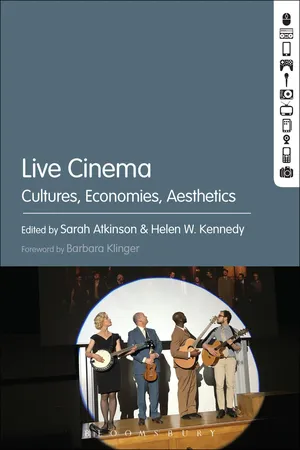
eBook - ePub
Live Cinema
Cultures, Economies, Aesthetics
- 336 pages
- English
- ePUB (mobile friendly)
- Available on iOS & Android
eBook - ePub
Live Cinema
Cultures, Economies, Aesthetics
About this book
Information
Section 1
Spaces
Introduction
Sarah Atkinson and Helen W. Kennedy
We open this volume with a focus on space: the initial typology of live cinema that we proposed (Atkinson and Kennedy 2016) took the alternate spaces and locations of screens, whether enhanced, augmented or participatory as a key definitional characteristic of the form. This increasingly pervasive relocation of screen away from the auditorium, and into exterior locations, on the one hand was made possible and ‘easy’ through new, accessible technologies – such as inflatable screens and directional audio – thus increasing the frequency of these types of screenings and a diversification in the types of spaces of screenings. On the other hand, these new possibilities posed difficulties due to limited flexibility of alternative internal venues – the lack of technical and acoustic infrastructure for the aesthetically satisfactory screening of films in concert halls and music venues. This lack of flexibility is innate in traditional cinema auditoriums as conventionally designed, and their limited capability to provide the specialist technologies for different types of screenings (i.e. those requiring audio mixing, lighting and performative elements, for example).
This section provides us with some rich examples of emergent forms of unbounded cinematic exhibition and the alternative sites of spectatorship in non-auditorium external spaces, including urban, rural, coastal and waterway contexts. These case studies are set within the wider context of cinema as a potential site of critique and for wider debates into placemaking, which both respond to and feed in to emergent tensions that exist between the reclamation of community spaces on the one hand and the impacts of regeneration and gentrification on the other.
One particular example of this tension emerged in the ‘Hit and Run Kino’ in Berlin: ‘an urban hunting experience combined with the chill atmosphere of a great movie night. Hundreds of people meeting up at a seemingly random place somewhere in Berlin, to be lead to an unused, unknown place where they’ll watch a movie somehow connected to it’. This ‘guerrilla tactic’ (de Certeau 1984) of Hit and Run Kino can be seen as a way for audiences to simultaneously reclaim films and urban spaces, in fleeting moments of community building. It is also suggestive of a cinema culture that is inherently democratic and egalitarian. These values are made manifest in one of the participant’s comments on the organization’s website: ‘Are you aware of the fact that you’re about to ruin this phenomenon with your coverage? Boost your ego with something else!’1 This remark illuminates tensions between the ideals of Hit and Run Kino and the commercialized iteration of this type of ‘underground’ experience, which are reminiscent of the clandestine and underground origins of Secret Cinema.
The elaborate stagings of contemporary Secret Cinema are a throwback to these renegade roots and are more comparable to a contemporary theme park replete with transactional opportunities and very often compulsory purchases, for food, drink, merchandise and disposable cameras. In the Back to the Future experience there was even an actual fairground – connections between film and fairground or theme park experiences are never far away. The pier (the focus of one of this section’s contributions) has its own histories of attractions that also belong within this trajectory.
They also invoke new viewing regimes and the alternative and augmented vistas of open-air screenings – a screen set against a coastal landscape, against the backdrop of a distant horizon and sunset opens up new aesthetic experiences, invoking the ‘mobile gaze’ (Anne Friedberg 2002) and the emergent ‘cinematic’ ways of seeing into urban space. The particular spatiovisual qualities of alternatively sited cinema and the ‘dramatically different ambiance of an outdoor screening can transform the reception of a film’ (Levitt, this section).
The theoretical bases for the studies within this section are varied – from film history – to apparatus theory, and this variety is echoed in the histories within which these contemporary examples are situated. Indeed, these works invoke many of the historical precursors that we cited in the introduction to this volume. All contributions situate their studies within a contemporary history of outdoor and open-air film screenings. The methodological approaches include socio-demographic statistical data, qualitative data gathered in interviews with those who attended, and an analysis of the critical and popular reception of the events.
The first contribution in this section (‘Nostalgia and Placemaking at Los Angeles’ Outdoor Movies’ by Linda Levitt) is focused on the nostalgic outdoor moviegoing experience in Los Angeles, through the case studies of Cinespia, Street Food Cinema and Eat|See|Hear, with a particular focus upon how these events contribute to place - making and place shaping. Levitt adopts an online audience reception approach in order to examine how these particular experiences contribute to a sense of community amongst the audience. She provides interesting insights into how personal memory and the shared experience of moviegoing come to ‘turn space into place’. Levitt explores the relationship between space and community, where the film text is less the focus of conversation and features less in memories and feelings of cinemagoing than the site of the experience. The audience data taken from social forums provides a rich form of oral history and presents a methodological intervention into capturing and analysing film audience histories.
In the second contribution of this volume – ‘Beyond the Metropolis: Immersive Cinema in a Rural Context’ – Emma Pett provides an analysis of a rural film audience in contradistinction to representations of the metropolitan audience (particularly the pleasures, behaviours and preferences of those studied by Richard McCulloch and Virginia Crisp, in Chapter 9). Pett illuminates the connections between the site – rural and outdoor – and the audience by focusing on two case studies of rural immersive cinema productions in the UK: Picnic Cinema in Cumbria and Cine North’s immersive productions for the BFI Love season, staged in the Yorkshire towns and villages of Masham, Pateley Bridge and Amerdale in late 2015. The research aligns with broader studies of contemporary rural cinemagoing which have focused on issues of community and cross-generational social relations (Aveyard 2015). In her analysis, Pett also pays attention to the continued role of the immersive cinema screening in community building. Drawing on the work of Aveyard, Pett examines the way in which rural event cinema interconnects with some of the distinctive social characteristics associated more generally with rural cinemagoing, such as resourcefulness, co-operation and an anti-commercial sentiment. Audience research has tended to be metrocentric and there has been little work conducted in the area of immersive cinema in a rural environment, Pett’s work provide a valuable contribution to the overall understanding of audience behaviours through the close study of these under-examined phenomena.
The third chapter, ‘Pop(-up)ular Culture at the Seaside: The British Pleasure Pier as Screening Space’, by Lavinia Brydon and Olu Jenzen, is based on practice-based research project entitled ‘The People’s Pier’ which was funded by the AHRC in the UK. The overall project examines the form of expanded cinema events that are situated on piers. The chapter examines the seaside pier as an alternative and distinctive space for live cinema, through insights garnered through their active participation in and observation of live cinema events. The live cinema offerings are situated within the broader context of seaside entertainment in general and the urban geographies of coastal leisure spaces. This chapter explores a set of enquiries situated at the intersections of cinema-as-event, community cinema and the current cultural and economically regenerative development or ‘re-purposing’ of pleasure piers as community spaces.
Jenzen and Brydon’s account of the pier screenings describes them as affording a double-layered immersive experience; the first aspect of immersion is produced through the environmental framing of the sea and sky which is enabled by the physical structure of a seaside pier, and the second form of immersion is provided by the frame of an outdoor cinema within this setting. Their chapter also examines the continuities of these apparently novel experiences with the piers’ own histories of attractions and entertainments. Drawing on empirical research conducted in collaboration with the Clevedon Pier and Heritage Foundation and the Curzon Community Cinema Clevedon, the chapter considers the traditional British seaside pier as a site-specific location for outdoor screenings, and examines how local communities can ‘reclaim’ a place via site-specific screenings. As a practice-based project, it had two distinct aims: one was to advance techniques through which to engage new or hard-to-reach local audiences, and the other was to explore the potentials and challenges that the open-air pier space offers for the cultural organizations who manage these sites, where their motivations are to avoid the ‘warehouse on stilts’, or commercially driven pleasure piers that are now a dominant feature of our coastal towns.
In ‘Serious Play’: Encountering Urban Space Live at The Floating Cinema’, Ella Harris examines how pop-up cinemas as a social model of film spectatorship are seen to afford and potentially stimulate a critical perspective on urban space through a case study into the London-based ‘Floating Cinema’. The Floating Cinema is a pop-up cinema that operates out of a purpose-built canal boat. The cinema travels the waterways of London bringing pop-up film screenings and related workshops to urban communities. Harris explores a series of events that The Floating Cinema held in the London suburb of Brentford in the summer of 2015 offering a critical account of the modes of encountering public space, cinematic ways of seeing the city and the conflicted instrumentalities those ways of seeing have at a time of rapid urban change.
In each of these chapters, the site of the viewing experience takes precedence over the film text itself, and cinema is foregrounded as a spatialized event that mobilizes new forms of spectatorship, new forms of embodiment and new possibilities for community engagement and participation.
1
Nostalgia and Placemaking at Los Angeles’ Outdoor Movies
Linda Levitt
Family movie night. A first date at the cinema. The must-see cult classic. Sharing films is a way for people to share their lives, their identities and parts of their emotional fabric with others. Movies help audiences make sense of the present and the past, while also connecting viewers to a larger cultural history. Over the last 100 years, the experience of movies has shifted dramatically. From movie palaces to drive-ins to multiplexes to home theatre, ‘going to the movies’ carries different meanings and social weight. The recent renovation and resurrection of movie palaces and drive-ins show the significance of place in the moviegoing experience. The emphasis on place and experience is in part a response to a cultural moment in which movies can be screened instantly in home theatres and on mobile devices or collected for easy access on DVD or Blu-ray. To bring people back to the cinema, some theatre owners are creating the movie theatre as a high-end destination with state-of-the-art audio, unmatched video quality, plush seating and, in some instances, alcoholic beverages and gourmet refreshments. Yet another new development acknowledges that moviegoing is inherently a social event: screening movies outdoors, often in a historic or culturally significant setting, draws audiences to the shared experience of watching a film in the company of others.
While outdoor film screenings are commonplace in many part of the world, the United States has not had a significant tradition of outdoor movies since the prevalence of drive-ins in the post-war years. Anne Friedberg notes that the introduction of television in the years between 1947 and 1957 reduced the moviegoing audience by one - half. Promotions for drive-ins worked to leverage this transformation by encouraging Americans to get out of the house, but with the convenience of not having to get out of the car (2002: 193). The drive-in, with its accessory entertainments of food, music and playgrounds, reached its peak with 4,603 theatres in 1958. As of 2016, only 325 remain.
A renegade move to create outdoor cinema experiences began in 2002 with the Santa Cruz Guerilla Drive-In, a group in California that held flash mob screenings in random locations as a way to assert the use of public space outside of restaurants, shopping malls and other corporate-run locations. Building on the guerilla screenings, many cities in the United States, including Chicago, Tucson and Austin, now host outdoor movies throughout the summer months each year. Because sites that host seasonal outdoor screenings are often rich with cultural history, organizers tie moviegoing to placemaking as an exemplar of cultural heritage tourism. Moviegoing draws visitors to a historical site for an experience: not merely a tour or an education visit, but a leisure activity that is meaningful and memorable. In this regard, outdoor movie screenings can function as a part of placemaking, turning space into place and tying people meaningfully to their communities.
This study focuses on Los Angeles: as home to Hollywood, films are deeply rooted in the city’s economy as well as in its identity as an urban destination and tourist attraction. The sheer volume of films being screened on any given day in Los Angeles is extraordinary. From IMAX to historic movie palaces, from art cinemas to university auditoriums to multiplexes, movies are ubiquitous in the Los Angeles metroplex. The city is unsurprisingly an early adopter of cinema outside, with several screening series vying for the attention of moviegoers across the city. Los Angeles is geographically diverse and large enough to support multiple screenings on a single night, some of which draw visitors as much for the location as for the film itself. Like Cindy Wong’s assertions about film festivals, outdoor film screenings ‘celebrate place’ and can ‘define the very cultural capital that cities and nations embrace as brand name events for cities of the creative class’ (2011: 2). This essay argues that outdoor screenings in Los Angeles celebrate the constellation of place and memory by locating films that reflect Hollywood’s best-known productions consumed in some of Los Angeles’ beloved outdoor places.
The desire to keep the past as part of the present makes Los Angeles a suitable venue for practices that articulate and perform cultural memory. Through tourism and film as nostalgic practices, culture holds onto Hollywood, marking and remarking the palimpsest of the city. The city is a centre of nostalgia, not only for ageing cinephiles but also for young audience members caught up in a passion for the more recent films they have enjoyed, whether on home video or at the IMAX or cineplex. Since the early 2000s, outdoor settings in Los Angeles have increasingly attracted film audiences, many of whom are watching a film they have seen countless times before.
This study considers audience response to three specific outdoor movie-screening series in Los Angeles: Street Food Cinema, with its array of food trucks that turn moviegoing into an event; the Eat|See|Hear series, which screens movies in a variety of significant destinations throughout the city; and Cinespia, which projects films on the exterior wall of the Cathedral Mausoleum at Hollywood Forever Cemetery. While audience members at outdoor screenings use social media sites including Twitter, Facebook and Instagram to share images and publicly share their moviegoing experiences, these tend to be brief notifications and status updates that are quickly posted without much reflection. More extensive discussion of outdoor movie experiences occurs at Yelp.com, a popular site for reviewing businesses and events in specific urban areas. Posts at Yelp are detailed reviews, providing significantly more depth and detail than social media posts. This study analysed 490 reviews for Cinespia Cemetery Screenings, 175 reviews for Street Food Cinema and 91 reviews for Eat|See|Hear at Yelp to determine what audience members found noteworthy and chose to report about the screenings. The earliest review for Cinespia, the longest running of the three series, was posted in September 2005. Themes were limited to mentions of location and atmosphere to determine how outdoor movies help create a sense of place for moviegoers.
Moviegoing and audiences
Outdoor movies are best considered within the realm of what Richard Maltby aptly calls ‘new cinema history’ (2011), a critical approach focused more on moviegoing and the social and cultural impact of film rather than the formal properties of film production and authorship. Maltby sees this perspective as coexisting alongside traditional film studies, bringing a different critical perspective to bear that can enhance film history by extending an eye towards both place and reception. He notes that moviegoing does not occur in a vacuum; rather, audience members bring their lifeways, their experiences and their social circumstances to the cinema. To not take context into account is to fail in understanding ‘the interpretive frameworks likely to have been available to particular audiences’ (2011: 14). This approach is especially necessary in a post-cinema landscape, where going to the movies in a public venue takes on a new set of meanings with the ready accessibility of movies for private consumption. As the cinematic experience changes, outdoor film series draw attention to the social qualities inherent in moviegoing. Whether screenings are at a historic theatre or in a city park, place has a strong effect on the interpretive lens moviegoers bring to the film experience. Film and media studies scholar Barbara Klinger argues that ‘if the same film were to be shown at an art house and a drive-in theatre, the patterns of consumption already associated with each venue would influence the audience’s viewing attitudes and behaviors’ (2006: 19). The filmic experience is influenced significantly by context, and the dramatically different ambiance of an outdoor screening can transform the reception of a film.
While nostalgically drawing on social practices of the drive-in, audiences at outdoor screenings create and perpetuate new patterns of consumption as repeat visitors. Outdoor movie screenings seldom show first-run films. Rather, the typical fare for outdoor screenings tends towards the popular: movies that audience members have already seen and will enjoy for repeat viewings. Many of these films are what will be called ‘cult contemporary’ here because of the cultlike following that results from watching the same film over and over again, to the point where each line of dialogue is familiar if not memorized. Movies create a sense of identification for audiences and help to establish and change worldviews: how we should understand ourselves, how we should interact with others and how our identities are shaped by the communities with which we affiliate.
For a generation that grew up watching movies everywhere but the cinema, the relationship to film is different fro...
Table of contents
- Cover
- Halftitle Page
- Title Page
- Dedication Page
- Contents
- Preface
- Foreword
- Acknowledgements
- List of Tables
- List of Figures
- Live Cinema Presents … Cultures, Economies, Aesthetics:
- Section 1: Spaces
- Section 2: Temporalities
- Section 3: Audiences
- Section 4: Creative and Artistic Practices
- Afterword
- Contributors
- Films, Broadcasts, Performances and Experiences
- Notes
- Bibliography
- Index
- Imprint
Trusted by 375,005 students
Access to over 1.5 million titles for a fair monthly price.
Study more efficiently using our study tools.
Frequently asked questions
Yes, you can cancel anytime from the Subscription tab in your account settings on the Perlego website. Your subscription will stay active until the end of your current billing period. Learn how to cancel your subscription
No, books cannot be downloaded as external files, such as PDFs, for use outside of Perlego. However, you can download books within the Perlego app for offline reading on mobile or tablet. Learn how to download books offline
Perlego offers two plans: Essential and Complete
- Essential is ideal for learners and professionals who enjoy exploring a wide range of subjects. Access the Essential Library with 800,000+ trusted titles and best-sellers across business, personal growth, and the humanities. Includes unlimited reading time and Standard Read Aloud voice.
- Complete: Perfect for advanced learners and researchers needing full, unrestricted access. Unlock 1.5M+ books across hundreds of subjects, including academic and specialized titles. The Complete Plan also includes advanced features like Premium Read Aloud and Research Assistant.
We are an online textbook subscription service, where you can get access to an entire online library for less than the price of a single book per month. With over 1.5 million books across 990+ topics, we’ve got you covered! Learn about our mission
Look out for the read-aloud symbol on your next book to see if you can listen to it. The read-aloud tool reads text aloud for you, highlighting the text as it is being read. You can pause it, speed it up and slow it down. Learn more about Read Aloud
Yes! You can use the Perlego app on both iOS and Android devices to read anytime, anywhere — even offline. Perfect for commutes or when you’re on the go.
Please note we cannot support devices running on iOS 13 and Android 7 or earlier. Learn more about using the app
Please note we cannot support devices running on iOS 13 and Android 7 or earlier. Learn more about using the app
Yes, you can access Live Cinema by Sarah Atkinson, Helen W. Kennedy, Sarah Atkinson,Helen W. Kennedy in PDF and/or ePUB format, as well as other popular books in Media & Performing Arts & Film & Video. We have over 1.5 million books available in our catalogue for you to explore.