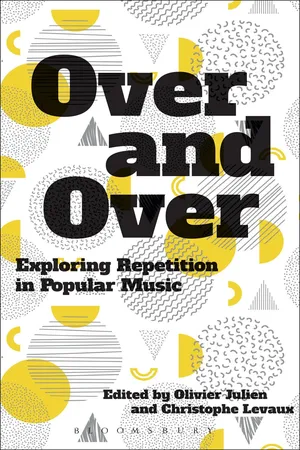
From the Tin Pan Alley 32-bar form, through the cyclical forms of modal jazz, to the more recent accumulation of digital layers, beats, and breaks in Electronic Dance Music, repetition as both an aesthetic disposition and a formal property has stimulated a diverse range of genres and techniques. From the angles of musicology, psychology, sociology, and science and technology, Over and Over reassesses the complexity connected to notions of repetition in a variety of musical genres.
The first edited volume on repetition in 20th- and 21st-century popular music, Over and Over explores the wide-ranging forms and use of repetition - from large repetitive structures to micro repetitions - in relation to both specific and large-scale issues and contexts. The book brings together a selection of original texts by leading authors in a field that is, as yet, little explored. Aimed at both specialists and neophytes, it sheds important new light on one of the fundamental phenomena of music of our times.
A culture of repetition arises when the extremely high level of repetitive structuring necessary to sustain capitalist modernity becomes salient in its own right, experienced directly as constituent of subjectivity.
Robert Fink, Repeating Ourselves (2005: 4)
It is no longer the character who stutters in speech; it is the writer who becomes a stutterer in language. He makes the language as such stutter: an affective and intensive language, and no longer an affectation of the one who speaks.
Gilles Deleuze, “He Stuttered” ([1993] 1997: 107)
As Elizabeth Margulis notes in On Repeat, her wide-ranging study of musical repetition, there is a “stubborn repeatability” to music which sets it apart from language and the other arts (2013: 4). A taste for repetition seems to be one of the few genuine musical universals, according to a small but growing number of cross-cultural empirical studies (see Ollen and Huron 2003). Margulis observes that “musical repetitiveness is so common as to be almost invisible”; the very fact that a stream of sound can be parsed into repeating units effectively musicalizes it, marking out the boundary between intelligibility and noise (1).1 Thus it is striking how ambivalent the post-Enlightenment tradition in the West has been about the subject. While even the most austere modernists have accepted, if grudgingly, the link between repetition and intelligibility (as Arnold Schoenberg puts it, “intelligibility in music seems to be impossible without repetition” (1967: 20), one of the defining characteristics of European musical culture has been a pervasive anxiety about the effects of “too much” repetition, especially at the increasingly porous boundary between art and popular music.2
The case of so-called “minimal” music is instructive. Minimalism in the visual arts was genuinely reductionist but the music that caught people’s attention, of course, was not; 1960s pulse-pattern composers used just as many notes as their predecessors and contemporaries. What they reduced was the amount of difference in their music. From this angle, “repetitive music”—used by composers such as Steve Reich and Philip Glass—is also a misnomer. This music is no more repetitive than any other: it simply refuses to disguise the incessant repetition that underpins all musical forms with the usual composing tricks of variation and development. Refusing to paper over the essential repetitiveness of our shared musical experiences, 1960s minimal music resembles nothing so much as contemporaneous Pop, the art most open to serial repetition and mechanical reproduction. Suzi Gablik once praised Andy Warhol and Roy Lichtenstein for having used chance operations and found images to “avoid tasteful choices,” which allowed them to achieve a “tougher” art (Russell and Gablik 1969: 18). Minimalist repetition in music has this tough-minded quality, which Gablik raises to the level of a moral strategy: it reflects back to us the staggering levels of repetition (musical and otherwise) in our daily world, without the usual comforting veneer of artistic decoration. In this way, fully developed industrial modernity gives rise to a characteristic structure of feeling which one might call a “culture of repetition” (Fink 2005: 3–4) within which works of art engage in “excessive” repetition to aestheticize the massive doses of experiential repetition which necessarily constitute subjectivity in an advanced consumer society. But the resulting relationship between repetition and teleology in music is never simply adversarial: it might be more productive to consider such excess of repetition as a breeding ground for exotic “recombinant teleologies,” that is, for new, deliberately manufactured configurations of sound, repetition, time, and human desire.3
Don’t stop ’til you get enough
As soon as one attempts to define an “excess” of repetition, especially in popular music, an epistemological roadblock arises. It was clear that minimalism in art music was a textbook culture of repetition, because “too much repetition” basically defined the style, especially when contrasted with the maximally non-redundant music which dominated imaginations in the avant-garde of that historical moment. But groove-based popular music is already—has always already been—highly redundant. In fact, no one who actually likes a particular style of electronic dance music (EDM) worries simultaneously that it is “too repetitive.” How does one even talk about a musical culture of repetition when, to take the most obvious example, the once-extreme levels of repetition pioneered by minimalism and techno have long since turned into a marker of the familiar, as normalized in contemporary pop music as guitar distortion in rock or saxophone screams in modern jazz?4
Is it possible to identify a repetitive musical gesture which resists normalization, which intrinsically signifies a culturally significant “excess” of repetition? I do believe such a gesture exists. Even in the most slowly evolving, cyclically repetitive musical environments, one finds arresting moments when the groove’s ongoing orbital progression through time gets audibly “stuck,” enacting, through irregular complex submetrical repetitions of recorded slices, what producers and listeners call a “stutter edit”—or, simply, “a stutter.” My claim is that when we hear music metaphorically “stuttering,” whether or not the moment actually involves the slicing and rearranging of vocal samples, we invoke a particular, highly charged instance of communicative neurodiversity—disfluent speech rhythm—precisely as a sign of excessive repetition. However repetitious a given musical situation may be, a perceptual stutter makes it more repetitious—makes it, at least for a moment, too repetitious.
Musical repetition and stuttering have long been linked; delving into the medical literature, as we will do in some detail below, reveals that the repetitive structures of music have often been prescribed as an antidote for a wide range of speech disfluencies. They have also been used as a framework within which to understand the specifically temporal set of speech disfluencies researchers group together as stuttering. Turning speech into music is also one of the most effective ways to erase a vocal stutter. But—and this is the real point of the comparison—stutter edits in contemporary electronic popular music become a clear sign that music itself can also stutter, analogous in that moment to overloads of repetitions and blockages in poetic speech that trigger transcendent breakthroughs into the pure intensity of performative affect that Gilles Deleuze, perhaps the most consequential philosopher of “excessive” repetition, has influentially called out as making “language as such stutter” ([1993] 1997: 107—my emphasis).
Two “moments of stuttering”
I will begin by calling up two characteristic moments of musical stuttering; this chapter will then proceed as a provisional attempt to explore the aesthetic space between them. In 1969, Alvin Lucier created the elegant and simple piece of minimalist process music, I Am Sitting in a Room. The work proceeds by subjecting recorded speech to audio feedback over and over—a repetitive process in which, as the composer notes, “the resonant frequencies of the room reinforce themselves so that any semblance of speech … is destroyed” (1995: 322). Over the course of forty minutes, looped repetition performs its “magic,” musicalizing a bald statement of the composer’s process and goals into a haunting, fragile structure of extended tones.
One of those goals is self-directed, because the person sitting in the room different than the one we are in now is, of course, the composer himself; as he notes in the text, and as is obvious from early recordings of his recitation, his speech displays striking moments of temporal dysfluency (they cluster around his attempts to pronounce the postalveolar approximant [
] at the beginning of words like “resonant” and “rhythm”), and the repetition process is meant to deal, acoustically, with that fact.
I am sitting in a room different from the one you are in now. I am recording the sound of my speaking voice and I am going to play it back into the room again and again until the resonant frequencies of the room reinforce themselves so that any semblance of my speech, with perhaps the exception of rhythm, is destroyed. What you will hear, then, are the natural resonant frequencies of the room articulated by speech. I regard this activity not so much as a demonstration of a physical fact, but more as a way to smooth out any irregularities my speech might have.
(Lucier, quoted in Collins 1990—my emphasis)
Let us take Lucier at ...
Table of contents
Cover
Half-Title Page
Title Page
Contents
List of Abbreviations and Contractions
List of Musical Examples, Figures, and Tables
Acknowledgments
List of Contributors
Preface
Introduction: Play It Again (and Again), Sam
Part One: Repetition as an Aesthetic Disposition
1 When the Music Stutters: Notes Toward A Symptomatology
2 Time and Time Again
3 Toward an Alternative History of Repetitive Audio Technologies
Part Two: Issues of Perception
4 Loops, Memories, and Meanings
5 Machine Possession
6 Repetition and Musical Meaning
Part Three: Repetition as a Structuring Device
7 From “Sectional Refrains” to Repeated Verses
8 Standard Jazz Harmony and the Constraints of Hypermeter
9 A Psychological Perspective on Repetition in Popular Music
References
Index
Copyright
Trusted by 375,005 students
Access to over 1.5 million titles for a fair monthly price.
Study more efficiently using our study tools.
Frequently asked questions
Yes, you can cancel anytime from the Subscription tab in your account settings on the Perlego website. Your subscription will stay active until the end of your current billing period. Learn how to cancel your subscription
No, books cannot be downloaded as external files, such as PDFs, for use outside of Perlego. However, you can download books within the Perlego app for offline reading on mobile or tablet. Learn how to download books offline
Perlego offers two plans: Essential and Complete
Essential is ideal for learners and professionals who enjoy exploring a wide range of subjects. Access the Essential Library with 800,000+ trusted titles and best-sellers across business, personal growth, and the humanities. Includes unlimited reading time and Standard Read Aloud voice.
Complete: Perfect for advanced learners and researchers needing full, unrestricted access. Unlock 1.5M+ books across hundreds of subjects, including academic and specialized titles. The Complete Plan also includes advanced features like Premium Read Aloud and Research Assistant.
Both plans are available with monthly, semester, or annual billing cycles.
We are an online textbook subscription service, where you can get access to an entire online library for less than the price of a single book per month. With over 1.5 million books across 990+ topics, we’ve got you covered! Learn about our mission
Look out for the read-aloud symbol on your next book to see if you can listen to it. The read-aloud tool reads text aloud for you, highlighting the text as it is being read. You can pause it, speed it up and slow it down. Learn more about Read Aloud
Yes! You can use the Perlego app on both iOS and Android devices to read anytime, anywhere — even offline. Perfect for commutes or when you’re on the go. Please note we cannot support devices running on iOS 13 and Android 7 or earlier. Learn more about using the app
Yes, you can access Over and Over by Olivier Julien, Christophe Levaux, Olivier Julien,Christophe Levaux in PDF and/or ePUB format, as well as other popular books in Media & Performing Arts & Music. We have over 1.5 million books available in our catalogue for you to explore.