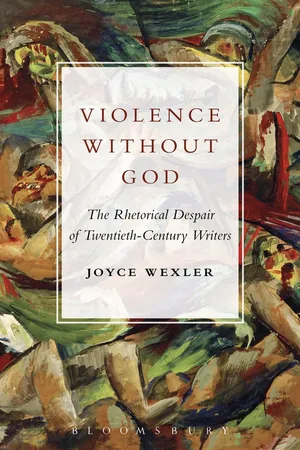
As twentieth-century writers confronted the political violence of their time, they were overcome by rhetorical despair. Unspeakable acts left writers speechless. They knew that the atrocities of the century had to be recorded, but how? A dead body does not explain itself, and the narrative of the suicide bomber is not the story of the child killed in the blast. In the past, communal beliefs had justified or condemned the most horrific acts, but the late nineteenth-century crisis of belief made it more difficult to come to terms with the meaning of violence.
In this major new study, Joyce Wexler argues that this situation produced an aesthetic dilemma that writers solved by inventing new forms. Although Symbolism, Expressionism, Modernism, Magic Realism, and Postmodernism have been criticized for turning away from public events, these forms allowed writers to represent violence without imposing a specific meaning on events or claiming to explain them. Wexler's investigation of the way we think and write about violence takes her across national and period boundaries and into the work of some of the greatest writers of the century, among them Joseph Conrad, T. S. Eliot, D. H. Lawrence, James Joyce, Alfred Döblin, Günter Grass, Gabriel García Márquez, Salman Rushdie, and W. G. Sebald.
- 176 pages
- English
- ePUB (mobile friendly)
- Available on iOS & Android
eBook - ePub
About this book
Information
1
Symbolism in a secular age
Heart of Darkness appeared the same year that Arthur Symons published The Symbolist Movement in Literature, and both texts respond to the period’s secularity. Symons takes the demise of faith for granted and embraces the Symbolist Movement as a turn-of-the-century aesthetic substitute. He interprets the movement as a fight “against exteriority, against rhetoric, against a materialistic tradition,” and he praises Symbolist poets for seeking the kind of meaning that religious faith provides.1 The “conscious” construction of symbols (3), Symons explains, performs a spiritual function: “in speaking to us so intimately, so solemnly, as only religion had hitherto spoken to us, [literature] becomes itself a kind of religion, with all the duties and responsibilities of the sacred ritual” (9). Like other writers of the time, Joseph Conrad reacted to the loss of unifying religious beliefs by searching for alternative versions of nonempirical experience. Conrad did not make his art a substitute for religion, but he did turn to symbolism to resist economic and philosophical materialism. His use of symbolism in Heart of Darkness to represent the violence of colonialism became a prototype for later responses to the nightmares of history. The use of symbolism also became the target of scathing ethical and political attacks, notably by Chinua Achebe and Fredric Jameson.
Using Roman Jakobson’s structural definition of symbolism, we can begin to understand why Conrad and so many other twentieth-century writers found symbolism useful, as well as the reasons that so many critics have objected to it. Jakobson graphs language on a horizontal axis of syntax and a vertical axis of semantics.2 He compares syntax to the figure of metonymy because both are based on contiguity, and he associates semantics with metaphor because both depend on substitution in a given position (78). Extending this model to literary forms, Jakobson argues that realism, which refers to observable reality, is metonymic, and symbolism, which can evoke referents beyond sensory experience, is metaphoric.3 Just as every sentence operates on both the syntactic axis and the semantic axis, every text has realistic and symbolic significance.
Jakobson’s linguistic model clarifies the relation between realism and symbolism in Heart of Darkness. The specificity of realism represents historical conditions, and the multiple meanings of symbolism frustrate attempts to explain events. Conrad signals symbolic meaning by embedding realistic events in various discourses. For example, as Marlow steams upstream, he speaks with the precision of an official report: “It was just two months from the day we left the creek when we came to the bank below Kurtz’s station.”4 These coordinates of time and place are empirical details that establish the verisimilitude of realism. In the next sentence, however, Marlow posits a completely different kind of meaning: “Going up that river was like travelling back to the earliest beginnings of the world, when vegetation rioted on the earth and the big trees were kings” (33). The animistic metaphors suggest an imagined world that is primordial, prehistoric, primitive, and mythic. This oscillation between the empirical referent and nonempirical associations connects historical events to multiple patterns of symbolic meaning.
References to a particular time and place are the end point of realism but the starting point of symbolism. Conrad needed both forms to represent the nightmare of colonialism. He had witnessed the brutality of colonialism in the Belgian Congo, but instead of writing a strictly realistic account of his personal experience, he added multiple symbolic patterns to his story. As the frame narrator says, Marlow is a “seaman” for whom “the meaning of an episode was not inside like a kernel but outside, enveloping the tale which brought it out only as a glow brings out a haze” (5). The multiple meanings of symbolism in a secular period produce such a haze, and Marlow makes the difficulty of describing and understanding his African journey part of his tale.
Conrad’s diverse explanations of the European presence in Africa illustrate the absence of consensus that Charles Taylor associates with secularity. As Taylor explains, when there is a loss of “publicly available orders of meaning,” the proliferation of beliefs weakens the authority of each one.5 Marlow says that his reason for going to Africa is that as a child he was captivated by the continent. It was one of the “blank spaces on the earth,” though by the time he arrived “it was not a blank space any more.”6 His anecdote conveys a boy’s naïve wish for an adventure that would leave a mark on the world. Others have different motives. The Belgian Company’s doctor confides that he has a scientific interest in Africa: “I have a little theory which you Messieurs who go out there must help me to prove. This is my share in the advantages my country shall reap from the possession of such a magnificent dependency” (12). Marlow’s aunt speaks of “weaning those ignorant millions from their horrid ways,” though Marlow considers her view of colonialism “humbug,” and he ventures “to hint that the Company was run for profit” (12). The Eldorado Exploring Expedition comes to Africa for its riches. Although the name of the group echoes Marlow’s boyhood wish, these Europeans are nothing more than “sordid buccaneers,” no better than “burglars breaking into a safe” (30). A variety of reasons for being in Africa—adventure, knowledge, westernization, fortune—drives the colonial enterprise.
But individual motives are inadequate when they lead to violence. Witnessing the casual and opportunistic cruelty of colonialism, Marlow claims that a transcendent belief, an idea, is necessary to justify it:
The conquest of the earth, which mostly means the taking it away from those who have a different complexion or slightly flatter noses than ourselves, is not a pretty thing when you look into it too much. What redeems it is the idea only. An idea at the back of it, not a sentimental pretence but an idea; and an unselfish belief in the idea—something you can set up, and bow down before, and offer a sacrifice to. (7)
Religion no longer sustains this kind of belief, and Marlow’s longing for a redeeming idea seems sincere. The narrative, however, undermines his ethical justification of conquest by introducing Kurtz, who becomes a node of symbolic meanings. As Marlow says, “All Europe contributed to the making of Kurtz” (49). Kurtz expounds the big ideas circulating in Europe at the time. He is reputed to be a journalist, a politician of indeterminate convictions, a scientist, a painter, and a musician. He speaks of love to the young Russian and promises profits to the Company. Kurtz has too many attributes and too many professions. This excess undermines the credibility of each one. By the time Marlow describes him as a “universal genius” (72), the words ironically suggest something more like a con man. The succession of identities that Kurtz assumes is an individual manifestation of the surplus of beliefs Taylor observes in a secular culture. Instead of committing himself to any of these beliefs, Kurtz installs himself as an object of worship: “unspeakable rites” are “offered up to him” (50). Marlow’s justification of conquest and Kurtz’s transgression are both expressed as forms of worship. The parallel between setting up an idea and setting up oneself as something to “bow down before” demonstrates how easy it is to conflate grand ideas and selfish desires.
In his encounter with Kurtz, Marlow confronts the consequences of actions based on merely personal beliefs: “I had to deal with a being to whom I could not appeal in the name of anything high or low. I had, even like the niggers, to invoke him—himself—his own exalted and incredible degradation” (66). The two men have no shared beliefs to ground the meaning of their words. Their impasse is not uncommon, and Marlow calls attention to other examples of the malleability of language. In the colonial vocabulary, natives are “enemies” (14), and indentured African laborers are “criminals” (16). On being told that Kurtz’s victims were rebels, Marlow exclaims, “Rebels! What would be the next definition I was to hear. There had been enemies, criminals, workers—and these were— rebels” (58). This instability of meaning gives his conversations with Kurtz “the terrific suggestiveness of words heard in dreams, of phrases spoken in nightmares” (66). Just as realism fails to express nightmares, it is incapable of conveying Marlow’s extreme experience. Like his contemporaries and successors, Conrad turned to symbolism.
The most provocative source of symbolism in the text is extremity, particularly transgressive extremity. As Michel Foucault argues, the impact of transgression is inherently symbolic.7 Realistic descriptions of extremity convey the particularity of an event—what happened—and symbolic associations convey its impact—how it felt. Marlow uses both strategies to express his astonishment when he sees Kurtz’s house:
These round knobs were not ornamental but symbolic; they were expressive and puzzling, striking and disturbing—food for thought and also for vultures if there had been any looking down from the sky; but at all events for such ants as were industrious enough to ascend the pole. They would have been even more impressive, those heads on the stakes, if their faces had not been turned to the house.8
This passage shows how objects become symbols. Marlow’s reaction begins in empirical description, but the shock of realizing that he is looking at human skulls transforms them from the “ornamental” to the “symbolic.” The extremity of the objects causes them to accumulate additional meanings that are both empirical and nonempirical. The “knobs” become “expressive,” “puzzling,” “striking,” “disturbing”—they are “food for thought,” as well as for vultures and ants. This multiplicity, the capacity of the empirical referent to be itself and something else, represents violence without explaining it.
When Heart of Darkness appeared in Blackwood’s Magazine in 1899, the proliferation of symbolic meanings fed the hunger for nonreligious sources of meaning. In Conrad in the Nineteenth Century, Ian Watt argues that Heart of Darkness “belongs to a specifically symbolic tradition of fiction, and it is the only one of Conrad’s novels which does.”9 Like Taylor, Watt associates symbolism with the breakdown of religious belief. He argues that “Marlow is confronting a general intellectual and moral impasse … and this gap, in turn, can be seen in a wider historical and philosophical perspective as a reflection of the same breakdown of the shared categories of understanding and judgment, as had originally imposed on Conrad and many of his contemporaries the indirect, subjective, and guarded strategies that characterized the expressive modes of Symbolism” (195). Conrad dramatizes this breakdown in Marlow’s reaction to Kurtz. Close to death, in a state of “extremity,” Kurtz whispers, “The horror! The horror!”10 Like someone who encounters the sublime, Kurtz is incapable of saying more. This is the “supreme moment of complete knowledge” (69), yet it is inexpressible. Marlow ponders these words at length. By the time he visits Kurtz’s Intended, the possible meanings even include her name. He tells her: “The last word he pronounced was—your name” (77).
The ambiguity of Kurtz’s last words troubles critics. Patrick Brantlinger, for example, cites the diversity of interpretations of Kurtz’s utterance as evidence that the symbolism in the text cancels “external referents.”11 He argues, “Conrad overlays the political and moral content of his novella with symbolic and mythic patterns that divert attention from Kurtz and the Congo to misty halos and moonshine” (387). Brantlinger assumes that symbolic and mythic patterns undermine political and moral meanings. He prefers the specific “external referents” of realism because they connect meaning to a particular time and place.
In contrast to Brantlinger’s uneasiness with multiple meanings, Marlow accepts uncertainty. He interprets Kurtz’s cry symbolically, that is, as the foundation of a structure that allows innumerable possibilities: “I saw on that ivory face the expression of sombre pride, of ruthless power, of craven terror—of an intense and hopeless despair.”12 Whatever Kurtz means by “The horror!” the word constitutes a judgment. The judgment itself is less important than Kurtz’s willingness to judge. In the absence of moral principles, “He had summed up—he had judged. ‘The horror!’ He was a remarkable man” (70). In a secular period, this passes as an achievement: “After all, this was the expression of some sort of belief; it had candour, it had conviction, it had a vibrating note of revolt in its whisper, it had the appalling face of a glimpsed truth—the strange commingling of desire and hate” (70). Although Kurtz’s last words do not affirm a specific meaning, Marlow regards them as a revelation. Kurtz’s truth, like the sublime, is inexpressible and incontrovertible.
Watt regards this indeterminacy as a weakness in the narrative. He recognizes that symbolism changed in response to the “the intellectual crisis of the late nineteenth century, a crisis by now most familiar to literary history in its twin manifestations of the death of God and the disappearance of the omniscient author.”13 Like Taylor, Watt notes that the relation between particular objects or...
Table of contents
- Cover
- Halftitle Page
- Title Page
- Dedication
- Contents
- Acknowledgments
- Introduction: The problem
- 1. Symbolism in a secular age
- 2. T. S. Eliot’s Expressionist angst
- 3. D. H. Lawrence’s Women in Love and men at war
- 4. Ulysses, the mythical method, and magic realism
- 5. The German route from Ulysses to magic realism
- 6. How to write about the Holocaust
- Epilogue: The end of the secular age
- Bibliography
- Index
- Imprint
Trusted by 375,005 students
Access to over 1.5 million titles for a fair monthly price.
Study more efficiently using our study tools.
Frequently asked questions
Yes, you can cancel anytime from the Subscription tab in your account settings on the Perlego website. Your subscription will stay active until the end of your current billing period. Learn how to cancel your subscription
No, books cannot be downloaded as external files, such as PDFs, for use outside of Perlego. However, you can download books within the Perlego app for offline reading on mobile or tablet. Learn how to download books offline
We are an online textbook subscription service, where you can get access to an entire online library for less than the price of a single book per month. With over 1.5 million books across 990+ topics, we’ve got you covered! Learn about our mission
Look out for the read-aloud symbol on your next book to see if you can listen to it. The read-aloud tool reads text aloud for you, highlighting the text as it is being read. You can pause it, speed it up and slow it down. Learn more about Read Aloud
Yes! You can use the Perlego app on both iOS and Android devices to read anytime, anywhere — even offline. Perfect for commutes or when you’re on the go.
Please note we cannot support devices running on iOS 13 and Android 7 or earlier. Learn more about using the app
Please note we cannot support devices running on iOS 13 and Android 7 or earlier. Learn more about using the app
Yes, you can access Violence Without God by Joyce Wexler in PDF and/or ePUB format, as well as other popular books in Literature & Literary Criticism. We have over 1.5 million books available in our catalogue for you to explore.