eBook - ePub
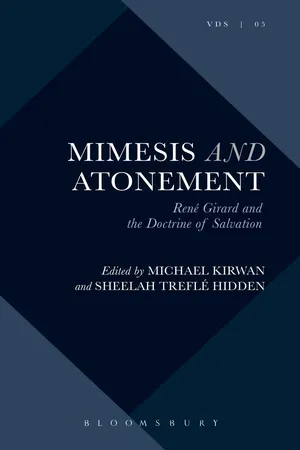
Mimesis and Atonement
René Girard and the Doctrine of Salvation
- 192 pages
- English
- ePUB (mobile friendly)
- Available on iOS & Android
eBook - ePub
Mimesis and Atonement
René Girard and the Doctrine of Salvation
About this book
How are we to best understand the statement of faith that Jesus Christ lived, died and rose again 'for us and for salvation?' This question has animated Christian thought for two millennia: it has also bitterly divided believers, not least in Reformation and post-Reformation disputes about atonement, justification, sanctification and sacrifice. René Girard's Violence and the Sacred (1972) made startling connections between religion, violence and culture. His work has enlivened the theological and philosophical debate once again, especially the question of whether and how we are to understand Christ's death as a 'sacrifice'. Mimesis and Atonement brings together philosophers from Catholic, Evangelical, Orthodox, and Jewish backgrounds to examine the continued significance of Girard's work. They do so in the light of new developments, such as the controversial 'new scholarship' on Paul.
Information
1
Traversing Hostility: The sine qua non of Any Christian Talk about Atonement
James Alison
Recovering Our Lord’s account of his atonement
In each of the three Synoptic gospels, Jesus teaches the parable we know as that of the ‘Wicked Tenants’ or the ‘Murderous Vinedressers’. The place in which the parable is given, the Temple, is the same in each version, as is the timing. It follows Jesus’ triumphant entry into Jerusalem, to the accompaniment of Davidic acclamations, his prophetic acting out of judgement on the Temple and his announcement of its caducity, by means of the overturning of the tables and the blighting of the fig tree. The parable then precedes Jesus’ prophecy of the physical destruction of the Temple and his remarks concerning the unimportance of that event, his eschatological teaching and his closing the parentheses of all this teaching with the final example of the fig tree. In all three cases, the parable is delivered to the Chief Priests, Scribes and Elders (Mk, Mt.) or in their presence (Lk.), and is part of Jesus’ response to their question concerning his authority for performing the signs he has just performed.
There are differences between the three versions of the parable. The Marcan and Lucan versions reveal greater hints of the day-to-day agricultural concerns and property law, which the first listeners would have understood as appropriate to a rental arrangement of the sort described, while the Matthaean version is more schematic – and for anyone interested in following up on those matters, I cannot recommend highly enough the late Duncan Derrett’s masterly discussion.1 It is not, however, those differences that interest me here, but, rather, the way that Matthew resolves the flow of the story by comparison with Mark and Luke.
In Mark’s version (Mk 12.1-12), the parable is a monologue, with Jesus telling the story of the tenants, asking what the owner will do, and himself giving the answer to the effect that the owner will destroy the tenants and give the vineyard to others. Then he quotes Psalm 118 concerning the stone that the builders rejected, and at some point, his listeners pick up that he has told the parable against them. In Luke’s version, Jesus tells the story, asks what the owner will do, and himself gives the answer concerning destroying the tenants and giving the vineyard to others. At this point, his listeners interject: ‘Heaven forbid!’ whereupon Jesus looks at them and asks them what the quote from Psalm 118 means, adding some thoughts concerning falling and being crushed. These seem to be an interpretation of Isaiah 28.16 and Isaiah 8.14-15, appropriately enough for a parable whose most obvious scriptural allusion is to the vineyard of the Lord’s beloved in Isaiah (Isa. 5.1-2). Again the Scribes and Chief Priests, who are among the listeners, pick up that he has told the story against them, and are only restrained by fear of the crowd from arresting him on the spot.
In Matthew’s version (Mt. 21.33-46), Jesus is talking to the Chief Priests and elders, and tells the story of the tenants rather succinctly. However, when he asks what the owner will do when he comes, this is not a rhetorical question, and the Chief Priests and elders supply a vehement answer: the owner will put those bastards to a bastardly death and lease the vineyard to others who will produce its fruit in due season. Reacting to this, Jesus quotes Psalm 118 to them, in wonderment that they seem to have no understanding of it. He then implies that it is because of that lack of understanding that the Kingdom of God will be taken away from them, his listeners, (whom he here addresses directly as ‘you’), and given to others who will produce its fruit. He then adds, at least in some ancient authorities, the verse about falling on the stone and being crushed. The Chief Priests and the Pharisees (whose first appearance is in this chapter – earlier it had been the scribes or the elders who had accompanied the Chief Priests) realize that the parables (i.e. not this one alone) were about them (not against them as in Mark and Luke), and want to arrest him, but fear the crowds.
I take for granted that each of the three versions is a different way, presupposing a different audience, of enabling a Christian preacher, teacher or expositor to make available from highly compacted material something that Jesus really did teach in just the circumstances described, and which was sufficiently dense, complex and surprising that those who first heard it did not grasp it immediately, but gradually. And what the authorities who were listening, and who were by no means stupid, did eventually understand, or thought they understood, was sufficiently shocking that they then contemplated the comparative danger to public order of doing something about it as opposed to doing nothing, neither being a good option. However, whatever it was that Jesus was teaching was not so obviously and straightforwardly blasphemous, seditious or partisan, so that only particularly stupid stage baddies could have missed out on its point until it was too late, when they were left to grind their teeth in a vaudeville of villainous vexation.
I would like to concentrate on Matthew’s account here, since there is something about the pauses, gaps and changes of voice and of emphasis in his version that seem to me especially useful if we are to focus on a particularly Jewish sense of the difference between what is of God and how we humans think. I consider this to be of the essence in bringing out the dimension of awe to which I fear that I, at least, have often failed to bear witness when discussing the atonement.
First, let us remember that Matthew’s account, like all the others, is Jesus’ partial answer to the question put to him by the Chief Priests and those with them as to ‘by what authority he did these things’ – the things in question being his prophetic acting out of the arrival into Jerusalem of the promised Davidic heir, and the symbolic and enacted declarations of the Temple’s usefulness and time having come to an end. So no account of the parable that does not offer some hint of an answer to that question can be said to be entirely plausible.
As most commentators observe, Matthew does not follow the legal niceties present in Luke and Mark, where the owner first sends servants before any fruits could possibly be claimed, servants who must return bloodied as part of showing that they had at least staked their master’s claim. Nor does he seem particularly interested in following the tenants’ progress towards establishing ownership by the law of ‘adverse possession’.2 Rather, in Matthew’s account, the sendings of the servants seem already to be those of the prophets, divided into two series: those from before the Babylonian exile and those after. And so we come to the arrival of the final emissary, the son, whom the tenants refer to as the κληρονόμος (kleronomos), which is usually translated as ‘the heir’, though it might also mean the usurper, or the one who has come to lay rightful claim to the property.
I guess most of us assume that the word ‘heir’ refers to someone who expects in due time to become the owner of the property, rather than someone who, following the demise of the landowner in whose will they are named, is, in fact, already the new owner. But there is in the word itself no indication as to which of the two is the case – and this raises the question of whether or not the tenants in the story thought they were killing their future or their current landlord. If they thought they were killing their future landlord while their current landlord, although distant, was very much alive, they would have been doing something rather stupid, since, of course, the current landlord, on hearing the news, could be expected to engage in reprisals to re-establish his authority.
However, if they thought that the arrival of the κληρονόμος was a sign that the old man had died, and that they were dealing with the current owner, who had, furthermore, arrived without any backup, then killing him was not a bad idea at all – especially if they did it outside the vineyard, so that the circumstances could be murky, and they could prevent his spilled blood from soiling productive ground. Such soiling would, for generations, have rendered the vineyard’s produce impure, and thus much less valuable. Under these circumstances, however immoral it may seem to us, killing him, and doing so off the premises, may well have seemed quite savvy, since there would henceforth be no one to contest their title, and no one to be a witness against them or to vindicate the original owner’s authority.
I hope that you can see that, given the ambiguity concerning the status of the κληρονόμος, how Jesus poses the next question to his listeners and what he means by it are crucial. He asks them, ‘Now when the owner of the vineyard comes, what will he do to those tenants?’ Up until this point in the story, it has not been clear to the tenants that the first owner, the father of the son who has just been killed, was still alive. They may well have thought that there was no owner to come, since they had killed the one they imagined to be the current owner. But for those outside the story, like Jesus’ listeners, it has been obvious all along that the original owner is still alive. So they answer in the obvious way: the original owner will establish his authority over the vineyard, his ownership of it, in a violently retributive way, doing unto the criminals, who thought they had got away with a successful takeover scheme, what they had done to his son.
And here’s the rub: in answering him in the obvious way, Jesus’ listeners remain outside the capacity to imagine the parable as a response to their own question: ‘by whose authority’? For that question concerns the signs they had witnessed, and which were perfectly comprehensible to them, by which Jesus is establishing that he is the Priestly King of Davidic line, promised from of old, turning up to visit the vineyard, and, of course, its Watchtower, the Temple. It would have been perfectly obvious to them all that King David was long since dead, and not capable of turning up with an army to punish anybody. But if Jesus is the long-awaited anointed Son of David, then, in fact, he is not representing the owner: he is the owner.
It is at this point that Jesus shifts register by expressing amazement that they have not understood the verse from Psalm 118 (with which they were certainly familiar, and so had ‘read’ in the obvious sense) concerning the stone that the builders rejected becoming the cornerstone. By asking them ‘Have you never read …?’ he is pointing out to them that they have, by their answer, chosen to remain outside the story, rather than answering him concerning the owner as if they were the tenants from within the story. If they had thought of themselves as the tenants from within the story, and could recognize their own murderousness, then they had in Psalm 118 a rather good defence of what the tenants had done: their putting the one they had thought to be the owner to death was part of a providential plan and the Lord would vindicate his own authority, outside any retributory logic, by making this to be for the best of all of them: ‘This was the Lord’s doing, and it is wonderful in our eyes.’
However, his listeners are either incapable of accepting, or unwilling to accept the implicit challenge, by entering inside the story and seeing themselves as the murderous tenants. Rather, they remain outside it and beholden to an entirely retributory logic of righteous innocence: ‘We would never do anything like that, and anyone who does something like that should have meted out to them the same violence they had themselves meted out.’ It is this retributory logic, preventing them from reading the murder in a providential way, rather than the murder itself, that is the cause of the Kingdom of God being taken away from them and given to a people producing its fruits. It is not the fact of the murder, but whether that murder functions for its accomplices as a source of accusation or of forgiveness, that is going to be key. The retributory logic within which Jesus’ listeners choose to remain will henceforth be perpetually scandalized. They will be outmanoeuvred by the logic of the providential vindication of the Lord’s authority in instantiating and making visible, through his death and resurrection, the mechanism of the aleatory victim. The mechanism was accurately prophesied by David in his psalm, and the consequences of its instantiation clearly understood by Isaiah – for the verses quoted from Isaiah concerning falling on a stone and being crushed point out how exactly the same mechanism that brings salvation to some ties others into scandal.
Please notice the rather subtle distinction I am attempting to bring out: in Jesus’ telling and reaction, it is not at all the fact that the tenants have killed the son that is the problem. In fact, Jesus in telling the parable seems cheerfully unconcerned – indeed, almost indulgent – about the murder. The murder is the baseline, differing reactions to which will determine future tenancy, and it is those differing reactions that bear the weight of the story. Where the parable ‘catches’ its listener is that it requires a movement from outside the story to inside the story if it is to answer the question that the Chief Priests and elders had put to Jesus concerning ‘by what authority do you do these things’. But the moment its listeners take that step inside the story, then they accept complicity, identifying with murderers whose murder is going to be turned to their advantage.
For Jesus is effectively saying to them: The Lord, through David his beloved, planted this vineyard long ago. I, deliberately acting out the coming into the vineyard of David’s son and heir, Am the one whom I am enacting. Hence my entry into Jerusalem, my curing of blind and lame people in the Temple who have not been allowed onto the Temple mound since David’s time, even before Solomon built the Temple (Mt. 21.14; 2 Sam. 5.8-9). Hence my refusal to silence the children who are announcing the return of the Davidic heir. I am bringing to an end the tenancy, with the need to pay me first fruits, which is represented by the Temple. Indeed, I have not found any fruit there, merely a lot of cosmetic foliage, as I demonstrated with the fig tree. Henceforth I intend to be present myself in those working the vineyard. My Davidic authority, which is a first-person authority, will be demonstrated, after you have killed me, in exactly the way David himself prophesied through Psalm 118. The coming of the owner, the posthumous vindication of the son and the bringing to an end of the Temple regime of sacrifice will turn out to be the same thing. And it is only in the light of David’s own words that you could conceivably interpret any question of Davidic authority. From now on, those who are scandalized by their own involvement in the murder that is to happen and by this teaching about it will remain scandalized by it; while those who recognize their complicity with the perpetrators of what has gone on and allow themselves to be forgiven will find themselves producing the desired fruit of the vineyard.
I hope now that it is clearer why Matthew says that the Priests and Pharisees perceived that he was speaking ‘about’ them rather than ‘against’ them: they are being challenged to consider their place in all this. The answer to the question of ‘by whose authority you do this’ is only available when they step inside the story. Yet, the moment they do step inside the story, they are faced with the fact that they are going to have to assess for themselves the first person authority of the one coming towards them. There is no other way to be sure whether they are dealing with the current or the future owner and, therefore, what the owner’s exercise of authority might look like – and they will only understand any answer given to the question of ‘by whose authority you do this’ in the degree to which they accurately assess the one with whom they are dealing. Furthermore, they are being invited to consider that the owner may have a more indulgent understanding of the tenants’ own murderousness than they themselves, an indulgence that shades into a benevolence which they can access precisely in their recognizing that murderousness: ‘This is the Lord’s doing, and it is marvellous in our eyes’ (Ps. 118.23).
I hope it is clear that contemplating this leaves them stuck, both inside and outside the story, as people who are, in fact, thinking about doing to Jesus just what is described, but have no wish for any divine elements to accrue to that. These are not scenarios that are quickly thought through without scandal.
Taking incomprehension seriously
Please excuse the very long introduction to what are going to be some shorter observations. My purpose here is not to remain focused on textual detail, but to enter into the underlying hints of theological vision. I suspect that we have in this parable the nearest thing to Our Lord’s own narrative account of the atonement, a fuller acting out of which he is shortly to perform for his disciples in the Last Supper. In John’s Gospel, the two valencies of the reading of the murder, from outside and from inside the story, are brought out in Caiaphas’ remark about one man dying for the nation, and in the Evangelist’s own gloss on this: that Caiaphas had been telling the truth despite himself, being the mouthpiece of a High Priestly prophecy that was, in fact, being fulfilled, and of whose fulfilment its utterer had no understanding at all.3 Piercing knowledge ...
Table of contents
- Cover
- Half-Title
- Series
- Dedication
- Title
- Contents
- Contributors
- Preface
- Foreword, Rowan Williams
- 1 Traversing Hostility: The sine qua non of Any Christian Talk about Atonement
- 2 Jewish Atonement and the Book of Jonah: From Sacrifice to Non-Violence
- 3 Orthodox Debates in the Twentieth Century on the Question of Atonement
- 4 Wright, Wrong and Wrath: Apocalypse in Paul and in Girard
- 5 Paul and Girard Agonistes: Against Theological Violence
- 6 Salvation through Forgiveness or through the Cross? Raymund Schwager’s Dramatic Solution to a False Alternative
- 7 ‘Strategies of Grace’: Mimesis as Conversion in Girard and in Theology
- 8 Violence Unveiled: Understanding Christianity and Politics in Northern Ireland after René Girard’s Rereading of Atonement
- 9 Sacrifice and Atonement: Strengthening the Trinitarian Aspects of Mimetic Theory
- Index
- Copyright
Trusted by 375,005 students
Access to over 1.5 million titles for a fair monthly price.
Study more efficiently using our study tools.
Frequently asked questions
Yes, you can cancel anytime from the Subscription tab in your account settings on the Perlego website. Your subscription will stay active until the end of your current billing period. Learn how to cancel your subscription
No, books cannot be downloaded as external files, such as PDFs, for use outside of Perlego. However, you can download books within the Perlego app for offline reading on mobile or tablet. Learn how to download books offline
Perlego offers two plans: Essential and Complete
- Essential is ideal for learners and professionals who enjoy exploring a wide range of subjects. Access the Essential Library with 800,000+ trusted titles and best-sellers across business, personal growth, and the humanities. Includes unlimited reading time and Standard Read Aloud voice.
- Complete: Perfect for advanced learners and researchers needing full, unrestricted access. Unlock 1.5M+ books across hundreds of subjects, including academic and specialized titles. The Complete Plan also includes advanced features like Premium Read Aloud and Research Assistant.
We are an online textbook subscription service, where you can get access to an entire online library for less than the price of a single book per month. With over 1.5 million books across 990+ topics, we’ve got you covered! Learn about our mission
Look out for the read-aloud symbol on your next book to see if you can listen to it. The read-aloud tool reads text aloud for you, highlighting the text as it is being read. You can pause it, speed it up and slow it down. Learn more about Read Aloud
Yes! You can use the Perlego app on both iOS and Android devices to read anytime, anywhere — even offline. Perfect for commutes or when you’re on the go.
Please note we cannot support devices running on iOS 13 and Android 7 or earlier. Learn more about using the app
Please note we cannot support devices running on iOS 13 and Android 7 or earlier. Learn more about using the app
Yes, you can access Mimesis and Atonement by Michael Kirwan, Sheelah Treflé Hidden, Michael Kirwan,Sheelah Treflé Hidden in PDF and/or ePUB format, as well as other popular books in Theology & Religion & Christian Denominations. We have over 1.5 million books available in our catalogue for you to explore.