- 184 pages
- English
- ePUB (mobile friendly)
- Available on iOS & Android
eBook - ePub
About this book
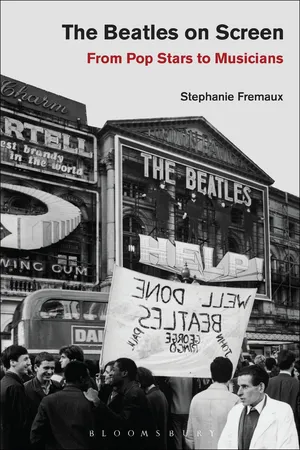
The 1960s ushered in a time of creative freedom and idealism reflected in the popular music and films on both sides of the Atlantic. At the forefront of driving that creative change were four mop-topped musicians from Liverpool, The Beatles. While many scholars have examined their role as songwriters, as countercultural and political figures, and as solo artists, few have considered the important role film played in The Beatles' career. This book focuses on the overlooked films the Beatles performed in from 1964 to 1970 in order to chart their journey from pop stars to musicians. Through these case studies, The Beatles on Screen uncovers how the relationship between film and pop music has changed the ways in which bands communicate with their fans.
Information
1
A Hard Day’s Night: Beatlemania hits the big screen
Writing for the Village Voice on August 27, 1964, film critic Andrew Sarris made a bold comparison between a faddish pop musical and one of the great Hollywood classics by calling A Hard Day’s Night “the Citizen Kane of jukebox musicals.” (Sarris 1970, 161) He also used adjectives such as “brilliant,” “diverse,” and “studied” to describe the Beatles’ first pop film. Citizen Kane is of course best known for Orson Welles’s talents as a director and actor, a film made at the pinnacle of his career, using groundbreaking techniques and mesmerizing aesthetics. On the other hand, A Hard Day’s Night was produced quickly and on a low budget in order to fully exploit the Beatles’ talents before they had become the next passing fad. Though trying to ignore Beatlemania for as long as possible, Sarris could not deny the unusual nature of the film. The story of how A Hard Day’s Night came to be is the same as that of countless other rock ’n’ roll, pop musicals that preceded it. Producer Walter Shenson approached Brian Epstein in October 1963 with a three-picture deal that would give United Artists the right to distribute the films and give the film company ownership of the original soundtrack rights. In return, the Beatles would receive large scale exposure in Europe and in the much-coveted American market, as well as 25 percent of each film’s revenue. Arguably, Epstein’s mistake was in grossly underestimating the Beatles’ worth as he initially only asked for a 7.5 percent share in the deal (Ingham 2003, 193). Having seen the high turnovers Paramount and American International Pictures (AIP) made from the pop musicals starring Elvis Presley and Cliff Richard, United Artists were determined to secure a contract with the Beatles. By 1964, the Beatlemania craze was fully established in both Britain and America and there was already speculation as to how much longer the Beatles’ chart-topping success could last, especially as the band had already been recording and working professionally under contract with Parlaphone since 1962.
Many writers have acknowledged A Hard Day’s Night as being innovative and as having contributed to the development of the pop musical. Donnelly (2001, 18, 19) argues that the film “rethought the possibilities for a film featuring pop music” and that it was not just “a simple vehicle for the group.” Similarly, Agajanian (2000, 96) notes that A Hard Day’s Night “has been recognized as one of the first artistic pop musicals.” Reference has already been made to Medhurst’s (1995) deliberate exclusion of A Hard Day’s Night in his essay on the sixties pop musical, outlining a thesis to examine the “less celebrated mid-60s films which sought out various solutions to the continuing dilemma of how to put British pop on film” (65). Yet, he ironically concludes that any pop musical to ignore A Hard Day’s Night’s successful innovations were actually quite stale and contrived. As outlined in the introduction, previous authors have focused on a basic analysis of genre and themes, but this chapter will consider the film’s reworking of the classical musical and how, through an analysis of the musical sequences, tension is created between the intimacy afforded between star and audience and the restrictive nature of stardom. Drawing upon Dyer (2002) and Sutton’s (1981) work on patterns of meaning in the musical help to gain a better understanding of how the musical sequences function in relation to the narrative to create a point of comparison from the classically inspired teen musicals. Dyer (2002, 20) argues that at the heart of entertainment is the depiction of utopianism and that entertainment “offers the image of ‘something better’ to escape into, or something we want deeply that our day-to-day lives don’t provide.” For the Beatles’ audience, 1964 marked a turning point of new social mobility based on a person’s talents and creativity, rather than their position within the class structure. Marwick (1996; 1998) refers to this in his work as “meritocracy.” This is not to suggest that this new mobility was enjoyed by all or that it was instantaneous. There were still middle- and upper-class white men running companies within the media industries, exploiting their newfound talent. But the potential was there as part of the new optimism of the age, and television news and magazines began to report on musicians and other pop culture figures in ways that were once reserved only for the great Hollywood actors, royalty, and political figures, as stardom gave way to celebrity.
In examining how the Hollywood musicals “promote an idealized ‘utopian’ view of life,” Dyer (cited in Babington and Evans 1985, 3) has studied the representational (character, themes, etc.) and the nonrepresentational (style, music and dance patterns). Applying Dyer’s scholarship to my analysis of A Hard Day’s Night has unraveled contradictions and complexities that do not fit neatly in his definitions. The function of the musical number can vary—Dyer (ibid., 3) argues that the number contains feelings of energy, abundance, transparency, community, and intensity. Similarly Babington and Evans (1985, 15) argue that the numbers are where “the most intense meanings are registered.” In the case of A Hard Day’s Night, the film works on two levels—as a backstage pop musical that allows fans into a fictionalized recreation of pop stardom and as a self-referential take on the subgenre that undermines traditional conventions, questioning the glamorized ideals of stardom that the audience brings to their reading and enjoyment of the film. While the film’s musical sequences provide the moments of close proximity and intimacy for the viewing audience, these are not moments of escape into some utopia for the band. Traditionally, classical Hollywood musicals used a structure that allowed for the narrative and the numbers to be integrated in a way that presents “tension between the real and the ideal,” with the real being represented by the narrative and the ideal depicted in the numbers (Mundy 1999, 56–57). Another way the film differs from classical musicals is in how the latter used the numbers to communicate a lot of information or quickly push the plot forward, and Kislan (1980, 231) uses the dance numbers in West Side Story (dirs. Jerome Robbins and Robert Wise, 1961) as an example of this. Neaverson (1997, 17), however, has noted that A Hard Day’s Night instead,
embraces sequences which do nothing to advance the plot, and the group often seems merely to “exist” within a series of episodic situations rather than to act as highly motivated, goal-orientated protagonists.
However, the mixture of locations, film styles, and the way the fans are depicted, all create underlying tension of entrapment reflected in both the narrative and numbers. Mundy (1999, 57) notes how those performing in the numbers of traditional musicals often use a direct mode of address in order to “implicate [the viewer] in a space where the ideal appears to triumph over the real.” But a closer reading of the musical sequences in A Hard Day’s Night shows that it is not the Beatles who are addressing the viewer in this way. Instead, the stylistic codes associated with live performance and television creates the sense of direct address to the viewers’ experience, to show that they too are part of the Beatles’ story rather than just passive viewers. A high level of inclusion is also reflected in Lester’s reliance on cinema vérité techniques. Most young fans would have read the close-ups of the Beatles as intimate and exclusive moments in which to fetishize their idols. While the film does operate on that level, by taking into account all the other signs of confinement the theme of being trapped by stardom becomes starkly apparent.
Unusually, the film begins with the Beatles already at the height of their success. Performing music and playing in a band to achieve fame was a crucial theme to the teen musicals of the 1950s and early 1960s. Such films depicted the struggles endured on the road to stardom but the Beatles’ film begins with that goal already achieved. It is not a rags-to-riches story, nor does it depict the plight of a teen trying to defy the order of the establishment, and there are no real conflicts or crises to overcome. For fans that feel an allegiance to a particular Beatle, each gets their moment to perform original compositions and these musical sequences work to emphasize the audience/fan’s role within Beatlemania as part of the band’s success. Most of the research on Lester’s style as a director makes the point of noting that despite not being a cinephile, Lester’s practical approaches to filmmaking were very similar to the techniques made popular by French New Wave directors such as Jean-Luc Godard and François Truffaut. Adding to Lester’s style was an interest in jazz music that naturally made him aware of rhythm and pacing. In this way, Lester shows awareness throughout of the duality of the Beatles’ fame by reinforcing that theme of the story with his visual style. By using these unconventional techniques, A Hard Day’s Night is not only aesthetically separated from classical and pop musicals but it also gives an alternative to the restrictive, production-line approach of Hollywood cinema. Paralleling the rigid structure of Hollywood was the “Tradition of Quality” in France. New Wave filmmakers found such cinema to be “old fashioned,” arguing that French cinema was the work of “skilled craftsmen—not inspired by artists . . . who put their very souls into their work” (Greene 2007, 8–9). The early New Wave of filmmakers, along with Lester, favored location filming, made possible by the new technological developments in handheld cameras as well as nonprofessional actors to symbolize their departure from carefully constructed artifice. In this way, these new filmmakers created films that upheld “the notion of truth(s),” not only through production techniques and the developing idea of the filmmaker as auteur, but also through “the need to draw close [. . .] to reality itself” (Greene 2007, 9). Lester draws upon this idea throughout the film and that sense of realism in his approach appealed to the Beatles too.
The other technique that communicates a sense of realism is the use of television performance codes and the ways in which Lester highlights the mechanisms of television production throughout the film. The live show at the end is presented under the premise that it is being televised and the theater that the Beatles perform in has a television gallery space and a stage area that can accommodate television studio cameras. The viewing audience sees the Beatles performing from the gallery, on the on-set monitors, and even through the viewfinder of a stationary camera. Television was “the newly dominant and dexterous medium” that helped to “universalize” the Beatles’ image and performance style (Glynn 2005, 65). Television provided an immediate source of entertainment and information that could be updated and broadcast more quickly than the newsreels in the cinema. Jacobs (2000, 117) argues that television quickly emerged as a medium that could draw on theatrical and cinematic styles to create an experience that was both intimate and expansive—a tradition that television dramas and popular quality programming still achieves today (see also, Nelson 2007; Weissmann 2012). Also, actors had to be aware of the multiple cameras filming their every move during live broadcasts. Specifically, actors “needed to be aware of when and where aspects of their performance were being covered: Is my face in close up now? Where do I turn next?” (Jacobs 2000, 117). Also the initial pop performances on television were broadcast live, giving the viewer a sense of exclusivity and closeness they might not otherwise experience at an actual gig whereas, in the case of the Beatles, US stadium performances had the band situated in the middle of the playing field while the audience was some distance away in the stands. Marwick (1998, 73) notes how television programs targeted toward the youth culture were “integral [to the] rock/pop based youth subculture” and it was also the primary medium that the Beatles were promoted through. Between 1963 and 1965, they regularly appeared on music shows such as Top of the Pops, Thank Your Lucky Stars, and Ready, Steady, Go! and had record breaking appearances on The Ed Sullivan Show and Sunday Night at the London Palladium (see also Lewisohn 2004; Pieper and Path 2005). Even when the Beatles stopped performing live, Top of the Pops used their promotional music film performances regularly.
I would argue that the reason Lester avoided traditional film codes, opting instead for “authentic” musical performances and television codes, was because conventional film form worked to distance the audience from the film star. The idea is that film stars act in order to build “the artifice of becoming the person one was playing” (Marshall 1997, 80). Since as early as the 1920s, the film industry worked hard to “protect the image the star conveyed to the public” (81). This control over a star’s image would naturally make fans want to know more about who the star really was in order to create those connections of investment and ownership associated with fandom and fan practices. Television, on the other hand, is a medium that resides in the intimate spaces of a person’s home. This sense of intimacy was exploited by television in order to give the illusion that “the hidden world of the stars” would be exposed in the more informal and “authentic” atmosphere of live television (Marshall 1997, 125). So rather than sharing the viewing experience with a cinema full of people in a darkened room, a live television performance created the sense that the performance was a personal one for the lone viewer or the nuclear family watching together of an evening. Marshall (1997, 119) makes the point that the “television celebrity embodies the characteristics of familiarity and mass acceptability.” Such characteristics were an integral part of the design of their image and to their success at being accepted by the target audience and their parents. Since the Beatles were not trained actors and since they were not experienced in acting for film, Lester’s decision to focus much of the film’s action around what they were familiar with, performing live and on television, allowed the director to elicit a more continuous and natural performance from the band and enabled the audience a sense of community and a more realistic, behind-the-scenes experience than previous pop musicals.
By complicating the traditional musical formula in these ways, Lester also complicates the narrative/number opposition that Sutton proposes. Sutton (1981, 191) considers the musicals in which the number appears “‘naturally’ as part of the plot,” as it does in A Hard Day’s Night, as the numbers either take place during the band’s free time or as part of the show’s rehearsal. But Sutton also argues that the musical sequences provide the viewer with “a feeling of energy, freedom, and optimism,” while the narrative creates “a sense of inhibition and repression” (191). This separation of narrative and number functionality simply does not happen in A Hard Day’s Night. Until the climactic musical sequence of “Can’t Buy Me Love,” the numbers visually reflect repression and confinement. This again reflects the duality of meaning conveyed in the musical sequences as the viewing audience might experience a sense of intimacy in the use of extreme close-ups and a lack of on-screen fans, but for the Beatles, movement is restricted in the performance spaces and the close-ups could be read as intrusive. Entrapment is not just depicted in physical spaces, but is also caused by the band’s class and age. As youths, the Beatles continually stand up against and defy symbols of authority, but as famous pop stars they are allowed into both discotheques and exclusive gentlemen’s gambling clubs. None of the establishment figures in the film, however, actually pose any real threat as they are presented as being comical caricatures (the gentleman on the train, “I fought the war for your sort”) or as being misunderstood (the police who just want to protect Ringo and Grandfather from being hurt). The narratives of Jailhouse Rock or The Young Ones (dir. Sidney J. Furie, 1961), however, thrive on the conflict within the social hierarchy to drive the narrative. Presley turns to music to escape the social prejudices his character experiences as the result of the jail time he served. Similarly, The Young Ones places the squeaky-clean teens against a corrupt and selfish establishment figure. In both films, the music sequences clearly act as emotional outlets both for the characters who voice their frustrations and for those who use the number as a call to action. On the other hand, the Beatles are presented as the three-dimensional personalities their fans would have recognized from their television appearances and press interviews, whose wit and humor are as much of a desired spectacle as their musical performances. The narrative works to highlight the individuality of the band, just as the musical sequences do, but the narrative also works to stress the gr...
Table of contents
- Cover
- Half Title
- Dedication
- Title Page
- Contents
- Acknowledgments
- Introduction
- 1 A Hard Day’s Night: Beatlemania hits the big screen
- 2 Help! Beatlemania is out of control
- 3 Roll up for the Magical Mystery Tour
- 4 From seaside mystery trips to Pepperland: Aboard the Yellow Submarine
- 5 The end of an era, the end of the Beatles—Let It Be
- Conclusion
- Bibliography
- Index
- Copyright Page
Trusted by 375,005 students
Access to over 1.5 million titles for a fair monthly price.
Study more efficiently using our study tools.
Frequently asked questions
Yes, you can cancel anytime from the Subscription tab in your account settings on the Perlego website. Your subscription will stay active until the end of your current billing period. Learn how to cancel your subscription
No, books cannot be downloaded as external files, such as PDFs, for use outside of Perlego. However, you can download books within the Perlego app for offline reading on mobile or tablet. Learn how to download books offline
Perlego offers two plans: Essential and Complete
- Essential is ideal for learners and professionals who enjoy exploring a wide range of subjects. Access the Essential Library with 800,000+ trusted titles and best-sellers across business, personal growth, and the humanities. Includes unlimited reading time and Standard Read Aloud voice.
- Complete: Perfect for advanced learners and researchers needing full, unrestricted access. Unlock 1.5M+ books across hundreds of subjects, including academic and specialized titles. The Complete Plan also includes advanced features like Premium Read Aloud and Research Assistant.
We are an online textbook subscription service, where you can get access to an entire online library for less than the price of a single book per month. With over 1.5 million books across 990+ topics, we’ve got you covered! Learn about our mission
Look out for the read-aloud symbol on your next book to see if you can listen to it. The read-aloud tool reads text aloud for you, highlighting the text as it is being read. You can pause it, speed it up and slow it down. Learn more about Read Aloud
Yes! You can use the Perlego app on both iOS and Android devices to read anytime, anywhere — even offline. Perfect for commutes or when you’re on the go.
Please note we cannot support devices running on iOS 13 and Android 7 or earlier. Learn more about using the app
Please note we cannot support devices running on iOS 13 and Android 7 or earlier. Learn more about using the app
Yes, you can access The Beatles on Screen by Stephanie Fremaux in PDF and/or ePUB format, as well as other popular books in Media & Performing Arts & Music. We have over 1.5 million books available in our catalogue for you to explore.