- 344 pages
- English
- ePUB (mobile friendly)
- Available on iOS & Android
eBook - ePub
About this book
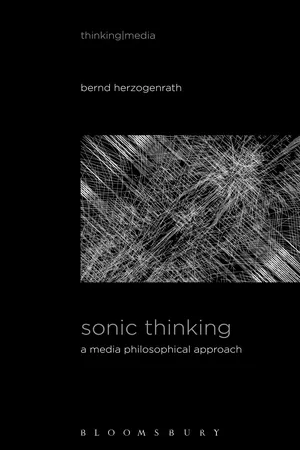
Sonic Thinking attempts to extend the burgeoning field of media philosophy, which so far is defined by a strong focus on cinema, to the field of sound. The contributors urge readers to re-adjust their ideas of Sound Studies by attempting to think not only about sound [by external criteria, such as (cultural) meaning], but to think with and through sound. Series editor Bernd Herzogenrath's collection serves two interconnected purposes: in developing an alternative philosophy of music that takes music serious as a 'form of thinking'; and in bringing this approach into a fertile symbiosis with the concepts and practices of 'artistic research': art, philosophy, and science as heterogeneous, yet coequal forms of thinking and researching. Including contributions by both established figures and younger scholars working on cutting edge material, and weaving artistic responses and interventions in between the more theoretical texts, Herzogenrath's collection provides a lively introduction to a fresh debate.
Information
1
sonic thinking—An Introduction
Bernd Herzogenrath
I would like to start with a set of resonances. First of all, a resonance on the word “resonance”—on the one hand it means something like “echo,” or “reverberation,” on the other hand, the word “reason” is somehow hidden in “resonance.” The French verb résonner makes this resonance even stronger—one might even be tempted to invent the word re[a]sonance here.
Thus, a kind of knowledge is involved here. A kind of thinking—maybe not what we would call rational thinking, but a kind of thinking nonetheless. As the Polish philosopher and mathematician Józef Hoëné-Wronski has it, as quoted by Edgar Varèse: “Music is the corporealization of the intelligence that is in sound” (Varèse 1966: 17). Music as the becoming-body of the knowledge of sound—sound thinking.
Again, also this knowledge that sound is, has a highly interesting resonance in its “wordhood” in French: connaître—knowledge as a process of “being-born-with”—this could mean that this knowledge, this thinking, this re[a]sonance, that sound is not a knowledge about the world, coming to you only in retrospective reflection, but a thinking of and in the world, a part of the world we live in, intervening in the world directly.
Friedrich Nietzsche, in his unpublished early notebooks, dating from the period of his Unfashionable Observations (1872–3), relates the true philosopher to the scientist and the artist as listener: “The concept of the philosopher … : he tries to let all the sounds of the world reverberate in him and to place this comprehensive sound outside himself into concepts” (19[71], 115); whereas the artist lets the tones of the world resonate within him and projects them by means of percepts and affects. So, here, sound-art practice becomes research and philosophy, and vice versa.
Rainer Maria Rilke, in his 1919 essay “Primal Sound” (Urgeräusch in the German original) described an experience he had as a young boy, when introduced to a phonograph for the first time, seeing how the needle produced sounds out of grooves in a wax cylinder, grooves that the recording of actual sounds had put there in the first place. Years later, while attending anatomical lectures in Paris, Rilke connected the lines of coronal suture of the human skull to his childhood observations—“I knew at once what it reminded me of: one of those unforgotten grooves, which had been scratched in a little wax cylinder by the point of a bristle!” (2001: 22). From this incident, Rilke derives the following “experimental set-up”: “The coronal suture of the skull (this would first have to be investigated) has—let us assume—a certain similarity to the closely wavy line which the needle of a phonograph engraves on the receiving, rotating cylinder of the apparatus. What if one changed the needle and directed it on its return journey along a tracing which was not derived from the graphic translation of a sound, but existed of itself naturally—well: to put it plainly, along the coronal suture, for example. What would happen?” (23). Rilke’s obvious answer, is, of course, noise, music—sound! Probing further, Rilke asks himself, “What variety of lines then, occurring anywhere, could one not put under the needle and try out? Is there any contour that one could not, in a sense, complete in this way and then experience it, as it makes itself felt, thus transformed, in another field of sense?” (23).
In a letter, Rilke specifies this idea. Writing to Dieter Bassermann, Rilke speculates on “set[ting] to sound the countless signatures of Creation which in the skeleton, in minerals … in a thousand places persist in their remarkable versions and variations. The grain in wood, the gait of an insect: our eye is practiced in following and ascertaining them. What a gift to our hearing were we to succeed in transmuting this zigzag … into auditory events!” (2007: 391–2).
The project “sonic thinking” aims to serve two interconnected purposes: on the one hand it wants to develop an alternative philosophy of music that takes music seriously as a “form of thinking” (and that might revise our notion of what “thinking” means). On the other hand, it aims to bring this approach into a fertile symbiosis with the concepts and practices of “artistic research”: art, philosophy, and science as heterogeneous, yet co-equal forms of thinking and researching (and let me point out that we are using the concept of “artistic research” not in the meaning of art being a handmaiden subordinate to [and evaluated by] parameters of the sciences [a highly debatable practice], but more as a mediaphilosophical praxeology—artists [in this case: sound artists] thinking with and through their medium [in this case: sound]).
The debate about the sphere of sound is presently fought with high intensity. The emerging field of research “Sound Studies” is primarily discussed in the humanities and social sciences—the “Acoustic Turn” is tackled with the means of cultural sciences and semiotics. These disciplines are however based on foundations that could not be more alien to music (or sound, noise—the “sonic field’). Deeply rooted in one of the major strands of western philosophy, the concepts of cultural studies and especially semiotics are based on what Gilles Deleuze calls “image of thought,” dependent on the metaphysics of being, representation, and identity. Accordingly, a (passive) nature, matter, etc., is “informed” extrinsically, a substance affects existence, the subject organizes (the objects of) experience, progress determines the course of history, etc.
On the other hand, how Hans Jonas, among others, has demonstrated in his groundbreaking essay, “The Nobility of Sight” (1954) these foundations of western existential philosophy are in turn rooted in the ubiquity of a “visual regime”: a hierarchy of senses was established, in which the eye almost inevitably was declared the origin and foundation of all philosophy—central categories like “[in]finity,” “distance,” “abstraction,” and “objectivity,” are indebted to the intrinsic sensory qualities of visual perception. Since the twilight of the nineteenth century the consequences of this hierarchization of the senses (and the “supremacy” of the eye) are discussed with increasing intensity. In his treatise about the origin of tragedy, Friedrich Nietzsche tried to regain the “aural culture” of the old, pre-platonic Greeks, and in a later note he hinted at the revolutionary implications for our culture, which a reorientation away from the eye towards the ear would trigger: “Images in the human eye! This governs the entire nature of the human being: from the eye! Subject! The ear hears sound! An entirely different, marvelous conception of the same world!” (19[66]: 25). Here Nietzsche is congruent with the bigger part of twentieth-century theoretical reflection, that deems the prioritization of the visual sense as the original sin of western thinking.
As Jonas further explains, the concept of “simultaneity”—and eventually of “identity”—is an effect of the visual regime: visual perception constitutes a “co-temporaneous manifold … at rest” (1954: 507), the sense of hearing however “construct[s its] perceptual unities out of a temporal sequence of sensations” (ibid.). Thus the eye suggests the notion of a permanent existence we would not have, if we could merely resort to “time-senses” (like hearing and feeling).
Music and sound, however, can also be considered the “other” of this ontology of being and the visual regime—ephemeral, a time-art, non-visual. So what could be the nature of a “sound thinking”? Initially one would have to oppose (or accompany) the predominant discourses in sound studies to a philosophy that is process-orientated: an ontology of becoming, not of being, which recognizes entities as events and contingent actualizations of virtual potentiality, as a flow consisting of “variously formed matters, and very different dates and speeds … phenomena of relative slowness and viscosity, or … of acceleration and rupture” (Deleuze and Guattari 1987: 3–4); an “alternative” philosophical lineage, which relies on thinkers like Spinoza, Schopenhauer, Nietzsche, Bergson, Whitehead and Deleuze. This perspective transforms “givens” with a preset and stable taxonomy of particular functions and agencies into “a construction site of exploration and connection” (Cox 2003: 3).
From this vantage point, the rigorous division between aesthetics and research (and the likewise rigorous division between the various related [academic] disciplines, e.g., “art” and “science”) can no longer be seriously upheld.
Deleuze is also interested in “the relations between the arts, science, and philosophy. There is no order of priority among those disciplines” (1995: 123) for Deleuze. Whereas science involves the creation of functions, of a propositional mapping of the world, and art involves the creation of blocs of sensation (or affects and percepts), philosophy involves the invention of concepts. According to Deleuze|Guattari, philosophy, art, and science are defined by their relation to chaos. Whereas science “relinquishes the infinite in order to gain reference” (1994: 197), by creating definitions, functions and propositions, art, on the other hand, “wants to create the finite that restores the infinite” (197). In contrast, “philosophy wants to save the infinite by giving it consistency” (197).
Yet, since “sciences, arts, and philosophies are equally creative” (5), it might be fruitful, as Deleuze proposes, “to pose the question of echoes and resonances between them” (1995: 123)—that is, to pose the question of their ecology.
As Deleuze specified in one of his seminars, “Between a philosophical concept, a painted line and a musical sonorous bloc, resonances emerge, very, very strange correspondences that one shouldn’t even theorize, I think, and which I would prefer to call ‘affective’ … these are privileged moments” (“Image Mouvement Image Temps”).1 These moments privilege an affect where thought and sensation merge into a very specific way of “doing thinking” beyond representation and categorization.
The hiatus of art and research is the result of the idea of a linear process ranging from invention|concept (mental) to design (material realization). This however does not do justice to the complexity of the matter: mental and corporeal processes and interactions as well as “implicit/tacit/practical knowledge” become relevant on all levels, for all decisions. As Martin Tröndle has pointed out, conceptual cognitive and manual affective activities go hand in hand, the sensual examination of the material and emotional reactivity is also of highest importance. As Deleuze and Guattari put it in their idea of the “artisan” (rather than the “artist”): “It is a question of surrendering to the [materiality], then following where it leads by connecting operations to a materiality, instead of imposing a form on matter: what one addresses is less a matter submitted to laws than a materiality possessing a nomos” (1987: 408).
The mind is tightly embedded into the interplay between body, environment, and matter. This is the quintessence of Embodied Mind Philosophy. Alva Noë, one of its originators, even takes it...
Table of contents
- Cover
- Half Title
- Series
- Title Page
- Contents
- Acknowledgments
- Contributors
- 1 sonic thinking—An Introduction Bernd Herzogenrath
- 2 Time|Place|Memory: Artistic Research as a Form of Thinking-Through-Media Krien Clevis
- sonic thought i
- 3 Soundscape as a System and an Auditory Gestalt Sabine Breitsameter
- 4 Memories of Memories of Memories of Memories: Remembering and Recording on the Silent Mountain Angus Carlyle
- sonic thought ii
- sonic thought iii
- 5 Sonic Thought Christoph Cox
- 6 in|human rhythms Bernd Herzogenrath
- 7 Sound Without Organs: Inhuman Refrains and the Speculative Potential of a Cosmos-Without-Us Jason Wallin and Jessie Beier
- 8 Buzzing off … Toward Sonic Thinking Christoph Lischka
- 9 Sound Beyond Nature | Sound Beyond Culture, or: Why is the Prague Golem Mute? Jakob Ullmann
- 10 One Dimensional Music Without Context or Meaning Mark Fell
- 11 How to Think Sonically? On the Generativity of the Flesh Holger Schulze
- 12 Immanent Non-Musicology: Deleuze|Guattari vs. Laruelle Achim Szepanski
- 13 Sonic Figure: The Sound of The Black Soft Julia Meier
- 14 Images of Thought | Images of Music Adam Harper
- 15 Digital Sound, Thought Aden Evens
- sonic thought iv
- Index
- Copyright
Trusted by 375,005 students
Access to over 1.5 million titles for a fair monthly price.
Study more efficiently using our study tools.
Frequently asked questions
Yes, you can cancel anytime from the Subscription tab in your account settings on the Perlego website. Your subscription will stay active until the end of your current billing period. Learn how to cancel your subscription
No, books cannot be downloaded as external files, such as PDFs, for use outside of Perlego. However, you can download books within the Perlego app for offline reading on mobile or tablet. Learn how to download books offline
Perlego offers two plans: Essential and Complete
- Essential is ideal for learners and professionals who enjoy exploring a wide range of subjects. Access the Essential Library with 800,000+ trusted titles and best-sellers across business, personal growth, and the humanities. Includes unlimited reading time and Standard Read Aloud voice.
- Complete: Perfect for advanced learners and researchers needing full, unrestricted access. Unlock 1.5M+ books across hundreds of subjects, including academic and specialized titles. The Complete Plan also includes advanced features like Premium Read Aloud and Research Assistant.
We are an online textbook subscription service, where you can get access to an entire online library for less than the price of a single book per month. With over 1.5 million books across 990+ topics, we’ve got you covered! Learn about our mission
Look out for the read-aloud symbol on your next book to see if you can listen to it. The read-aloud tool reads text aloud for you, highlighting the text as it is being read. You can pause it, speed it up and slow it down. Learn more about Read Aloud
Yes! You can use the Perlego app on both iOS and Android devices to read anytime, anywhere — even offline. Perfect for commutes or when you’re on the go.
Please note we cannot support devices running on iOS 13 and Android 7 or earlier. Learn more about using the app
Please note we cannot support devices running on iOS 13 and Android 7 or earlier. Learn more about using the app
Yes, you can access Sonic Thinking by Bernd Herzogenrath in PDF and/or ePUB format, as well as other popular books in Media & Performing Arts & Music. We have over 1.5 million books available in our catalogue for you to explore.