eBook - ePub
The Science of Screenwriting
The Neuroscience Behind Storytelling Strategies
- 184 pages
- English
- ePUB (mobile friendly)
- Available on iOS & Android
eBook - ePub
The Science of Screenwriting
The Neuroscience Behind Storytelling Strategies
About this book
In a world awash in screenwriting books, The Science of Screenwriting provides an alternative approach that will help the aspiring screenwriter navigate this mass of often contradictory advice: exploring the science behind storytelling strategies. Paul Gulino, author of the best-selling Screenwriting: The Sequence Approach, and Connie Shears, a noted cognitive psychologist, build, chapter-by-chapter, an understanding of the human perceptual/cognitive processes, from the functions of our eyes and ears bringing real world information into our brains, to the intricate networks within our brains connecting our decisions and emotions. They draw on a variety of examples from film and television -- The Social Network, Silver Linings Playbook and Breaking Bad -- to show how the human perceptual process is reflected in the storytelling strategies of these filmmakers. They conclude with a detailed analysis of one of the most successful and influential films of all time, Star Wars, to discover just how it had the effect that it had.
Information
Chapter 1
THE SCIENCE OF INFORMATION FLOW, OR, I SAY SCHEMA, YOU SAY SCHEMATA: TOP-DOWN VERSUS BOTTOM-UP
Suppose you are walking along a road and you encounter a large, snarling dog? Your natural reaction might well be to drop your belongings and climb the nearest tree to get out of the dog’s reach. Suppose you do so—and shortly afterward, from your perch on the tree, you watch as another person, in response to the same snarling dog, simply claps her hands, whereupon the dog wags its tail and leaps about playfully?
You’ve just experienced the two kinds of cognitive processes that work in the human brain—and which inform many of the chapters in this book. Screenwriters (and filmmakers) who are aware of their audience’s propensity to arrive at conclusions based on partial information can exploit it to great effect, especially in manipulating and foiling audience expectation.

Figure 1.1Ever encountered one of these? (Art_man/Shutterstock).
Top-Down and Bottom-Up
Perceptual processes—those involving the five senses—rely on external physical stimulation and are termed bottom-up processes. The incoming sensory information arrives through your sense organs as raw stimuli—wavelengths of light, shapes, vibrations in the air—and are passed into the neurons of your brain. Stimuli start at the “bottom”—the outside world—and go up into your brain.
Gradually our experiences are assembled as memories, with emotions and relationships between various stimuli established in the brain’s “experience structures.” While there is no single brain location that stores each new experience, there are some key players in structures beneath the cortex—or surface of the brain—subcortical areas with exotic names like thalamus, amygdala, and hippocampi. All that real-world energy becomes patterns of electrical impulses and is eventually organized into concepts and categories. This process occurs throughout our lives, but is especially active in our early years, when the brain is exposed to a virtually constant stream of new information. From repeated experience with real-world stimuli, we begin to know our world, other people, and ourselves. This experience-based processing enables what is called top-down information flow and evolves into our own personalized understanding of an object or event. The external world enters our brains through our spectacular sensory systems and is perceived only after our brain compares our stored information with new information flowing in.
Thus our response to the snarling dog was not based solely on the sight of an animal with bared teeth; it was a consequence of previous information stored in the brain’s experience structures, information about what snarling dogs look like, cross-referenced with information about what snarling dogs can do to you with their teeth. Our processing starts at the top—our brains—and determines our behavior in the world—down.
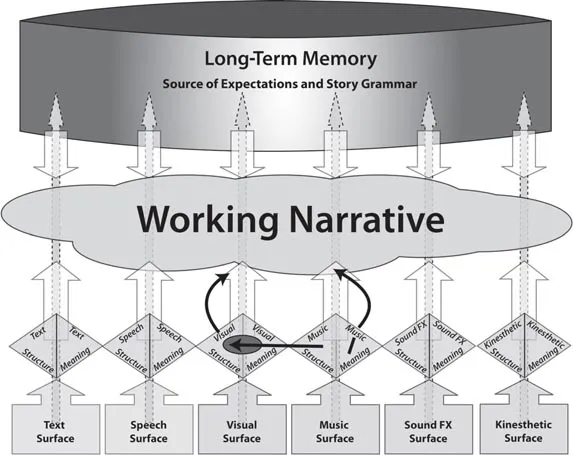
Figure 1.2Cohen’s Congruent Association Model with Working Narrative (CAM-WN).
A. J. Cohen, a psychologist from the University of Prince Edward Island in Canada, has depicted the intersection of top-down and bottom-up as forming the working narrative in a reader’s or a viewer’s brain. From the bottom of the model, she presents six sensory sources of incoming, real-world energy, termed surface information—this is the snarling dog part of the scenario above. Next, sight and sound—now electrochemical brain activity—begin to connect with our search for meaning. In the model, labeled long-term memory, all our life’s experiences, expectations, and understanding feed down, forming a structure to associate what we know with what is incoming: this is where we climb up the tree in our flight from the aforementioned snarling dog. Cohen’s CAM-WN illustrates the audience members’ brains as they process your movie from bottom-up sights and sounds associating with their top-down expectations, as the cloud in the middle, an evolving comprehension of your story, their working narrative.
The woman who appeared after you were in a tree, though, received the same visual information, but responded differently. Why? In this case, her brain contained a piece of information yours lacked—this was her dog. She knew from prior experience that her own dog snarled when it wanted to play.
Actually, she was operating under a different schema than you.
I Say Schema, You Say Schemata
Although our brains are very complex, they are easily overwhelmed by all the information that comes through our senses. As a consequence, the brain works by way of some significant shortcuts. These shortcuts can be manipulated by skillful storytellers in important ways relating to maintaining audience attention.

Figure 1.3If you recognized this object without thinking about it, you can thank your brain’s top-down processing. (USDA/ARS).
One such shortcut is object recognition. For example, the first time you encounter an array of stimuli through your eyes as a pattern of orange and black colors with a distinct shape, these details will be noted and stored in your brain’s memory in detail (bottom-up processing). However, once these details are identified as a butterfly, subsequent encounters with these stimuli will be instantly recognizable as a butterfly (top-down processing) without a detailed analysis. The recognition is virtually instantaneous—a great advantage if your life depends on quickly recognizing a dangerous animal or a possible food source. In addition, your experience encountering a butterfly—warm, sunny day, clouds puffy in blue skies, your caregiver exclaiming “How beautiful! A butterfly!”—shape your object recognition into your attitude and potential behavioral response for the next time you encounter that object. Consider your response if your first encounter with an object is cold, wet, and someone is screeching, “Spider! Squash it!”
So you can see our brain’s object recognition is an integral automatic process that intimately combines bottom-up and top-down information flows. In fact, we really don’t have any control over our ability to recognize things or people—it just happens.
Another very important cognitive shortcut is called a schema (or schemata—the terms are interchangeable): an organized set of related concepts or objects, usually within a specific scene—the word scene in this case having a scientific—as opposed to cinematic—meaning (a figure in the context of a background). For example, if you enter a room and encounter a pile of gift-wrapped boxes, ribbons, place settings consisting of paper plates and plastic forks, and a cake with some candles on it, your brain will likely identify the schema birthday party.
But our top-down processing has another important aspect beyond the simple recognition of patterns and organized shortcuts: it can affect our behavior. In fact, much of the information we receive through our senses is incomplete or ambiguous, and the brain, as a consequence, is quite creative, actively filling in blanks with assumptions, based on experience (this is known in psychology as the theory of constructivism).
The snarling dog you encountered earlier was an object within a scene—strange dog, bared teeth, unattended—and your response was to flee. The woman who played with the dog, though, had a very different response, which informed her behavior: “my dog.” Your incomplete information led you to a conclusion that proved to be untrue, because the snarling dog was not dangerous. When new information arises that contradicts a schema, psychologists term this a violation of one’s schema.
How can the audience’s propensity to construct schemas be exploited by filmmakers? Essentially, any time you experience a “surprise twist” in a movie, chances are the filmmaker gave you clues by which you constructed a schema, then violated the schema by introducing information that was withheld from you.
Examples from cinema are innumerable.
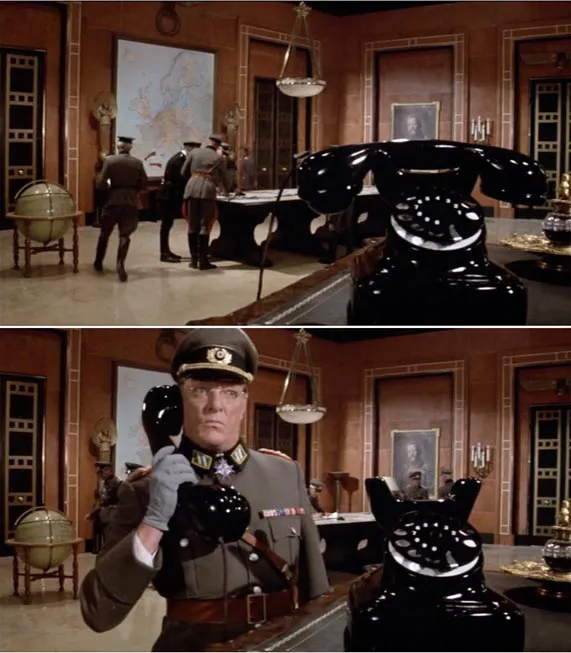
Figure 1.4The schema scene here is office with a phone on the desk in the foreground (top frame). Soon, though, we get new information: it’s a huge phone (bottom frame). The new information is termed by psychologists a violation of the schema scene. From Top Secret (1984).
Several of the sight gags in the 1984 film Top Secret rely on offering the viewer incomplete information, resulting in the construction of top-down connections in the viewers’ mind that, with new information, prove to be false (see Figure 1.4).
Another example of such a top-down construction can be seen in Figure 1.5, from the 1949 film The Third Man. The clues suggest menace; the reality proves to be very different.
Frame versus Scene
Schemas, organized sets of knowledge, are set within frames—a boundary that allows viewers to see the ominous shadow in Figure 1.5 within the frame of a dark, lonely street. Frames, then, are mental limits, setting expectations based on viewers’ experiences (their schemas). When The Third Man changes camera perspective revealing the source of the shadow, viewers have had their expectations violated. Such violations of the frame create tension that helps to hold the viewer’s attention—which is the primary job of any storyteller.

Figure 1.5The shadow of a figure on a dark street suggests menace, creating a good deal of consternation for the characters and audience of The Third Man (1949). When we get new information that the shadow belongs to one very harmless balloon salesman, the schema frame is violated and we (along with the characters) can safely say “never mind.”
Of central importance to screenwriters and filmmakers is the second type of knowledge within schemas, known by psychologists, appropriately enough, as a schema script—the actions we have come to associate with a particular schema. For example, in our birthday party schema, the frame could be a family home or a gathering at a specific place. The schema script would include actions such as arriving guests, lighting candles, singing Happy Birthday, and opening gifts. However, if after everyone sings Happy Birthday, a gunman pops out of the cake and guns people down, we have a violation of script for our schema: An unexpected action has gr...
Table of contents
- Cover
- Half Title
- Dedication
- Title Page
- Contents
- Acknowledgments
- Introduction, or, Should I Save the Cat and Send the Hero on His Journey?
- Chapter 1 The Science of Information Flow, or, I Say Schema, You Say Schemata: Top-Down versus Bottom-Up
- Chapter 2 The Science of Connecting to the Main Character, or, Why Do I Worry That a Meth Dealer Might Get Caught?
- Chapter 3 The Science of Contrast, or, Why Did the Big Huge Spaceship Follow the Little Tiny Spaceship in the Opening of Star Wars?
- Chapter 4 The Science of Exposition, or, What’s Wrong with an Information Dump?
- Chapter 5 The Science of Cause and Effect, or, Did the Packers Really Lose Because I Didn’t Wear My Cheesehead Hat?
- Chapter 6 The Science of Shared Attention, or, If I Write a Screenplay in Which a Tree Falls in the Forest, and the Reader Falls Asleep Halfway Through, Have I Written a Screenplay?
- Chapter 7 The Science of Conflict, or, What’s Wrong with Watching Two Hours of People Just Getting Along and Helping Each Other?
- Chapter 8 The Science of Imagination: Temporal Lobes, How to Think Creatively, Stages of Mind, or, Your Dope-Fueled Imaginings
- Chapter 9 The Structure Question, or, How Many Acts Does It Take to Sell a Script?
- Chapter 10 Star Wars, or, How George Did It
- Chapter 11 Epilogue, or, Go Forth and Create
- References
- Index
- Copyright Page
Trusted by 375,005 students
Access to over 1.5 million titles for a fair monthly price.
Study more efficiently using our study tools.
Frequently asked questions
Yes, you can cancel anytime from the Subscription tab in your account settings on the Perlego website. Your subscription will stay active until the end of your current billing period. Learn how to cancel your subscription
No, books cannot be downloaded as external files, such as PDFs, for use outside of Perlego. However, you can download books within the Perlego app for offline reading on mobile or tablet. Learn how to download books offline
We are an online textbook subscription service, where you can get access to an entire online library for less than the price of a single book per month. With over 1.5 million books across 990+ topics, we’ve got you covered! Learn about our mission
Look out for the read-aloud symbol on your next book to see if you can listen to it. The read-aloud tool reads text aloud for you, highlighting the text as it is being read. You can pause it, speed it up and slow it down. Learn more about Read Aloud
Yes! You can use the Perlego app on both iOS and Android devices to read anytime, anywhere — even offline. Perfect for commutes or when you’re on the go.
Please note we cannot support devices running on iOS 13 and Android 7 or earlier. Learn more about using the app
Please note we cannot support devices running on iOS 13 and Android 7 or earlier. Learn more about using the app
Yes, you can access The Science of Screenwriting by Paul Joseph Gulino,Connie Shears in PDF and/or ePUB format, as well as other popular books in Media & Performing Arts & Film Screenwriting. We have over 1.5 million books available in our catalogue for you to explore.