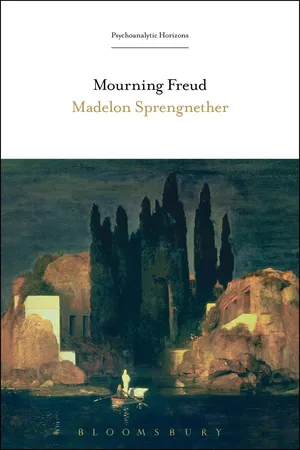
Mourning Freud analyses Freud's experiences and theories of mourning as the basis for exploring changes in psychoanalytic theories and practices over the course of the 20th century.
The modernist Freud of the early 20th century has ceded to the postmodern Freud of the 21st. Madelon Sprengnether examines this phenomenon from the perspective of Freud's self-analysis in relation to his generation of theory, the challenges and transformations wrought by feminism, cultural studies and postmodernism, and the speculations of contemporary neuroscience concerning the unreliability of memory. She offers a significant interpretation of major biographical episodes in Freud's life, arguing that Freud's inability to mourn the losses of his early life shaped his theories of mourning, which in turn opened the field of pre-oedipal studies to his successors, enabling a host of new psychoanalytic theories such as object relations, intersubjective and countertransference theories, Lacanian analysis, and trauma theory. Many of these approaches converge on the formulation of mourning as critical to the process of ego development. Through this argument, Sprengnether traces the shift from modernism to postmodernism-from an emphasis on mastery to vulnerability, from vertical to horizontal systems of meaning-making, and from what is representable in words to the realm of the nonverbal.
Mourning Freud, by exploring Freud's own struggles with mourning, allows us, in turn, to mourn him-releasing him from frozen idealization while demonstrating the relevance of his work to the 21st century.
- 288 pages
- English
- ePUB (mobile friendly)
- Available on iOS & Android
eBook - ePub
Mourning Freud
About this book
Information
PART ONE
Biography and Theory
1
Reading Freud’s Life
Naturally the writer’s life will be seen as irrelevant to his works if you reduce biography to the level of gossip. But if you respect the biographer’s art, a better alternative presents itself. Rather than maintain that a philosopher’s moral character has no bearing on his thinking, wouldn’t it make more sense to suppose that the life and thought of a philosopher, a writer, or a literary theorist must interact in numerous complex and significant ways?
DAVID LEHMAN, SIGNS OF THE TIMES
In a series of essays on the life and death of Sylvia Plath, Janet Malcolm draws the following distinction between fiction and nonfiction. “The facts of imaginative literature,” she writes, “are as hard as the stone that Dr. Johnson kicked. We must always take the novelist’s and the playwright’s and the poet’s word, just as we are almost always free to doubt the biographer’s or the historian’s or the journalist’s” (1993, 138). The shock value of this statement derives from its reversal of the usual alignment of poetry, drama, and fiction with the realm of illusion, non-fiction with fact. “In imaginative literature,” she continues, “we are constrained from considering alternative scenarios—there are none. This is the way it is. Only in nonfiction does the question of what happened and how people thought and felt remain open” (138). The point she is making is that biography is a matter of interpretation, a particular construction of the available evidence, from a special angle of vision. This should not be news to a contemporary practitioner, yet the striking thing to me about the standard biographies of Freud (Ernest Jones 1953–57 and Peter Gay 1988) is precisely their consistency, their failure to present competing perspectives on the same (and gradually expanding) body of materials.1
Freud himself, I believe, is largely responsible for this phenomenon, having first created, then promulgated a construction of his life that continues to circulate in the work of his major biographers. The effect of such unanimity not only sustains Freud’s own self-image but also implies a homologous relationship between his theory, insofar as it derives from his labor of self-analysis, and his life. Should Freud prove to be a fallible narrator/interpreter of his own life, certain aspects of his theory might also come into question.
In my own practice of reading Freud’s life, I wish to disrupt the canonical version of his biography by demonstrating the way it derives from and legitimizes Freud’s own heavily invested self-construction, and then to offer an alternative and competing version of two episodes of Freud’s life based on existing evidence. I hope to make clear how much is at stake not only in the interpretation of Freud’s life but also in the construction of biography generally.
Freud’s self-fashioning
Writing to his fiancée, Martha Bernays, in the spring of 1885, Freud declares that he has nearly completed a purge of his personal papers, having destroyed “all my notes of the past fourteen years, as well as letters, scientific excerpts, and the manuscripts of my papers,” an action “which a number of as yet unborn and unfortunate people will one day resent” (E. Freud 1975, 140). That Freud had in mind his future biographers becomes evident in the following comment:
I couldn’t have matured or died without worrying about who would get hold of those old papers. Everything, moreover, that lies beyond the great turning point in my life, beyond our love and my choice of a profession, died long ago and must not be deprived of a worthy funeral. As for the biographers, let them worry, we have no desire to make it too easy for them. Each of them will be right in his opinion of “The Development of the Hero,” and I am already looking forward to seeing them go astray. (141)
According to Ernest Jones (1953, xii), Freud conducted a similar purge in 1907 on the occasion of his making some changes in his living arrangements, while his departure from Vienna offered Anna Freud and Marie Bonaparte the opportunity (presumably at his direction) to sift through his papers and correspondence, “burning masses of what they considered not worth taking to London” (Vol. 3: 223).
Freud was consistent in his hostility toward the notion of being discovered or anatomized by his biographers. When Bonaparte approached him in 1936 with the idea of purchasing his letters to Wilhelm Fliess from a Berlin bookseller, Freud countered with a proposal to obtain them himself, with the clear intention of destroying them. “I want none of them to come to the notice of so-called posterity,” he told her, warning her further that “with the very intimate nature of our relationship, these letters naturally dilate on just anything” (Gay 1988, 614). Bonaparte (with her eye on history in this instance) resisted Freud’s urgent pleadings to allow him to dispose of the letters, depositing them instead in the Rothschild Bank in Vienna, where they remained until after the Anschluss.
When Arnold Zweig suggested, on the basis of his close acquaintance with Freud and reverence for his work, that he write his friend’s biography, Freud acted quickly to squelch the idea. “No, I am far too fond of you to permit such a thing,” Freud responded with genial finality, adding somewhat testily that “anyone who writes a biography is committed to lies, concealments, hypocrisy, flattery and even to hiding his own lack of understanding, for biographical truth does not exist, and if it did we could not use it” (E. Freud 1970, 127).
The exuberance of Freud’s comment to Martha concerning the obstacles he has set in the path of his future biographers, whose task it will be to construct a narrative of heroic development, contrasts sharply with his admonition to Zweig, which concludes with the sardonic observation: “Truth is unobtainable, mankind does not deserve it, and in any case is not our Prince Hamlet right when he asks who could escape whipping were he used after his desert?” (127). Whereas early in his life Freud imagined his biography in somewhat mythic terms as “The Development of the Hero,” later he seems to have feared not only the depredations of false flattery and outright misrepresentations of fact but also the kind of critical judgment that the disclosure of his intimate life circumstances might bring. While Freud is undoubtedly right to emphasize the “impossibility” of biography, its pursuit of an unobtainable truth, his own efforts to lead his biographers astray, if not actually to prevent his life from being written, bears closer scrutiny.2 Specifically, for someone whose major theoretical concepts derive from his labor of self-analysis and whose published writings repeatedly refer to aspects of his own experience, such resistance to the notion of his own biography virtually cries out for interpretation.3
When Freud, who never wrote a formal autobiography, finally did produce a work focused explicitly on himself (An Autobiographical Study 1925), it was almost exclusively an account of his professional life, devoted to a description of his medical career and the way in which he was led to the founding of psychoanalysis. Indeed, in his 1935 postscript to this essay, he avers that his life has no particular status of its own apart from the history of that movement. “Two themes,” he writes, “run through these pages: the story of my life and the history of psycho-analysis. They are intimately interwoven.” Further, “This Autobiographical Study shows how psycho-analysis came to be the whole content of my life and rightly assumes that no personal experiences of mine are of any interest in comparison to my relations with that science” (71). It seems that Freud wishes to subsume his life into his work and to be known henceforward only through this medium. Later, in the same postscript, he offers a rationale for this stance. “The public,” he states categorically,
has no claim to learn any more of my personal affairs—of my struggles, my disappointments, and my successes. I have in any case been more open and frank in some of my writings … than people usually are who describe their lives for their contemporaries or for posterity. I have had small thanks for it, and from my experience I cannot recommend anyone to follow my example. (73)
Evidently wishing he had been more discreet, Freud now wants to spare himself further discomfort. By enfolding his life into the history of psychoanalysis, Freud not only protects his personal privacy but in the same stroke recreates himself as a cultural icon, no small accomplishment, given his designs on posterity.
Freud’s self-portrayal in his Autobiographical Study, while strikingly unautobiographical in the commonly understood sense, does, however, convey significant information about how he wanted to be perceived by future generations. In this regard, his seeming detachment, and hence objectivity, betrays an undertone of urgent instruction. A cluster of statements dealing with issues of isolation, independence, and priority, for instance, attest to Freud’s investment in his status as heroic founder or originator and hence his belief in his singular personal destiny.4
As a student at the university, Freud states that he stood apart from his contemporaries by virtue of his Jewishness, which conferred on him an alien identity. Refusing this characterization on the grounds that he has never felt any reason “to feel ashamed of [his] descent,” Freud nevertheless admits that he suffered from a degree of social ostracism. “I put up, without much regret, with my non-acceptance into the community; for it seemed to me that in spite of this exclusion an active fellow-worker could not fail to find some nook or cranny in the framework of humanity” (9). Later, as if to congratulate himself for his ability to sustain himself in a hostile environment, Freud distinguishes between himself and his former friend and mentor Josef Breuer on the basis of the latter’s thin-skinned response to criticism of their jointly published Studies on Hysteria. “I was able to laugh,” Freud claims, “at the lack of comprehension which [Strumpell’s] criticism showed, but Breuer felt hurt and grew discouraged” (23). When Freud finds Breuer, whose “self-confidence and powers of resistance were not developed so fully as the rest of his mental organization,” unable to follow him in his research into the sexual origins of the neuroses, he clearly also implies that the older man falls short of his own standard of intellectual courage and stamina (23).
Freud returns to this theme in regard to the early reception of his psychoanalytic studies. “For more than ten years after my separation from Breuer,” he states unequivocally, “I had no followers. I was completely isolated. In Vienna I was shunned; abroad no notice was taken of me” (48). Even after his work began to attract attention, Freud steadfastly maintains that its reception in Germany was “nowhere friendly or even benevolently non-committal” (49). “After the briefest acquaintance with psycho-analysis,” he concludes rather bitterly, “German science was united in rejecting it” (49). Freud’s description of his trip to the United States in 1909 contrasts with this portrait of nearly unrelieved isolation, yet it functions in part to draw out the full implications of his European disregard. “Whereas in Europe I felt as though I were despised,” he tells us indignantly, “over there I found myself received by the foremost men as an equal” (52). Freud’s summary of what he calls the “first phase” of psychoanalysis is considerably more blunt. “I stood alone, ‘he states flatly,’ and had to do all the work myself” (55).5
Freud’s professions of his isolation, combined with his emphasis on himself as sole originator of psychoanalysis, constitute what I would call a profound labor of self-construction. In this otherwise modest summary of his life’s work, Freud offers very clear instructions about how he wants to be viewed from the vantage point of history—as a quietly heroic figure who has virtually single-handedly brought about a revolution in consciousness. For the most part rhetorically successful, Freud’s narrative efforts are punctuated, however, by two instances of conspicuous anxiety: the first when he all but blames his fiancée Martha for standing in the way of his achieving early fame for discovering the anesthetic properties of cocaine, and the second when he goes out of his way to dismiss the work of Pierre Janet as in any way anticipating his own.
In an otherwise smooth description of his early scientific activities, Freud makes a sudden detour to describe why he did not become famous for advocating the use of cocaine as an anesthetic in ophthalmic surgery. After introducing the subject of his marriage in 1886, he interrupts the flow of his narrative to dilate on the subject of this missed opportunity. “I may here go back a little,” he begins, “and explain how it was the fault of my fiancée that I was not already famous at that youthful age” (14). His experiments with cocaine, he explains, were cut short by the prospect of a visit to his fiancée in Wandsbek from whom he had been separated for two years. In his absence, a colleague, Carl Koller, to whom he had spoken about his work, conducted the crucial experiments, which demonstrated the specific usefulness of the drug in anesthetizing the eye. Koller published a paper on the subject and thus earned credit for the discovery.
There is evidence that Freud did not immediately resent his failure to achieve this distinction, but rather that his annoyance at having been superseded by his friend developed over time, as he became aware of the full significance of the fact that the use of cocaine for a variety of medical problems had come into disrepute. Shortly after the publication of Koller’s paper, for instance, Freud wrote to Martha that “a colleague has found a striking application for coca in ophthalmology and communicated it to the Heidelberg Congress, where it caused great excitement,” concluding, evidently without rancor, that “it is to the credit of coca, and my work retains its reputation of having successfully recommended it to the Viennese” (Jones 1953, Vol. 1: 88). Three months later, his attitude toward Koller’s celebrity seems unchanged. “On Sunday,” he writes to Martha, “Koller was on duty at the Journal, the man who made cocaine so famous with whom I have recently become more intimate” (E. Freud 1975, 131). Most of what follows, as if to indicate Freud’s lack of envy for his friend’s success, is taken up not with cocaine but with Koller’s response to a personal insult.
Freud’s attitude toward the issue of priority seems to have undergone a gradual transformation, until he came to regard himself as the virtual author of Koller’s discovery. In retelling this story many years later, Freud emphasized his own awareness of the anesthetic properties of cocaine, thus enhancing his role in the critical finding of its application to the eye, while downgrading that of Koller by laying stress on his rather narrow medical aims in conjunction with his obvious opportunism.
One day I was standing in the courtyard with a group of colleagues of whom this man was one, when another interne passed us showing signs of intense pain. [Here Freud told what the localization of the pain was, but I have forgotten this detail.] I said to him: “I think I can help you,” and we all went to my room, where I applied a few drops of medicine, which made the pain disappear instantly. I explained to my friends that this drug was the extract of a Southern American plant, the coca, which seemed to have powerful qualities of relieving pain and about which I was preparing a publication. The man with the permanent interest in the eye, whose name was Koller, did not say anything, but a few months later I learned that he had begun to revolutionize eye surgery by the use of cocaine, making operations easy which till then had been impossible. (Brackets in Jones 1953, Vol. 1: 86)
In 1924, when Freud composed his Autobiographical Study, he was perturbed enough by his failure to gain credit for the one property of cocaine that had proven of lasting medical use that he was willing to implicate his fiancée in his lapse. Calling it an “omission” [“mein damaliges Versäumnis”], however, he took the final blame on himself. By 1935, his judgment had once again changed. This time he concluded his discussion of this episode by saying that he “bore [his] fiancée no grudge for the interruption” [“die damalige Störung,” emphasis mine], clearly implying that she alone was responsible for his not having pursued his research further (15, n. 2).
From this distance in time, Freud’s need to assure his audience that only his love for his fiancée stood in the way of his having become famous at a relatively early age speaks more to his anxiety about his personal distinction as well as to his reputation for having indiscriminately endorsed cocaine than it does to the truth of his claim to have been the first to divine its specific anesthetic properties.6
Freud’s tirade against Pierre Janet, in the midst of an otherwise dispassionate account of the early development of psychoanalysis, betrays similar self-promotional concerns. Here it is the vehemence of Freud’s assertion that he owes nothing to the work of Janet, whose studies he and Breuer had once cited as bearing on their own, which suggests something more than an impersonal judgment.
After carefully distinguishing between his and Janet’s understanding of the dynamics of hysteria, Freud claims, in something of a non sequitur, that “this distinction seems to me to be far-reaching enough to put an end to the glib repetition of the view that whatever is of value in psychoanalysis is merely borrowed from the ideas of Janet” (31). Once having embarked on this topic, moreover, he cannot let it go. “The reader will have learned from my account that historically psychoanalysis is completely independent of Janet’s discoveries,” Freud continues, “just as in its content it diverges from them and goes far beyond them” (31). Janet’s works, next to his own, he states, are negligible and “would never have had the implications which have made psycho-analysis of such im...
Table of contents
- Cover
- Halftitle Page
- Title Page
- Dedication
- Contents
- Preface
- Acknowledgements
- Introduction: Insight and Blindness
- Part One: Biography and Theory
- Part Two: Transitions
- Part Three: Ghosts and Ancestors
- Conclusion
- Works Cited
- Index
- Imprint
Trusted by 375,005 students
Access to over 1.5 million titles for a fair monthly price.
Study more efficiently using our study tools.
Frequently asked questions
Yes, you can cancel anytime from the Subscription tab in your account settings on the Perlego website. Your subscription will stay active until the end of your current billing period. Learn how to cancel your subscription
No, books cannot be downloaded as external files, such as PDFs, for use outside of Perlego. However, you can download books within the Perlego app for offline reading on mobile or tablet. Learn how to download books offline
Perlego offers two plans: Essential and Complete
- Essential is ideal for learners and professionals who enjoy exploring a wide range of subjects. Access the Essential Library with 800,000+ trusted titles and best-sellers across business, personal growth, and the humanities. Includes unlimited reading time and Standard Read Aloud voice.
- Complete: Perfect for advanced learners and researchers needing full, unrestricted access. Unlock 1.5M+ books across hundreds of subjects, including academic and specialized titles. The Complete Plan also includes advanced features like Premium Read Aloud and Research Assistant.
We are an online textbook subscription service, where you can get access to an entire online library for less than the price of a single book per month. With over 1.5 million books across 990+ topics, we’ve got you covered! Learn about our mission
Look out for the read-aloud symbol on your next book to see if you can listen to it. The read-aloud tool reads text aloud for you, highlighting the text as it is being read. You can pause it, speed it up and slow it down. Learn more about Read Aloud
Yes! You can use the Perlego app on both iOS and Android devices to read anytime, anywhere — even offline. Perfect for commutes or when you’re on the go.
Please note we cannot support devices running on iOS 13 and Android 7 or earlier. Learn more about using the app
Please note we cannot support devices running on iOS 13 and Android 7 or earlier. Learn more about using the app
Yes, you can access Mourning Freud by Madelon Sprengnether in PDF and/or ePUB format, as well as other popular books in Psychology & Literary Criticism for Comparative Literature. We have over 1.5 million books available in our catalogue for you to explore.