Building Socialism reveals how East German writers' engagement with the rapidly changing built environment from the mid-1950s to the early 1970s constitutes an untold story about the emergence of literary experimentation in the post-War period. It breaks new ground by exploring the centrality of architecture to a mid-century modernist literature in dialogue with multiple literary and left-wing theoretical traditions and in tune with international assessments of modernist architecture and urban planning.
Design and construction were a central part of politics and everyday life in East Germany during this time as buildings old and new were asked to bear heavy ideological and social burdens. In their novels, stories, and plays, Heiner Müller, Christa Wolf, Günter Kunert, Volker Braun, Günter de Bruyn, and Brigitte Reimann responded to enormous new factory complexes, experimental new towns, the demolition of Berlin's tenements, and the propagation of a pared-down modernist aesthetic in interior design. Writers' representation of the design, construction, and use of architecture formed part of a turn to modernist literary devices, including montage, metaphor, and shifting narrative perspectives. East Germany's literary architecture also represents a sophisticated theoretical reflection on the intractable problems of East Germany's socialist modernity, including the alliance between state socialism and technological modernization, competing commitments to working-class self-organization and the power of specialist planners and designers, and the attempt to create an alternative to fascism.
eBook - ePub
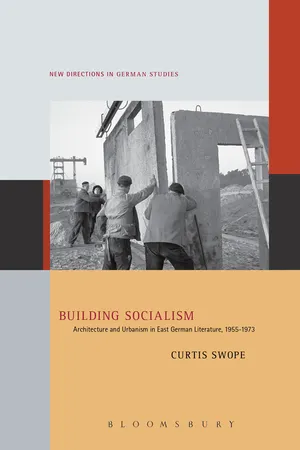
Building Socialism
Architecture and Urbanism in East German Literature, 1955-1973
- 256 pages
- English
- ePUB (mobile friendly)
- Available on iOS & Android
eBook - ePub
About this book
Information
Part I
Framing East Germany: Marxism, Architecture, and Literature
Introduction
In a 1968 talk, East Germany’s leading architect, Hermann Henselmann, gave an expansive definition of architecture:
By the term “architecture,” I mean the spatial organization of people’s way of living. It is both a passive and active means of material and intellectual communication. As a component of intellectual-cultural communication it functions as a “sign” and medium of the intellectually and psychically conditioned substance of individuals and of the community of citizens.1
For Henselmann, who by the time of this quotation knew the writings of Marxist theorists Walter Benjamin and Theodor Adorno, and of Modernist architect Walter Gropius, architecture stands in a close dialectical relationship with the human beings who make and use it.2 Architecture is not a bourgeois art that conveys clear meanings through facades. Rather, in Henselmann’s Marxist and Modernist view, architecture bridges base and superstructure and transcends narrow disciplinary boundaries. In so doing, it reclaims its role as a fundamental means for meeting the material and emotional needs of human communities.3 The structures people build for work, play, and housing grow from and shape everyday life as much as language does. Architecture is for Henselmann not a discrete art form, but a built environment inseparable from the daily realities of human existence. Buildings shape and are shaped by the “substance” of individuals and communities; architecture has an intimate connection to everyday human existence across diverse cultures.
Henselmann’s views on architecture stand in a long tradition among twentieth-century Marxist commentators and Modernist architects.4 Benjamin, who was familiar with the architecture of the Swiss Modernist Le Corbusier and Gropius and with architectural historian Siegfried Giedion’s writings on modern architecture, notes in his Arcades that “architecture was the earliest [of the arts] to historically outgrow the concepts of art, or, better said, it could least endure being viewed as ‘art’.”5 Accordingly, Benjamin finds in the built environment of Paris the revolutionary communicative potential that Henselmann ascribes to architecture in its nearness to everyday life. For the Modernist architect Richard Neutra, whose career began in Germany in the 1920s, continued in the United States in the 1930s, and culminated with recognition on both sides of the Iron Curtain, the notion of the “built environment” superseded traditional definitions of architecture and became the centerpiece of a theory about the use and experience of built space.6 So, for the Marxist Benjamin, the Modernist architect Neutra, and the East German architect Henselmann, buildings are not unchanging projections of architectural intent. Rather, they are characterized by mutual interaction with the human beings who make and use them and by their place in the ever-evolving physical, social, and psychic context in which they stand.
What are the ramifications for novels, plays, and poems that represent the design, construction, and use of built space as part of the fabric of everyday life? To answer this question, Building Socialism analyses built space in the literature of East Germany’s Scientific Technological Revolution, from 1955 to 1973.7 From Heiner Müller’s production plays of the 1950s to the publication of Brigitte Reimann’s architect-novel, Franziska Linkerhand (1973), the built environment was a defining element in playwrights’ and novelists’ structural and linguistic choices and a literary platform for critiquing East Germany’s modern industrial society in an internationally attuned way. For writers as politically diverse as Müller, Helmut Baierl, Erik Neutsch, Karl-Heinz Jakobs, Brigitte Reimann, Günter de Bruyn, Christa Wolf, and Günter Kunert, the representation of buildings, streets, and interiors was never a static backdrop to human agency. Instead, it was imbued with an urgent temporality, for example of social revolution or the history of the working class, that impinged upon the temporality of dramatic action and narrative structure and became implicated in the choice between metaphoric and descriptive language.8
There are three main ways that built space is temporal in the literature treated in this study. First, it gives evidence of the movements of history, particularly of East Germany’s rush to industrial modernity. The second is that it is not merely a surface to be mined for semantic meanings but also a material object whose value is dependent on the process of its design and production. The third is that it exerts its effects after the moment of production through continual use and reuse by different communities of users. Architecture is for Benjamin, as for Henselmann, something whose production and use are inherent to its status as an object of aesthetic interest. Paul Eggert, in his Securing the Past, defines texts as meeting points of different forms of agency: “The document, whether handwritten or printed, is the textual site where the agents of textuality meet: author, copyist, editor, typesetter and reader. In the acts of writing, copying or reading, the work’s documentary and textual dimensions dynamically interrelate: they can be seen as a translation or performance of one another.”9 This applies well to architecture. Designers, builders, and users all have a hand in shaping the physical structure of buildings themselves and the way those structures come to be understood as part of everyday life. In his analysis of the use of architecture in Use Matters, Kenny Cupers asks how the “unknowable universe of everyday experience” of built space can “trickle back into the conception and production of architecture” and insists on the historical specificity of this process.10 The East German novels and plays treated in Building Socialism were conceived in part as Marxist analyses of built space meant to intervene in the perception and production of architecture—necessarily temporal processes.
The temporality of built space—its production, use, and place in history—has an effect on literary structure because it makes architecture a platform for generating associations with people and places not immediately part of a building’s tangible reality. A building’s production process and use history depend on but transcend the visual forms of the physical structure. Temporalized built space thus creates gaps between the physical and the mental, between present, future, and past, and between the unfeeling object itself and the troubled flesh and blood of those confronted with it. These gaps, which address the fraught relationship of language and reality, lie at the heart of how the temporality of built space influences the linguistic and structural choices of literature. Building Socialism uncovers such gaps through close analysis of key passages supported by contextual information ranging from letters to archival material. Key passages include ekphrastic descriptions by characters or narrators of building interiors and exteriors; passages that mention specific tastes in or styles of architecture, or specific architects or designers; and textual moments in which making buildings, arranging home interiors, and using the built environment are explored in their sensory and emotional dimensions.
Building Socialism is organized into three parts. The first part, consisting of the Introduction and Chapter 1, lays the theoretical groundwork for the interaction of architecture, literature, and modernity in twentieth-century socialist thought. This includes, in the introduction, the little studied nexus of Marxism and architectural theory and how Hermann Henselmann’s architectural theories brought Marxist and Modernist spatial thought into the GDR. Chapter 1 then treats the role of architecture in Bertolt Brecht’s journals and poetry, the Soviet writer Sergei Tret’iakov’s essays about Germany, Anna Seghers’s pre-war prose, Adorno’s Aesthetic Theory, and Benjamin’s Arcades. Key concepts addressed include ones that recur in subsequent chapters: old neighborhoods as latently revolutionary; Modernist architecture as a static, anti-human imposition; the industrial city as a modern threat to human life; the improvised use of architecture.
The second part of this book, consisting of Chapters 2 and 3, analyses architecture and modernity in socialist theater at the start of the Scientific-Technological Revolution. Chapter 2 deals with Heiner Müller’s production plays Der Lohndrücker (The Scab, 1957) and Der Bau (The Construction Site, 1963–4). It does so using Müller’s own dual concept of architecture, drawn from archival material, which saw buildings as both expressions of modern power structures and potential platforms for revolutionary action. Chapter 3 examines the text and staging of Helmut Baierl’s Frau Flinz (1961). Baierl and the production team thought that architectural forms had fixed meanings: some, such as unadorned window frames, projected socialism’s alliance with modernity in East Germany, while others, such as baroque detailing, undermined it. The Flinz team’s limiting architectural vision is revealed through archival material that shows the influence of Walter Ulbricht himself on set design choices.
Part III, by far the longest part of the book, examines the prose of the 1960s in two chapters. Chapter 4 addresses the representation of domestic space, while Chapter 5 focuses on urban environments. In Chapter 4, domestic space in Günter de Bruyn’s Buridans Esel (Buridans Ass, 1968), Christa Wolf’s Nachdenken über Christa T (Pondering Christa T., 1968), Irmtraud Morgner’s Haus am Rand der Stadt (1962), and Brigitte Reimann’s Franziska Linkerhand (1964/73) is placed in terms of Alexander Kluge’s theory of the novel of diversity, in which descriptions of home interiors functioned as destabilizing subplots. These writers’ architectural passages function as stand-alone theoretical ruminations that interrupt the forward movement of the action. Chapter 5 treats urban space in literature in connection to the Benjaminian notion of the urban montage and its afterlife in GDR architectural theory. De Bruyn, Reimann, Morgner, Wolf, in her short story “Unter den Linden” (1968), and Günter Kunert in his short prose on Berlin, developed increasingly patchwork prose structures to account for the ...
Table of contents
- New Directions in German Studies
- Volumes in the series:
- Dedication
- Title
- Contents
- List of Illustrations
- Acknowledgments
- PART I FRAMING EAST GERMANY: MARXISM, ARCHITECTURE, AND LITERATURE
- Introduction
- 1 Socialist Writers and Modern Architecture
- PART II ARCHITECTURE, THEATER, AND THE EARLY YEARS OF THE SCIENTIFIC-TECHNOLOGICAL REVOLUTION
- 2 Confronting the Construction Site: Heiner Müller from Operativity to Metaphor
- 3 Towards a Bourgeois Architecture: Helmut Baierl’s Frau Flinz and the Space of the Class Enemy
- PART III ARCHITECTURE AND MODERNITY IN THE PROSE OF THE 1960s
- 4 Time at Home: The Domestic Interior in Günter de Bruyn, Irmtraud Morgner, Brigitte Reimann, Christa Wolf, and Gerhard Wolf
- 5 Literary Responses to East German Urbanism
- Conclusion
- Bibliography
- Index
- Copyright
Trusted by 375,005 students
Access to over 1.5 million titles for a fair monthly price.
Study more efficiently using our study tools.
Frequently asked questions
Yes, you can cancel anytime from the Subscription tab in your account settings on the Perlego website. Your subscription will stay active until the end of your current billing period. Learn how to cancel your subscription
No, books cannot be downloaded as external files, such as PDFs, for use outside of Perlego. However, you can download books within the Perlego app for offline reading on mobile or tablet. Learn how to download books offline
Perlego offers two plans: Essential and Complete
- Essential is ideal for learners and professionals who enjoy exploring a wide range of subjects. Access the Essential Library with 800,000+ trusted titles and best-sellers across business, personal growth, and the humanities. Includes unlimited reading time and Standard Read Aloud voice.
- Complete: Perfect for advanced learners and researchers needing full, unrestricted access. Unlock 1.5M+ books across hundreds of subjects, including academic and specialized titles. The Complete Plan also includes advanced features like Premium Read Aloud and Research Assistant.
We are an online textbook subscription service, where you can get access to an entire online library for less than the price of a single book per month. With over 1.5 million books across 990+ topics, we’ve got you covered! Learn about our mission
Look out for the read-aloud symbol on your next book to see if you can listen to it. The read-aloud tool reads text aloud for you, highlighting the text as it is being read. You can pause it, speed it up and slow it down. Learn more about Read Aloud
Yes! You can use the Perlego app on both iOS and Android devices to read anytime, anywhere — even offline. Perfect for commutes or when you’re on the go.
Please note we cannot support devices running on iOS 13 and Android 7 or earlier. Learn more about using the app
Please note we cannot support devices running on iOS 13 and Android 7 or earlier. Learn more about using the app
Yes, you can access Building Socialism by Curtis Swope in PDF and/or ePUB format, as well as other popular books in Literature & Architecture Criticism. We have over 1.5 million books available in our catalogue for you to explore.