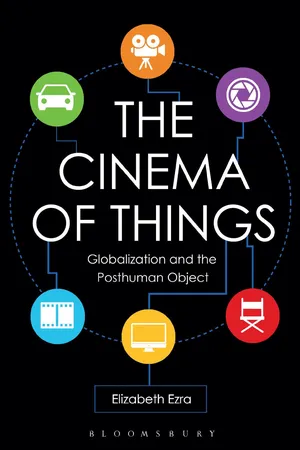
This book explores the border zones between life and non-life as represented in cinema from the end of the nineteenth century, when France led the global film industry, to the first decades of the twenty-first century, when world film markets are dominated by Hollywood. Informed by both the Internet of Things and the Parliament of Things, The Cinema of Things examines cinematic depictions of the ways in which human beings are prosthetically engaged with life beyond the self in the global age: by hyperconsumption; by structures of racial and sexual objectification that reduce people designated as "others" to objects of fascination, sexual gratification, warfare, or labor; and by information technology that replaces human agency with encoding.
Consumer culture, a key feature of globalization, posits that we must supplement ourselves with commodities without which we would otherwise be incomplete: but these prostheses, rather than enhancing us, end up creating the insufficiencies they were meant to overcome. We are engulfed by objects, to the extent that we ourselves are becoming objectified. At the same time, objects, especially technological objects, are becoming increasingly autonomous, assuming roles that were once the preserve of human agency. We are becoming the objects of globalization, and cinema imaginatively represents this transformation, but it also offers us the possibility of retaining our humanity in the process.
- 216 pages
- English
- ePUB (mobile friendly)
- Available on iOS & Android
eBook - ePub
About this book
Information
1
Consuming Objects
Commodity culture is the most visible emblem of the supplementarity that characterizes globalization. The drive to purchase and surround oneself with objects seems never to be sated and is fueled by planned obsolescence, capitalism’s privileged temporal mode. The pinnacle of planned obsolescence is fashion, whose acolytes are, by definition, engaged in a never-ending search for the new. Beginning with an analysis of Sex and the City 2 (SATC2), a sequel in the brunch-and-stiletto franchise that started life as a television series and culminated in a cinematic ode to the excesses of consumer society, this chapter explores the hyperconsumption that underpins the culture of planned obsolescence, and the cultural implications of all the waste thus generated.
The biological process of consumption is, of course, eating. In digestion, matter that is surplus to requirements is not absorbed but is excreted from the body. The consumption of commodities replaces biological consumption for stick-thin female characters either shown forgoing food, or eating far more than the actors who play them clearly do, in films such as Sex and the City (SATC) (Michael Patrick King, 2008) and SATC2, and The Devil Wears Prada (David Frankel, 2006). The excessive consumption depicted in these films has its correlate in biological metaphors of waste in films such as Bridesmaids (Paul Feig, 2011) and The Help (Tate Taylor, 2011), whose preoccupation with excrement equates human waste with what Zygmunt Bauman (2004) calls the “wasted lives” of exploitation. By examining these films together, it is possible to trace a trajectory from the manifest content of advanced consumer culture to the latent biological metaphors of toxic bodies characterized by obesity and excrescence, visible signs of excess that hint at consumption’s gurgling underbelly. These films also ultimately suggest a larger social dimension to the dynamic of consumption and waste in advanced consumer culture: the consumption and waste of the labor and lives of human beings in a global system marked by the imbricated legacies of sexism, colonialism, racial segregation, and exploitation.
The current phase of advanced consumer capitalism is unsustainable, as many have argued, and in its very excesses, its frenzied will to power, it is transforming into other things. The emphasis on reuse, recycling, and sustainability is one such transformation. If in SATC2, Carrie and company are so wed to their purchases that they risk changing places with them, becoming almost an extension of the commodities with which they surround themselves, Micmacs à tire-larigot (Micmacs, Jean-Pierre Jeunet, 2009) takes this exchange to its logical conclusion, imbuing objects with a life of their own. For Jane Bennett, “The sheer volume of commodities, and the hyperconsumptive necessity of junking them to make room for new ones, conceals the vitality of matter” (Bennett 2010: 5). This vitality is revealed in Micmacs, which rejects the commodity culture whose apogee SATC2 represents, replacing the planned obsolescence emphasized in the latter film with an ethic—and an aesthetic—of salvage. The celebration of obsolescence in commodity culture is counterbalanced by its refusal in what I am calling “reuse value.” The ragtag band of homeless people in Jeunet’s film who live together beneath a refuse dump in the film reuse discarded objects, revealing the palimpsestic layering of different eras that accrete to the objects themselves when they are given a new lease of life. In Micmacs, the attributes of people and those of objects have changed places: the memory-imbued objects are, in a sense, alive, while the people have been consigned to the scrapheap of history. Through sheer pluck and determination, those whom history has discarded manage to turn discarded objects into what, in many ways, is an idyllic new home. This film thus allegorizes the vitality of matter, while presenting a vision of resistance to structures of objectification—but a vision whose utopian aspirations are compromised by its lapses into the very objectification it seeks to expose.
“Dubai is so last year”: Sex and the City 2
Sex and the City 2, as is apparent from the title, is a sequel. As such, it supplements an earlier film, Sex and the City (SATC, Michael Patrick King, 2008) which itself supplemented the television series of the same name, each of whose episodes supplemented the preceding ones, all of which supplemented the 1997 collection of essays by Candace Bushnell (and all of which were in turn supplemented by the televisual prequel The Carrie Diaries, which ran in the United States from 2013 to 2014). Not only in its form, but also by virtue of its subject matter and images, the second film in the franchise invites a meditation on the manifold forms and figures of supplementarity. In particular, it is the temporal dimension of supplementarity, obsolescence, that structures the film’s principal themes of biological reproduction, urban modernity, and commodity culture: or sex, the city, and shoes.
The television series charted the romantic escapades of four single women living in Manhattan, working in glamorous jobs, shopping for designer labels, and meeting for brunch to discuss their colorful sex lives. The main character, Carrie Bradshaw, writes a newspaper column entitled “Sex and the City,” which discusses the customs and mores of single life in a quasi-anthropological fashion, from the point of view of a participant-observer who is at once removed from and part of the phenomenon she is describing. In the first feature film based on the series, Carrie finally marries “Big,” the man with whom she has had an on-again, off-again relationship for several years, and her three girlfriends are all, despite some wobbles, happily settled with husbands or boyfriends, and, in the case of Miranda and Charlotte, children. In the second film, the sexually voracious and slightly older Samantha is single again, and Carrie fears she is beginning to grow bored with her marriage. The friends jump at the chance to accompany Samantha, who works as a publicist, on an all-expense-paid trip to Abu Dhabi, where much of the action is set (though the film was actually shot in Morocco). In Abu Dhabi, the women experience romantic crises, which force them to reassess their individual domestic lives, before Samantha offends the locals with her overtly sexualized behavior, and the four are ignominiously sent home.
When SATC2 was released in 2010, reviews were overwhelmingly hostile. Although critics duly condemned the film’s lackluster script and dubious gender and racial politics, much of the criticism focused on its aging stars, who were deemed to be over the hill, too “old” to portray sexually desirable (and desiring) fashion icons. Ella Taylor in the Village Voice, for example, opined that “Sarah Jessica Parker is now 45 years old, and, frankly, I cannot stomach another moment of the simpering, mincing, hair-tossing, eyelash-batting little-girl shtick,” and described “sadistic close-ups of faces too old for th eir fuck-me junior attire and problems 15 years too young” (Taylor 2010: n.p.). Andrew O’Hagan compared the film unfavorably to its televisual predecessor, declaring that, in the television series, the women’s dreams “appeared to chime with those of many a late-twentysomething looking for love. Now, though, Carrie Bradshaw is 45 and Samantha, her blonde slut friend, is 53, and it’s more than difficult to love them” (O’Hagan 2010: n.p.). It is worth pointing out, however, that the actors playing Carrie (Sarah Jessica Parker), Charlotte (Kristin Davis), and Miranda (Cynthia Nixon) are all younger than those playing the principal male love interests (both Parker and Davis were born in 1965 and Nixon in 1966, while Chris Noth, who plays Big, was born in 1954, and John Corbett, who plays Aidan, was born in 1961); even Kim Cattrall, who plays menopausal elder stateswoman Samantha, is two years younger than Chris Noth. None of the female actors plays a character significantly younger than herself, and none of the male actors was criticized for playing a character unbefitting his age. Yet, because they were approaching the end of their childbearing years, the women were considered obsolete, surplus to requirements. In Hollywood, after the age of about forty, female stars either disappear, migrate to television, or, if they are lucky, establish below-the-title afterlives as “character” actors (unlike male actors, whose age is ignored until they cannot walk unaided or speak without dribbling).
Carrie tries to combat the oppression of obsolescence through her interest in vintage items. Though deeply invested in the latest fashions, she ultimately prefers vintage clothes and jewelry. Although in the first film she models a number of up-to-the-minute designer wedding gowns in the pages of Vogue and wears one of them to her aborted wedding, she eventually gets married in a vintage dress. Carrie passes herself off as a kind of Luddite, who, in the first film professes not to know how to use an iPhone and needs help sorting out her email and is told by Big, as she reads a library book in bed, that she must be the last person in New York who still takes out library books (as if to reinforce this point, Carrie plans her dream wedding at the New York Public Library). The watch she presents Big for their wedding anniversary in SATC2 is, she notes, vintage. This film sequel insists on the passage of time in its visual emphasis on clocks, and it exhibits a nostalgic fondness for the past in an early flashback sequence in which the four female friends are shown as they are supposed to have looked when they first met in the 1980s.
The apparent privileging of the past over the present also figures in the conflict between Carrie and Big over DVDs (which would allow Carrie to watch her “black-and-white films”) versus TV (on which Big wants to watch sporting events and modern-day action films). Although cinema has traditionally depicted television unsympathetically, the antipathy is especially ironic here, given that SATC started life as a TV show. But the thing that most appeals to Carrie about DVD technology may be the fact that it allows viewers to freeze individual frames, creating a “stillness” that Laura Mulvey calls cinema’s “best-kept secret” (Mulvey 2005: 22). Carrie’s preference for cinema evokes Stiegler’s hypothesis of an “essentially cinemato-graphic structure for consciousness in general” (Stiegler 2011: 13; original hyphen). Cinema is a means of mechanical reproduction, like the photograph, but it is also a means of mirroring the temporal flux that characterizes consciousness. For Stiegler, this mirroring of the temporal flux does not merely reproduce the workings of consciousness; it is the “revelation of the structure of all temporal objects” (Stiegler 2011: 21). Conversely, live broadcasts (including the kinds of television programs that Big likes to watch, such as sporting events) do not show that which has already taken place, and so do not reveal the workings of retentional finitude, or the consciousness of temporality (Stiegler 2011: 16–21). This dichotomy, which highlights Carrie’s acute awareness of the passage of time, thus brings to the fore the structure of obsolescence itself, and, in particular, the notion of a “biological clock.”
A dangerous supplement
Youth for women in SATC2 (as for women in Hollywood) is implicitly equated with the capacity to bear children—hence the perimenopausal cut-off point implied in the scathing reviews of the film. Samantha spends much of her time popping pills, slathering on creams, and consuming estrogen-rich foods in order to turn back the tide of menopause. She fears becoming surplus to requirements in the economy of sexual attraction, which seems to be linked, for women, to the ability to reproduce. In her previous appearances in the earlier film and the television series, Samantha never expresses any anxiety about the aging process; it is only when she reaches the point of losing her fertility once and for all—despite her unchanging resolve to remain childless—that she becomes hysterically attached to preserving her youth. “When you ladies are fifty,” she proclaims, flaunting the rejuvenating effects of her hormone treatments, “I’ll be thirty-five.” It is precisely because Samantha has never expressed any desire to have children that her sexuality is perceived as excessive.
Miranda’s problems with maintaining a work-life balance certainly do not provide any incentive for Samantha to change her mind about childbearing. Miranda is the quintessential working mother, too busy working to attend her child’s school functions, and too busy looking after her child to provide the kind of unwavering dedication to her job that her colleagues seem to expect. She engages in work correspondence at social occasions, and her work impinges on her romantic life, prompting her to curtail sexual relations with her husband because she has to get up early to go to the office. Neither Carrie nor Samantha has children, and they can continue pursuing their careers without distraction, but Miranda struggles to raise her child and devote herself as fully to her job as she did before she became a mother.
Charlotte, as a stay-at-home mother with a wealthy, bread-winning husband, represents the other pole of maternal identity, but despite the fact that she does not work outside the home and has a full-time nanny, she finds it difficult to cope with the practical and emotional demands of motherhood. In the second film, Miranda and Charlotte commiserate, over cocktails in their luxurious hotel in Abu Dhabi, about the challenges and frustrations of motherhood. Charlotte mentions that she cannot begin to understand “how women without full-time help manage,” when she finds it so challenging. This remark received a lot of derision and condemnation in the press at the time of the film’s release because of its profound elitism (see, for example, Koplinski 2010 and Bray, n.d.), but the statement seems intended to emphasize the challenges faced by all mothers, even the most privileged. Much of the insecurity that women face in relation to the idea of motherhood revolves around the idea of supplementarity, and this anxiety is reflected in the SATC films. Women who stop working in order to raise children are no longer seen as an integral part of the economic infrastructure, and their social statu s suffers as a result; conversely, women who decide not to have children in order to pursue their careers are perceived to be missing out on a fundamental life experience. The expression “having it all,” referring to work and child-rearing, implies that engaging in one but not the other activity amounts to a shortcoming.
It is significant that the issue of childlessness is first highlighted in the film sequel at a gay wedding. As if to underline the nonutilitarian nature of (nonreproductive) homosexuality, the wedding is a masterpiece of unabashed excess, with the set made to look like a 1930s Hollywood musical. None other than an eternally middle-aged Liza Minnelli officiates at the ceremony and performs the Beyoncé song “Single Ladies (Put a Ring on It)”: here the Child of Dorothy (Minnelli is the daughter of Judy Garland, who starred in the 1939 film The Wizard of Oz, directed by Victor Fleming), performing for Friends of Dorothy, sings of the desire for matrimony, something not available to children or, until recently, to gay people. Carrie herself is likened to a gay man by virtue of her transvestism: a member of the wedding party, she dresses in a tuxedo and marches down the aisle accompanied by her identically dressed husband. Carrie’s childlessness is emphasized when a wedding guest who claims that her life so closely resembles Carrie’s that she “is” Carrie learns that, unlike her, Carrie has no plans to try for a child, and abruptly distances herself from Carrie in great embarrassment. Children come between Carrie and her doppelgänger, as they come between Miranda and her job, and between Charlotte and her sense of decorum and self-worth. Carrie is united with her gay male friends not only by virtue of her fashion sense, but also through her choice to remain childless. Sex in a childless marriage, like homosexuality, has traditionally been represented as excessive or supplementary, in the same way that Rousseau, in his Confessions, deemed masturbation, or sex without the potential for reproduction, to be a “dangerous supplement” (Rousseau: 1959: 108–09).
The gay subtext is continued throughout SAT...
Table of contents
- Cover
- Half-Title
- Title
- Contents
- Acknowledgements
- Introduction: Cinema, Globalization, and the Posthuman Object
- 1 Consuming Objects
- 2 Exotic Objects
- 3 Part-Objects
- 4 Objects of Desire
- 5 Posthuman Objects
- Bibliography
- Filmography
- Index
- Copyright
Trusted by 375,005 students
Access to over 1.5 million titles for a fair monthly price.
Study more efficiently using our study tools.
Frequently asked questions
Yes, you can cancel anytime from the Subscription tab in your account settings on the Perlego website. Your subscription will stay active until the end of your current billing period. Learn how to cancel your subscription
No, books cannot be downloaded as external files, such as PDFs, for use outside of Perlego. However, you can download books within the Perlego app for offline reading on mobile or tablet. Learn how to download books offline
Perlego offers two plans: Essential and Complete
- Essential is ideal for learners and professionals who enjoy exploring a wide range of subjects. Access the Essential Library with 800,000+ trusted titles and best-sellers across business, personal growth, and the humanities. Includes unlimited reading time and Standard Read Aloud voice.
- Complete: Perfect for advanced learners and researchers needing full, unrestricted access. Unlock 1.5M+ books across hundreds of subjects, including academic and specialized titles. The Complete Plan also includes advanced features like Premium Read Aloud and Research Assistant.
We are an online textbook subscription service, where you can get access to an entire online library for less than the price of a single book per month. With over 1.5 million books across 990+ topics, we’ve got you covered! Learn about our mission
Look out for the read-aloud symbol on your next book to see if you can listen to it. The read-aloud tool reads text aloud for you, highlighting the text as it is being read. You can pause it, speed it up and slow it down. Learn more about Read Aloud
Yes! You can use the Perlego app on both iOS and Android devices to read anytime, anywhere — even offline. Perfect for commutes or when you’re on the go.
Please note we cannot support devices running on iOS 13 and Android 7 or earlier. Learn more about using the app
Please note we cannot support devices running on iOS 13 and Android 7 or earlier. Learn more about using the app
Yes, you can access The Cinema of Things by Elizabeth Ezra in PDF and/or ePUB format, as well as other popular books in Media & Performing Arts & Film & Video. We have over 1.5 million books available in our catalogue for you to explore.