eBook - ePub
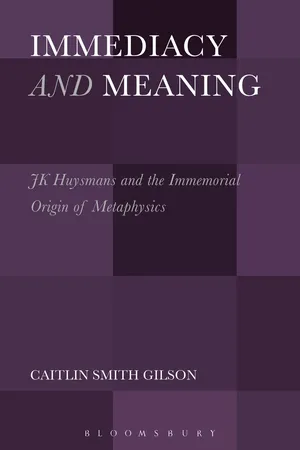
Immediacy and Meaning
J. K. Huysmans and the Immemorial Origin of Metaphysics
- 304 pages
- English
- ePUB (mobile friendly)
- Available on iOS & Android
eBook - ePub
About this book
Immediacy and Meaning seeks to approach the odd uneasiness at root in all metaphysical meaning; that the human knower attempts to mediate what cannot be mediated; that there is a pre-cognitive immemorial immediacy to Being that renders its participants irreducible, incommunicable and personal. The dilemma of metaphysics rests on the relationship between the spectator and the player, both as essential responses to the immediacy of Being. Immediacy and Meaning is an attempt to pause, but without retreat, to be a spectator within the game, to gain access into this immediate Presence, for a moment only perhaps, before the signatory failure into metaphysical language returns us to the mediated. J. K. Huysman's semi-autobiographical tetralogy anchors this book as a meditation, neither purely poetic nor only philosophical; it claims a unique territory when attempting to speak what cannot be spoken. The unnerving merits of nominalism, the difficulties of an honest appraisal of efficacious prayer, the mad sanity of the muse, the relationship between the uncreated and the created, and an originary ethics of antagonism, each serves to clarify the formation of a new epistemology.
Information
Part One
St. Thomas and the Paradox of Mediation and Intentionality
Meanwhile two Little Sisters of the Poor came and knelt not far from him, and meditated, their heads between their hands. He thought as he looked at them—those souls are to be envied who can thus be abstracted in prayer. How do they manage it? For, in fact, it is not easy if one thinks of the sorrows of the world, to praise the vaunted mercy of God. It is all very fine to believe that He exists, to be certain that He is good; in fact, we do not know Him, we are ignorant of Him. He is, and, in fact, he can only be, immanent, permanent, and inaccessible. He is we know not what, and at most we know what He is not. Try to imagine Him, and the senses fail, for He is above, about, and in each one of us. He is three and He is one; He is each and He is all; He is without beginning, and He will be without end; He is above all and forever incomprehensible. If we try to picture Him to ourselves and give Him a human wrappage, we come back to the simple conception of the early times, we represent Him under the features of an ancestor. Some old Italian model, some old Father Tourgeneff, with a long beard, and we cannot but smile, so childish is the likeness of God the Father. He is, in fact, so absolutely above the imagination and the senses, that He comes only nominally into prayer, and the impulses of humanity ascend especially to the Son, Who only can be addressed, because He became a man, and is to us somewhat of an elder brother, because, having wept in human form, we think He will hear us more readily, and be more compassionate to our sorrows. As to the third Person, He is even more disconcerting than the first. He is especially the unknowable. How can we imagine this God formless and bodiless, this Substance equal to the two others, who, as it were, breathe Him forth? We think of Him as a brightness, a fluid, a breath; we cannot even lend to Him as to the Father the face of a man, since on the two occasions that He took to Himself a body, He showed Himself under the likenesses of a dove and of tongues of fire, and these two different aspects do not help to a suggestion of the new appearance He might assume. Certainly the Trinity is terrible, and makes the brain reel. Ruysbrock has moreover said admirably, let those who would know and study what God is, know that it is forbidden; they will go mad. So, he continued, looking at the two Little Sisters, who were now telling their beads, these good women are right not to try to understand, and to confine themselves to praying with all their heart to the Mother and the Son.1
Because God, for St. Thomas, is never estranged from his own pure To Be, this immediate Actus is thus identical with the creative grace of His personhood and the personal ordination given to creaturely beings by way of their responsiveness.2 How the soul is in a way all things—how the I is the Other and how both respond to the immediacy of the creative I-for-Other of To Be—is given its deeper image in the Trinitarian relational effulgence which confirms the startling depths of To Be, as transformed from the natural knowledge of God derived from creatures or effects to the knowledge of persons which only Revelation can fully provide even as it reveals an enduring metaphysical compatibility.3
Et in arcadia ego
If the muscle can feel repugnance, there is still a false move to be made;
If the mind can imagine tomorrow, there is still a defeat to remember;
As long as the self can say “I,” it is impossible not to rebel;
As long as there is an accidental virtue, there is a necessary vice:
And the garden cannot exist, the miracle cannot occur.
For the garden is the only place there is, but you will not find it
Until you have looked for it everywhere and found nowhere that is not a desert.4
The non-mediated instantiated Presence of Being and its refusal to be stripped from the Act of the person are revealed in the triunity to be the metaphysical life of otherness, receptivity, communion, and consummation at the highest level of existence, and “inscribed in some manner on all being.”5 Metaphysics may proceed epistemologically from its grundsatz to a natural theology, but the ground itself is existentially personal: it is the universal communicated by way of its own personal incommunicability. The non-mediated To Be disseminates personhood in the other-as-man as he gazes on To-Be-as-other; each is the other as self only in the face of the other whom each reveals in its need by way of mutual, primal, and binding communion and consummation. This consummation is the supreme gift of God’s own unreduced To Be which enables God to be in Himself as beloved in lover and thus reveals the non-objectival or non-entitative basis of Being within the procession of creatures:
As the object known is in the knower to the extent that it is known, so the beloved must be in the lover, as loved. The lover is, in some way, moved by the beloved with a certain interior impulse. Therefore, since a mover is in contact with the object moved the beloved must be intrinsic to the lover. But God, just as He understands Himself, must likewise love Himself; for good, as apprehended, is in itself lovable. Consequently God is in Himself as beloved in lover.6
Metaphysics died when it became merely entitative, but lives again in the Trinity which is its homeland; Being’s refusal to be mediated is the critical indicator of its supreme and divine personhood. Being is thus One and beyond Being: it is the monad which reflects itself triadically as well as the triad which resolves itself without division or separation. The Trinity is therefore the revelation of the unreduced To Be rendering the very origin of metaphysics to be enduring and personal.7
In his discussion of the Trinity, St. Thomas speaks to the flowering of the three persons in terms of their subsistence, differentiating divine subsistence from human contingency. Because God is in Himself as beloved in lover, His subsistence, while utterly unified as One in Being, is not contrary to the threefold personhood.
We must conclude from all we have said that in the Godhead there is something threefold which is not opposed to the unity and simplicity of the divine essence. We must acknowledge that God is, as existing in His nature, and that He is known and loved by Himself.8
The persons do not designate secondary or dependent manifestations; while each is distinct, real, and not a mere mental mode, the three persons refuse to be disengaged from the Immediacy of Being. By contrasting God’s subsistence with man’s type of creaturely subsistence, St. Thomas shows how oneness and the threefold nature are not contradictory:
Man, to be sure, is a substance in his nature, but his actions of knowing and loving are not his substance. Considered in his nature, man is indeed a subsisting thing; as he exists in his mind, however, he is not a subsisting thing, but a certain representation of a subsisting thing; and similarly with regard to his existence in himself as beloved in lover. Thus man may be regarded under three aspects: that is, man existing in his nature, man existing in his intellect, and man existing in his love. Yet these three are not one, for man’s knowing is not his existing, and the same is true of his loving. Only one of these three is a subsisting thing, namely, man existing in his nature.9
Of great interest is the fact that man can be understood in three aspects, in his nature, in his intellect, and in his love; the latter two—knowing and loving—unlike in God, are not identical with his existence. Yet there is, in his nature, an aspect refusing mediation: by existing in our nature, we are subsisting things residing beneath and within intellect and love. As subsisting things, we receive this existential subsistence by way of efficient causation, from God’s To Be as innermost in all things. And because God’s Being cannot be stripped from His existence, there is therefore an aspect of man that cannot be stripped of this divine existence. We live beyond reflection and carry a theo-noetic experience of Being-as-person prior to the act of intellectual mediation, prior to assimilating the known in the form of the knower or even lovingly re-collecting or reconciling ourselves to the other-as-other. This theo-noetic experience indicates the type of non-mediated noesis which God is as Act.
Both Intellect and Love, as distinct from our creaturely subsisting nature, provide the well of reflection, the objectival horizon where we view Being-and-God as Other, separate from ourselves and the world. It is through the severed intellectual act that metaphysics receives its creative power and by that same token its inauthenticity and failure. The intellect cannot help but mediate Being and mediate it by way of the intellect’s own nature as distinct from existing as a subsisting being. The intellect thereby conforms Being in the form of the knower, but in doing so it renders Being entitatively distinct from existence which it cannot be. But this distinction is at the same time a reflection of man as a reflexive knower who stands apart from other creatures, for only he knows the distinction between his intellect and his subsistence.
The intellect metaphysically builds this eidetic view of Being as an entity in accordance with its own creaturely nature and, in doing so, is in danger of erecting a tower of Babel, of conceiving God within or inside the boundaries of the intellect’s own distinction between nature and intellect. The intellect then renders God the watchmaker (or the idol) just outside time; the God who cannot enter existence without being an alien force which natures cannot accommodate without being changed or diminished. Love, on the other hand, while also not identical with existence, is perhaps the truer act of becoming and consummation. While distinct from nature, Love seeks to recover what it lacks. Love’s object is the beloved and seeks to conform itself to it. Love is needful humility even at its metaphysical basis. Because Love is not identical with existence and because the proper end of love is to be conformed to the Other, love actually ameliorates the mediatory powers of the intellect and, combined with that intellect, perhaps informs us of the truer human nature. The intellect at first seems to have a similar path for (a) its object is also the other and (b) it is not identical with existence. In order to complete the act of knowledge, the intellect must assimilate the object of knowledge in the form of the knower. But when the intellect lives by way of the creaturely distinction between nature and intellect alone, homo faber has the immense temptation to assimilate this knowledge in the form of a knower reduced to nothing more than an idea-maker. The intellect quickly bypasses the unity, the identical subsistence beneath its nature as its prime causation. It builds knowledge and metaphysical systems as if they abide by these distinctions, when it is oddly clear that Being both reveals itself and refuses to be mediated. Love, on the other hand, desirous of being in the form of the beloved, becomes the act of becoming and needful consummation. Unlike the reductive tendencies of the intellect, it does not end by assimilating the beloved as itself but by becoming-of-the-beloved, and in doing so it seeks to re-collect the aspect of the subsisting nature it shares with non-mediated Being. The intellect is not, however, to be derided, for it alone has the power to articulate the agonic gap between our nature and what we know, and it is always there for those brave enough not to cover it over. It is for love to re-collect this loss of immediacy so Arcadian and yet so present that it moves us to recollect what we cannot even comprehend.10 It is the marriage of eros and agape.
But neither creaturely recognition by way of the intellect nor re-collection by way of love is sufficient to account for that subsisting Presence in us that refuses to be mediated; that personhood too real to be accosted by objects and entities, and that only the cosmic absurdities of the oneness as Threeness and the dying God on the Cross can imagine for us.
The miracle is the only thing that happens, but to you it will not be apparent,
Until all events have been studied and nothing happens that you cannot explain;
And life is the destiny you are bound to refuse until you have consented to die.
Therefore, see without looking, hear without listening, breathe without asking:
The Inevitable is what will seem to happen to you purely by chance;
The Real is what will strike you as really absurd;
Unless you are certain you are dreaming, it is certainly a dream of your own;
Unless you exclaim—“There must be some mistake”—you must be mistaken.11
The metaphysics of human nature is Trinitarian, acting itself out by nature, intellect and love, and it must seek to unify the unique and often contradictory situatedness of all three aspects. While it is true, as St. Thomas indicates, that man differs from God’s nature because knowing and loving are not identical to each other or to nature, this difference is only a difference because it derives its differentiation from the prime identity and unstripped immediacy of Being. Man is a subsisting thing and he subsists through Being. But Being itself, even when differentiated as three persons, is identical in Being:
In God, on the contrary, to be, to know, and to love are identical. Therefore God existing in His natural being and God existing in the divine intellect and God existing in the divine love are one thing. Yet each of them is subsistent. And, as things subsisting in intellectual nature are usually called persons in Latin, or hypostases in Greek, the Latins say that there are three persons in God, and the Greeks say that there are three hypostases, namely, the Father, the Son, and the Holy Spirit.12
God’s To Be, when manifested in the metaphysical Trinitarian life of the three persons—Existence, Intellect, and Love—is still one in Being. The hypostases are each Intellectual because they are the Other wholly. Because each person is completely the Other, and each is the Intellect, they are each designated...
Table of contents
- Cover
- Halftitle Page
- Title Page
- Dedication Page
- Contents
- Preface: Stating the Problem of Metaphysics
- Acknowledgments
- Prologue: En Route to Memory
- 1. St. Thomas and the Paradox of Mediation and Intentionality
- 2. Re-Approaching Immediacy
- 3. Efficacious Prayer, Suffering, and Self-Presence
- Epilogue: Heaven: They do Things Differently There
- Bibliography
- Index
- Imprint
Trusted by 375,005 students
Access to over 1.5 million titles for a fair monthly price.
Study more efficiently using our study tools.
Frequently asked questions
Yes, you can cancel anytime from the Subscription tab in your account settings on the Perlego website. Your subscription will stay active until the end of your current billing period. Learn how to cancel your subscription
No, books cannot be downloaded as external files, such as PDFs, for use outside of Perlego. However, you can download books within the Perlego app for offline reading on mobile or tablet. Learn how to download books offline
Perlego offers two plans: Essential and Complete
- Essential is ideal for learners and professionals who enjoy exploring a wide range of subjects. Access the Essential Library with 800,000+ trusted titles and best-sellers across business, personal growth, and the humanities. Includes unlimited reading time and Standard Read Aloud voice.
- Complete: Perfect for advanced learners and researchers needing full, unrestricted access. Unlock 1.5M+ books across hundreds of subjects, including academic and specialized titles. The Complete Plan also includes advanced features like Premium Read Aloud and Research Assistant.
We are an online textbook subscription service, where you can get access to an entire online library for less than the price of a single book per month. With over 1.5 million books across 990+ topics, we’ve got you covered! Learn about our mission
Look out for the read-aloud symbol on your next book to see if you can listen to it. The read-aloud tool reads text aloud for you, highlighting the text as it is being read. You can pause it, speed it up and slow it down. Learn more about Read Aloud
Yes! You can use the Perlego app on both iOS and Android devices to read anytime, anywhere — even offline. Perfect for commutes or when you’re on the go.
Please note we cannot support devices running on iOS 13 and Android 7 or earlier. Learn more about using the app
Please note we cannot support devices running on iOS 13 and Android 7 or earlier. Learn more about using the app
Yes, you can access Immediacy and Meaning by Caitlin Smith Gilson in PDF and/or ePUB format, as well as other popular books in Philosophy & Philosophical Metaphysics. We have over 1.5 million books available in our catalogue for you to explore.