eBook - ePub
Witness to Phenomenon
Group ZERO and the Development of New Media in Postwar European Art
- 320 pages
- English
- ePUB (mobile friendly)
- Available on iOS & Android
eBook - ePub
Witness to Phenomenon
Group ZERO and the Development of New Media in Postwar European Art
About this book
Witness to Phenomenon articulates a fresh examination of the German Group Zero-Heinz Mack, Otto Piene, and Günter Uecker-and other new tendency artists, who rejected painting and introduced new art media in postwar Europe. Group ZERO evolved into a network across Europe- Amsterdam, Milan, Paris, and Zagreb. This pan-European affiliation of artists generated a continuous stream of innovative artistic statements through the 1960s, incorporating non-traditional materials and new technologies to create kinetic art, light installations, performances, immersive multimedia installations, monumental land art, and the communication media of video and television. They transformed the visual arts from the inanimate objet d'art to a sensory experience by adopting the ascendant philosophy of Phenomenology as their conceptual foundation. Drawing from a decade of research on unpublished archives of the artists and critics of this period, this publication positions Group ZERO as a catalytic art moment in the transition from modern to contemporary art.
Information
CHAPTER ONE
Europe After the Rain: Un art autre, art informel
Max Ernst’s painting Europe after the Rain (1940–42, Figure 1.1) serves as a prophetic metaphor for the physical destruction and emotional despair that would await Europe at the end of the Second World War. His response to the First World War was to join Dada in Cologne. Subsequently, he moved to Paris, where he became a founding member of André Breton’s surrealist movement. He parted ways with Breton in 1938 and fled to southern France as war appeared on the horizon. Ernst had foreseen the impending cataclysm in 1935: “I see barbarians looking toward the west, barbarians emerging from the forest, barbarians walking to the west.” He did not escape the barbarians by hiding in the provinces, however. Upon the German invasion of Poland in 1939, the French interned him as an enemy alien. The Germans arrested him again in 1940, when they invaded France; he eventually escaped and crossed the Pyrenees to Madrid, from where he emigrated to the United States, traveling with Peggy Guggenheim.1
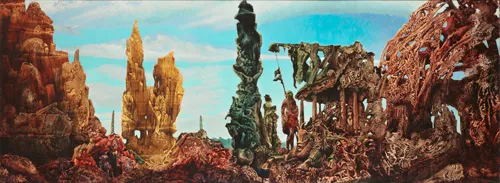
Figure 1.1 Max Ernst, Europe After the Rain, 1940–1942, oil on canvas, 21 9/16 × 58 3/16 in. The Ellen Gallup Sumner and Mary Catlin Sumner Collection Fund. 1942.281. Wadsworth Atheneum Museum of Art, Hartford, Connecticut. Photo: Allen Phillips/Wadsworth Atheneum.
While in southern France, Ernst began a new series of works, including Europe after the Rain, in a new technique, décalcomanie. He applied pigment, diluted with vehicle, to the canvas and pressed it against another surface to generate automatic images. The chance process evoked subconscious images, which Ernst then inpainted among the ridges of pigment. Redolent of the primeval German Urwald, these paintings embody, critic Suzi Gablick said, a “sense of growth and decay, of past giving way to future, the hint of forces beyond control, of days before the human span. Here time does not pass.”2
In Europe after the Rain, Ernst clearly references Adolf Hitler’s war, symbolized by the lance-wielding figure confronting the female figure of Europa, who turns her back on him in disgust at her ravaged landscape. Ernst implied his own view of Europe and its culture as a petrified, denuded landscape.3 The oracular imagery of Ernst’s painting, initiated during a tense period of inner emigration and completed in exile during the climax of the conflict,4 portends the physical destruction of Europe, the emotional horror at the inhumanity, and the shared postwar sentiment on the grim prospects for Europe’s future.
The devastation of the Second World War was on a scale unprecedented in human history. The nations of Europe had for the second time in thirty years attempted to destroy one another. Many historians view the Second World War as a continuation of the conflict that began with the First World War and was left unresolved by the Treaty of Versailles in 1919. As historian Tony Judt noted, “World War I destroyed old Europe; World War Two created the conditions for a new Europe.” Most of the death and destruction occurred in the initial German invasions of other nations and in the final counterattack by the Allied forces. The most significant proportion of the destruction occurred in the final three years, with daily bombing raids over Germany and the scorched-earth advance of the Soviet Union westward. In the final assault on Berlin, in May 1945, the city absorbed forty thousand tons of bombs, rendering seventy-five percent of the buildings uninhabitable.5
The loss of life, vastly greater than in any previous conflict, was as staggering as the physical damage. Approximately forty-one million people died in Europe during the Second World War. Judt has observed that this number was equivalent to the population of France at the outbreak of war.6 The losses on the battlefield and among civilians were compounded in the final months of the war by the discovery of the concentration camps. The first photographs of the death camps were released in April 1945. Then, only a few months later, in August, the United States dropped atomic bombs on Japan, incinerating two cities. These events forced the recognition that for the first time in history human beings possessed the capacity to cause our own extinction.
It was a psychological shock to recognize the horrors of which humanity is capable. Not only did the war destroy the institutions of society in which people were raised; the very foundation of morality was suspect. People wondered how they should respond to the death and destruction that they witnessed, and how they could reconcile their moral and ethical beliefs with the reality of the world.
All over Europe there was a strong disposition to put the past away and start afresh, to follow Isocrates’ recommendation to the Athenians at the close of the Peloponnesian Wars: “Let us govern collectively as though nothing bad had taken place.” Without such collective amnesia, Europe’s astonishing post-war recovery would not have been possible. To be sure, much was put out of mind that would subsequently return in discomforting wa ys. . . . The price paid was a certain amount of selective, collective forgetting, notably in Germany.7
Communal and individual emotional responses to the conclusion of the conflict took three forms: jubilation and relief, existential questioning of the war and its aftermath, and resolve to reconstruct their culture.
How did artists respond to this physical, emotional, and moral devastation? What did they create? In the first decade after the war, art took several paths that paralleled the collective psyche and evolved with the changing political dynamics. Initially, Europeans witnessed a recapitulation of prewar modernism in their attempt to rebuild their cultural foundations, while other artists attempted to render the existential reality, as either a physical or an emotional state, through figuration or abstraction. And, among those interested in a new artistic identity for postwar Europe, there emerged a style of painterly expressionism that drew from the painterly tradition of modern art and from the subconscious, irrational content of surrealism and that has come to be called art informel. Art informel became a style of painting that appeared across the world that had been affected by the Second World War. However, after a decade, the formlessness of informel had become formalized into academic pictorial rhetoric. In the changing historical climate of the mid-1950s, it ceased to resonate with the European psyche.
At the end of the combat, Europe initially expressed a feeling of relief and euphoria. Immediately after the Nazis left Paris, in August 1944, Pablo Picasso, one of the modern artists to remain in Europe during the war, painted his Cock of the Liberation (1944, Figure 1.2). The French cock proudly crows to announce the retreat of German troops from Paris. His puffed chest leads the viewer’s eye to the rising sun that promises a new and fertile future for Europe. The jubilation, however, was quickly replaced by a realization of the enormous effort necessary to rebuild Europe.8 Writer Simone de Beauvoir realized at this moment that although the fighting was over, the war “remained on our hands like a great, unwanted corpse, and there was no place on earth to bury it.”9 Yet the devastation was not just perceived as a tremendous burden; it was also viewed as clearing away the past for a new beginning. Philosopher Italo Calvino described the potential for optimism at this grave moment, asserting that the crushing of fascism engendered “a dream of revolution which would take off from a tabula rasa.”10 The postwar mindset vacillated between these theoretically contradictory, but psychologically compatible, positions: a desire to return to the comfort of the prewar culture and a resolution to make a new beginning. Europeans wanted, as art historian Sarah Wilson has described it, “caesura, continuity and catharsis.”11
This chapter outlines some of the manifestations in the visual arts among the first postwar generation of artists, from the revival of several forms of modernism to existential purgings of subconscious agony, and the development of an international style of gestural expressionism, art informel, that by 1955 became fossilized as the artistic establishment against whom the second postwar generation rebelled. The account begins with events at the end of the war in 1945 and closes with the deaths of some of the leading artists of this period—of Willi Baumeister, Karl Hofer, and Nicolas de Staël in 1955, and Jackson Pollock in 1956—at precisely the time when the second generation came of age.
In the visual arts, Europeans immediately attempted to reclaim a semblance of their past and to establish continuity with their prewar lives, resulting in the resurrection of interwar modernism, with the Ecole de Paris (School of Paris) at its fulcrum. In France, Germany, Italy, and Spain the cultural reconstruction began with the major artistic figures of the prewar generation returning from exile or resurfacing after nearly a decade of inner emigration, each country attempting to resuscitate their culture by reviving successful interwar artistic practices.
The French hosted a Salon d’Automne in fall 1944, only a few months after the Germans had evacuated, and prior to the cessation of combat in Europe. The Salon de Libération announced the return of the Ecole de Paris and provided a forum to lionize Picasso, whom the French championed as the postwar Jacques-Louis David. Picasso, the leading artist who remained in Paris during the war, “alone fortified the world around him during the Occupation. . . . He gave back hope to those who were starting to wonder about our chances of salvation. His confidence . . . that better days were ahead, brings gratitude from all intellectuals, all our country’s artists.”12 These words indicate the importance that people placed on reconnecting with their cultural i...
Table of contents
- Cover
- Half-Title
- Series
- Title
- Contents
- Acknowledgements
- List of Illustrations
- Introduction
- 1 Europe After the Rain: Un art autre, art informel
- 2 “Does Contemporary Painting Influence the Shape of the World?”: The Problem of Painting and the Question of Reality
- 3 ZERO, the New Tendency, and New Media
- 4 Artistsʼ Actions into Theater
- 5 Aistheton: Immersive Multimedia Environments
- 6 The Vision of Television
- 7 Coda
- Selected Bibliography
- Index
- Copyright
Trusted by 375,005 students
Access to over 1.5 million titles for a fair monthly price.
Study more efficiently using our study tools.
Frequently asked questions
Yes, you can cancel anytime from the Subscription tab in your account settings on the Perlego website. Your subscription will stay active until the end of your current billing period. Learn how to cancel your subscription
No, books cannot be downloaded as external files, such as PDFs, for use outside of Perlego. However, you can download books within the Perlego app for offline reading on mobile or tablet. Learn how to download books offline
Perlego offers two plans: Essential and Complete
- Essential is ideal for learners and professionals who enjoy exploring a wide range of subjects. Access the Essential Library with 800,000+ trusted titles and best-sellers across business, personal growth, and the humanities. Includes unlimited reading time and Standard Read Aloud voice.
- Complete: Perfect for advanced learners and researchers needing full, unrestricted access. Unlock 1.5M+ books across hundreds of subjects, including academic and specialized titles. The Complete Plan also includes advanced features like Premium Read Aloud and Research Assistant.
We are an online textbook subscription service, where you can get access to an entire online library for less than the price of a single book per month. With over 1.5 million books across 990+ topics, we’ve got you covered! Learn about our mission
Look out for the read-aloud symbol on your next book to see if you can listen to it. The read-aloud tool reads text aloud for you, highlighting the text as it is being read. You can pause it, speed it up and slow it down. Learn more about Read Aloud
Yes! You can use the Perlego app on both iOS and Android devices to read anytime, anywhere — even offline. Perfect for commutes or when you’re on the go.
Please note we cannot support devices running on iOS 13 and Android 7 or earlier. Learn more about using the app
Please note we cannot support devices running on iOS 13 and Android 7 or earlier. Learn more about using the app
Yes, you can access Witness to Phenomenon by Joseph D. Ketner II in PDF and/or ePUB format, as well as other popular books in Media & Performing Arts & History of Modern Art. We have over 1.5 million books available in our catalogue for you to explore.