Shortlisted for the H.R.F. Keating Award 2020
James Ellroy's identity as a crime writer is rooted in his extraordinary life story and relationship with his home city of Los Angeles. Beginning with the unsolved murder of his mother, Geneva Hilliker Ellroy, in 1958, Ellroy's early life played a large role in shaping his obsessions with murder, the criminal underworld of L.A. and the redemptive power of the feminine. Ellroy's life could be seen as a brutal, visceral and emotionally exhausting realisation of the American Dream, a theme he has explored in his writing to the extent that he is credited with reinventing crime fiction.
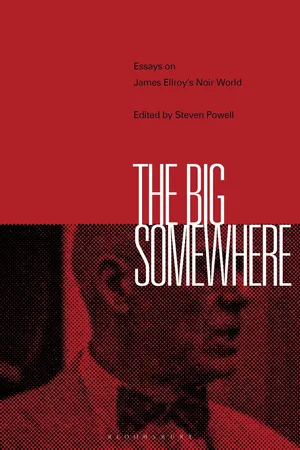
The Big Somewhere: Essays on James Ellroy's Noir World is an in-depth, scholarly study of the work of James Ellroy, featuring leading Ellroy scholars such as Anna Flügge, Jim Mancall and Rodney Taveira. Moving from Ellroy's early detective novels to his later epic works of historical fiction, it explores how Ellroy found his place in the history of the genre by building on, and then surpassing, the works of authors who influenced him such as Dashiell Hammett, Raymond Chandler and Joseph Wambaugh. It also examines Ellroy's impact on contemporary writers and on the cultural perception of L.A., which has been his legacy through the L.A. Quartet novels.
The 'Big Somewhere' is not a geographical location, but a conglomeration of the cinematic, historical and fictional worlds that influenced Ellroy, from film noir to the Kennedy era in American politics, and on which he, in turn, has left his mark.
- 224 pages
- English
- ePUB (mobile friendly)
- Available on iOS & Android
eBook - ePub
About this book
Information
Part One
Genre and Literary Influences
1
‘Tragic Power’: The Influence of Raymond Chandler and Dashiell Hammett on the Work of James Ellroy
Steven Powell
James Ellroy has often reflected on other authors and on his own place within the literary canon. His opinion of crime writers and how they influenced him, however, has been changeful and, in some cases, caustically dismissive. His comments on Ross Macdonald, for example, show a re-evaluation of his own early tastes and influences: ‘I loved the Lew Archer books. I don’t know if I could stand them now’ (Hogan 1995: 58). Ellroy concedes that although the ‘lost child motif’ of Macdonald’s novels was formative in developing his early narrative structures, upon revisiting Macdonald’s novels, he found them to be ‘appallingly overwritten, full of metaphor’ (Hogan 1995: 58). This harsh re-evaluation comes just over ten years after he described Macdonald as ‘my greatest teacher’ (Tucker 1984: 7). Once Ellroy surpassed Macdonald’s influence by creating increasingly complex narratives and themes more expansive and interwoven than what he had learnt from reading and studying the Lew Archer private detective novels, he subsequently played down the impact of Macdonald’s work. Through comparison with his own writing, he chastises the very thing that once inspired his novels. Macdonald’s novels, Ellroy later claimed, are ‘not really my bowl of rice’ (Hogan 1995: 58).
Although Ellroy has only fleetingly spoken of Macdonald, by contrast, other authors have gained a permanence in Ellroy’s writing and summation of his own work. Ellroy has consistently referred to the work of Raymond Chandler, in recent years with increasing scepticism. Ellroy acknowledges that Chandler’s writing was a significant influence on his first novel Brown’s Requiem (1981) but, as he put it, ‘I have less affection for [Chandler] by the day’ (Hogan 1995: 57). According to Ellroy, Chandler created a style which ‘is easy to adapt to the personal prejudices of the individual writers, which is why you now have the gay private eye, the black private eye, the woman private eye, and every other kind of private eye’ (Hogan 1995: 57). To an aspiring writer, Ellroy concedes this effect was beneficial; Brown’s Requiem melds Ellroy’s ‘personal prejudices’ onto the formula Chandler created in the Philip Marlowe novels. But rather than develop this Chandler-inspired narrative further, Ellroy claims that after the publication of his first novel, the influence came to an abrupt halt. Yet, unlike Macdonald, whom Ellroy does not go back to, Ellroy cannot help but refer to Chandler even if only to criticize. This inspiration, and subsequent recantation, focuses on Chandler’s work as a novelist. While Chandler made his name writing for pulp magazines such as Black Mask, Ellroy by contrast ‘didn’t buy the old canard that you had to start by writing short stories’ (Rich 2008: 181). This criticism is ironic given that Ellroy’s own education as a writer had been through reading pulp novels, and when, after developing a successful career as a novelist, Ellroy turned to composing his own short stories, he did not show much flair for them. Despite this, Ellroy has consistently stated that the private-eye novel or anything else that could be considered Chandler-influenced were no longer present in his work. Arguably, Ellroy’s noir settings and old Hollywood narratives, would evoke, if not Chandler, then his contemporaries. The author Ellroy would credit with being an influence, more than anyone else, on the LA Quartet was Dashiell Hammett. As Lee Clark Mitchell has argued though, major thematic and stylistic differences which supposedly separate Chandler’s and Hammett’s work are less significant than has been assumed:
At first glance Chandler seems utterly different from Hammett, though it soon becomes clear that he embraces his predecessor’s techniques, extending and complicating them via both setting and syntax. Or rather, he takes Hammett’s concentration on quirky details and ups the ante by lowering the stakes, giving us less essential description, more frequent diversions and digressions, as a way of further impeding the plot. (Mitchell 2015: 10)
Ellroy has been guilty of simplifying Chandler’s legacy, limiting it to the creation of the easily imitated hard-boiled private detective. Like Chandler’s revisionism of Hammett’s themes, Ellroy ‘ups the ante by lowering the stakes’. The paradox here is that the hard-boiled PI is not Chandler’s creation alone, his legacy is both smaller, and in some ways, creatively bigger than Ellroy gives him credit for. Ellroy began shifting his vision of the genre to Hammett, while not acknowledging that Chandler ‘embraces his predecessor’s techniques’. Yet, in interviews, Ellroy would rarely bring up Chandler’s name without also mentioning Hammett and vice versa, indicating some innate understanding of their pairing.
Ellroy’s open acknowledgement and then disavowal of Chandler has not had its similar counterpart in Hammett, partly because Hammett’s influence on Ellroy’s work was more subliminal. As late as 2008, Ellroy claimed that in retrospect the work of Hammett had been more influential than he realized when he was first writing the Quartet novels: ‘I had to reread a little Hammett, because I wrote the Everyman Library introduction to one of their volumes, and was amazed at how my sensibility of the goon and the political fixer and the bagman and the hatchet man strike-breaker came out of that’ (Powell 2008b: 170). Ellroy looks more kindly on these subconscious influences, as his debt during and after the writing process is indistinct. They are not fully formed fonts of inspiration, as Macdonald ‘my greatest teacher’ was, nor do they provide any tangible impediment to creativity, as Chandler’s PI in Brown’s Requiem did (Tucker 1984: 7).
By continually playing Hammett against Chandler, the overt and the subverted, the defined and the undefinable, Ellroy has purposefully created a paradox in his relationship with two of the most important practitioners of detective fiction. Ellroy’s definition of the two men is key: Chandler, in Ellroy’s view, was conservative, predictable and set the conventions of the genre, whereas Hammett’s writing was edgy and existed in a narrative world without conventions. It is not difficult to observe, given Ellroy’s somewhat unhinged Demon Dog persona, why he would prefer the latter influence. But the oppositional roles he designs for both authors, both oddly reliant on each other, are too simplistic and conveniently suited to the image Ellroy was trying to acquire. In this chapter, I will argue that Chandler’s influence on Ellroy’s work extended far further than the debut novel in which Ellroy has always attempted to contain it, and that, much like how he overlooked Hammett for lengthy periods of his career, the Chandler effect has been more complex, undefinable and subliminal.
Neither Hammett nor Chandler could have known the enormous influence their writing would have in the field of crime fiction over fifty years since their death. Both men died relatively you ng, unhappy and past their best. Neither man produced as much as was expected of their peers, such as Erle Stanley Gardner who wrote hundreds of books and had to employ pseudonyms in order to effectively market the enormous output. Nor was there such an interest in crime fiction as an academic discipline. It fell on Chandler himself to codify some of the traits of the hard-boiled school in The Simple Art of Murder (1944), a practice which was common among writers from the Golden Age of detective fiction which Chandler explicitly criticizes.
Down these mean streets a man must go who is not himself mean, who is neither tarnished nor afraid. The detective must be a complete man and a common man and yet an unusual man. He must be, to use a rather weathered phrase, a man of honor. (Chandler 1944: 987)
Years later, Ellroy parodied these words to elevate his work above Chandler’s, and bring his narrative to the same plateau as Hammett’s:
Down these mean streets the single man who can make a difference must go. There is an institutionalized rebelliousness to it that comes out of a cheap liberalism that I despise. It’s always the rebel. It’s always the private eye standing up to the system. That doesn’t interest me. What interest me are the toadies of the system. (Duncan 1996: 85)
By separating Chandler’s detective ‘man of honor’ from the ‘toadies of the system’ Ellroy brings the genre full circle. Chandler himself recognized Hammett’s influence, and how both their writing was a reaction to Golden Age detective fiction:
Hammett took murder out of the Venetian vase and dropped it into the alley; it doesn’t have to stay there forever, but it was a good idea to begin by getting as far as possible from Emily Post’s idea of how a well-bred debutante gnaws a chicken wing. (Chandler 1944: 988–9)
Chandler and Hammett met only once, at a 1936 gathering of Black Mask writers in LA, and the relationship appeared amicable. There was no professional rivalry as Hammett’s writing career ended fairly early amidst his struggles with alcoholism and the House of Un-American Activities Committee. Instead, Ellroy has himself invented and prolonged a literary feud of sorts, pitting the men’s work against each other as opposing ends of the crime genre. In his own work, it could be argued that Ellroy is, in many ways, continuing Chandler’s theory of a genre which is in constant movement, rejecting that which came before it (in Chandler’s case Golden Age mysteries). In Ellroy’s oeuvre, the movement is from private and police detective novels, Brown’s Requiem and the Lloyd Hopkins novels, to historical crime fiction, the LA Quartet and Underworld USA trilogy. By casting both Chandler and Hammett as the originators of the hard-boiled genre, and minimizing the importance of the writers that followed them, he crowns himself as the third point of the trinity – Chandler, Hammett, Ellroy – and navigates a new journey from hard-boiled to neo-noir.
Due to the shifting, malleable nature of Chandler’s influence on Ellroy’s work, in attempting to fully assess it, a difficulty arises not unfamiliar to that faced in film noir criticism – that of definition and classification. Starting from the novel Ellroy himself tied to Chandler, from the title alone, Brown’s Requiem reveals this debt. Chandler had sued the writer James Hadley Chase after Chase had directly lifted material from the Marlowe novels for his work Blonde’s Requiem (1946). It may just be a coincidence but, in referencing Blonde’s Requiem, Ellroy could have intended the novel to be a parody of a plagiarism as he was so deeply indebted to Chandler himself. Certainly his titular detective, Fritz Brown, is derived as much from pastiche as praise for the Philip Marlowe model. Brown’s first-person narration takes the reader through the story, employing a succession of wisecracks and colourful similes that are clearly mimicking Chandler’s prose, and Marlowe himself is referenced directly at one point when Brown walks into the Westwood Hotel:
The flat finished white stucco walls, ratty Persian carpets in the hallway and mahogany doors almost had me convinced it was 1938 and that my fictional predecessor Philip Marlowe was about to confront me with a wisecrack. (Ellroy 1981: 193)
This is the most overly metafictional moment in the text, but the more influential traces of Chandler can be found in Ellroy’s exploration of how relationships form through an oppositional attraction, which in some ways echoes his ambivalent reading of the creator of Brown’s ‘fictional predecessor Philip Marlowe’. Brown’s one client is Freddy ‘Fat Dog’ Baker, a corpulent, racist, foul-mouthed and suspiciously wealthy golf caddy. Brown is in some ways the antithesis of Fat Dog; he is handsome and charming and even begins an affair with Fat Dog’s sister who he has been hired to watch with the specific intention of stopping her forming a relationship with another man. In short, Brown is a ‘complete man and a common man’, and he cannot hide a degree of affection for the client he soon discovers is capable of horrific acts of violence (Chandler 1944: 987).
Brown finds that Fat Dog has been brutally murdered in Mexico. This unexpected event occurs halfway through the novel, thus denying the reader an expected showdown between the private detective and the would-be antagonist. Shortly after discovering his corpse, Brown admits his sympathy for Fat Dog:
He deserved to live. He just never had the chance. He had no choice in the matter. It was locked in, from the beginning. He was destined to become what he became. I’m no liberal, but I learned one thing from being a cop: that some people have to do what they are doing, that they can’t help it. (Ellroy 1981: 121–2)
Brown delivers this monologue, somewhat insensitively, to a character who was also seeking his revenge on Fat Dog. His references to being a cop reveals how Ellroy conceived Brown as being like Marlowe, who also alludes to a prior career in law enforcement. But since leaving the LAPD, Brown has not entirely become Ellroy’s interpretation of the Chandler-model outsider working against the system, which in many respects Marlowe was not anyway despite his sceptical view of the corrupt Bay City police. Brown lost his job in the LAPD, but he has reinvented himself as the archetypal self-made 1980s businessman in the semi-legit car repossession trade; thus his private detective label is merely a tax write-off. He knows that Fat Dog is a more blue-collar version of himself, only burdened by psychosexual urges, such as incestuous feelings for his sister, ingrained in him so deeply he can never reform. This is a more explicit version of Marlowe quoting Shakespeare out of tacit sympathy for his client, the psychopathic but lovelorn Moose Malloy – one of the many characters in Farewell, My Lovely – who he claims ‘had loved not wisely, but too well’ (Chandler 1940: 366).
Ellroy’s attempts to create a homage to Chandler led to an epiphany after its publication: ‘I wrote Brown’s Requiem, and I had a tremendous revelation when I finished it. I realized that all modern private-eye novels are bullshit, and that I would never write another one’ (Silet 1995: 44). Yet while Ellroy excised the private eye from his narratives, I would argue that he did not lose the influence of Chandler, which could still be detected both in overt references and tonal undercurrents in his first mammoth undertaking as a novelist, the LA Quartet series, simply because he could not write about the time and the city of Chandler without referring to the author. Starting with Ellroy’s most celebrated work, The Black Dahlia (1987), Ellroy makes a factual reference to Chandler’s work through his choice of title. Chandler had scripted the film noir The Blue Dahlia (1944). It was not a notable crime film, as Chandler would later freely admit, and was hampered by a troubled production in which the author struggled to control his drinking in order to deliver the script. It did however gain a footnote in film history because the title inspired the moniker the LA Press gave Elizabeth Short when the Black Dahlia murder became headline news, as Ellroy’s novel acknowledges, without, significantly, naming the film’s screenwriter, Chandler:
We can thank Bevo Means for that. He went down to Long Beach and talked to the desk clerk at the hotel where the girl stayed last summer. The clerk told him Betty Short always wore tight black dresses. Bevo thought of that movie with Alan Ladd, The Blue Dahlia, and took it from there. I figure the image is good for at least another dozen confessions a day. As Harry says when he’s had a few, ‘Hollywood will f**k you when no one else will.’ (Ellroy 1987: 105)
There are also thematic parallels between the two works which go deeper than the title. In the original draft Chandler envisioned the killer to be serving in the US Navy and suffering from trauma-induced blackouts related to his wartime service, but the studios considered this to be overly controversial and unpatriotic for a film made during wartime. Ellroy’s novel follows the original police investigation fairly closely, including, the false murder confession of Corporal Joseph Dumais. Ellroy renames Dumais as Dulange in the novel, and as Dulange is one of Elizabeth Short’s boyfriends, Ellroy uses him to provide backstory about the murder victim. Dulange is cleared, as was Dumais in real life, once his confession is discredited due, in part, to his chronic alcoholism as he was receiving treatment for addiction at the time of the murder. However, his loathsome behaviour is permanently exposed, including how he cruelly manipulated Short by bribing a doctor to tell her she was pregnant. As a survivor of the trenches, Chandler intuitively knew that the inner violence and trauma of those who survive combat, and the military indoctrination that comes with it, would be an issue in post-war America just as it had been a major factor in driving the popularity of hard-boiled fiction in the 1920s and 1930s. Chandler’s ideas were shunted aside, but within a few years film noirs such as Crossfire (1947) and Act of Violence (1949) would candidly explore trauma and violent compulsions in war veterans, a trend that Ellroy would continue by making the killer of Elizabeth Short – Georgie Tilden – a disfigured veteran of the First World War. The Blue Dahlia was structurally confusing as Chandler’s original vision was rewritten, and he completed the script in a haze of perpetual alcoholism. As Chandler’s most recent biographer Tom Williams put it, ‘The Blue Dahlia has become a footnote in the story of the Black one’ (Williams 2014: 222).
Chandler was paid $1,000 a week by MGM to adapt his fourth novel, The Lady in the Lake. However, his opinion of Hollywood had already soured after working on The Blue Dahlia and he gave up after three months’ work. The subsequent film adaptation was scripted by Steve Fisher, and directed by and starring Robert Montgomery as Marlowe. The film is most notable among the Chandler adaptations for the optical-point-of-view technique by which everything is seen from Marlowe’s viewpoint, and the only glimpse of the private detective the audience is granted is when he looks in a mirror or if he breaks the fourth wall and addresses the audience directly. Chandler’s efforts on the script had never attempted any such literal-minded methods to visualize the first-person narration of the novels, and he dismissed it as a gimmick and, perhaps a touch slighted, not original, ‘Let’s make the camera a character; it’s been said at every lunch table in Hollywood one time or another’ (Hiney 1997: 159). Ellroy, however, considered the idea of point-of-view detection promising enough to revive and revise it in The Big Nowhere. In the novel, Sheriff’s Deputy Danny Upshaw is investigating a series of mutilation murders and employs an innovative technique called Man Camera which imagines frame by frame the point of view of the perpetrator: ‘As the Man Camera, Upshaw recreates crime scenes as movie scenes’ (Mancall 2014: 83). The more obvious danger for Upshaw would be that the det...
Table of contents
- Cover
- Half-Title
- Dedication
- Title
- Contents
- Acknowledgements
- Notes on Contributors
- Introduction
- Part 1 Genre and Literary Influences
- Part 2 Ellroy and Noir
- Part 3 ‘America Was Never Innocent’: Underworld and Government Power Structures
- Part 4 Ellroy and After: The Ellrovian Influence on Authors and Genre
- Bibliography
- Index
- Copyright
Trusted by 375,005 students
Access to over 1.5 million titles for a fair monthly price.
Study more efficiently using our study tools.
Frequently asked questions
Yes, you can cancel anytime from the Subscription tab in your account settings on the Perlego website. Your subscription will stay active until the end of your current billing period. Learn how to cancel your subscription
No, books cannot be downloaded as external files, such as PDFs, for use outside of Perlego. However, you can download books within the Perlego app for offline reading on mobile or tablet. Learn how to download books offline
Perlego offers two plans: Essential and Complete
- Essential is ideal for learners and professionals who enjoy exploring a wide range of subjects. Access the Essential Library with 800,000+ trusted titles and best-sellers across business, personal growth, and the humanities. Includes unlimited reading time and Standard Read Aloud voice.
- Complete: Perfect for advanced learners and researchers needing full, unrestricted access. Unlock 1.5M+ books across hundreds of subjects, including academic and specialized titles. The Complete Plan also includes advanced features like Premium Read Aloud and Research Assistant.
We are an online textbook subscription service, where you can get access to an entire online library for less than the price of a single book per month. With over 1.5 million books across 990+ topics, we’ve got you covered! Learn about our mission
Look out for the read-aloud symbol on your next book to see if you can listen to it. The read-aloud tool reads text aloud for you, highlighting the text as it is being read. You can pause it, speed it up and slow it down. Learn more about Read Aloud
Yes! You can use the Perlego app on both iOS and Android devices to read anytime, anywhere — even offline. Perfect for commutes or when you’re on the go.
Please note we cannot support devices running on iOS 13 and Android 7 or earlier. Learn more about using the app
Please note we cannot support devices running on iOS 13 and Android 7 or earlier. Learn more about using the app
Yes, you can access The Big Somewhere by Steven Powell in PDF and/or ePUB format, as well as other popular books in Literature & Literary Criticism. We have over 1.5 million books available in our catalogue for you to explore.