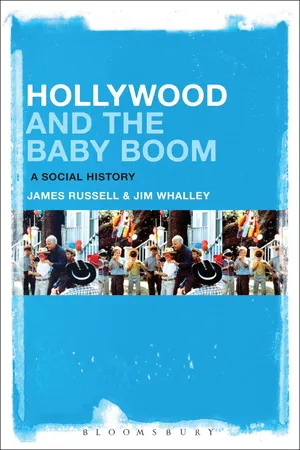
Between 1946 and 1964 seventy-five million babies were born, dwarfing the generations that preceded and succeeded them. At each stage of its life-cycle, the baby boom's great size has dictated the terms of national policy and public debate. While aspects of this history are well-documented, the relationship between the baby boom and Hollywood has never been explored. And yet, for almost 40 years, baby boomers made up the majority of Hollywood's audience, and since the 1970s, boomers have dominated movie production.
Hollywood and the Baby Boom weaves together interviews with leading filmmakers, archival research and the memories of hundreds of ordinary filmgoers to tell the full story of Hollywood's relationship with the boomers for the first time. The authors demonstrate the profound influence of the boomers on the ways that movies were made, seen and understood since the 1950s. The result is a compelling new account that draws upon an unprecedented range of sources, and offers new insights into the history of American movies.
- 352 pages
- English
- ePUB (mobile friendly)
- Available on iOS & Android
eBook - ePub
About this book
Information
PART ONE
Childhood
1
Hollywood and the Baby Boom in the 1950s
At first, the baby boom’s impact on Hollywood was unclear. The social and economic changes that were bound up with the baby boom changed the habits of Hollywood’s audiences, but made no great difference to the makeup of that audience, or to the concerns of industry personnel. It took until the mid-1950s for Hollywood to feel the effects of baby boomers as an audience and as a social phenomenon. Consequently, this chapter focuses on the prehistory of the baby boom, and explains how the baby boom fed into wider social changes in America. In the first half, we look in detail at the immediate causes and consequences of the baby boom. In the second half, we examine the structure and operating practices of the Hollywood studios at the end of the 1940s, as the baby boom began to affect the norms of the American movie industry, along with other seismic shifts.
The origins and impact of the baby boom
Just as the end of the Second World War put an end to declining birth rates, it also signalled the end of the two decades of economic and social hardship that had begun with the great depression in the late 1920s. As a result the baby boomers grew up in an unprecedented era of prosperity, which Landon Jones has described as ‘a buccaneering orgy of buying and selling that carried all things before it’. 1 Unlike other countries, the war had left America well positioned for economic growth as American ingenuity was turned from producing armaments and waging war on foreign powers to combating more prosaic human problems – getting clothes clean, keeping food cold, moving from A to B. The GIs returned home to a country that was more thoroughly modernized and wealthier than ever before. The war had restricted family life while it boosted the country’s commercial infrastructure. For the first time in decades, peoples’ life prospects were visibly improving. In 1946, Fortune magazine celebrated a tangible change in the wind, declaring, ‘This is the dream era, this is what everyone was waiting through the blackouts for.... The Great American Boom is on.’ 2
In his history of the baby boom, Landon Jones observes that the economic impact of the boom was understandably first felt by businesses catering to the very young:
The spending boom started, literally, at the bottom. Diapers went from a $32 million industry in 1947 to a $50 million in 1957 … mothers and fathers were paying $5 million annually (twice the pre-boom business) to have baby’s shoes bronze plated at L.E. Mason Inc., in Boston. More than one in ten Americans was consuming baby food at a rate of 1.5 billion cans a year in 1953 (up from 270 million in 1940).
As the kids grew up, so did the markets. Throughout the 1950s the 5–13 age group grew by an additional one million baby boomers every year. The toy industry set records annually after 1940, growing from an $84 million stripling, to a $1.5 billion giant. Sales of bicycles doubled, children’s toys became a boom market. At its peak, the juvenile market was ringing up a staggering $33 billion annually. 3
The commercial opportunities of the age weren’t limited to the sale of toys and nappies. As more of these new families emerged, they increasingly began to move to a new kind of physical environment, which also encouraged intensified forms of consumerism – the suburbs. Suburbia, of a sort, had been observed since the early nineteenth century. 4 However, the dream of suburban living as a distinct, clearly defined part of the American experience, and landscape, only really came to fruition in the 1950s, in a ‘suburban revolution which changed the landscape of urban America’. 5 ‘True’ rural communities declined, as peripheral urban populations expanded dramatically into the empty lands surrounding urban conurbations across the United States.
The first modern suburb of the period is generally understood to be Levittown, New York, a planned development of 2,000 homes on the southern tip of Long Island, within commuting distance of New York City. The housing industry had been in a slump throughout the war years, but Levitt and Sons were encouraged to pursue the development by the terms of the GI Bill, which guaranteed government support for veterans seeking to buy homes. All of the homes were sold within days of going on the market, and the firm used assembly line production methods (pre-cut timber, identical blueprints) to keep up with demand. By 1951, the company had established four separate developments, made up of over 17,000 homes, and similar sites were springing up across the country. Levittown was most notable for its uniformity: the homes were uniform in layout and construction, occupied uniform strips of land and provided a relatively uniform social experience.
The fact that Americans had the space and resources to build more and more suburbs helped to sustain the baby boom for so long. Herbert S. Klein argues that the baby boom effectively occurred as a result of a range of interconnected factors, with new housing at the centre:
New levels of family income, new availability of federal credit to the middle and lower classes for home ownership, the introduction of cheap mass produced tract housing, and increasing economic mobility due to the movement to high status employment on the part of the younger population all had their impact on temporarily reversing the trends in fertility. The space and income for providing for more children was now available, and Americans responded to these opportunities by lowering the age at which they married, beginning their families at an earlier age, and opting for marriage more frequently, thus increasing their overall fertility. 6
By moving away from the city into sprawling, newly minted suburbs Americans were realizing a primal element of the American dream: heading into (a version of) the frontier. Nicholas Sammond has noted that ‘the growth of the American suburbs recapitulated the frontier experience, both in its familiarity and its strangeness … by 1954, the image of the frontier had become common’. 7 Perhaps unsurprisingly, the suburbs almost immediately drew the attention of social commentators like David Reisman and William Whyte. In his bestseller The Lonely Crowd, which decried the emergence of the suburbs, college professor Reisman repeatedly used the frontier as the only viable metaphor to describe places like Levittown. 8 In his equally pessimistic 1956 account The Organisation Man, Whyte wrote, ‘When suburbanites speak of re-establishing the spirit of the frontier communities, there is truth in their analogy. Our country was born as a series of highly communal enterprises and though the individualist may have opened the frontier, it was the co-operative who settled it.’ 9 For Reisman and Whyte, suburbia and the commercialized culture of the 1950s were dulling the spark of individual agency that had previously defined the American national character. In the suburbs, they claimed, individual liberty gave way to henpecked conformity and groupthink.
For the men, women and children who lived in these suburbs, the situation felt different. After the great depression and the Second World War, the space and leisure opportunities provided by the suburbs must have seemed utopian. Suburbia also evoked the frontier experience more directly, in that it brought millions of Americans into previously unsettled spaces of the American landscape. Levittown and other planned suburban communities were often sold to urban Americans as a wholesome environment to raise a family.
Much has been made of the fact that the suburbs either encouraged, or at least benefitted from, a new kind of intense consumerism:
[In the 1950s] consumer spending helped secure a historic reign of prosperity, longer lasting and more universally enjoyed than ever before in American history … the purchase of a new single family home generally obligated buyers to acquire new household appliances and furnishings, and, if the house was in the suburbs (as over 80% were) at least one car as well. Consequently, between 1949 and 1979, family income doubled. 10
Increased consumer spending drove the development of new commercial environments. In 1950, an article in the New York Times Magazine observed that ‘there is a widely held belief that American households are ready to do more buying than they presently do. … They would do it more readily but for the difficulty of getting to the downtowns where the full range of goods was available.’ 11 The solution was already on its way: pre-planned shopping centres located closer to the suburbs. By 1957, 940 shopping centres had been built across America, and when the political scientist Robert Wood wrote his own account of suburban living in 1959, he was able to confidently declare that ‘the shopping center has become as much part of suburbia as the rows of ranch houses, split levels and Cape Cods’. 12
Like the suburbs, malls depended on the other great commercial development of the 1950s – car ownership. According to Lizabeth Cohen, ‘New car sales quadrupled between 1946 and 1955, until three quarters of American households owned at least one car by the end of the 1950s.’ 13 Refrigerators and televisions were adopted in boomer households at an equally dramatic rate, and all of these domestic technologies would shape the experiences of the boomers, perhaps none more so than television, which we will return to shortly. Not all of the baby boomers experienced these developments in the same way, because not all were wealthy, not all grew up in the suburbs and many were not born in the 1950s, but it is nonetheless the case that the dominant experience for many boomers included a suburban upbringing and an intense ethic of consumerism. Certainly, many of the young baby boomers who would go on to become filmmakers shared a similar kind of suburban upbringing.
In 1953, Steven Spielberg’s family moved to a two-storey, ‘colonial style’ home in a recently constructed suburb of Haddon Township, New Jersey. Despite the colonial trappings, the Spielberg house was brand new, part of a suburb constructed on the site of a potato farm in 1949. He grew up surrounded...
Table of contents
- Cover
- Title Page
- Dedication
- Contents
- List of Images
- List of Figures
- Acknowledgements
- Introduction
- Part One: Childhood
- Part Two: Youth
- Part Three: Success
- Part Four: Maturity
- Part Five: Legacy
- Conclusion: A Legacy
- Appendix A: The Survey
- Appendix B: MPAA Age Demographics
- Bibliography
- Index
- eCopyright
Trusted by 375,005 students
Access to over 1.5 million titles for a fair monthly price.
Study more efficiently using our study tools.
Frequently asked questions
Yes, you can cancel anytime from the Subscription tab in your account settings on the Perlego website. Your subscription will stay active until the end of your current billing period. Learn how to cancel your subscription
No, books cannot be downloaded as external files, such as PDFs, for use outside of Perlego. However, you can download books within the Perlego app for offline reading on mobile or tablet. Learn how to download books offline
Perlego offers two plans: Essential and Complete
- Essential is ideal for learners and professionals who enjoy exploring a wide range of subjects. Access the Essential Library with 800,000+ trusted titles and best-sellers across business, personal growth, and the humanities. Includes unlimited reading time and Standard Read Aloud voice.
- Complete: Perfect for advanced learners and researchers needing full, unrestricted access. Unlock 1.5M+ books across hundreds of subjects, including academic and specialized titles. The Complete Plan also includes advanced features like Premium Read Aloud and Research Assistant.
We are an online textbook subscription service, where you can get access to an entire online library for less than the price of a single book per month. With over 1.5 million books across 990+ topics, we’ve got you covered! Learn about our mission
Look out for the read-aloud symbol on your next book to see if you can listen to it. The read-aloud tool reads text aloud for you, highlighting the text as it is being read. You can pause it, speed it up and slow it down. Learn more about Read Aloud
Yes! You can use the Perlego app on both iOS and Android devices to read anytime, anywhere — even offline. Perfect for commutes or when you’re on the go.
Please note we cannot support devices running on iOS 13 and Android 7 or earlier. Learn more about using the app
Please note we cannot support devices running on iOS 13 and Android 7 or earlier. Learn more about using the app
Yes, you can access Hollywood and the Baby Boom by James Russell,Jim Whalley in PDF and/or ePUB format, as well as other popular books in Medios de comunicación y artes escénicas & Historia y crítica cinematográficas. We have over 1.5 million books available in our catalogue for you to explore.