For more than 40 years, the radically subjective style of participatory journalism known as Gonzo has been inextricably associated with the American writer Hunter S. Thompson. Around the world, however, other journalists approach unconventional material in risky ways, placing themselves in the middle of off-beat stories, and relate those accounts in the supercharged rhetoric of Gonzo. In some cases, Thompson's influence is apparent, even explicit; in others, writers have crafted their journalistic provocations independently, only later to have that work labelled "Gonzo." In either case, Gonzo journalism has clearly become an international phenomenon.
In Fear and Loathing Worldwide, scholars from fourteen countries discuss writers from Europe, the Americas, Africa and Australia, whose work bears unmistakable traces of the mutant Gonzo gene. In each chapter, "Gonzo" emerges as a powerful but unstable signifier, read and practiced with different accents and emphases in the various national, cultural, political, and journalistic contexts in which it has erupted. Whether immersed in the Dutch crack scene, exploring the Polish version of Route 66, following the trail of the 2014 South African General Election, or committing unspeakable acts on the bus to Turku, the writers described in this volume are driven by the same fearless disdain for convention and profound commitment to rattling received opinion with which the "outlaw journalist" Thompson scorched his way into the American consciousness in the 1960s, '70s, and beyond.
eBook - ePub
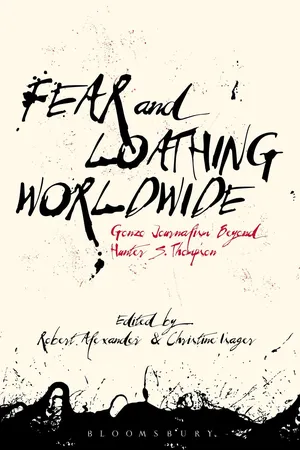
Fear and Loathing Worldwide
Gonzo Journalism Beyond Hunter S. Thompson
- 352 pages
- English
- ePUB (mobile friendly)
- Available on iOS & Android
eBook - ePub
Fear and Loathing Worldwide
Gonzo Journalism Beyond Hunter S. Thompson
About this book
Information
PART ONE
First Waves, Currents of Tradition
1
Gonzo Down Under: Matthew Thompson and the literary and political legacy of Hunter S. Thompson
Christopher Kremmer
Framed as a professional trouble seeker, Matthew Thompson has been called Australia’s answer to Hunter S. Thompson, the embodiment of Gonzo Down Under. His first book, My Colombian Death, sees him chasing paramilitaries and drug highs and lows in Colombia; his second, Running with the Blood God, finds him roaming the world on a tight budget “chasing those who will live freely whatever the cost” in Iran, Kosovo, the Philippines, and Oregon. This chapter examines Matthew Thompson’s published works for traces of literary and journalistic practices associated with Gonzo and its progenitor. The observed commonalities include literary techniques such as immersion, quests, an outsider perspective, satire, idealism, literary-political stunts, humor, drug tropes, and critiques of journalistic practice and political leaders. The chapter argues that both writers at times push the genre boundaries of journalistic writing; in Hunter S. Thompson’s case, the push is towards fiction; in Matthew Thompson’s case it is towards a creative nonfiction approach in which personal narrative at times trumps journalistic concerns. The chapter concludes that, although the two Thompsons represent different countries, generations, and literary and political priorities, the Gonzo legacy is clearly apparent in Matthew Thompson’s writing, embodying aspects of Hunter S. Thompson’s legacy adapted and re-interpreted in the context of contemporary Australian nonfiction writing and media change.
In the cramped, book-lined study of a modest home in the Australian countryside, a writer shifts uncomfortably in his chair. A big-boned, rangy man in his mid-forties, he places his large legs and bare feet in a new array that will soon be revised, and then undone again. This awkwardness, I will learn, is not merely a physical predisposition, but an existential one as well. Speaking about his past and his writing, Matthew Thompson cracks his knuckles, picks up a book, asks tentatively if I have read it, seems embarrassed when I say I have not, thinks to offer it, withdraws, resumes the conversation at a tangent, retraces his mental steps, then backtracks again, and finally hands me the book. He is an embodiment of restless diffidence.
It’s not the drugs. He cannot afford to do the drugs in Australia. In Colombia, the cocaine was two dollars a gram. In Colombia, he did the coke and the local psychotropic, yagé (MT 2009: 137, 299). In Iran, it was opium (MT 2013a: 58), but that was work, guided by his self-authored manifesto of literary-journalistic practice and ethics, which urges writers to “join your subjects in their intoxicants” in order to gain access and understanding (MT 2015b). If he travelled on expenses things might be different, but, some ten years ago, Matthew Thompson quit his job on the foreign desk of one of Australia’s oldest and most respected newspapers after being refused leave to “run free with gangbangers, paramilitaries, bulls and a shaman” (Leys 2013). The Sydney Morning Herald, he later jibed, tended to avoid using “photographs from poor countries showing gore or men with guns, even if those are commonplace realities, because we want neither to depress readers nor stereotype developing nations” (MT 2009: 4).
Political correctness, it seemed, had turned a dream job in journalism into an intolerable fetter, cutting him off from “the range and depth of experience” needed to know himself (MT 2009: 5). Craving a world in which “tension is wired through all aspects of life,” he chose Colombia, “home of the artfully arranged severed head,” as the right place to find the longed-for hard-wired tension (MT 2009: 5–6). Not long after his wife gave birth to their first child, Matthew Thompson left for Latin America. Sixty years earlier, another aspiring journalist and author, Hunter Stockton Thompson, was similarly restless and frustrated with journalism, and eyeing reporting opportunities far away. In “The Curse of the Bronze Plaque,” William Kennedy recalls receiving a job application from Hunter, aged twenty-two, for a position on a small newspaper in San Juan, Puerto Rico. In the letter, Thompson framed his need for the position in terms of a critique of American journalism, writing that “The decline of the American press has long been obvious, and my time is too valuable to waste in an effort to supply the ‘man in the street’ with his daily quota of clichés” (Kennedy 1997: xv). He would eventually get his break as a roving reporter for the National Observer in Latin America.
Matthew Thompson’s urgent literary style, nervy first-person viewpoint, and penchant for troubled places and people have led his publishers and some Australian critics to declare him “one of the closest things Australia has to Hunter S. Thompson” and even the “Australian guru of Gonzo journalism” (Pan Macmillan 2016). In exploring these claims, this chapter poses a number of questions. First, what traces of Gonzo, as pioneered by one Thompson, are discernible in the work of the other? Second, how—and perhaps why—do they differ? Third, what, if anything, might the young pretender’s writing tell us about the elder’s legacy? In pursuit of answers to these questions, I focus on aspects of Matthew Thompson’s writing and research that recall the spirit—and in some cases the practice—of Gonzo journalism, and traces of Hunter S. Thompson’s approach. These traces—manifest, though at times unstable—include such literary techniques as immersion, quests, an outsider perspective, satire, idealism, literary-political stunts, humor, drug tropes, and critiques of journalistic practice and political leadership. This chapter argues that both writers at times push the genre boundaries of journalistic writing; in Hunter S. Thompson’s case, the push is towards fiction; in Matthew Thompson’s case it tends towards a creative nonfiction approach in which personal narrative at times trumps journalistic concerns. Key differences in the performative aspects of the texts are discerned, particularly with regard to the framing, voice, and pursuits of their narrators. The chapter concludes that, although the two Thompsons represent different countries and generations, and have different literary and political priorities, the Gonzo legacy is clearly apparent in Matthew Thompson’s writing, albeit adapted and re-interpreted in the context of contemporary Australian nonfiction writing and media change.
For the purposes of this discussion, I will rely primarily on Bowe’s succinct formulation that defines Gonzo journalism as “an energetic first-person participatory writing style in which the author is a protagonist … [that] draws its power from a combination of both social critique and self-satire” (Bowe 2012: 93). Although this definition is adequate, it lacks a sense of Gonzo’s manic extremes, and therefore can be usefully complemented by Hirst’s description of Hunter S. Thompson’s style as “a crazed mix of sharp insight, humor, drugs, sex and violence” (Hirst 2004: 7). Based on these definitions, and a reading of the published works of the two writers, I conclude that Gonzo is an active ingredient in contemporary Australian literary production. Hunter S. Thompson’s diverse body of work has bequeathed a flexible literary subgenre. Gonzo has outgrown its origins and survived the death of its progenitor. Often shocking, it continues to surprise with an unexpected suppleness and endurance.
*
Matthew Thompson, like his namesake, is a natural and instinctive outsider. Born in Portland, Oregon, he was raised from the age of four in Australia. The “laconic Aussie thing” did not come naturally; it had to be learned (Kremmer 2016). After leaving school, he tried and failed at his first attempt at an undergraduate university degree, but at his second attempt won the University Medal for English. A subsequent, short-lived newspaper career in Sydney induced restlessness and frustration, leading him to resign his position and embark upon a freer, if less certain, career path as a freelance journalist, author, and teacher (Kremmer 2016).
Dungog, in the Hunter region—yes, the Hunter region—of New South Wales, is where he now lives, and where we met. It is a town of some two thousand inhabitants, and some very large pubs (“Quiet Streets of Dungog” 2013). Over the nearby hills, grapes are grown and mashed into drinkable wine, and marijuana thrives illegally in the privacy afforded by rugged acreages. Dressed casually in his preferred black T-shirt, stubble, and shades, he suspects that, at first, the locals took him for a drug dealer, at least until he signed on for shifts with the town’s fire and emergency services. Since then, his bouts of writing have been punctuated by rushed trips along the region’s narrow, winding roads, stopping occasionally to cut motorists out of wrecked cars, rescue people from floods, or make other interventions to save lives (Kremmer 2016; Mexon 2016). He also freelances as a teacher and sub-editor.
The paratexts of Thompson’s first published book, My Colombian Death: A Journey into the Heart of South America’s Most Dangerous Country (2009), inform readers that Matthew Thompson has “check(ed) out from the Australian Dream,” bound for Latin America, where “kidnappings, car bombs, cocaine, paramilitaries, bullfights, the Amazon [River] and madness” promise redemption from developed-world ennui (Amazon.com 2018). The phrasing of the subtitle and reference to national myth bear a passing resemblance to Hunter S. Thompson’s Fear and Loathing in Las Vegas: A Savage Journey to the Heart of the American Dream (1972). Both books are framed as quests, but their aims are different. Hunter S. Thompson’s seeks to understand and explain when, where, and how America’s governing myth lost its salience and capacity to inspire. It reprises a theme that has pre-occupied generations of American writers, from F. Scott Fitzgerald and Arthur Miller, to Jack Kerouac and Norman Mailer. By contrast, Matthew Thompson’s book is not a search for the roots or fate of a generation or a myth. His quest is framed as an escape from Australia’s stultifying security and material comfort. He seeks to revivify his life, to measure his worth and find himself in the world as so many white Australians have done since Anglo-Celtic convicts were cast out of Europe and dumped in the Antipodes more than two centuries ago (Groundwater 2015).
In My Colombian Death, Colombia itself is renamed “Locombia,” a land of “perpetual civil war, the highest kidnapping rate on the planet, murders uncounted, narco-terrorism, narco-militias, narco-economies, [and] native shamans dispensing the world’s most powerful hallucinogens” (MT 2009: 6). From the moment Thompson first sees it from the air, the Colombian countryside seethes with threat, “sliced by rivers and scratched with roads and towns.” He pictures villages where farmers, laborers, and families “spend nights on guard against bands of guerrillas and outlaws that must roam in their thousands amid the unlimited green of forest and jungle radiating in all directions” (MT 2009: 29–30). Having been warned by a Cuban émigré: “Do not trust nobody. Colombia is a bad country,” Thompson is unsettled to find Bogota more relaxed than he expects. Hoping to infiltrate the nation’s “circles of risk,” he heads for the inland town of Arjona where a corralejas—a bullfighting festival that includes humans running with bulls—is to be staged. The gore and “madness” of the event show Thompson to be in his element. His literary juices are in spate when one of the runners falls in front of a bull:
The fallen man looks over his shoulder straight into the horned head coming at him, fronting 500 kilograms of rage, and he is facedown again as though he does not want to see his fate but just have it over with, and the bull slams its horns into his legs and twists. The lad who tried to distract now just stands with the cloth slung over his shoulder, staring as the bull works the man over, one twitch of its neck spinning him—his legs flip through the air—and I see him hit the ground facedown again, but this time looking broken, arms caught awkwardly beneath and his mouth open in the dirt. (MT 2009: 111)
Here, Thompson displays his talent for adroitly observed reportage, observing but not endorsing, engaged but distanced. Yet having already concluded that bullfighting is “not a pursuit fit for adults,” he joins the mob on the field (MT 2009: 57, 114). This change of perspective—or immersion in the action—is tinged with black humor.
Up to now, I didn’t understand, didn’t comprehend, that for all their tremendous weight and power, bulls are shorter than men and easily lost in a crowd … my feet are primed to flee and my eyes feel like necks, craning in their sockets for a glimpse of the terror loose amid the chaotic mob and the long afternoon shadows … “There.” The bull … Snorting. Huffing. Scoring the dirt with a front hoof. We are on its left flank, poised on the rim of the innermost circle of idiots … The horns are neither clipped nor blunted, but end in points as fine as a pin. (MT 2009: 115–17)
Thompson emerges unscathed, but before the day is over he witnesses what he believes to be the death of an injured man whose “grimace now relaxes over a second or two into no expression at all” (MT 2009: 122). Yet, like a war photographer, his craft absorbs and processes, objectifies and insulates. Immersion notwithstanding, he remains the outside observer.
My Colombian Death and Matthew Thompson’s second book, Running with the Blood God: Down and Dirty with Freedom Fighters, Rebels and Misfits, exhibit all the main characteristics of the Gonzo style of writing identified by Bowe and Hirst. The narration is high energy, first person, and participatory, with the author doubling up as protagonist. The tone ranges from self-deprecating to manic, while the plot focuses on violence, drugs, political and economic conflicts, and social problems. All this is dutifully telegraphed in paratexts, such as the epigraph from Paul Kavanagh: “blood brawls with thought in my head” (MT 2009: 2). As Ferris reminds us, Hunter S. Thompson was “the onstage protagonist of most of his works” (Ferris 2003: xiii). But both he and the author of My Colombian Death curate the action outside the text as well. Put simply, the main events in these books do not happen unless a Thompson decides to enter the field of action (Reynolds 2012: 51).
*
Hunter S. Thompson’s many talents included an aptitude for staging literary-political stunts. His 1970 campaign for election as sheriff of Pitkin County failed to win him elected office, but secured a landslide of other benefits. First, it generated an enormous amount of publicity for candidate Thompson. Second, it drew public attention to civil liberties issues, in particular, unjustifiably harsh penalties for possession of marijuana. Third, it helped to normalize marginal identities and viewpoints within American public discourse. Fourth, it entertained and amused a large number of people. Fifth and finally, it provided plenty of material for Thompson’s prodigious output of articles and books. The campaign is still studied decades later (Wenzel 2017).
Matthew Thompson has also tried his hand at similar stunts. In 2002, sexist laws that prevented women from boxing in the state of New South Wales prompted Thompson to organize an event promoted as the “Women’s Boxing Extravaganza.” This political and literary event, staged to an overture of The Prodigy’s Smack My Bitch Up, mocked gender stereotypes like the idea that women are more vulnerable to int...
Table of contents
- Cover
- Halftitle Page
- Title Page
- Contents
- List of Illustrations
- Contributors
- Acknowledgments
- Introduction
- Part One: First Waves, Currents of Tradition
- Part Two: Gonzo as Socio-Political Intervention
- Part Three: Gender and the Osmotic Gonzo Body
- Part Four: Edgework, Fantasy, and Truth
- Part Five: The Continuing Story of Gonzo Worldwide
- Afterword: Gonzo without end, amen
- Index
- Imprint
Trusted by 375,005 students
Access to over 1.5 million titles for a fair monthly price.
Study more efficiently using our study tools.
Frequently asked questions
Yes, you can cancel anytime from the Subscription tab in your account settings on the Perlego website. Your subscription will stay active until the end of your current billing period. Learn how to cancel your subscription
No, books cannot be downloaded as external files, such as PDFs, for use outside of Perlego. However, you can download books within the Perlego app for offline reading on mobile or tablet. Learn how to download books offline
Perlego offers two plans: Essential and Complete
- Essential is ideal for learners and professionals who enjoy exploring a wide range of subjects. Access the Essential Library with 800,000+ trusted titles and best-sellers across business, personal growth, and the humanities. Includes unlimited reading time and Standard Read Aloud voice.
- Complete: Perfect for advanced learners and researchers needing full, unrestricted access. Unlock 1.5M+ books across hundreds of subjects, including academic and specialized titles. The Complete Plan also includes advanced features like Premium Read Aloud and Research Assistant.
We are an online textbook subscription service, where you can get access to an entire online library for less than the price of a single book per month. With over 1.5 million books across 990+ topics, we’ve got you covered! Learn about our mission
Look out for the read-aloud symbol on your next book to see if you can listen to it. The read-aloud tool reads text aloud for you, highlighting the text as it is being read. You can pause it, speed it up and slow it down. Learn more about Read Aloud
Yes! You can use the Perlego app on both iOS and Android devices to read anytime, anywhere — even offline. Perfect for commutes or when you’re on the go.
Please note we cannot support devices running on iOS 13 and Android 7 or earlier. Learn more about using the app
Please note we cannot support devices running on iOS 13 and Android 7 or earlier. Learn more about using the app
Yes, you can access Fear and Loathing Worldwide by Robert Alexander, Christine Isager, Robert Alexander,Christine Isager in PDF and/or ePUB format, as well as other popular books in Sciences sociales & Journalisme. We have over 1.5 million books available in our catalogue for you to explore.