- 232 pages
- English
- ePUB (mobile friendly)
- Available on iOS & Android
eBook - ePub
About this book
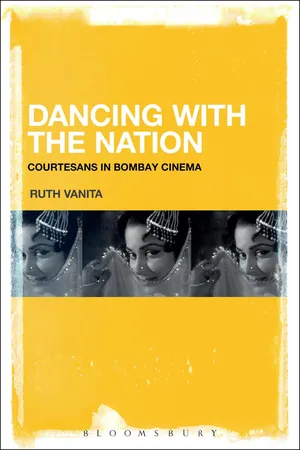
Indian cinema is the only body of world cinema that depicts courtesans as important characters. In early films courtesan characters transmitted Indian classical dance, music and aesthetics to large audiences. They represent the nation's past, tracing their heritage to the fourth-century Kamasutra and to nineteenth-century courtly cultures, but they are also the first group of modern women in Hindi films. They are working professionals living on their own or in matrilineal families. Like male protagonists, they travel widely and develop networks of friends and chosen kin. They have relations with men outside marriage and become single mothers. Courtesan films are heroine-oriented and almost every major female actor has played this role. Challenging received wisdom, Vanita demonstrates that a larger number of courtesans in Bombay cinema are Hindu and indeterminate than are Muslim, and that films depict their culture as hybrid Hindu-Muslim, not Islamicate. Courtesans speak in the ambiguous voice of the modern nation, inviting spectators to seize pleasure here and now but also to search for the meaning of life. Vanita's groundbreaking study of courtesans and courtesan imagery in 235 films brings fresh evidence to show that the courtesan figure shapes the modern Indian erotic, political and religious imagination.
Information
1
Family
If someone is yours, in spite of not being yours, what do you call that relationship?
Anand Babu in Amar Prem, 1972
Bombay cinema has always celebrated non-biological and non-marital kinship.1 Inherited from Indian literary traditions dating back to the epics, the theme of chosen kinship is one of Bombay cinema’s most distinctive features. Chosen kinship pervades and transforms the conventional family to such a degree that one could argue that the truly conventional family, nuclear or joint, exists more as an abstract ideal than as a represented reality in Bombay films.2
As in Victorian novels, conventional families in Bombay films often dissolve at the start due to accident, poverty or the machinations of family members (Waqt [Time], 1965, is a typical example). The family is then replaced by non-biological groupings, and usually reunites only at the very end. Such family breakdowns are often depicted as driving women to become courtesans. Thus, courtesan films explore the fault lines of the conventional family (both the courtesan’s own and those of her clients).
Because films invent the narrative of family breakdown driving women to become courtesans, they pay less attention to the matrilineal family structures of real-life courtesan households, in which girls born to courtesans were trained to take up their mothers’ profession, parallel to the traditional practice in most professions of children, usually sons, training in their fathers’ line of work. Even so, courtesan films do make visible some sort of matrilineal family, albeit in a distorted form.
Films of the 1940s to the 1960s depict matrilineal households as somewhat stable units. From the 1970s onwards, this depiction changes, and matrilineal families are shown as more exploitative than patrilineal ones. This makes the patriarchal family’s oppression seem more palatable by contrast.
Courtesan characters are usually depicted as discontented both in the matrilineal family they inherit and in the unconventional family they create. They long to marry and get absorbed into a conventional family. Historically, courtesan who married became the later, lower-status wives of wealthy men. As this possibility becomes less and less respectable in modern India, it is hardly ever depicted in films but continues to haunt them via convoluted plots, resurfacing in the imagined pleasures and perils of co-motherhood.
Marriage not the End
Commentators tend to focus on the courtesan heroine who gives up her profession in order to marry or dies because she cannot marry. It is important to remember, though, that even when the heroine leaves the courtesan establishment, it continues to exist and her friends living there continue to be courtesans. The main story is not the only story; minor characters remind us of the continuity of courtesan households.
Of 106 films I saw that depict a courtesan establishment or kotha, in 59 it survives after the heroine leaves. Seven films end with the main tawaif character continuing in her profession. Nineteen show a kotha in just one scene or episode. Thus, 84 kothas or 80 per cent of the total survive.
Of the remaining, in seventeen films the heroine appears to be the only one living in the kotha, usually with one older woman, so it is unclear whether it survives after she leaves. In four, the kotha is destroyed but we are told that the bazaar where kothas flourish survives. In one film, Adha Din Adhi Raat [Half Day Half Night] (1977), all the women are rescued so the kotha appears to definitely shut down. In Begum Jaan (2017), the kotha unrealistically exists not in a neighbourhood but in a complete vacuum. Most of the inhabitants burn to death in it.
Matrilineal Families
In courtesan households, skills and property passed from mothers and aunts to daughters and nieces. From the late nineteenth century onwards, social reformers and nationalists tried to make family structures uniform across the country, based on a Victorian model, which resulted in the denigration of matrilineal families.
In the 1950s, Nehru’s government codified and changed Hindu laws of marriage and inheritance, which until then had varied across regions and communities. In one stroke, the new laws did away with matrilineal inheritance. Attitudes common in heavily patriarchal formations, such as devaluation of daughters and contempt for men living with their in-laws, became dominant in late colonial and postcolonial India. In Chapter 5, I discuss how this debate plays out in films in relation to ideas of the nation.
Char Dil Char Rahen [Four Hearts, Four Paths] (1959) is perhaps the only film in which a courtesan strongly affirms her duty to take care of her ageing mother. When chauffeur Dilawar proposes marriage to tawaif Pyari, she joyfully tells her mother, ‘We both will serve you.’ Dilawar, however, declares that a tawaif cannot live in his house. Pyari asks, ‘So I have to leave my mother?’ and Dilawar responds, ‘What’s so special about that? Every girl leaves her mother when she marries.’
Pyari then makes a moving statement about the difference between matrilineal and patriarchal households:
‘You’re right, every girl leaves her mother. But a tawaif’s daughter does not leave her mother. Those other mothers have homes, husbands and relatives. A tawaif’s kinship (rishtedari) culminates in her daughter. I can leave the whole world for you. But I cannot leave my mother for you.’
When Dilawar reiterates that he cannot have a tawaif in his house, Pyari retorts, ‘She’s not a tawaif, she’s my mother.’ Pyari marries Dilawar at the end of the film only after he has a change of heart and tells her, ‘Your mother is my mother.’
By the 1970s, a courtesan character’s links to her mother have to be erased in order for her to be recuperated into respectable society. Even if the mother does not die, she disappears from the narrative without explanation. Thus, in Guide (1965), Rosie’s devadasi mother arranges her marriage. When the marriage breaks down, Rosie decides to dance again and tells her husband, ‘I have begun to see more honour in my mother’s profession than in your name.’ But her mother does not appear again in the film.
A courtesan has to keep her background hidden after she marries, thus in Rajkumar [Prince] (1964), the hero’s stepmother insists that he keep her secret: ‘My mother was a dancer and singer (nachne-gane wali). If this becomes known, it will be a stain (kalank) for the royal line. Your father will not be able to bear it.’
Films project a courtesan mother as good if she protects her daughter’s virginity in order to get her married. A bad courtesan mother is one who tries to preserve the matrilineal household by training her daughter and granddaughter to become courtesans.
A good mother has her daughter raised by others in order to erase the relationship. Pannabai in Mamta [Maternal Love] (1966) hides from her daughter long after it is necessary. Najma in Mehboob ki Mehndi [Beloved’s Henna; name of a red-light area in Hyderabad] (1971) throws herself from a window rather than meet her daughter. In films like Paise ki Gudiya [Paid Doll] (1974), so contaminated is the tawaif mother that only on her deathbed can she meet her daughter.
A more benign depiction of an adopted mother’s erasure appears in Khilona [Toy] (1970). Heerabai refuses to sell Chand’s services, saying, ‘Mamta ki ko’i qeemat nahin hoti’ (maternal love cannot be bought). She confesses on her deathbed that she had kidnapped Chand as a child, yet Chand extols her, saying that she gave her both ma ki mamta (a mother’s fond love) and bap ka pyar (a father’s affection). This is perhaps because Heerabai wanted Chand to marry. As Heerabai dies, her paan box clangs shut, signifying the end of Chand’s relationship with the tawaif lineage.
Occasionally, a courtesan mother who hides her motherhood is absorbed into the conventional family. In Hanste Zakhm [Laughing Wounds] (1973), an old tawaif tries to sell her granddaughter Rekha. Rekha’s mother, Heerabai, intervenes and accidentally kills her mother. Before going to prison, she gets a middle-class widower to adopt Rekha. When she emerges from prison years later, he asks her to live with them as his sister. A double erasure (Heerabai killing her own mother and then posing as her daughter’s aunt) is required for her to be accepted.
By the 1990s, prejudice against the courtesan’s matrilineal family reaches virulent proportions. In Pati Patni aur Tawaif [Husband, Wife and Courtesan] (1990), tawaif Gauri kills both her mother and her maternal uncle. She does this because her mother, Chhaiya, insists that according to the principles of their community (biraderi ke usool), Gauri’s daughter Phool is the support of her grandmother’s old age and must learn to dance.
Gauri shoots Chhaiya, declaring, ‘Your daughter did not shoot you. A mother killed a tawaif.’ This is a complete reversal of Pyari’s declaration three decades earlier in Char Dil Char Rahen: ‘She’s not a tawaif, she’s my mother.’
A more realistic depiction of how courtesans transition from matriliny to patriliny appears in Ram Balram (1980). Gangubai raises her daughter, Tara, in the kotha. Tara has a relationship with a man whose mother is a tawaif and whose father is a seller of jasmine garlands (a low-status job in the kotha), but marriage to a social reformer becomes Tara’s path out of the kotha. Remade as a Westernized lady, she raises her daughter Madhu in middle-class style. Here, we see three generations of a tawaif family, the grandmother remaining on the kotha, the daughter transitioning but not entirely, and the granddaughter becoming a middle-class girl.
Maternal Uncle
The denigration of the courtesan mother extends to her brother, who is often the heroine’s mama (maternal uncle). Wicked maternal uncles and their wives are common to both matrilineal and patriarchal households in movies, and they are equally nasty to nephews and nieces.
Villainous maternal uncles far outnumber villainous paternal uncles; this is partly due to the Puranic and epic archetypes of Kansa, Krishna’s murderous uncle, and Shakuni, the Kauravas’ cunning uncle. In Ghungroo ki Awaaz [Sound of Ankle Bells] (1981), the villainous uncle, when denounced as a Kansa, shoots himself, but in Ghungroo [Ankle Bells] (1983), he compounds his villainy by declaring, ‘Kansa ruined the reputation of all maternal uncles, but I will restore it’, even while he is working to destroy his nephew.
The denigration of a woman’s brothers in popular discourse (e.g., using the word saala [wife’s brother] as a term of abuse) is also connected to the fact that traditionally they constitute her only refuge from an abusive husband. From a man’s point of view, his wife’s brother obstructs his complete control over his wife.
Like the maternal uncle and his wife in Dil hi to Hai [It’s Just the Heart] (1963), who abandon their nephew so that their...
Table of contents
- Cover
- Half-Title
- Dedication
- Title
- Contents
- Acknowledgements
- Introduction
- 1 Family
- 2 Eros
- 3 Work
- 4 Male Allies
- 5 Nation
- 6 Religion
- Conclusion
- Alphabetical List of Films
- Chronological List of Films
- Bibliography
- Glossary
- Index
- Copyright
Trusted by 375,005 students
Access to over 1.5 million titles for a fair monthly price.
Study more efficiently using our study tools.
Frequently asked questions
Yes, you can cancel anytime from the Subscription tab in your account settings on the Perlego website. Your subscription will stay active until the end of your current billing period. Learn how to cancel your subscription
No, books cannot be downloaded as external files, such as PDFs, for use outside of Perlego. However, you can download books within the Perlego app for offline reading on mobile or tablet. Learn how to download books offline
Perlego offers two plans: Essential and Complete
- Essential is ideal for learners and professionals who enjoy exploring a wide range of subjects. Access the Essential Library with 800,000+ trusted titles and best-sellers across business, personal growth, and the humanities. Includes unlimited reading time and Standard Read Aloud voice.
- Complete: Perfect for advanced learners and researchers needing full, unrestricted access. Unlock 1.5M+ books across hundreds of subjects, including academic and specialized titles. The Complete Plan also includes advanced features like Premium Read Aloud and Research Assistant.
We are an online textbook subscription service, where you can get access to an entire online library for less than the price of a single book per month. With over 1.5 million books across 990+ topics, we’ve got you covered! Learn about our mission
Look out for the read-aloud symbol on your next book to see if you can listen to it. The read-aloud tool reads text aloud for you, highlighting the text as it is being read. You can pause it, speed it up and slow it down. Learn more about Read Aloud
Yes! You can use the Perlego app on both iOS and Android devices to read anytime, anywhere — even offline. Perfect for commutes or when you’re on the go.
Please note we cannot support devices running on iOS 13 and Android 7 or earlier. Learn more about using the app
Please note we cannot support devices running on iOS 13 and Android 7 or earlier. Learn more about using the app
Yes, you can access Dancing with the Nation by Ruth Vanita in PDF and/or ePUB format, as well as other popular books in Media & Performing Arts & Film & Video. We have over 1.5 million books available in our catalogue for you to explore.