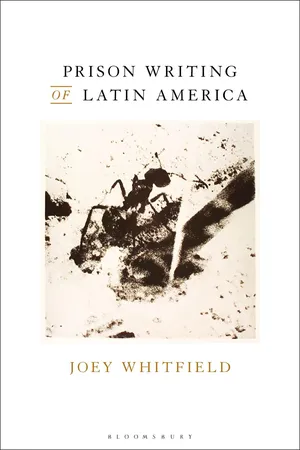
What happens inside Latin American prisons? How does the social organisation of prisoners relate to the political structures beyond the walls? Is it possible to resist corrupt penal regimes? In Prison Writing of Latin America, Joey Whitfield turns to those best placed to answer these questions: people who have been imprisoned themselves.
Drawing on a century of material produced by Latin American prisoners from Mexico, Cuba, Costa Rica, Colombia, Peru, Bolivia and Brazil, Whitfield weaves readings of novels, memoirs and testimonial texts with social and political analysis. Rather than distinguishing between dictatorial and democratic periods of government, he shows that from the point of view of the prisoner, all states are authoritarian in nature. In the face of oppression, however, prisoners both 'political' and 'criminal' have found ways not only to resist but also to create alternative communities both real and imagined, sometimes in collaboration with each other.
- 216 pages
- English
- ePUB (mobile friendly)
- Available on iOS & Android
eBook - ePub
Prison Writing of Latin America
About this book
Information
1
The Punitive and the Lettered City: The Politics of Prison Writing
In 1963 the Costa Rican literary establishment was shocked when the country’s most infamous prisoner, José León Sánchez, won the national short story prize, the Premio Juegos Florales (Floral Games), for the story ‘El poeta, el niño y el río’ (‘The Poet, the Boy, and the River’).1 Thirteen years earlier, León Sánchez had confessed to being responsible for the most sensational crime of the century. On the morning of 13 May 1950, thieves broke into the Basílica de Nuestra Señora de los Ángeles (The Basilica of Our Lady of the Angels) – home of the Virgen de los Ángeles, the patron saint of Costa Rica – killed a guard and made off with the saint’s jewels, which were worth several million dollars. Following a national manhunt for the man the press dubbed ‘el Monstruo de la Basílica’ (the monster of the Basilica), the then nineteen-year-old León Sánchez was accused of being el monstruo (the monster). An illiterate indigenous orphan whose mother had been a sex worker, León Sánchez was identified by his father-in-law, who claimed to have seen him with a bag of jewellery, although neither bag nor jewels were ever recovered. No lawyer would agree to defend the teenager, whose confession had been extracted after a brutal police interrogation. He was excommunicated from the Catholic Church and condemned to ‘cadena perpetua’ (imprisonment for life), which meant spending the rest of his life dragging a ball and chain on the tiny island of San Lucas, a penal colony off Costa Rica’s Pacific coast. The colony had been founded after the abolition of the death penalty and had an annual mortality rate of 20 per cent. Against these odds, León Sánchez not only survived on San Lucas, but eventually learned to read and write from a fellow prisoner.2 Shortly after the success of ‘El poeta, el niño y el río’, in 1967 he published a novel set on the island, La isla de los hombres solos (The Island of Lonely Men), composed on paper bags of cement that he used to sleep on.3
La isla was a huge commercial success, with sales figures rivalling those of classic boom texts in the same period. In 1974 it was made into a film in Mexico and it is now in its hundredth edition, with over 2 million copies sold.4 Because of its initial popularity, Ervin Beck, in an American review of the English translation, titled God Was Looking the Other Way (1973), even went so far as to describe the novel as the ‘chief rival of One Hundred Years of Solitude’.5 Thanks to his literary successes, León Sánchez was transformed from ‘el reo más temido y odiado del pueblo costarricense’ (the most feared and hated prisoner in Costa Rica) into a national cultural curiosity.6 In his words, ‘el Monstruo de la Basílica’ became ‘el Loco del Libro’ (the lunatic with the book).7 His success as a writer paved the way for his release from prison in 1980, seventeen years after he won the Premio Juegos Florales. He is now the bestselling writer in Costa Rican history, with twenty-seven literary works, many academic articles, and a string of prizes and honorary degrees to his name. In 1998 he was pardoned of the crime for which he was convicted, and the Catholic Church has apologized for excommunicating him.8 León Sánchez’s life story is one of redemption through literature, with the writing of La isla de los hombres solos at its centre.
As I have outlined, the ciudad letrada has come to stand as a shorthand for both the processes of discursive nation-building and the exclusions that this inevitably entailed. The prison was a complicit exclusionary institution, making concrete the epistemic violence and exclusions of the ciudad letrada. The success of La isla de los hombres solos represents an incursion into the ciudad letrada by one whose subaltern position had led to his exclusion, not only from the realm of lettered discourse, but from the whole of Costa Rican society. This chapter interrogates the politics of prison writing, particularly its claim to challenge lettered hierarchies, by contrasting La isla de los hombres solos with a prison text by an author who is more representative of the traditional letrado, Álvaro Mutis’s Diario de Lecumberri (Diary of Lecumberri).9
Álvaro Mutis was the son of a Colombian diplomat who fled to Mexico in 1956, after using funds from his job at Standard Oil to aid political dissidents in his native country. A keen poet, he arrived in Mexico City bearing a letter recommending him to Luis Buñuel and was soon moving in elite cultured circles. However, at the request of the Colombian government he was arrested by Interpol and held in the infamous prison of Lecumberri in central Mexico City for over a year. This institution is famous for having once held a number of political figures, including the revolutionary leader Pancho Villa, who famously escaped in 1912, the muralist David Alfaro Siqueiros, the writer José Revueltas and Trotsky’s murderer, Ramón Mercader. While in prison Mutis received the attention of important writers such as Octavio Paz, Elena Poniatowska and others, who visited him and campaigned on his behalf. After his release, he too became a bestselling author of fiction, best known for his series of novels about the misanthropic anti-hero Maqroll el Gaviero. Diario de Lecumberri is often published in the same volume as La mansión de Araucaíma (The Manor of Araucaíma), a collection of short stories also composed in prison. He also maintained friendships with writers as celebrated as Gabriel García Márquez, Octavio Paz and Carlos Fuentes.
Diario de Lecumberri and La isla de los hombres solos invite comparison because both indicate their political intention to be the denunciation of the conditions and abuses that take place within the prisons in which they were composed. Both strive to function, in Beverley’s phrase, as ‘a form of social action’ by taking aim at the prison.10 In this they seem to conform to Franklin’s claim that ‘prison writing’ is, because of its circumstances of composition, an inherently politicized cultural form that arises in direct ideological conflict with traditional elite forms of literature and culture.11
The very idea of ‘prison writing’ as a genre recognizes that the material situation and context of the writer will inevitably impact upon the political content of his or her text. This is a familiar notion in historical materialist criticism. For Fredric Jameson, the ‘situatedness’ of an author (understood in terms of the material traces of their social, racial and gendered origins) will affect everything that they write, albeit often in unpredictable ways.12 Sometimes also called ‘positionality’, or in feminist theory, ‘standpoint’, these terms signal a determining logic according to which knowledge is defined by a subject’s social position of relative advantage (or disadvantage) in relation to others. It does not follow that a position of social, economic or gender disadvantage will translate into epistemic disadvantage. On the contrary, feminists, such as Nancy Hartsock, have argued that women occupy a position of epistemic privilege in relation to the understanding of patriarchy, while Marxists have shown how the working class has occupied a privileged position in relation to understandings of labour and capital.13 It does not take much to see how the notion of epistemic privilege is relevant to prison writing. Indeed, it is common sense that those who have experienced imprisonment will be in a privileged position with regard to understanding the prison. But Franklin’s assumptions around prisoner consciousness go further in that he echoes the Marxist notion that class position translates not only into political consciousness, but also into action to bring about material change. Rather than class struggle and revolution, however, in the case of prison writing any oppositional politics might be measured by its opposition to the prison as an institution.
This chapter aims to explore the politics of situatedness in terms both the texts’ composition within prison and to their authors’ class subject positions prior to confinement. There are numerous points of contrast between them: Mutis was imprisoned for financial crime with a political justification, León Sánchez for a notorious murder; Mutis hailed from well-educated, traditional letrado stock (his father, Santiago Mutis Dávila, was also a lawyer), while León Sánchez was an illiterate orphan of indigenous heritage.14 While León Sánchez enacts a discursive incursion into the realm of the ciudad letrada from below, Mutis writes from within its edifice.
The chapter is an exploration of the division made between elite and popular culture according to which the literature and novels of a letrado are contrasted with those of an author of subaltern origin. It gives credence to, yet also confounds, some of the assumptions that might be made about the determining relationship between social standpoint and political ideology. Crucial to my reading is the fact that both texts are narrated by subjects who occupy positions very similar to the authors’ own. Arguably both authors also use writing to constitute themselves as subjects in relation to the institution of letters and the state. The politics of each of these texts is also inflected by the ways in which they are figured as a means to either reproduce or, in the case of León Sánchez, transform their authorial subject’s position in the eyes of the state.
In exploring the questions above, I draw on some of the theoretical work of the Latin American Subaltern Studies group. The group, mainly through their defence of the truth-value of testimonio in the 1990s, attempted to enact a politics of solidarity with subaltern sectors. In promoting the testimonio as a form of anti-literature they attempted to widen what Jean Franco called the ‘breach’ in the walls of the lettered city.15 Their political views divided over the nature of ‘subalternist politics’ and split into several factions. These are characterized by one of its former members, John Beverley, as statist and anti-statist. In Latin Americanism after 9/11, Beverley sets out the distinction between those ‘anti-statist’ subalternists, such as Gayatri Spivak, who have celebrated this potential of subalternity to undermine the state. The anti-statist position is also, for Beverley, epitomized by the deconstructionist thinking which saw the figure of the subaltern as that which was inherently outside politics and therefore, through a Derridean, ‘supplementary’ logic, constituted a threat to the established order by virtue of its very exclusion from that order.16 This position is opposed by other subalternists, such as Álvaro García Linera, who see the possibility for the inclusion of the subaltern in the processes of statehood. According to Beverley, the ‘anti-statist’ engagement with subalternist politics can only ever be an ‘ethical gesture’ while the ‘statist’ subaltern position on the other hand is ‘political’ because only through engagement with something like the state is it possible to produce real change.17 In fact, Beverley (who is influenced by Ernesto Laclau’s thinking on hegemony here) argues that by attempting to include the ‘demands, values, experiences from the popular-subaltern sectors’ w...
Table of contents
- Cover
- Halftitle Page
- Title Page
- Contents
- List of Figures
- Acknowledgements
- Introduction
- 1. The Punitive and the Lettered City: The Politics of Prison Writing
- 2. ‘We Are the Men without Women’: Hegemonic Masculinity and the Hegemony of the Prison
- 3. Heterotopia, Utopia, Necrotopia: Sovereignty and Struggle in the Peruvian Prison
- 4. Prison Writing and the War on Drugs
- Beyond the Prison
- Bibliography
- Index
- Imprint
Trusted by 375,005 students
Access to over 1.5 million titles for a fair monthly price.
Study more efficiently using our study tools.
Frequently asked questions
Yes, you can cancel anytime from the Subscription tab in your account settings on the Perlego website. Your subscription will stay active until the end of your current billing period. Learn how to cancel your subscription
No, books cannot be downloaded as external files, such as PDFs, for use outside of Perlego. However, you can download books within the Perlego app for offline reading on mobile or tablet. Learn how to download books offline
Perlego offers two plans: Essential and Complete
- Essential is ideal for learners and professionals who enjoy exploring a wide range of subjects. Access the Essential Library with 800,000+ trusted titles and best-sellers across business, personal growth, and the humanities. Includes unlimited reading time and Standard Read Aloud voice.
- Complete: Perfect for advanced learners and researchers needing full, unrestricted access. Unlock 1.5M+ books across hundreds of subjects, including academic and specialized titles. The Complete Plan also includes advanced features like Premium Read Aloud and Research Assistant.
We are an online textbook subscription service, where you can get access to an entire online library for less than the price of a single book per month. With over 1.5 million books across 990+ topics, we’ve got you covered! Learn about our mission
Look out for the read-aloud symbol on your next book to see if you can listen to it. The read-aloud tool reads text aloud for you, highlighting the text as it is being read. You can pause it, speed it up and slow it down. Learn more about Read Aloud
Yes! You can use the Perlego app on both iOS and Android devices to read anytime, anywhere — even offline. Perfect for commutes or when you’re on the go.
Please note we cannot support devices running on iOS 13 and Android 7 or earlier. Learn more about using the app
Please note we cannot support devices running on iOS 13 and Android 7 or earlier. Learn more about using the app
Yes, you can access Prison Writing of Latin America by Joey Whitfield in PDF and/or ePUB format, as well as other popular books in Literature & Latin American & Caribbean Literary Criticism. We have over 1.5 million books available in our catalogue for you to explore.