Over the course of the long 18th century, many of England's grandest country houses became known for displaying noteworthy architecture and design, large collections of sculptures and paintings, and expansive landscape gardens and parks. Although these houses continued to function as residences and spaces of elite retreat, they had powerful public identities: increasingly accessible to tourists and extensively described by travel writers, they began to be celebrated as sites of great importance to national culture. This book examines how these identities emerged, repositioning the importance of country houses in 18th-century Britain and exploring what it took to turn them into tourist attractions.
Drawing on travel books, guidebooks, and dozens of tourists' diaries and letters, it explores what it meant to tour country houses such as Blenheim Palace, Chatsworth, Wilton, Kedleston and Burghley in the tumultuous 1700s. It also questions the legacies of these early tourists: both as a critical cultural practice in the 18th century and an extraordinary and controversial influence in British culture today, country-house tourism is a phenomenon that demands investigation.
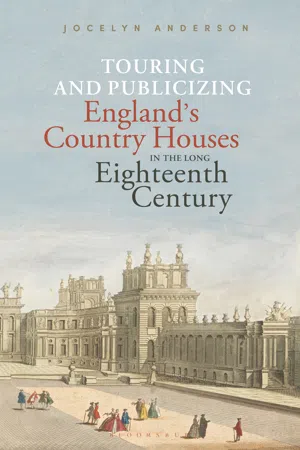
eBook - ePub
Touring and Publicizing England's Country Houses in the Long Eighteenth Century
- 256 pages
- English
- ePUB (mobile friendly)
- Available on iOS & Android
eBook - ePub
Touring and Publicizing England's Country Houses in the Long Eighteenth Century
About this book
Information
1
‘For the Numerous Strangers Who Visit’: Tourists’ Itineraries and Practices
Lady Wilson, whose passion for making annual Tours to different parts of England, Scotland and Wales, in search of the various beauties with which Nature and Art have so abundantly stored this happy Country and its sister Kingdom and dependencies, increases with her age … resolved to make a Journey.
– Millicent Bant, 18081
No country house attracts significant numbers of tourists without some form of publicity: if it is not well known as a site which is unusual in its monumentality, beauty, history, modernity, possession of great rarities or some other extraordinary quality, there is simply no good reason for travellers to attempt to visit it. In 1971, the Duke of Bedford jokingly claimed that the majority of people visited stately homes because they possessed cars and they needed somewhere to go: while he was no doubt correct about the importance of transportation, it is always a house’s public reputation which ensures it is chosen as a destination.2 In the eighteenth century, the English countryside was filled with country houses, but many would never have attracted tourists; those that did were sites where people expected to see something significant. To attempt to view a house with no advance knowledge of it was certainly possible, but there was considerable risk of disappointment. Describing a visit to Euston Hall (Suffolk) in 1775, a house which was not typically included on tourists’ itineraries, William Drake wrote with great exasperation ‘what did you see there? a noble Suite of Apartments, no. – Magnificent Furniture? – no. – Elegance of Ornaments? no. – Capital Paintings? – nemin de – in short Sir what did you see? – that there was nothing, literally nothing, worth seeing’.3 Drake’s letter not only reveals his frustration on this occasion, it also indicates what his expectations of the country houses he was visiting were: he was interested in the magnificent, the elegant and the prestigious. What he considered ‘worth seeing’ was not merely a reflection of his personal preferences, it was something which was cultivated by a growing tourist industry.
Like Lady Wilson, most eighteenth-century tourists undertook their travels because of general interests rather than a goal of viewing country houses. Travel literature introduced them to a myriad of sites, and the promotion of a specific country house’s architecture, art collection, interior decorations or gardens depended in part on how that house might be drawn into tourists’ networks. As travel became more straightforward in practical terms, country-house tourism increasingly began to fuel itself: travel writers wrote extensively about country houses such that many houses became widely known, tourists visited in such significant numbers that owners created formal systems for dealing with them, thus making it easier to accommodate more visitors, and as visitor numbers increased, so too did the books written for them. Touring Britain was celebrated as a pleasurable and informative activity, and tourists’ desires to seek out what was educational, novel and unusual shaped their visits to country houses.
Touring Britain in the long eighteenth century
Eighteenth-century Britain witnessed a tremendous growth in tourism: by the early 1800s, there were books for tourists, inns for tourists, guides for tourists, souvenirs for tourists and, above all, popular itineraries for tourists. Country-house tourism depended on and strengthened this nascent industry: many estates were attractive in part because they could be integrated into plans for long journeys, while at the same time they were expected to enrich the experience; this symbiosis was critical to the establishment of specific houses as popular attractions and to visitors’ motivations. On a practical level, as innovations in transport made travelling around Britain easier, faster and more comfortable, travelling for leisure became more and more popular. The opportunity to visit country houses was one of several pleasures a tourist might anticipate: other attractions included antiquities, regions of natural beauty, cities, spa towns and factories. All of these destinations were easily accessible through the improved road networks, and they were widely written about, both by professional travel writers and by tourists themselves. Descriptions of country houses appeared alongside descriptions of ecclesiastical ruins, churches and castles, of the wonders of the Peak and the Lake Districts, of Bath and London and of the growing textile, ceramic and manufacturing industries. As more and more accounts of travelling in Britain circulated, the collective attractions of these sites acquired an enhanced significance, and touring was increasingly treated as an activity which was not only pleasurable, but also patriotic.
The popularity of tourism depended above all on the feasibility and convenience of travelling by road. In the early 1700s, many areas of the country remained relatively difficult and time-consuming to access, and while there were some intrepid travellers who made the journey anyway, it was only when the infrastructure improved that tourist numbers rose sharply. Celia Fiennes, for instance, visited Chatsworth in 1697, but by the time Philip Yorke visited in 1763, he could confidently state that ‘The roads newly made through the Peak are so good that this part of the kingdom is now as accessible as Hertfordshire or Surrey.’4 Even a site as monumental and extraordinary as Stonehenge owed at least some of its appeal to tourists to its convenient location (in between London and Bath) and ease of access.5 Critically, in the mid-eighteenth century, there was a major increase in the number of turnpike roads (toll roads which were well maintained): the government passed 25 turnpike acts in the 1730s, 37 in the 1740s, 170 in the 1750s and 170 again in the 1760s, 75 in the 1770s and 34 in the 1780s.6 The quality of these new roads enabled travellers to complete their journeys in less than half the time: in 1754, it took 230 hours to travel from Edinburgh to London but by 1780, the journey took a little over eighty hours.7 All tourists would have been aware of the advantages of these roads, and some commented on them; for example, during a tour in 1799, Dr William George Maton noted ‘a good lime-stone turnpike road’ from Newport Pagnell to Northampton, and ‘A pleasing drive on a broad level turnpike road’ between Loughborough and Derby.8 In addition to the improvements in roads, the design and technology of carriages became much more sophisticated; for example, stage coaches began to rely on steel springs, which enabled them to drive faster more safely. Competition between providers led to increases in the available transport services, and there were improvements in milestones, signposts and route maps.9 Once travel had become less time-consuming and unpredictable, it also became less expensive, and as such, many more people could travel for pleasure.
One of the earliest types of attractions to become popular was antiquities, an eighteenth-century historical umbrella which could encompass everything from ancient British ruins to sixteenth-century paintings. Official interest in antiquities grew over the course of the eighteenth century: the Society of Antiquaries began meeting in 1707, began sponsoring the publication of Vetusta Monumenta (a series of engravings of ancient monuments) in 1747, received a royal charter in 1751 and began publishing a journal, Archaeologia, in 1770. From the very beginning, one of the Society’s priorities had been to generate greater enthusiasm for and awareness of antiquities, and many leading antiquarians not only made extensive tours of Britain as part of their research, they went on to publish accounts of the places they had visited.10 In 1724, William Stukeley published Itinerarium Curiosum, or, An Account of the Antiquitys and Remarkable Curiositys in Nature or Art, Observ’d in Travels thro’ Great Brittan, a work which describes a journey to Wales, a tour from London to Lincoln and back and a series of excursions in Wiltshire, among others. Texts like the Itinerarium helped establish tourism as a patriotic pursuit: in a study of antiquaries’ activities, Rosemary Sweet observed that visiting and recording antiquities was ‘firmly grounded in a patriotic agenda because antiquities cast light upon history, and a nation’s history was its identity’.11 Throughout the eighteenth century, cathedrals, monastic ruins, notable churches, castle ruins and prehistoric remains all attracted visitors, often the same visitors who were touring country houses on other days of their trips. Craven Ord, for example, was a keen antiquarian, and in his tour of Norfolk (c. 1781) he visited country houses, including Narford, Rainham, Houghton and Holkham, but the majority of his journal discusses medieval religious buildings, ranging from small parish churches to Norwich Cathedral and the ruins of Castle Acre Priory.12 Antiquarian enthusiasts were not necessarily the same as country-house tourists – some of the former were infamous for their lack of interest in non-medieval art works – but in general, their interest in pursuing ‘research on antiquity in their spare time and for their own entertainment’ was fundamental to the emergence of what might be called educational sightseeing.13 This aspect of tourism would quickly become essential for country-house visiting, particularly at houses known for displaying collections of paintings, sculptures or other rarities.
Opportunities to view art collections were highly valuable not simply for their novelty, but because of the tremendous importance attached to being a person of taste. To be recognized as having good taste was an important sign of social distinction in the eighteenth century; John Styles and Amanda Vickery have described it as ‘an obsession of the genteel classes’.14 Although the term was notoriously difficult to define and signified slightly different things depending on the context, in general, to be a person of taste was to be a sophisticated observer of culture, a person who appreciated the fine arts and could articulate their thoughts about them in a manner which was well informed and critical.15 Cultivating this expertise was a matter of reading and experience, and this made travelling to sites where one could view grand buildings and art collections highly beneficial as well as pleasurable.
London is often overlooked in histories of eighteenth-century British tourism, but it played a critical role: while many tourists travelled from London on tours, others travelled to the city, visiting numerous attractions on their way and then staying for weeks at a time. The Rev. William MacRitchie, for example, lived in Clunie (Perthshire) and in 1795, he set out from home on 22 June, arrived in London on 21 July having visited several plac...
Table of contents
- Cover
- Halftitle Page
- Title Page
- Dedication Page
- Contents
- Illustrations
- Acknowledgements
- Introduction
- 1. ‘For the Numerous Strangers Who Visit’: Tourists’ Itineraries and Practices
- 2. ‘A Sumptuous Pile of Building’: Remaking the Sights and Spaces of the House
- 3. ‘Eminent in Public Estimation’: The Transformation of Country Houses’ Paintings and Sculptures
- 4. ‘A Degree of Taste and Elegance’: Commenting on Country Houses’ Interiors
- 5. ‘The Beauties of Nature’: Descriptions of Country-House Gardens and Parks
- Conclusion
- Appendix: Country-House Guidebooks
- Bibliography
- Index
- Imprint
Trusted by 375,005 students
Access to over 1.5 million titles for a fair monthly price.
Study more efficiently using our study tools.
Frequently asked questions
Yes, you can cancel anytime from the Subscription tab in your account settings on the Perlego website. Your subscription will stay active until the end of your current billing period. Learn how to cancel your subscription
No, books cannot be downloaded as external files, such as PDFs, for use outside of Perlego. However, you can download books within the Perlego app for offline reading on mobile or tablet. Learn how to download books offline
Perlego offers two plans: Essential and Complete
- Essential is ideal for learners and professionals who enjoy exploring a wide range of subjects. Access the Essential Library with 800,000+ trusted titles and best-sellers across business, personal growth, and the humanities. Includes unlimited reading time and Standard Read Aloud voice.
- Complete: Perfect for advanced learners and researchers needing full, unrestricted access. Unlock 1.5M+ books across hundreds of subjects, including academic and specialized titles. The Complete Plan also includes advanced features like Premium Read Aloud and Research Assistant.
We are an online textbook subscription service, where you can get access to an entire online library for less than the price of a single book per month. With over 1.5 million books across 990+ topics, we’ve got you covered! Learn about our mission
Look out for the read-aloud symbol on your next book to see if you can listen to it. The read-aloud tool reads text aloud for you, highlighting the text as it is being read. You can pause it, speed it up and slow it down. Learn more about Read Aloud
Yes! You can use the Perlego app on both iOS and Android devices to read anytime, anywhere — even offline. Perfect for commutes or when you’re on the go.
Please note we cannot support devices running on iOS 13 and Android 7 or earlier. Learn more about using the app
Please note we cannot support devices running on iOS 13 and Android 7 or earlier. Learn more about using the app
Yes, you can access Touring and Publicizing England's Country Houses in the Long Eighteenth Century by Jocelyn Anderson in PDF and/or ePUB format, as well as other popular books in Art & History of Architecture. We have over 1.5 million books available in our catalogue for you to explore.