Mastering Fear analyzes horror as play and examines what functions horror has and why it is adaptive and beneficial for audiences. It takes a biocultural approach, and focusing on emotions, gender, and play, it argues we play with fiction horror. In horror we engage not only with the negative emotions of fear and disgust, but with a wide range of emotions, both positive and negative. The book lays out a new theory of horror and analyzes female protagonists in contemporary horror from child to teen, adult, middle age, and old age.
Since the turn of the millennium, we have seen a new generation of female protagonists in horror. There are feisty teens in The Vampire Diaries (2009–2017), troubled mothers in The Babadook (2014), and struggling women in the New French extremity with Martyrs (2008) and Inside (2007). At the fuzzy edges of the genre are dramas like Pan's Labyrinth (2006) and Black Swan (2010), and middle-age women are now protagonists with Carol in The Walking Dead (2010–) and Jessica Lange's characters in American Horror Story (2011–). Horror is not just for men, but also for women, and not just for the young, but for audiences of all ages.
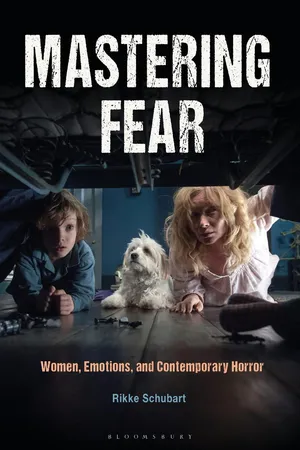
- 384 pages
- English
- ePUB (mobile friendly)
- Available on iOS & Android
eBook - ePub
About this book
Information
1
The Dark Stage
One of my favorite horror scenes is in the British monster movie The Descent (2005, Neil Marshall), where six women go on a trip into a mountain cave system. It happens after tunnels collapse behind them and there is no turning back. They now enter an enormous cave. The bouncing rays of lights from lamps mounted on their helmets capture something white at their feet: Bones. The protagonist Sarah (Shauna Macdonald) turns on the infrared sight on her camera to see better in the dark. “Hundreds of dead animals,” she concludes. One of the women has a twisted ankle and they are all terrified. What carnivorous creatures live miles down in the mountains? “What is this place,” one asks and another yells: “Hello? Is there ANYBODY THERE?” As Sarah turns her head, the infrared light suddenly reveals a humanoid, slimy, and hungry-looking creature right behind them. At this point, I jumped in the couch and screamed out loud, which made my children come running. I assured them there was nothing to be afraid of. Mom was just enjoying herself with a movie. Really, this was just fun.
Later in the film, when several of the women are dead, Sarah has learnt that the monsters have an excellent sense of hearing but are blind. When a creature approaches, she lies still and lets it walk over her. Holding her breath, she controls instincts telling her to flee. Sarah has learnt to master her fear. We, too, learn from fiction horror. And where Sarah ultimately dies despite having learnt to control her emotions, we, the audience, live. Unlike Sarah, our lives are not at stake, because we are playing with fear.
In this chapter, I outline horror as a dark stage where characters may die horrible deaths, but where audiences play with fear. It is divided into three sections on emotions, gender, and play. In conclusion, I discuss how horror taps into aggression and has three basic narratives, which I call survival horror, social horror and identity horror. There is also a fourth narrative, which I call creative horror. It is when the fiction demonstrates self-awareness about its status as fiction and play, like The Cabin in the Woods (2012, Drew Goddard). Horror teaches us to manage challenging emotions and make difficult choices. It functions like play fighting does for animals. However, the human mind is more complex than the animal mind, and our play with fear more complex than animal play fighting. To understand how horror teaches us to manage emotions and make choices, we will therefore first ask what emotions are, how we construct a “self,” how this self becomes gendered, and what it means to play on the edge, where characters fall into the abyss and our experience can feel unpleasant, sometimes even traumatizing.
EMOTIONS
… stepping into the light is also a powerful metaphor for consciousness, for the birth of the knowing mind, for the simple and yet momentous coming of the sense of self into the world of the mental.
ANTONIO DAMASIO (2000)
When I read neuroscientist Antonio Damasio’s The Feeling of What Happens (2000) I realized two things: Emotions are fundamental for our construction of mind and, second, our culture associates a “knowing” mind—consciousness—with the metaphor of “light.”
Before we engage with emotions and why they are relevant to an analysis of horror, I want to start with Damasio. The Feeling of What Happens explains how feelings are embedded in consciousness and are instrumental in the creation of mind and our sense of self. Damasio visualizes consciousness as a stage where the individual, the “I,” is an actor:
[W]e can imagine ourselves walking across the stage under the light … Then the intensity of the light increases and as it gets brighter, more of the universe is illuminated. More objects of our past than ever before can be clearly seen, first separately, then at once; more objects of our future, and more objects in our surrounding are brightly lit. Under the growing light of consciousness, more gets to be known each day, more finely, and at the same time.1
Consciousness begins with an awareness of feelings and the ability to store this awareness—which Damasio calls the feeling-of-a-feeling—to memory. Memory is a cognitive process which requires so-called second-order neural accounts. The ability to create these second-order accounts, to store them in the brain, and to remember them at will, separates us from animals. We can remember things from our past and we can make plans for a future. Animals cannot do mental time travel or create imaginary worlds.2 Animals share many emotions with us—they can love, hate, form friendship, be jealous, and hold grudges—but dolphins do not keep libraries in the sea, and chimpanzees do not trade stocks in the jungle. They have no abstract language, keep no archives, and do not imagine the non-existent (like vampire dolphins or zombie chimpanzees) or plan for a pension. Damasio explains that awareness of feeling—the second-order neural maps—enables memory and learning. Awareness enables meta-thinking, which is the ability to use abstract language, and meta-thinking enables choice in how we act in our world. In short, awareness of our feelings takes us to learning, choice, and free will. Because, like Sarah, you and I can learn about our emotions and we can choose to overrule our instincts. When we interact with our world, we can choose how to react. And this is where horror can teach us to face challenging situations and choose our response.
Damasio uses the metaphors “stage” and “light.” The latter is from the Bible’s “Let there be light,” which you might recall is followed by “the earth was a formless void and darkness covered the face of the deep …”3 In the West, we associate “light” with God, with what is good, and what is rational. In this mythic and binary thinking, we also, in contrast, associate “darkness” with Satan, with evil, and with chaos and irrationality.
In Mastering Fear, I twist Damasio’s “light” and “stage” into “dark” and “dark stage.” My stage is metaphor for mind, but the dark stage is also metaphor for the challenging emotions and things we fear. My darkness is frightening, but not evil or irrational. Where Damasio pictures mind bathed in light, I picture it in darkness too. Like blacklight, black holes, and black matter, darkness does not imply absence of matter. It designates things that are uncomfortable and dangerous. Like blacklight, darkness may be in a different spectrum than ordinary light. We might have to feel, before we can see. But what we feel on the dark stage is as significant to mind and consciousness as what we see in the light. In fact, the dark stage is crucial to create a resilient and strong mind, because the horror experience pushes us over the edge and forces us to fight and adapt.
Although I get ahead of myself, I want to mention Nobel prize winner and neuroeconomist Daniel Kahneman’s System 1 and System 2, concepts he uses to describe how the mind works. System 1 is intuitive and quick, and System 2 is deliberate and slow. We can say System 1 is hard-wired and System 2 evolves with learning and memory. System 2 is “associated with the subjective experience of agency, choice, and concentration.”4 If we remember Sarah, then System 1 makes you scream at the sight of monsters and System 2 can make you choose to pretend you are dead and let monsters walk over you.
It takes practice to use System 2 to overrule System 1 and “it is much easier to identify a minefield when you observe others wandering into it than when you are about to do so.”5 This is what horror offers: We observe characters wander into bad places, torture cellars, and deep woods, we share their emotions, and when they die, we remember their actions and we expand our skills and choices for the future.
What are Emotions?
My theoretical exchange of psychosemiotics with bioculturalism is recent, and when researching this book, I discovered my ignorance in the study of emotions. For example, cognitive scholars prefer emotions with clear cognitive aims, like fear, whereas phenomenologists and affects scholars talk of affects, feelings, and sensations rather than emotions. Emotions, it turned out, are not clearly defined. In science, and in everyday language, the word “emotions” interact and overlap with affect...
Table of contents
- Cover
- Half Title
- Dedication
- Title Page
- Epigraph
- Contents
- List of Illustrations
- List of Tables
- Acknowledgments
- Introduction: Approaching the Problem
- 1 The Dark Stage
- Child
- 2 Mud, Blood, and Magic: Genre and Gender in Pan’s Labyrinth
- 3 The Bio-Logic of Vengeance in Let the Right One In
- Teen & Emerging Adult
- 4 “She Made a Choice”: Werewolf Affordances and Female Character Development
- 5 Lust, Trust, and Educational Torture: The Vampire Diaries
- Adult
- 6 Disgust and Self-Injury: In My Skin, Martyrs, Black Swan
- 7 The Maternal Myth: Birth, Breastfeeding, Mothering
- Middle Age
- 8 Home and Road: Carol’s Change in The Walking Dead
- 9 Age Anxiety and Chills: Jessica Lange and American Horror Story
- Old
- 10 Abyss and Peak: The New Old Woman
- Exit: Playing the Ball Back to the Universe
- Appendix 1. A Note on Age
- Appendix 2. Table 3. Horror, Age, and Learning
- Notes
- Bibliography
- Filmography
- Index
- Copyright
Trusted by 375,005 students
Access to over 1.5 million titles for a fair monthly price.
Study more efficiently using our study tools.
Frequently asked questions
Yes, you can cancel anytime from the Subscription tab in your account settings on the Perlego website. Your subscription will stay active until the end of your current billing period. Learn how to cancel your subscription
No, books cannot be downloaded as external files, such as PDFs, for use outside of Perlego. However, you can download books within the Perlego app for offline reading on mobile or tablet. Learn how to download books offline
Perlego offers two plans: Essential and Complete
- Essential is ideal for learners and professionals who enjoy exploring a wide range of subjects. Access the Essential Library with 800,000+ trusted titles and best-sellers across business, personal growth, and the humanities. Includes unlimited reading time and Standard Read Aloud voice.
- Complete: Perfect for advanced learners and researchers needing full, unrestricted access. Unlock 1.5M+ books across hundreds of subjects, including academic and specialized titles. The Complete Plan also includes advanced features like Premium Read Aloud and Research Assistant.
We are an online textbook subscription service, where you can get access to an entire online library for less than the price of a single book per month. With over 1.5 million books across 990+ topics, we’ve got you covered! Learn about our mission
Look out for the read-aloud symbol on your next book to see if you can listen to it. The read-aloud tool reads text aloud for you, highlighting the text as it is being read. You can pause it, speed it up and slow it down. Learn more about Read Aloud
Yes! You can use the Perlego app on both iOS and Android devices to read anytime, anywhere — even offline. Perfect for commutes or when you’re on the go.
Please note we cannot support devices running on iOS 13 and Android 7 or earlier. Learn more about using the app
Please note we cannot support devices running on iOS 13 and Android 7 or earlier. Learn more about using the app
Yes, you can access Mastering Fear by Rikke Schubart in PDF and/or ePUB format, as well as other popular books in Social Sciences & Film & Video. We have over 1.5 million books available in our catalogue for you to explore.