eBook - ePub
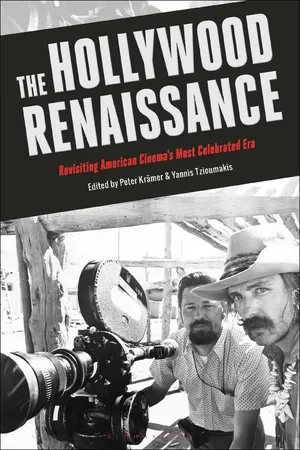
The Hollywood Renaissance
Revisiting American Cinema's Most Celebrated Era
- 288 pages
- English
- ePUB (mobile friendly)
- Available on iOS & Android
eBook - ePub
The Hollywood Renaissance
Revisiting American Cinema's Most Celebrated Era
About this book
In December 1967, Time magazine put Bonnie and Clyde on its cover and proudly declared that Hollywood cinema was undergoing a 'renaissance'. For the next few years, a wide range of formally and thematically challenging films were produced at the very centre of the American film industry, often (but by no means always) combining success at the box office with huge critical acclaim, both then and later. This collection brings together acknowledged experts on American cinema to examine thirteen key films from the years 1966 to 1974, starting with Who's Afraid of Virginia Woolf?, a major studio release which was in effect exempted from Hollywood's Production Code and thus helped to liberate American filmmaking from (self-)censorship. Long-standing taboos to do with sex, violence, race relations, drugs, politics, religion and much else could now be broken, often in conjunction with extensive stylistic experimentation. Whereas most previous scholarship has examined these developments through the prism of auteurism, with its tight focus on film directors and their oeuvres, the contributors to this collection also carefully examine production histories and processes. In doing so they pay particular attention to the economic underpinnings and collaborative nature of filmmaking, the influence of European art cinema as well as of exploitation, experimental and underground films, and the connections between cinema and other media (notably publishing, music and theatre). Several chapters show how the innovations of the Hollywood Renaissance relate to further changes in American cinema from the mid-1970s onwards.
Information
Chapter 1
BRIDGING COMMERCE AND CLASSIFICATION THROUGH THE AMERICAN ART FILM: THE CASE OF WHO’S AFRAID OF VIRGINIA WOOLF? (1966)
Justin Wyatt
Nominated for thirteen Academy Awards (one in every eligible category), Mike Nichols’ adaptation of Edward Albee’s Who’s Afraid of Virginia Woolf? (1966) recalls the days when box office revenue and critical acclaim matched more often than not. The film was a cultural sensation creating a firestorm of press and public interest. More than fifty years on, the film retains its power as an effective drama of psychological and marital warfare. Expertly crafted with clever, though subtle and small, changes from the play, Nichols followed his theatrical source closely. Recognized by the National Film Registry in 2013 as culturally significant and worthy of preservation in the Library of Congress, Virginia Woolf continues to be well regarded and a classic example of post-studio era dramatic filmmaking. Beyond the public and critical acclaim, Virginia Woolf is perhaps even more significant for breaking down institutional barriers in Hollywood. The film heralded a new era of film classification and can be viewed as one of the first ‘American art films’ of the Hollywood Renaissance of the late 1960s through the mid-1970s. In this chapter, I explore the key factors which led Virginia Woolf to be this groundbreaking work for the Hollywood Renaissance. Following conventional Hollywood logic, most of these defining elements are motivated, first and foremost, by a commercial imperative. The regulatory and historical landmarks of the film are merely ‘collateral damage’ occurring in the quest for strong box office revenue and studio market share.
Hollywood and the shifting cultural landscape
Set up in 1934 as a means of industry self-censorship, the Production Code Administration (PCA) ensured that Hollywood films adhered to a set of guidelines limiting adult material, sex and criminality. Each film from a studio was submitted for the ‘Seal of Approval’, which was essentially the industry’s mechanism to make sure that local and national forces would allow the exhibition of the film unfettered by censorship or controversy. Over the decades, the system worked well in securing a smooth flow of film for the national marketplace. Deviations from the Production Code were limited. In 1953, for instance, director Otto Preminger was denied a Seal for the romantic comedy The Moon Is Blue on the basis of the film’s ‘light and gay treatment of the subject of illicit sex and seduction.’ United Artists (UA) chose to release the film without the Seal. Although it ended up as the fifteenth most financially successful film of the year, The Moon Is Blue nevertheless was targeted for its subject matter, with the states of Kansas, Ohio and Maryland banning the film. The success of the film in release without the Seal helped to signal that the Seal was not always needed to secure a solid national audience.1
By the start of the 1960s, films were increasingly attempting to deal with more adult subject matter. The results were illuminating for the increased flexibility of the Production Code. For instance, in 1961, Splendor in the Grass (Elia Kazan) was rejected by Geoffrey Shurlock of the PCA for ‘overly vivid portrayal of sex in a number of sequences’.2 Jack Warner negotiated the dubbing, cutting and re-cutting of the film until a Seal was finally approved in October 1961. Even by this point, the studios viewed skirting the Production Code Seal as a strategy to be avoided.
In parallel, the Legion of Decency, transformed into the National Catholic Office for Motion Pictures (NCOMP) in 1965, served a similar function. Unlike the PCA, the Catholic institution was not directly linked to the film industry. As a result, films were classified ex-post rather than analysed as early as the script level by the PCA. Operating since 1933, the Legion of Decency was designed to uphold ‘moral standards’ by alerting potential moviegoers about content that would be objectionable. Of particular significance were the most stringent categories: a Legion classification of ‘B’ meant that a film is morally objectionable, while a ‘C’ rating gave a film condemned status. The latter was feared for impacting box office revenue and limiting audience and publicity/promotion for a film. As with the PCA, by the early 1960s, the Legion was engaging with liminal films that somehow were spared the ‘C’ rating. Stanley Kubrick’s Lolita (1962), for instance, was accepted by the Legion as ‘morally unobjectionable’ but for adults (over 18) only.3 Much more explicit in theme and content than Baby Doll (Elia Kazan, 1956), condemned just five years earlier, Kubrick’s film demonstrated just how flexible the Legion of Decency had become in dealing with the increasingly adult social content in film.
In addressing the landscape for movie censorship and classification, critic Richard Corliss sums up the impetus for much of the changes with the phrase, ‘Blame it on the Europeans!’4 Indeed, the influx of foreign films post-Second World War created not just a distinct market segment with its own theatres, marketing and distribution, but also the presentation of more adult content and themes. While these foreign films evidenced a strong aesthetic impact on the conventions of classical Hollywood storytelling, there was also a commercial impact of this new market. By the mid-1960s, independent distributors – from Cinema V to Audobon Films, Janus and New Yorker Films – started to feel some pressure from the studios. UA was the most aggressive in exploring the independent cinema terrain. Rather than risk tarnishing their own brand with potentially transgressive content, UA chose to release some of these films under the label of Lopert Films, their art house subsidiary. UA, for instance, pacted with Svensk Film-Industrie for global distribution of Ingmar Bergman films.5 Other studios, such as MGM with Premier Productions, followed suit by releasing foreign films with adult content through subsidiaries. This method allowed the studios to observe their agreement with the PCA to release only films with the Seal of Approval.
Against the background of foreign films making small, but significant, inroads to the marketplace, the domestic studios were being challenged via several parameters. The post-war era brought a rise in independent production along with the major studios divesting their theatre chains in light of the Paramount Consent Decrees. The competition from television was fierce during this period as well. Television made huge strides during the 1950s; by the end of the decade, only 1 in 10 homes were without a TV set.6 Meanwhile, film production costs were escalating and the studios were depending upon large-scale epics, often in a roadshow release pattern. While this pattern could be very lucrative (e.g. The Sound of Music [Robert Wise, 1965]), it could also lead to underwhelming results across a variety of genres (e.g. comedy, action-adventure, musical). In addition, these epics were inevitably accompanied by a larger production cost as well. Historian Drew Casper assesses this period as Hollywood mobilizing a ‘big kill strategy’, banking on large-scale proj...
Table of contents
- Cover
- Half Title
- Title
- CONTENTS
- LIST OF CONTRIBUTORS
- ACKNOWLEDGMENTS
- INTRODUCTION
- Chapter 1
- Chapter 2
- Chapter 3
- Chapter 4
- Chapter 5
- Chapter 6
- Chapter 7
- Chapter 8
- Chapter 9
- Chapter 10
- Chapter 11
- Chapter 12
- Chapter 13
- Index
- Copyright
Trusted by 375,005 students
Access to over 1.5 million titles for a fair monthly price.
Study more efficiently using our study tools.
Frequently asked questions
Yes, you can cancel anytime from the Subscription tab in your account settings on the Perlego website. Your subscription will stay active until the end of your current billing period. Learn how to cancel your subscription
No, books cannot be downloaded as external files, such as PDFs, for use outside of Perlego. However, you can download books within the Perlego app for offline reading on mobile or tablet. Learn how to download books offline
Perlego offers two plans: Essential and Complete
- Essential is ideal for learners and professionals who enjoy exploring a wide range of subjects. Access the Essential Library with 800,000+ trusted titles and best-sellers across business, personal growth, and the humanities. Includes unlimited reading time and Standard Read Aloud voice.
- Complete: Perfect for advanced learners and researchers needing full, unrestricted access. Unlock 1.5M+ books across hundreds of subjects, including academic and specialized titles. The Complete Plan also includes advanced features like Premium Read Aloud and Research Assistant.
We are an online textbook subscription service, where you can get access to an entire online library for less than the price of a single book per month. With over 1.5 million books across 990+ topics, we’ve got you covered! Learn about our mission
Look out for the read-aloud symbol on your next book to see if you can listen to it. The read-aloud tool reads text aloud for you, highlighting the text as it is being read. You can pause it, speed it up and slow it down. Learn more about Read Aloud
Yes! You can use the Perlego app on both iOS and Android devices to read anytime, anywhere — even offline. Perfect for commutes or when you’re on the go.
Please note we cannot support devices running on iOS 13 and Android 7 or earlier. Learn more about using the app
Please note we cannot support devices running on iOS 13 and Android 7 or earlier. Learn more about using the app
Yes, you can access The Hollywood Renaissance by Yannis Tzioumakis, Peter Krämer, Yannis Tzioumakis,Peter Krämer in PDF and/or ePUB format, as well as other popular books in Media & Performing Arts & North American History. We have over 1.5 million books available in our catalogue for you to explore.