- 248 pages
- English
- ePUB (mobile friendly)
- Available on iOS & Android
eBook - ePub
About this book
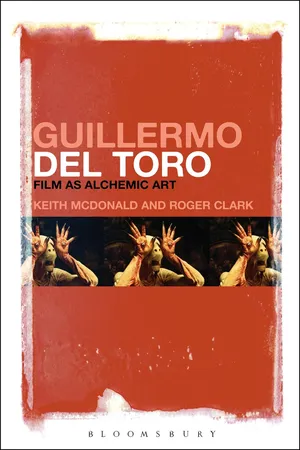
A critical exploration of one of the most exciting, original and influential figures to emerge in contemporary film, Guillermo del Toro: Film as Alchemic Art is a major contribution to the analysis of Guillermo del Toro's cinematic output. It offers an in-depth discussion of del Toro's oeuvre and investigates key ideas, recurrent motifs and subtle links between his movies. The book explores the sources that del Toro draws upon and transforms in the creation of his rich and complex body of work. These include the literary, artistic and cinematic influences on films such as Pan's Labyrinth, The Devil's Backbone, Cronos and Mimic, and the director's engagement with comic book culture in his two Hellboy films, Blade II and Pacific Rim. As well as offering extensive close textual analysis, the authors also consider del Toro's considerable impact on wider popular culture, including a discussion of his role as producer, ambassador for 'geek' culture and figurehead in new international cinema.
Information
Part One
Contexts and Audiences
1
Influences and Intertexts
This chapter represents an attempt to document some of the enormously varied filmic, literary and visual material that has contributed to the evolution of del Toro’s art. This evolving process might be dubbed (pace Harold Bloom) the ecstasy of influence, since del Toro’s eclecticism stems from an excitedly egalitarian fascination with high and popular culture that deliberately collapses critical and cultural boundaries. Inevitably, a considerable degree of selectivity was necessary in order to prioritize those figures and forms that seem, at this stage in his career, to be most significant.
Director as film historian
In 2012 Guillermo del Toro was asked to contribute to two significant film polls, despite his considerable reservations about the exercise. Criterion Films asked him to nominate his top ten films from their very distinguished collection list – a task del Toro bemoaned as the ‘unfair, arbitrary, and sadistic top ten practice’ (del Toro 2012c). The choice was obviously limited by the nature of the Criterion catalogue, but in response he produced a fascinating longer list of ‘thematic/authorial pairings’ which represented an eclectic and revealing range of films by classic directors such as Kurosawa, Bergman, Cocteau, Lean, Dreyer and Sturges, as well as more recent movies by Stanley Kubrick, Kaneto Shindō, Victor Erice, Terry Gilliam, George A. Romero and Ridley Scott amongst many others. For the 2012 BFI/Sight and Sound poll of the greatest films, he produced a contrasting list that included only one film made in the last 40 years – Martin Scorsese’s Goodfellas (1990). Perhaps more predictably, other choices included films by Hitchcock, Buñuel, Murnau as well as James Whale and Tod Browning – all key figures in the development of del Toro’s film vocabulary (for the full list of del Toro’s choices, see Bell 2012). Such exercises are notoriously random affairs, as del Toro seems to think, but his list does help to make more explicit the major influences that have shaped his work. To give a complete account of these would almost require a separate volume, since in the many interviews he has given he has mentioned an extraordinary array of contrasting and diverse films that have had a significant impact on the development of his art. Of the titles that are included in these lists a number do, however, stand out as having a particular significance for multiple reasons: these include Erice’s oblique commentary on the legacy of Francoism and the Spanish Civil War Spirit of the Beehive (1973), Buñuel’s most successful Mexican film Los Olvidados (1950) and Hitchcock’s first American classic Shadow of a Doubt (1943).
Formations
Before considering any of these filmic precursors it is worth contextualizing them in del Toro’s early experience of movies and also other formative influences. His early youth seems to have been saturated by the experience of film, both making and viewing. When he was eight he began making movies with his father’s camera, impeded only by the expensive cost of film. His teenage experiments with Super 8 and his time spent in the projection rooms of cinema clubs in Guadalajara, not to mention his early career in special effects through his experience with SFX artist Dick Smith and his own company Necropia, all fed into the melting-pot aesthetic that in part characterizes his approach to cinema. Childhood experiences watching repeats of TV shows that dealt in science fiction and fantasy/horror, such as The Outer Limits (1963–1965) and Rod Sterling’s The Night Gallery (1970–1973), not only gave the hyper-imaginative young del Toro repeatedly ghoulish nightmares but also inspired a fascination with horror as a genre. Before embarking on feature films, del Toro directed five episodes of a fantasy/horror Mexican TV series, La Hora Marcada (1986–1990), where he worked with other aspiring film-makers such as Alfonso Cuarón and his brother Carlos, as well as cinematographer Emmanuel Lubezki, now renowned for his work with Terence Malick and the Coen Brothers amongst others. Hora Marcada was a cheaply made simulacrum of The Twilight Zone, which del Toro and Alfonso Cuarón apparently nicknamed ‘The Toilet Zone’ because of the low budgets involved (Kehr 2006). However, it provided an invaluable opportunity to exchange ideas, narratives and techniques – in fact del Toro has described how Alfonso Cuarón told him one of his stories: ‘It was called “About Ogres” but it was actually “Pan’s Labyrinth”. He made it bigger, better and with more substance, but it’s exactly the same story’ (Kehr 2006). Cuarón has spoken himself about his long friendship with del Toro and the way in which their early experiences were translated into art:
Guillermo was always the lonely child. There’s a lot of him in the lonely little girls and boys he always portrays in his films. His stories are always about innocence, and he has an innocence that is very contagious, and helps you reconnect with your own. But at the same time it’s a kind of innocence that is almost perverse. (Kehr 2006)
Growing up in Guadalajara, Mexico’s second most populous city, also provided del Toro with contextual and circumstantial experiences that fed into his imaginative engagement with horror and fantasy. In a further interview with Jason Wood, he talks about images of brutality and violence that impacted upon him, including, at the age of four, the sight of mutilated corpses in a car crash (Wood 2006b: 30). He also cites the ‘gory’ religious imagery that he found in Mexican Catholicism, not only in the iconography and rituals of the Church but also in his grandmother’s alarmingly graphic accounts of the perils of purgatory and hell (her influence is affectionately acknowledged in the dedication of Cronos to her memory). He has talked, perhaps with a characteristically dark sense of humour, of spending a significant amount of his childhood worrying about the horrors of purgatory and hell: ‘I was a tortured soul … I suffered from the guilt of Catholic mythology’ – guilt fuelled apparently by his grandmother’s oppressive piety (Laezman 2002: 38). Despite the jokiness with which he describes it, this concern with purgatorial states is a key element in the del Toro canon, as numerous characters in his films seem to exist in a limbo-like, interstitial state of being that blurs the borders between life and death, light and darkness, redemption and loss, being and nothingness. Del Toro’s fondness for locating his narratives underground or in crepuscular spaces haunted by seen or unseen monsters is prefigured in this early immersion in the language, ritual and imagery of judgement and potential damnation.
Del Toro seems to have had a sophisticated taste in film as a child – in his commentary on the Criterion list he talks of having seen the two classic Kaneto Shindō shockers Onibaba (1964) and Kuroneko (1968) when aged ten years old, with the result that ‘they did some serious damage to my psyche’ (del Toro 2012c). He describes Shindō’s films as a ‘perverse, sweaty double bill’, and their melding of Japanese folklore with a modern sensibility rooted in violence and destructive desire embodies a dynamic that re-emerges in films such as The Devil’s Backbone and Pan’s Labyrinth, with their interweaving of fantasy and twentieth-century savagery (2012c). Rather more conventionally perhaps, Disney films such as Fantasia (1940) and Sleeping Beauty (1959) provided an early exposure to the power of fairy-tale narrative and, in particular, the obsessive and perverse appeal of monsters. Chernabog, the black demon who appears in the ‘Night on the Bald Mountain’ sequence of the earlier film, is named by del Toro as one of his favourite film creatures, along with the dragon that the evil fairy Maleficent from Sleeping Beauty morphs into at the end of the film. (He has collected statues and concept sketches of Chernabog for his ‘Man Cave’ collection of curiosities.) His first favourite actors were the undisputed stars of classic horror from the early to mid-twentieth century: Lon Chaney, Boris Karloff, Vincent Price and Peter Cushing. This fascination with the icons of classic horror later translated into del Toro’s assimilation of stylistic and thematic features from the Universal classics of Whale and Browning, the Poe adaptations of Roger Corman and the Hammer-produced films of Terence Fisher. Karloff’s extraordinary capacity for physical transformation is echoed in his repeated use of Doug Jones in roles that require similarly extraordinary metamorphoses. Del Toro’s boldly symbolic use of colour and light in particular seems to be heavily influenced by the latter two directors and was further enhanced by his love for the Italian ‘giallo’ horror movies of the 1960s and 1970s, in particular the work of directors such as Mario Bava (especially Black Sunday (1960) and Black Sabbath (1963)) and Dario Argento (especially Deep Red (1975) and Suspiria (1977)). The latter film clearly displayed Argento’s increased prioritizing of often extreme images at the expense of plot, surely an influence on del Toro’s own aesthetic given his stated preference for the visual over the verbal. Argento’s methodology is underpinned by the use of extreme colour contrasts (he used Eastman colour and an outdated Technicolor printing process in order to achieve maximum effect). As L. Andrew Cooper notes of Suspiria, ‘Jarring sounds, jagged shapes and jolting colors come together in compositions that suggest madness and horror. Their exquisite workmanship makes the film both sublime and beautiful, repellent and hypnotic. It telegraphs the unreality of the diegetic world’ (Cooper 2012: 86).
In general, del Toro’s account of his early life seems to suggest an extreme level of precocity in terms of taste and interests as well as an intense engagement with the potentially disturbing world of the imagination which also manifested itself in writing and drawing stories:
I started drawing at a very young age … I drew monster stories, but I would draw the illustrations and then I would never write the story – 20 illustrations for a novel and then never write the novel. I would write one chapter or half a chapter. Because the images were there, I wasn’t driven to tell the story anymore. I was too happy with the images by themselves. (Kehr 2006)
This capacity to imagine in elaborate visual images transcribed to paper has remained a vital feature of del Toro’s creative process, as evidenced in the extensive notebooks that he prepares for his films – images from these are collected in Guillermo del Toro Cabinet of Curiosities (2013, forthcoming) as well as in the Spanish publication of the screenplay for Pan’s Labyrinth (del Toro 2006). Similarly, the ‘Art of the Movie’ books published in conjunction with both Hellboy films and Pacific Rim contain extensive examples of his sketchbooks.
Del Toro’s ‘seed-time’ was indeed ‘fostered alike by beauty and by fear’ although in ways that differ radically from Wordsworth’s; it seems to have been a somewhat haunted space and he has spoken of being old before his time – seventy when he was seven – and is only now really able to be a child. This personal association of childhood with fear and haunting was to become recurrent trope in del Toro’s mature film-making and producing. His on-screen children are rarely portrayed in straightforward Romanticist terms of innocence and purity – rather they are witnesses and victims, fully engaged as agents within narratives dealing with power and struggle, identity and death:
A perfect child is not very interesting to me … I want the children in my movies to be empathetic. When I see children who are smart, cute, and spouting brilliant one-liners, like the kids in Jurassic Park, I know that the tyrannosaurus is not going to eat them. They are too perfect and perfection is not human. It is not the norm. (Laezman 2002)
The reference to Steven Spielberg here is significant in that the somewhat idealistic and sentimental view of childhood that emerges in Spielberg’s oeuvre could be seen as a reverse image of del Toro’s own position.
Another important artistic colloquy can be found in comparing the tone and sensibilities of del Toro’s work with that of his friend James Cameron. Both Cameron and del Toro have taken the baton from Ridley Scott and Steven Spielberg, who along with George Lucas, John Carpenter, Joe Dante and John Landis took genre and monster film-making out of its B-movie status and placed it at the centre of American popular cinema. Del Toro and Cameron are closely linked by key thematics and fascinations with Asian pop culture too. For example, strong ecological issues are to be found in both directors’ movies. Where Cameron provides us with a utopian science-fictional eco-tale in The Abyss (1989), del Toro’s take on the aquatic eco-narrative is more dystopian and Gothic and his alien visitors are intent on vicious destruction rather than spiritual enlightenment. Both del Toro and Cameron also re-present Japanese pop-cultural staples to Western audiences. For example, Cameron introduced the Mecha genre to his audience in Terminator (1984), refined this to a boy and his robot adventure in Terminator 2: Judgement Day (1991) and also included Mecha versus alien battles in Aliens (1986) and later Avatar (2009) – a concept that del Toro would later amp up in Pacific Rim.
As well as this dialogic relationship with his directorial contemporaries, del Toro is more directly involved with other filmic craftsmen, most notably the cinematographer Guillermo Navarro, comic book writer and artist Mike Mignola and actor Ron Perlman. Navarro has worked on all but two of del Toro’s films to date as well as with other intertextualists such as Quentin Tarantino and Robert Rodriguez. The rich, warm, colourful Gothic palette we associate with del Toro’s films is no doubt down to the collaborative coupling with Navarro. Indeed, the tonal through line whic...
Table of contents
- Cover
- Halftitle Page
- Title Page
- Dedication Page
- Contents
- Acknowledgements
- Introduction
- Part One: Contexts and Audiences
- Part Two: Texts and Thematics
- Filmography
- Bibliography
- Index
- Imprint
Trusted by 375,005 students
Access to over 1.5 million titles for a fair monthly price.
Study more efficiently using our study tools.
Frequently asked questions
Yes, you can cancel anytime from the Subscription tab in your account settings on the Perlego website. Your subscription will stay active until the end of your current billing period. Learn how to cancel your subscription
No, books cannot be downloaded as external files, such as PDFs, for use outside of Perlego. However, you can download books within the Perlego app for offline reading on mobile or tablet. Learn how to download books offline
Perlego offers two plans: Essential and Complete
- Essential is ideal for learners and professionals who enjoy exploring a wide range of subjects. Access the Essential Library with 800,000+ trusted titles and best-sellers across business, personal growth, and the humanities. Includes unlimited reading time and Standard Read Aloud voice.
- Complete: Perfect for advanced learners and researchers needing full, unrestricted access. Unlock 1.5M+ books across hundreds of subjects, including academic and specialized titles. The Complete Plan also includes advanced features like Premium Read Aloud and Research Assistant.
We are an online textbook subscription service, where you can get access to an entire online library for less than the price of a single book per month. With over 1.5 million books across 990+ topics, we’ve got you covered! Learn about our mission
Look out for the read-aloud symbol on your next book to see if you can listen to it. The read-aloud tool reads text aloud for you, highlighting the text as it is being read. You can pause it, speed it up and slow it down. Learn more about Read Aloud
Yes! You can use the Perlego app on both iOS and Android devices to read anytime, anywhere — even offline. Perfect for commutes or when you’re on the go.
Please note we cannot support devices running on iOS 13 and Android 7 or earlier. Learn more about using the app
Please note we cannot support devices running on iOS 13 and Android 7 or earlier. Learn more about using the app
Yes, you can access Guillermo del Toro by Keith McDonald,Roger Clark in PDF and/or ePUB format, as well as other popular books in Mezzi di comunicazione e arti performative & Film e video. We have over 1.5 million books available in our catalogue for you to explore.