Writing autobiography is a complicated, often fraught activity for both writer and reader. We can find many recent examples of the way such writing calls into question the author's truthfulness or their authority to present as definitive their 'version' of a particular event or portion of their lives. Drawing upon a wide range of late twentieth and early twenty-first-century autobiographical writing, The Fiction of Autobiography examines key aspects of autobiography from the interrelated perspectives of author, reader, critic and scholar, to reconsider how we view this form of writing, and its relationship to the way we understand and construct identity.
Maftei considers recent cases and texts such as Didion's The Year of Magical Thinking and Frey's A Million Little Pieces alongside older texts such as Proust's In Search of Lost Time¸ Nabokov's Speak, Memory and Stein's The Autobiography of Alice B. Toklas. In part, this is to emphasise that key issues reappear and arise over decades and centuries, and that texts distanced by time can speak to each other thoughtfully and poignantly.
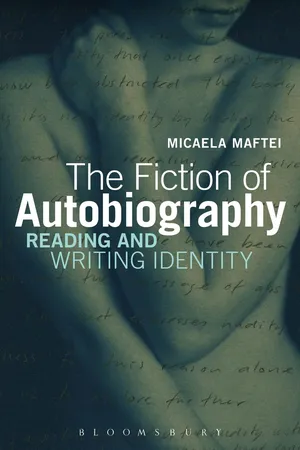
- 208 pages
- English
- ePUB (mobile friendly)
- Available on iOS & Android
eBook - ePub
About this book
Information
1
Truth and Trust
It is appropriate to begin with a chapter on truth and truthfulness. Memoir and autobiography are commonly held to be ‘true’ writing; they are understood to be based on events that occurred in reality. Shelved and sorted with other nonfiction titles, they are usually defined as accounts of experiences that actually happened to their authors. Moving no further than such an understanding, however, is simplistic. The most basic, everyday interactions, in which we find ourselves misunderstood, surprised or confused by the perceptions or actions of others, begin to confuse the notion of a singular, verifiable truth that all parties involved agree upon, and deny a straightforward mode of perceiving events. Most interactions feature multiple viewpoints and interpretations. We understand our fundamental inability to see the world through the eyes of anyone but ourselves; this inability brings with it a fixed gaze that can never be sure of the veracity of another’s interpretation. In this way, an author can describe an experience that ‘really’ happened to her, and find that someone else who was present disputes or even rejects the description.
As well, there are many understandings of what it means to write the truth. Expectations of the author and the writing fragment according to each reader’s particular understanding of the term: do we expect the author to rely on external documentation to support all their claims? Do we expect their story to be corroborated by other individuals? Or are we satisfied with a claim that this is their memory, without any form of support?
There are multiple truths bound up in most events and interactions. I believe this is self-evident. Critic and memoirist William Zinsser illustrates the point when he recalls his experience writing and publishing recollections of his deceased grandmother in the memoir collection Five Boyhoods (1962). After reading his account, Zinsser and his own mother realize they have conflicting ideas about the grandmother, because they each have different memories of her: ‘Grandma wasn’t really like that’, is his own mother’s response to Zinsser’s account, suggesting a single ‘way’ that she ‘was’, a way that Zinsser failed to reproduce (Zinsser 1998, 11). Of course, by providing her own interpretation of events and judging the grandmother accordingly (as well as judging Zinsser’s account), Zinsser’s mother is simply offering her own truth. But Zinsser trusts his memories and his construction of the memoir, and he stands by his version.
The crafting of memoir, he says, is the phase during which memories take shape and are turned into autobiographical writing. Constructing narrative from the ‘jumble’ of memory requires what he calls a ‘feat of manipulation’ (Zinsser 1998, 6). This feat eventually leads a memoirist to ‘arrive at a truth that is theirs alone, not quite like that of anybody else who was present at the same events’ (Zinsser 1998, 6). This phrasing is potentially very useful to writers working on an autobiographical piece. Rather than emphasizing a backwards-looking approach, in which the author must endeavour to return to the past in their current work, Zinsser’s words encourage dexterity, ‘manipulation’, sorting through the ‘jumble’. These are actions that are very much in the present, and working through them will hopefully bring the writer to a new, desired place. The piece will be ‘arrive[d]’ at, rather than returned to. Such phrasing can be influential in how we approach a piece of writing, as readers and/or as writers. Emphasizing the individuality of the account helps discourage anxiety about how an event or memory appears in the work, particularly in relation to others’ recollections or beliefs, and instead validates unique, even disputed, accounts and forms of expression.
Zinsser’s statement suggests numerous truths, and their more or less peaceful co-existence – if not in the same text, at least in the world. Zinsser does not suggest that conflict and dispute are inherent to this manipulation/writing process. If we understand memoir and autobiography as representative of a unique, individual and subjective truth belonging to an author, then it is up to the individual to define. This includes both readers and writers. Nevertheless, we can find many contemporary cases of angry reactions from readers who discover that a book they thought was true (in the sense that it adhered to whatever their definition of truth is) was not. This calls into question exactly how readers can be, or feel, betrayed, if their understanding and categorization of a book is final. James Frey’s A Million Little Pieces, a book I will later discuss at greater length, is possibly the most famous recent example, but there are many. These conflicts illustrate the relationship between author and reader which is often integral to an understanding of what autobiography ‘is’, and what rules some readers expect it to follow.
Zinsser complicates his position of multiple truths when he expands on the clash between his and his mother’s memories. ‘The truth lay somewhere between my mother’s version and mine’, he says, ‘But [his grandmother] was like that to me – and that’s the only truth a memoir writer can work with’ (Zinsser 1998, 12). It seems probable that both his version and his mother’s version of events were true in the sense that their overall (and lasting) image of the grandmother was closely aligned with events or experiences they shared with her, from which they compiled a particular idea of the ‘way she was’. It is possible that his grandmother was strict and unyielding at times, or with particular people, as he describes her in his writing, and also ‘unhappy and really quite shy’ at other times, as his mother recalls her (Zinsser 1998, 12). The memoirist can ‘work with’ alternate truths, alternate versions of events, or at least allow them into the scope of the work. Indeed, establishing one’s own story out of the stories of all other implicated individuals seems to necessarily involve carving one’s account from all possible accounts/constructions, thus involving ‘work[ing] with’ multiple truths. Ultimately, one can only be sure of one’s individual truth, the way a particular experience or event happened to them, but this does not mean that this is the only truth they can ‘work with’.
In the example above, I see the triangle of Zinsser’s version, his mother’s version and the truth he sees as lying ‘somewhere between’ them as problematic because, although I suspect he is telling this story in support of his own actions, and as an example of the multiplicity bound up in telling stories of the past, by suggesting that the truth lies elsewhere than in their words, he is implying their words’ untruth. I see this triangle as featuring truthfulness in two, and possibly all three, points. He describes his version and his mother’s version in ways that suggest they are both relating stories of the past without wilfully distorting or misrepresenting them, and I believe it is wholly possible that a third or fourth or tenth account of the same woman could be told with the same honesty of approach and still describe different aspects of her character. This illustrates the way truthfulness can be found in the storyteller’s actions and motivation, rather than in the resulting stories, an idea I will revisit in greater detail later in this chapter.
Although I think authors of memoir and autobiography do work with multiple truths while cultivating their own, Zinsser’s view quoted above is useful in that it suggests choice, action, shaping. While the craft aspect of autobiographical writing clearly influences the text (and its reception), this idea of ‘work[ing] with’ the truth implies excavation, discovery, decision, interpretation, revelation. This phrasing suggests that, as I will later discuss with reference to memory, truth is not a static entity or characteristic that is either adhered to or ignored, discovered or betrayed. It is more complex, more nuanced, more pliable. Regarding reportage (another form of personal narrative whose readers often insist on ‘the truth’), journalist Bill Buford argues: ‘[Reporting] is meant to relay and record the truth of things, as if truth were out there, hanging around, waiting for the reporter to show up’ (Buford 1990, 180). Truth, even if one believes that it is singular and fixed, can still be worked with, slowly discovered, seen from different angles and viewpoints.
Mary Karr, whose 1995 memoir The Liars’ Club is seen by some as one of the earliest texts of the late 1990s memoir boom (particularly the ‘misery memoir’ subgenre), openly approaches this issue of establishing her own truth during her recollection and writing process. The Liars’ Club is the story of Karr’s childhood; much of it is told from her perspective at seven years of age. On numerous occasions within the text she refers to how the book would read differently if written by her sister, or explicitly mentions that her sister claims, and remembers, events happening differently from how Karr describes them. (This is a practice which continues into her second and third memoirs.) She describes her writing process in interviews. After writing a first draft alone, without doing research, in order to access her own memories without external influence, she ‘may visit places and check stuff out, to clarify details’ (Karr 2009). She also mentions describing events to her family members, to gauge their reactions to her truth, and to verify what she has written (Karr 2009). Although she takes this sort of verification of factual details more seriously than some authors, and relies on ‘so many drafts’ in which she can ‘poke and prod and question’, she still reverts to a basic, individually determined definition of truth: ‘I know better than anybody else how I felt at fifteen or at forty. You might remember something I did that I don’t remember, but I know how I felt’ (Karr 2009). It is worth noting that information about Karr’s writing process (like many authors’) is often found in interviews, another forum in which she is able to speak according only to her version of truth. This mode of expression, as well as her outspokenness about her commitment to honouring her own memories, may help create the image that, for instance, Stephen King got from her first memoir: ‘she is a woman who remembers everything about her early years’ and presents it ‘in an almost unbroken panorama’ (King 2000, 3).
Karr expresses distaste for the increasing acceptance of stretching the boundaries of factual accuracy in autobiographical writing (‘It pissed me off when I saw James Frey on Larry King … if it didn’t happen, it’s fiction. If it did happen, it’s nonfiction’ [Karr 2009]). Although in her acknowledgments to The Liars’ Club she credits her older sister Lecia, who is a large presence in the book, with ‘confirm[ing] the veracity of what [is] written’, the memoir features many interjections where Karr suggests that Lecia would/does claim that an event happened in another way, acknowledging an alternate truth. In her third memoir, Lit, she does something quite similar with her ex-husband’s imagined version of the truth: ‘Were Warren laboring over this story, I’d no doubt appear drunkenly shrieking; spending every cent I could get my mitts on … none of this entirely untrue’ (Karr 2010, 87).
These interjections and admissions of other truths complicate her seemingly straightforward distinction between fiction and nonfiction, even if the events in question appear minor or trivial. For example: ‘I didn’t remember my mother’s paramour … being particularly goodlooking. Lecia said, Oh yes, he had steely white hair, blue eyes, and he was muscular’ (Karr 2009). Incidents like this suggest that, in principle, the truth is not ‘out there, hanging around, waiting for’ her to show up, but rather recalled differently, debated, sometimes never resolved, or even impossible to resolve. Little details can soon give way to larger issues. In The Liars’ Club, Karr experiences a car crash while her mother is driving. The text suggests that her mother may have deliberately caused the crash. Had Karr recalled that event differently, believing her mother to have definitely intentionally crashed the car, perhaps she would define that version as the truth, because she knows ‘better than anybody else’ what her impressions were of that experience. But if a later police report, for instance, found Karr’s mother guilty, or innocent, but this completely conflicted with Karr’s memory, which she knows ‘better than anybody else’, on which side would the truth lie?
Autobiographical writing necessarily involves the intersections between one’s own ideas of what is true and the ideas of others. Even while only being able to hold fast to one’s own version of events, the memoirist must incorporate the truths of others, even indirectly, acknowledging that they may deviate from one’s own, and may indeed contradict them outright. This handling, or negotiation, of multiple versions of an event is inherent to autobiographical writing. For Karr, acknowledging conflicting views and allowing them into her text is her way of providing the maximum amount of relevant information and highlighting the ambiguity or uncertainty of some experiences, while still arguing for, and defending, her own version of events.
Determining the truthfulness of a piece of autobiographical writing often reverts to a discussion of authorial intention, a problematic approach to discussing almost any kind of writing. Leading on from my reading of Zinsser’s view, which implies that truth is something requiring action, reaction and particular approaches in order to ‘work with’, I turn to John Barbour, whose distinction between truth and truthfulness was particularly illuminating and freeing in my consideration of how I (or anyone) could attach labels of honesty or truth to my (or any autobiographical) writing, and indeed how I could understand and approach the autobiographical writing I was reading. ‘It is easier to show specific achievements or failures of truthfulness in particular autobiographies than it is to define the nature of truthfulness’, Barbour claims (Barbour 1992, 26). This echoes the famous statement by US Supreme Court Judge Potter Stewart, regarding an obscenity charge: ‘I know it when I see it’ (Jacobellis v. Ohio 1964). Stewart’s statement has become almost shorthand for phenomena which are simultaneously extremely difficult to define and instantly recognizable. Yet they are only instantly recognizable on an individual level – obviously if obscenity was recognized by everybody in the same way, there would have been no need for Judge Stewart to consider it in a professional capacity. That he did, and that his ruling is both opaque and understandable, speaks to the subject’s simultaneous familiarity and uncertainty.
Barbour continues:
Truthfulness must be distinguished from truth. Truth is usually thought of as a kind of correspondence between human thought and reality, or as a matter of coherence among different ideas and propositions. Truthfulness, in contrast, is a process or quality of a person, a virtue we ascribe to certain individuals and not others … the autobiographer may err; he is as fallible as any human being in interpreting reality. The autobiographer may, however, demonstrate truthfulness, which is an active search for the most exact and insightful understanding of past experience. (Barbour 1992, 26)
These words are closely aligned with the notion of truth requiring excavation or ‘work’ by the author in order to shape it and help it emerge. Here, Barbour associates truthfulness with a quality, or approach, a way of handling one’s role as a writer. Writing autobiographically is an act at which one can fail, or ‘err’, while still maintaining the mantle of truthfulness if one remains committed to ‘interpreting reality’ in the most ‘exact and insightful’ way. These words do not suggest that truth is static, waiting to be accessed and written about by someone who can do it justice. These words show an understanding of the complexity of writing truthfully, and place a burden on the writer not to ensure ‘correspondence between thought and reality’, but rather to interpret the material they have according to certain principles. Once more the intention and behaviour of the author are drawn into discussions of the veracity of the writing.
The views quoted above are, I believe, satisfactory in establishing an important distinction: truthfulness describes an action or kind of behaviour, whereas truth is a state of affairs (of course, an unstable and not universally acknowledged state of affairs). It is impossible for a reader to be sure of an author’s intentions, but for writers, this framework bolsters the desire to allow the writing to stretch beyond the borders of the known in the name of truthfu...
Table of contents
- FC
- Title Page
- Copyright Page
- Contents
- Introduction
- 1. Truth and Trust
- 2. Me and Not-Me: Dismissing Unity in Autobiographical Writing
- 3. The Vortex Effect and The Tissue of Time
- 4. Inventing the Road With Every Step
- Conclusions
- Appendix
- References
- Index
Trusted by 375,005 students
Access to over 1.5 million titles for a fair monthly price.
Study more efficiently using our study tools.
Frequently asked questions
Yes, you can cancel anytime from the Subscription tab in your account settings on the Perlego website. Your subscription will stay active until the end of your current billing period. Learn how to cancel your subscription
No, books cannot be downloaded as external files, such as PDFs, for use outside of Perlego. However, you can download books within the Perlego app for offline reading on mobile or tablet. Learn how to download books offline
We are an online textbook subscription service, where you can get access to an entire online library for less than the price of a single book per month. With over 1.5 million books across 990+ topics, we’ve got you covered! Learn about our mission
Look out for the read-aloud symbol on your next book to see if you can listen to it. The read-aloud tool reads text aloud for you, highlighting the text as it is being read. You can pause it, speed it up and slow it down. Learn more about Read Aloud
Yes! You can use the Perlego app on both iOS and Android devices to read anytime, anywhere — even offline. Perfect for commutes or when you’re on the go.
Please note we cannot support devices running on iOS 13 and Android 7 or earlier. Learn more about using the app
Please note we cannot support devices running on iOS 13 and Android 7 or earlier. Learn more about using the app
Yes, you can access The Fiction of Autobiography by Micaela Maftei in PDF and/or ePUB format, as well as other popular books in Languages & Linguistics & Creative Writing. We have over 1.5 million books available in our catalogue for you to explore.