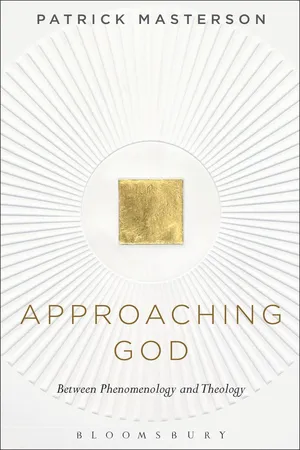
Approaching God explores the ways in which phenomenology, metaphysics and theological enquiry can throw light upon each other. This is a matter of great interest and importance to the future of philosophical theology and the philosophy of religion. What, if anything, has philosophical reflection about God to contribute to Christian theology? And if indeed philosophy plays a positive role in theological reflection-what kind of philosophy? The first-person philosophical perspective of phenomenology or the objective philosophical perspective of metaphysics?
Masterson devotes three chapters to, respectively, phenomenological, metaphysical, and theological approaches to God. Each are seen as animated by a first principle from which a comprehensive account of everything is said to follow-'Human Consciousness' in the case of phenomenology; 'Being' in the case of metaphysics; and 'God' in the case of theology.
Although philosophers and theologians such as Ricoeur, Levinas, Kearney, Caputo, and Barth are considered briefly, Approaching God essentially provides a dialogue about theological and theistic issues between the phenomenological approach of the leading French Christian phenomenologist Jean-Luc Marion and the realist metaphysical approach of Aquinas.
Masterson maintains that all three approaches are needed in trying to speak appropriately about God-they are irreducible but complementary.
- 224 pages
- English
- ePUB (mobile friendly)
- Available on iOS & Android
eBook - ePub
About this book
Information
1
Phenomenology
Religion
This chapter considers a particular philosophical approach to God, namely, a phenomenological account of the God of religious belief and experience. It may be called an exercise in philosophy of religion.1
Our ordinary pre-philosophical lived conception of religion is a rather broad one. It signifies in a general way the distinctive set of conscious relationships between us and a higher sacred reality or God. These include inner beliefs, sentiments, desires, prayers, etc. and outer professions, symbols, myths, rituals, cult and regulation of personal and social life inasmuch these are valued as mediating or embodying valid relationships between us and the sacred or, more specifically, between us and God.
Religion is at once theoretical and practical, a life of belief and practical engagement which nourish each other. It is profoundly self-involving – no mere detached assertion of a factual state of affairs. In professing my belief that I possess my being from God, I profess my radical dependence upon him. The God of religion is worshipped rather than just affirmed – a God of pre-philosophical culturally conditioned belief, conviction and worship, rather than a philosophically derived conclusion. As Henry Dumery remarks: ‘We should not speak of a God peculiar to philosophers, but of a God that religion worships and that philosophy must take into consideration, as it does any other value.’2 And again: ‘One pretends to believe that the idea of God is the property of philosophy, whereas it is borrowed from the religious life.’3 The terms in which the religious relationships between man and God can be expressed vary greatly, as is obvious from the rich variety of historical religions and religious experience.4 This situation creates the possibility of a comparative study of religions – a fascinating undertaking but not one for this work. What interests us primarily here, in this chapter at least, is to outline a particular philosophical understanding of the most basic feature of any religion, namely, that it distinctively concerns the close self-involving relationship alleged to obtain between human beings and God.
In religion, God is envisaged primarily, not detachedly as he is in himself, but rather in his relationship to humanity as its providential creator, sustainer and final goal. Through ‘natural belief’ or (as in the main monotheist religions) through ‘supernatural faith’, God is affirmed as God-for-man. This God, the object of religious worship, is attained and affirmed primarily as corresponding and providing resolution to deep specifically human experiences such as those of limitation, insufficiency, contingency, intransigence, fascination, dread, astonishment, hope and desire.
For many contemporary philosophers, the philosophical elucidation of this God of religious belief, this God-for-us, is best achieved by way of phenomenological enquiry and description rather than by way of metaphysical argument.
Phenomenology – introduction
Phenomenology, which traces its origin as a philosophical method to the primacy accorded by Descartes to the cogito, is a philosophical approach which interprets all beings, not metaphysically in terms of their self-possessed being, but rather in terms of and from the viewpoint of their manifestation as phenomena appearing to human consciousness. Any being, which is thus interpreted as relative, or co-relative, to human consciousness, must, for phenomenology, always be considered and appraised solely from this standpoint. It is a philosophy of cognitional immanence.
Phenomenology, which thus accords primary significance to phenomena as they present themselves to human consciousness, understands itself as the philosophical approach most attuned and adequate to a true understanding of all phenomena, including religious phenomena, as they manifests themselves to human consciousness. An object of religious consciousness is accessible phenomenologically only as an object for such consciousness; never as something of independent ontological significance (or insignificance). In the remainder of this chapter, I will indicate some general features of a phenomenological approach and its particular development as phenomenology of religion by some distinguished contemporary thinkers.
Pioneered in the twentieth century by philosophers such as Husserl, Heidegger, Sartre and Merleau-Ponty, phenomenology is, as I have just described, a philosophical approach which emphasizes the fundamental significance of conscious subjectivity in our appraisal of everything. This emphasis on subjectivity should not be construed as embracing a subjectivistic outlook or as necessarily espousing the idealist claims of an abstract transcendental subject. The phenomenological subject is affirmed as a being-in-the-world and in virtue of whom, as so existing, a world deploys and manifests itself. The subject is essentially a subject to whom a world becomes manifest, an intentional ex-static world-disclosing subject. The intending subject and the world it discloses, noesis and noema, are distinct but intrinsically connected. As Dan Zahavi remarks: ‘We cannot look at our experience from sideways on to see do they match with reality, nor can we consider our experiences and structures of understanding as mere elements in the world we experience and understand. The relation between mind and the world is an internal one, a relation constitutive of its relata, and not an external one of causality.’5
Phenomenology is not interested so much in the supposedly independent and scientifically calculable properties of things, such as their atomic weight or chemical composition, as in the ways in which they show themselves immediately as they are – in their ways and modes of givenness. A loved one, a work of art, a social relation, a utensil or a number manifest themselves in effectively different ways. Moreover, the same object can appear in different modes, for example, as perceived, imagined, feared, desired, etc. Phenomenologists consider the investigation of these ways and modes of manifestation and givenness to be of central philosophical importance.6
To accomplish this investigation, phenomenology insists that we must suspend our naive natural inclination to take for granted the independent reality of the world. This suspension of the natural attitude, an attitude which overlooks or misconceives the irreducible relationship of the given phenomena of the world to consciousness, is called the epoche or, more comprehensively, the phenomenological reduction. It is a bracketing or suspension of the spontaneous and metaphysical presuppositions of the natural attitude such as the autonomous existence, independently of our consciousness, of beings of various kinds. It is a method which achieves a reduction, a leading back or return, to a presupposition-less world in which a strict co-relativity of knowing and known obtains and in which the being of things is methodologically identified with its manifestation to consciousness. Thus Heidegger remarks: ‘For Husserl the phenomenological reduction . . . is the method of leading phenomenological vision from the natural attitude of the human being whose life is involved in the world of things and persons back to the transcendental life of consciousness and its noetic-noematic experiences, in which objects are constituted as correlates of consciousness.’7
This phenomenological reduction which suspends our naive commonsense presupposition of the independent reality of the world is not intended as an absolute denial of its reality but rather as a bracketing of the validity of this presupposition and of any attendant presumptions about its independent metaphysical status and structure. Therefore, rather than an outright denial of independently existing reality, what is achieved is a change of attitude towards it. One attains a first-person perspective which enables attention to be focused on an investigation of reality as it is given in its significance and manifestation for human consciousness, as the co-relative of this attentive consciousness.8
Phenomenology is critical of metaphysical realism which it views as a pre-critical naïve endeavour of the natural attitude to provide an account of the world and its modalities as though obtaining prior to our conscious engagement with it. For phenomenologists, the world that appears to us, and as it appears to us in various ways, is the only real world. There is no hidden world or reality behind or beyond that which is given experientially to our conscious incarnate subjectivity.9 As Goethe, cited by Heidegger advised: ‘look for nothing behind phenomena: they themselves are what have to be learned.’10 The task is to investigate and determine phenomenologically the intrinsic character of this world’s various modalities of manifestation and givenness to our consciousness.
Phenomenology of religion
Such phenomenological investigation, of what gives and manifests itself precisely as given and co-relative to consciousness, is very well adapted to undertake an exploration of religion conceived, as we have indicated, as an essentially first-person self-involving relationship with God – a God ‘intended’ and worshipped precisely as correlative and corresponding to the deepest conscious needs and desires of persons for meaning and value in their lives.
Hence, as might be surmised even from these brief remarks, it is not surprising that many contemporary philosophers, such as Emanuel Levinas, Richard Kearney, Jean-Luc Marion, Jacques Derrida, John Caputo and, to some extent, Paul Ricoeur, adopt a phenomenological approach in their philosophical consideration of religion. Let us consider how this approach has been developed.
Kearney develops his phenomenological – hermeneutical approach to religion chiefly in three books: The God Who May Be (2001), Strangers, Gods and Monsters (2003) and, more recently, Anatheism (2010). He introduces this approach with a robust dismissal of traditional metaphysical theodicy, or onto-theology as he calls it after Heidegger, which he sees as reifying God by reducing him to the status of a being, albeit the supreme or highest of all beings.11 The onto-theological conception of God, developed in terms of Greek metaphysics is seen as a distorting reformulation of the dynamic biblical God into an immutable, self-sufficient pure act of being, existing as an eternal now with no past or future, without movement desire or possibility.12 ‘I subscribe to the new turn in philosophy of religion which strives to overcome the metaphysical God of pure act and asks the question: what kind of divinity comes after metaphysics?’13
This overcoming of the God of metaphysics is achieved through a phenomenologically inspired inquiry delivering an account of the biblical God of religious belief as an ethically enabling possibility rather than as pure act, first cause or highest being.14 This God of religion, conceived as possibility, is not to be understood simply as an immanent possibility of the historically evolving world (such as the classless society) but rather as an ethically transfiguring possibility which transcends a subject’s own intrinsic possibilities. Here we are in the domain of eschatology not teleology, of ethical invocation not latent purpose. ‘From an eschatological perspective divinity is reconceived as that posse or posset which calls and invites us to actualise its proffered possibles by our poetical and ethical actions, contributing to the transformation of the world to the extent that we respond to this invitation.’15
Kearney elucidates this eschatological response to divine solicitation in terms of our response to the ethical appeal of the other person (the stranger, the widow, the heartbroken), calling us with an absolute claim to exercise goodness in her regard. ‘The phenomenon of the persona calls for a new or quasi-phenomenology, mobilised by ethics rather than eidetics . . . Persona is the in-finite other in the finite person before me. In and through that person . . . we refer to this persona as the sign of God. Not the other person as divine, mind you – that would be idolatry – but the divine in and through that person. The divine as trace, icon, visage, passage.’16
The thrust of this elucidation is an attempt to respect the radical transcendence of the divine while still envisaging it from a phenomenological perspective of concrete human experience. It involves an eschatological appeal to ‘a possible God’, experienced not as a direct object of intentional consciousness, but as an enabling ethical invocation which enables us to respond to others in a manner beyond any self-regarding consideration.
This concern of Kearney to somehow contain the affirmation of divine transcendence within a phenomenological frame of reference is motivated in part as a defence against deconstructionist philosophers such as Jacques Derrida. Derrida, as Kearney interprets him, insists that since transcendent ‘Otherness’ can never be given phenomenologically, we can know nothing about its nature and therefore can say nothing about its ethical character. In response, Kearney maintains that we can be assured of the ethical character of the divine because it is experienced, not as a direct object of consciousness, but obliquely, indirectly and negatively as the phenomenologically accessible eschaton or absent goal who possibilizes our self-transcending conscious religious and ethical experience.17
The God thus considered, described enigmatically as ‘presence-absence’, ‘possible-impossible’ and ‘eschatological Otherness’, transcends our direct awareness but does not surpass all our phenomenal horizons of anticipatory experience.18 Moreover, he is always envisaged in a religious optic in terms of God as he is for man. ‘God does not reveal himself, therefore, as an essence in se but as an I-Self for us . . . The God of Mosaic manifestation cannot be God without relating to his other – humanity.’19
Further, and even more significantly, God thus envisaged is not only co-relative to man – but also in a way dependent upon man. ‘God henceforth may be recognized as someone who has become with us, someone as dependent on us as we are on Him.’20 More explicitly he tells us: ‘God can be God only if we enable this to happen.’21 And again, ‘God will be God at the eschaton . . . But because God is posse (the possibility of being) rather than esse (the actuality of b...
Table of contents
- Cover
- Title
- Introduction
- 1 Phenomenology
- 2 Metaphysics
- 3 Theology
- 4 Spirit
- 5 Comparisons
- 6 Relationships
- Conclusions
- Notes
- Bibliography
- Index
Trusted by 375,005 students
Access to over 1.5 million titles for a fair monthly price.
Study more efficiently using our study tools.
Frequently asked questions
Yes, you can cancel anytime from the Subscription tab in your account settings on the Perlego website. Your subscription will stay active until the end of your current billing period. Learn how to cancel your subscription
No, books cannot be downloaded as external files, such as PDFs, for use outside of Perlego. However, you can download books within the Perlego app for offline reading on mobile or tablet. Learn how to download books offline
Perlego offers two plans: Essential and Complete
- Essential is ideal for learners and professionals who enjoy exploring a wide range of subjects. Access the Essential Library with 800,000+ trusted titles and best-sellers across business, personal growth, and the humanities. Includes unlimited reading time and Standard Read Aloud voice.
- Complete: Perfect for advanced learners and researchers needing full, unrestricted access. Unlock 1.5M+ books across hundreds of subjects, including academic and specialized titles. The Complete Plan also includes advanced features like Premium Read Aloud and Research Assistant.
We are an online textbook subscription service, where you can get access to an entire online library for less than the price of a single book per month. With over 1.5 million books across 990+ topics, we’ve got you covered! Learn about our mission
Look out for the read-aloud symbol on your next book to see if you can listen to it. The read-aloud tool reads text aloud for you, highlighting the text as it is being read. You can pause it, speed it up and slow it down. Learn more about Read Aloud
Yes! You can use the Perlego app on both iOS and Android devices to read anytime, anywhere — even offline. Perfect for commutes or when you’re on the go.
Please note we cannot support devices running on iOS 13 and Android 7 or earlier. Learn more about using the app
Please note we cannot support devices running on iOS 13 and Android 7 or earlier. Learn more about using the app
Yes, you can access Approaching God by Patrick Masterson in PDF and/or ePUB format, as well as other popular books in Theology & Religion & Christian Theology. We have over 1.5 million books available in our catalogue for you to explore.