- 352 pages
- English
- ePUB (mobile friendly)
- Available on iOS & Android
eBook - ePub
About this book
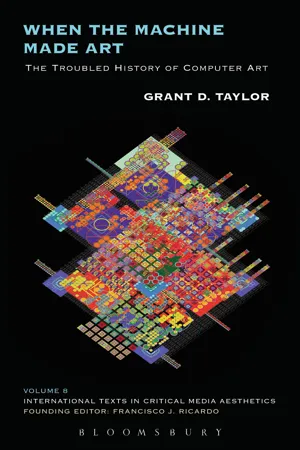
Considering how culturally indispensable digital technology is today, it is ironic that computer-generated art was attacked when it burst onto the scene in the early 1960s. In fact, no other twentieth-century art form has elicited such a negative and hostile response. When the Machine Made Art examines the cultural and critical response to computer art, or what we refer to today as digital art. Tracing the heated debates between art and science, the societal anxiety over nascent computer technology, and the myths and philosophies surrounding digital computation, Taylor is able to identify the destabilizing forces that shape and eventually fragment the computer art movement.
Information
CHAPTER ONE
Future crashes
In 1964, Toronto art critic Arnold Rockman joined with computer scientist Leslie Mezei to write the first recognizable piece of computer art criticism. Appearing in Canadian Art and entitled “The Electronic Computer as an Artist,” this seminal article possessed all of the basic elements of art criticism: historical context, stylistic analysis, and, most importantly, evaluative judgment. Still, these elements were limited in scope. The article, which was largely an introduction for unfamiliar readers, outlined recent achievements and prognosticated the future of this promising technology in the arts. While the article was notable for its attempt at formal criticism, the authors’ tone was distinctive, for its tenor was one of admonishment.
As with all co-authored writing, it is difficult—if not impossible—to entangle the prose, correctly identifying each author’s attitude. In this case, the authors were from two different disciplines, with one from the humanities and the other from the sciences. On a pragmatic level, the article required two sets of knowledge and expertise. Rockman would provide the art-history analysis and critic’s eye, and Mezei would supply the technical explanation and recent trends in computing. It remains entirely fitting that the first article on computer art required an interdisciplinary union, and this combined method would embody those tensions that would plague the movement. In their attempt to make sense of an emerging field, both artist and scientist were fully reliant on each other’s knowledge, thus recognizing the deficiencies and inherent duality of computer art. Yet whatever viewpoint each brought to the article, there was an agreement that visual artists were severely lacking, while the scientist, acting as a foil to the reticent artist, was the real avant-garde of computing.
Rockman and Mezei believed visual artists were blind to the power of the computer, believing the “lukewarm response” and lack of interest from painters and sculptors was perhaps “a result of ignorance.”1 Undeniably, visual artists were slow to recognize the computer’s potential. While many musicians and poets embraced the new technology as early as 1956, it would be a number of years later before technologists intentionally created visually aesthetic designs, and longer still before trained artists embraced digital computing. As Rockman and Mezei understood, the artist had no role in the development of the newest creative medium; rather, the scientist—or more particularly the technologist—had become the vanguard of computer-generated imagery.2 The authors were not alone in identifying apathy, for other technologists felt somewhat perplexed by the reticence shown by the art community. Some even felt that artists lacked the necessary insight to appreciate the implications of the computer, and that they, the scientists and technologists, were the only ones capable of exploring the mesmerizing vistas unleashed by computer technology. Mezei and Rockman simply believed that artists regarded the “machine as their enemy.”3 Later, Jonathan Benthall, who trained as a social anthropologist, stated, using a more sexualized metaphor, that the computer had become for the artist a “creature of great sexual attractiveness whose actual anatomy remains elusive, frigid and unexplored.”4
Beyond the reference to the growing epistemological divide between art and science, what is left out of the article is perhaps most revealing. Two award-winning computer artworks, entitled Splatter Pattern and Stain Glass Window (each published a year before in the journal Computers and Automation), were not attributed to an artist or a research laboratory, as all of the others featured in the article had been. Only months before, in May 1964, Mezei had given the first lecture on computer art at the fourth meeting of the Computing and Data Processing Society of Canada, which formed the basis for “Artistic Design by Computers,” an article printed in the 1964 August edition of Computers and Automation. In his timeline of recent events, he mentions Splatter Pattern again, though not by name but by the process in which it was made.5 This image, which graced the front cover of Computers and Automation, was the first computer art to be judged as the best out of that year’s submissions. Interestingly, the U.S. Military was responsible for the computer program that generated the artwork.
A military laboratory producing the first recognized award-winning piece of computer art in the United States is certainly unorthodox. In fact, there is no similar example in the history of art. The uncomfortable fact of computer art’s origins has prompted many commentators and proponents to situate the emergence of computer art a number of years after 1963, effectively bypassing its military beginnings. The reason why Rockman and Mezei failed to mention it may indicate a sensitivity that others in the arts acutely felt.
The trade journal Computers and Automation (later to become Computers and People) facilitated the birth of computer art through its “Computer Art Contest” of 1963. Submissions were invited for any artistic drawing or design made by a computer. That year, the first and second prizes went to the United States Army Ballistic Research Laboratories (BRL) in Aberdeen, Maryland, the same laboratory that had started the computer industry in the United States during World War II. The army-sponsored revolution in computing at BRL had produced the famous ENIAC, which was followed by the ORDVAC, EDVAC, and the BRLESC 1, which in 1962–3 most likely had a role in producing the first examples of computer art. The prize-winning art piece Splatter Pattern, which was printed on an early printer called a “dataplotter,” was a design analogue of the radial and tangential distortions of a camera lens (Figure 1.1). In 1964, the same laboratory won first prize for an image produced from the plotted trajectories of a ricocheting projectile (Figure 1.2). However, as mathematical visualizations of natural phenomena, these authorless images were not produced for aesthetic reasons. As the captions accompanying the artwork communicate, the artworks were, as Rockman and Mezei rightly assert, “merely an aesthetic by-product” of utilitarian pursuits.6

FIGURE 1.1 United States Army Ballistic Research Laboratories, Splatter Pattern, 1963. Computer-generated, graphed on an Electronic Associates, Inc. Dataplotter. From Computers and Automation (August 1963). Courtesy of the U.S. Army Research Laboratory.

FIGURE 1.2 United States Army Ballistic Research Laboratories, Trajectories of a Ricocheting Projectile, 1964. Computer-generated, graphed on an Electronic Associates, Inc. Dataplotter. Courtesy of the U.S. Army Research Laboratory.
Notwithstanding, the images—deemed “beautiful” by Computers and Automation’s editor Edmund C. Berkeley—were published as “art.” Three years before, in 1960, William Fetter, a Boeing employee, had coined the term “computer graphics” to describe computer-generated imagery. Berkeley, through Computers and Automation, contributed to the general currency of the term “computer art” and, in consequence, propelled these new creations toward the discourse of art.
While these images, automated and functional as they were, were not construed as objects in the tradition of Marcel Duchamp’s Readymades, neither were the technologists anti-art in the Duchampian sense. Rather, they perceived their machine-made product through the narrow lens of conventional pattern-making and novel design. Nevertheless, the fact remains that technologists working for government-funded military agencies created the first computer-generated imagery deemed to be fine art objects. An analysis of the entries in Computers and Automation dating from 1963 to 1965 reveals that large research laboratories associated with the military or otherwise dominated computer art production. These included the Westernhouse Electric Corporation, Bettis Atomic Power Laboratory, California Computer Products, Inc., and Calcomp Plotter. Indeed, the military link would persist, in not only the development of computer technology but also the funding of computer art exhibitions, including in 1968 when the U.S. Air Force partly funded computer art’s first international exhibition, Cybernetic Serendipity. Within the sciences, there would be little surprise if a government-funded laboratory won a competition; however, to the art community it appeared particularly objectionable. Fortunately for the artistic community, the publication was a specialist trade journal, popular to a small but growing group of technologists involved in the computer industry.
As an industry-related special interest journal, Computers and Automation played an important role in popularizing the idea of computer art. Through the competition, the journal attracted works from all over the world. From 1965, technologists from Canada, Germany, London, Italy, and Japan published their work in the journal. By 1970, artists from France, Holland, and Sweden were also publishing in the journal. In this respect, the contest was the first of its kind—self-consciously global—and the only forum in the world that published and discussed computer art as a self-contained category. The journal had a crucial role in connecting the growing number of interested technologists and artists. From 1968, the journal published the names and addresses of practitioners as a way to encourage interaction and communication. In addition, the journal was the first medium in which computer artwork was sold. The journal published advertising for Compro, a computer printing company from New Jersey that sold award-winning prints.
The appearance of Computers and Automation reveals that computer art and its growing discourse was active among technologists some years before the first exhibitions. Technologists perceived computer art in the context of the flourishing computer industry, which had been expanding significantly through the early 1960s. Computer art was an extension of the computer industry rather than a natural outgrowth of the arts. Although it had developed independently of criticism, the computer art project was self-sufficient. Within the scope of the periodical, computer art had a small but growing audience. It was attracting international practitioners and diversifying through competitions and mail-order art catalogs. In many ways, computer art was the by-product of computer science’s self-confidence, rather than an invention of some technologically inspired artistic movement. Like the computer hobbyists of the period, individuals who would shape personal computing in the 1970s, the computer art practitioners perceived what they were doing as amateur rather than professional, happenstance rather than ideological.
However, computer art was not to remain within the bounds of the insular world of computer engineering for long. In April 1965, the fir...
Table of contents
- Cover
- Halftitle Page
- Title Page
- Dedication Page
- Contents
- Acknowledgments
- Introduction: Unorthodox
- 1. Future crashes
- 2. Coded aesthetics
- 3. Virtual renaissance
- 4. Frontier exploration
- 5. Critical impact
- Epilogue: Aftermath
- Notes
- Bibliography
- Index
- Imprint
Trusted by 375,005 students
Access to over 1.5 million titles for a fair monthly price.
Study more efficiently using our study tools.
Frequently asked questions
Yes, you can cancel anytime from the Subscription tab in your account settings on the Perlego website. Your subscription will stay active until the end of your current billing period. Learn how to cancel your subscription
No, books cannot be downloaded as external files, such as PDFs, for use outside of Perlego. However, you can download books within the Perlego app for offline reading on mobile or tablet. Learn how to download books offline
Perlego offers two plans: Essential and Complete
- Essential is ideal for learners and professionals who enjoy exploring a wide range of subjects. Access the Essential Library with 800,000+ trusted titles and best-sellers across business, personal growth, and the humanities. Includes unlimited reading time and Standard Read Aloud voice.
- Complete: Perfect for advanced learners and researchers needing full, unrestricted access. Unlock 1.5M+ books across hundreds of subjects, including academic and specialized titles. The Complete Plan also includes advanced features like Premium Read Aloud and Research Assistant.
We are an online textbook subscription service, where you can get access to an entire online library for less than the price of a single book per month. With over 1.5 million books across 990+ topics, we’ve got you covered! Learn about our mission
Look out for the read-aloud symbol on your next book to see if you can listen to it. The read-aloud tool reads text aloud for you, highlighting the text as it is being read. You can pause it, speed it up and slow it down. Learn more about Read Aloud
Yes! You can use the Perlego app on both iOS and Android devices to read anytime, anywhere — even offline. Perfect for commutes or when you’re on the go.
Please note we cannot support devices running on iOS 13 and Android 7 or earlier. Learn more about using the app
Please note we cannot support devices running on iOS 13 and Android 7 or earlier. Learn more about using the app
Yes, you can access When the Machine Made Art by Grant D. Taylor in PDF and/or ePUB format, as well as other popular books in Social Sciences & History of Art. We have over 1.5 million books available in our catalogue for you to explore.