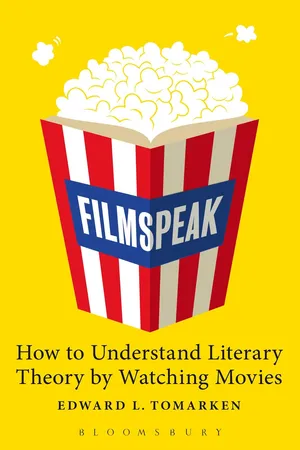
Filmspeak is an accessible, innovative book which uses specific examples to show how once arcane literary and cultural theory has infiltrated popular culture.
Theory reaches us in ways we do not even realize. Issues such as the nature of knowledge or truth, the function of personal response in interpretation, the nature of the forces of politics, the female alternative to the male view of the world, are fundamental for all of us. And intelligent analysis of the relationship between literary theory and popular culture can help us to understand our fast-changing world.
Here, experienced literary scholar and teacher Edward L. Tomarken explains how it is possible to study the rudiments of literary theory by watching and analyzing contemporary mainstream movies - from The Dark Knight to Kill Bill, and from The Social Network to The Devil Wears Prada. Theorists discussed include Foucault, Jameson, Iser, and Cixous. Tomarken brilliantly demonstrates that anyone can grasp modern literary theory by way of mainstream movies without having to wade through stacks of impenetrable jargon.
- 176 pages
- English
- ePUB (mobile friendly)
- Available on iOS & Android
eBook - ePub
About this book
Information
CHAPTER ONE
Deconstruction
Summary: I begin with deconstruction because all of the other theorists in the volume use it as a strategy. The first topic of discussion is decentering, illustrated by Christoph Waltz who plays SS officer Hans Lander in Quentin Tarantino’s “Inglourious Basterds” (2009). The second key idea of Derrida’s, originary myths, is described in relation to “Inglourious Basterds.” Since Derrida’s main contribution is his concept of metaphor, the second section uses “Kill Bill” to explain his view that death is inherent in metaphor. However, the third section, an analysis of “The Dark Knight,” makes clear that the films move beyond deconstruction toward ethical ends. Another area where films move beyond deconstruction is history, considered in a discussion of ”Inglourious Basterds.” Two other uses of deconstruction for ethical ends are seen in “The Bourne Supremacy,” the goal of which is personal integrity, and “Everyone Says I Love You,” designed to highlight a new kind of friendship. The last two films, “Deconstructing Harry” and “Man of the Year,” are examples of satirical uses of deconstruction, demonstrating in particular how deconstructing ones self may serve an ethical purpose.
This book begins with deconstruction for two reasons: 1) all of the theorists in the succeeding chapters use deconstruction as a strategy; 2) deconstruction in the context of film provides a means of relating literary theory to life, to the issues and problems of our everyday existence. In an interview, Derrida was asked what he thought of the term deconstruction being bandied about in common parlance. He replied that, even if people did not understand it as he would wish, the term must have some meaning in common usage and about that he was not unhappy. This chapter will show how the use of deconstruction by theorists is related to its applicability to daily life.
“Inglourious Basterds” (2009), starring Brad Pitt and Christoph Waltz, provides a vivid illustration of deconstruction. In fact, the central plot of this film demonstrates how a movie-maker and a cinema owner deconstruct Nazism. The story involves Hitler and his staff attending the premiere of a film about a German sniper who single-handedly killed nearly 300 Allied soldiers. Hence the film is entitled “Nation’s Pride.” During the viewing, the cinema is set on fire by a young woman whose family has been murdered by the Nazis. The fuel used is highly flammable old films. While burning alive, Hitler and his senior officers are shown a film made by the cinema owner informing her victims that they are dying at the hands of a Jew, who laughs as the cinema burns. The Nazi movie is one of Hitler’s pet projects: he wishes to defeat David Selznick, the Jewish Hollywood mogul, at his own game. Tarantino turns the tables on Hitler. We see the Führer and his generals so enamored with the heroic exploits of the German sniper—as presumably we are by Tarantino’s film—that they are unaware of the plot to kill them unfolding around them in the cinema.
Decentering and Christoph Waltz
The process being portrayed by Tarantino is basic to deconstruction, what Derrida calls “decentering.” For Hitler and his staff, “Nation’s Pride,” the Nazi propaganda movie, is the heart of a project to convince the German army that they can win the war. For the Allies the film screening provides a means of destroying the Third Reich which, in a moment of self-congratulation (with the exception of one officer, who decides not to give the game away), is caught off guard. Derrida explains as follows: “At the center the permutation or transformation of elements […] is forbidden. […] Thus it has always been thought that the center, which is by definition unique, constituted that very thing within a structure which while governing a structure, escapes structurality […]. The center is not the center” (Structure, 84). The German high command is unable to comprehend how “Nation’s Pride” can be the center of a plan to destroy the command structure of the German army. The movie-house is another example of decentering in that it was conceived by the Germans as a refuge and made secure as such, but the Allies convert the secure refuge into a tomb, a fire trap that prevents escape. Tarantino’s use of stylized violence, a hallmark of most of his films, is very much in evidence here. Prevented by the Nazis from doing his job because of his skin color, the “Negro” projectionist flips a cigarette into the pile of film reels, igniting the fire, while the “inglorious basterds” in the balcony machine-gun down the German officers. The carnage points up the surreal, fantasy-like quality of the scene: the point being not that this could have happened but that the imagined possibility is based upon changing the center from Hitler and his retinue to the cinema owner, the projectionist, and the “basterds.” Turning Nazi power upon itself is not so much a historical possibility as an imaginative leap involving a violent questioning of customary assumptions—in this instance, that the Nazis can control the historical record. For the goal of deconstruction is not so much to subvert the establishment or change the state of things as to put accepted premises into play, to shake up our way of thinking.
The one German officer capable of such thinking, who understands how the enemy plans to use the cinema, is the Nazi SS officer, Hans Lander, the only German to anticipate and uncover the Allied plot. His ability at decentering is seen in the opening scene of the film. Known as the “Jew Hunter,” he comes to a French farmhouse in search of a Jewish family. While Lander, brilliantly portrayed by Christoph Waltz, is interviewing the Frenchman in the farmhouse, the audience is shown the Dreyfus family hiding beneath the floorboards. Lander’s speech and action illustrate deconstruction. First he explains his pride in his moniker, the “Jew Hunter,” an achievement, he explains, that derives from thinking not like a German, but like a Jew. Germans, he continues, act like hawks and therefore expect Jews to hide in places a hawk might choose. Jews, on the other hand, behave like rats and therefore seek refuge in places where hawks would not expect them to be. He goes on to point out that it is no more offensive to characterize Jews as rats than to call him the “Jew Hunter.” Both are merely adapting to their situation: Lander is doing his job and Jews are struggling to survive.
Having established that he is a hawk able to adopt the perspective of a rat, Lander makes clear that he knows the Frenchman is harboring a Jewish family on his property, but that if he cooperates his own family will be spared. Note that here Lander decenters the French farmer’s focus, moving his concern from the Dreyfus family to his own family. Also, as we shall see, language is crucial in this scene. Lander, an adept linguist, begins the conversation with the Frenchman in French, then changes to English, understood by the Frenchman but not by the Jewish family. Having made his pact with the Frenchman in English, Lander reverts to French, stating, for the Jewish family to hear, that the investigation is over. Upon leaving, he orders his men in German to machine-gun the unsuspecting family beneath the floor. As we shall see, language and the manipulation of words is a key element of deconstruction.
Here we note that decentering is a basic principle of deconstruction. Any position, whether physical or intellectual, contains within itself the means of its own undoing: Derrida often uses the term “seams” to suggest the vulnerability of any human construct. In this scene from “Inglorious Basterds” the process is compounded, for the Jews have replaced the center of the German hawk with that of the rat, and Lander, anticipating this form of deconstruction, has discovered the hiding place of the Jews. This episode makes clear that the decentered is not immune to deconstruction, to being itself decentered. This point is key to the main plot of “Inglourious Basterds” where, as we have already suggested, Hitler’s attempt to decenter David Selznick is itself decentered by Tarantino. For this reason deconstruction is, in my view, not a theory but a strategy that serves theory: any position arrived at by way of deconstruction is itself susceptible to being deconstructed, so any ethical move goes beyond the realm of deconstruction. I shall demonstrate that the movies used in this chapter to illustrate deconstruction in the end go beyond it, and that the theorists in subsequent chapters who use deconstruction also conclude by moving to a different level.
Originary myths and “Inglourious Basterds”
For our purposes, two important ideas emerge from deconstruction. One is decentering, illustrated in the above example, and the other is that of the originary myth. The two are related in that the center implies a story or an account explaining its centrality and a narrative involving a beginning or an origin. Derrida coins the term deconstruction to suggest a process neither destructive nor reconstructive, but a technique that oscillates or, to use Derrida’s term, “plays” between the two for the purpose of questioning or “decentering” accepted dichotomies and exposing the mythic elements of explanations of origins. The goal of this analysis involves uncovering what Derrida calls forms of mastery. For instance, Lander points out to the farmer that our abhorrence of rats versus hawks is irrational, without empirical evidence, and thus we are prepared for Lander to alter his attitude at the end, recognizing the hawk-like quality of some Jews.
Addressing this issue in one of his early well-known works, “Structure, Sign and Play in the Discourse of the Human Sciences,” Derrida deconstructs the analysis of the famous anthropologist, Claude Lévi-Strauss, whose view of cultural myths is based upon the distinction between “raw and cooked,” a variation on the nature/nurture dichotomy, that is, inherited or instinctive qualities versus learned behavior. Derrida demonstrates that Lévi-Strauss’s account of the distinction between raw and cooked actually shows that the two are never completely divorced from one another. Hence, Derrida makes much of Lévi-Strauss’s remark that there is no society without the incest taboo, a statement that leads to questions about the distinction between raw and cooked, since it cannot be determined whether the incest taboo is a result of nature or nurture. As a constant, the incest taboo may be solely a function of nurture, each culture following the one before it, or the result of nature, an element inherent in the human gene pool. Derrida’s point is that Lévi-Strauss’s raw–cooked dualism is not an empirical phenomenon, a natural occurrence, but a pattern devised for the purpose of interpreting nature.
What Derrida means by pattern or model is provided by Tarantino’s presentation of his signature as interpreter in the form of chapter titles and volume numbers, a device used in both of his movies discussed in this chapter, to interrupt vivid, violent images with printed language. Like a bespectacled librarian wandering misguidedly onto a movie set, these insertions of printed words on the screen serve to remind the audience that, despite the appearance of mayhem and chaos, these films are written with an artistic purpose. We are thus encouraged to interpret, to read, in every sense of the term, the visual events before us. Although we may be tempted to believe that a film with fast-paced action and clipped dialogue is largely improvised, the written word leads us to question that assumption. And the juxtaposition of oral and written language is reminiscent of Derrida’s analysis of this dichotomy.
Another influential work by Derrida, dating from the 1970s, about assumptions, Of Grammatology, considers the concept of “originary myths,” that is, unexamined beliefs about or accounts of beginnings which are taken as factual or beyond dispute but which, according to Derrida, involve interpretation. His prime example is the belief that speech precedes writing. We take for granted from the Biblical account of the creation of the universe that God said, rather than wrote, “let there be light.” But Derrida points out that the documents cited to demonstrate the original orality of early cultures, whether the ancient epics or scriptural texts, such as the Bible or the Koran, are written works and make reference to writing, so that we lack conclusive evidence that speech predated writing. Derrida’s point is not that writing preceded speech. That would itself be another absolute dichotomy, or what Derrida would call a “binarism” subject to deconstruction. Rather, he wishes to put into play the speech–writing dichotomy and question the mutual exclusivity of either. Why? Because Derrida asserts that all human constructs favor one origin over another for purposes of power. Philosophical ideas are never neutral but involve what Derrida calls the “privileging” of some elements over others. All human constructs involve hierarchies of power that for the most part favor the establishment. However, putting the absolutes—the accepted binarisms and originary myths—into play does not necessarily for Derrida involve reversal or revolution, because the alternative is equally subject to deconstruction.
In Of Grammatology Derrida re-examines the assumption of Ferdinand de Saussure, a key thinker for structuralism, the French version of formalism, that oral language determines the structure of written language:
One should, moreover, say model rather than structure; it is not a question of a system constructed and functioning perfectly, but of an ideal explicitly directing a functioning which in fact is never completely phonetic. […] it does not respond to any necessity of an absolute and universal essence (Of Grammatology, 39).
Because an interpretive decision, not an objective description, is involved, Derrida prefers the term “model” to “structure.” Other models could have been selected. For Derrida, phonetics, the basis of Saussure’s model, cannot bolster any claim for linguistics as a science. Rather, linguistics based upon phonetics is an influential theory founded upon an interpretation privileging the oral over the written. The term “grammatology” is offered as an alternative to Saussure’s “semiology,” his version of linguistics as a science of linguistics that privileges the oral over the written. Grammatology applies to both speech and writing, leaving open the question of origin.
The advantage of this substitution will not only be to give to the theory of writing the scope needed to counter logocentric repression and the subordination to linguistics. It will liberate the semiological project itself from what, in spite of its greater theoretical extension, remained governed by linguistics, organized as if linguistics were at once its center and its telos. Even though semiology was in fact more general and comprehensive than linguistics, it continued to be regulated as if it were one of the areas of linguistics. The linguistic sign remained exemplary of semiology, it dominated it as the master-sign and as the generative model: the pattern (Of Grammatology, 51).
Again, Derrida is not reversing the hierarchy to herald a linguistics of the written as the new science. Instead, he asserts that decisions about which one takes precedence must not be taken for granted but be based upon sound argument or interpretation. The title “Inglourious Basterds” is illustrative both of the playfulness of language and of the sort of binarisms that interest Derrida. The “inglourious basterds” are the polar opposite of Hans Lander. Adept at four languages, Lander is a well educated, sophisticated, and urbane European; the “basterds” are fearless and forthright American Jews but for their leader First Lieutenant Aldo Raine, a tough country boy who takes no prisoners. The mission of the basterds is to beat to death with a baseball bat and scalp Nazis. Tarantino continually plays with this contrast between European finesse and American bluntness. One of the more memorable moments of the film is when Aldo Raine and two of his cohorts pretend to be Italian and Lander exposes the deception by speaking volubly to them in fluent Italian. Tarantino, however, goes beyond Derrida in not being content to toy with and upset the balance of this European–American dichotomy. The title, “Inglourious Basterds,” indicates that Tarantino sides with the uncouth Americans, who not only beat the Nazis but also brand them with a swastika, an ethical move to be considered later in this chapter. And the misspelling in the title—errors that would be more likely to be associated with the less well-educated Americans—reinforces the point that Tarantino sides with Aldo Raine and his gang. In fact, Terantino stated on the Dave Letterman show that the misspelling of the title was “his spelling,” and Tarantino has made clear that he regards this film as his masterpiece, the very words Aldo Raine uses at the end of the movie when a swastika is carved on the forehead of Hans Lander.
For purposes of literary analysis, deconstruction is most useful in the context of the analysis of metaphor, and the most important piece that Derrida has written in this regard is one first published in English in New Literary History, entitled “White Mythology: Metaphor in the Text of Philosophy.” What Derrida means by metaphor is clear from the literary example he offers early in his essay. In Anatole France’s The Garden of Epicurus, one of the characters offers a metaphor for the language of metaphysicians:
Instead of knives and scissors [metaphysicians] […] should put medals and coins to the grindstone to efface [them] until nothing is visible in their crown-pieces, […] neither King Edward, nor the Emperor William, nor the Republic […] having nothing either English, German, nor French. […] By this knife-grinder’s activity words are changed from a physical to a metaphysical acceptation (“White Mythology,” 7–8).
Since metaphor is a key factor in literature, some think the most important one of all, Derrida shows how deconstruction applies to literary criticism. The overall importance of metaphor in all discourse is made quite clear throughout the essay: “it is not so much that metaphor is in the text […] rather these texts are in metaphor” (“White Mythology,” 60). The point here is not that literature is one huge metaphor, but that the necessarily interpretive nature of metaphor is characteristic of all literature. The implication is that metaphor cannot be escaped or transcended; no single generalization or overriding conception can be found that permits mastery by philosophy or any other discipline. In Derrida’s terms there can be no metaphor of metaphors. Why not? Because the moment one establishes a metaphor of metaphors, it is subject to deconstruction.
The purpose of this assertion is to emphasize the function of interpretation, to highlight the basis for decisions about origins and the privileging of one side of a dichotomy, since a literary trope is usually seen as not straightforward but calling for a reading or interpretation. For example, one of the most famous metaphors is Dante’s multifoliate rose, traditionally seen as an image of love. The thorns of the rose are usually viewed as the trials and tribulations of courtship and romance. But Derrida suggests that metaphor “always has its own death within it” (“White Mythology,” 74), providing for the possibility that the multifoliate rose could be seen as a symbol of anti-love or indifference, as disinterested as the thorn is in the wounded thumb. Again, the point is not to reverse the traditional assumption about love but to point out that it is just that, an assumption based upon an unexamined interpretation. And lest we are tempted to think of the multifoliate rose as the metaphor of metaphors, one need only imagine a skillful poet using the rambler rose, the single-layered flower, to represent everything Dante presented with the multifoliate one. This notion that metaphor can never be encapsulated or contained within some larger concept is at the very heart of literature, literary criticism, and literary theory. Any attempt at a metaphor of metaphors becomes another metaphor subject to deconstruction, that is, it can be appropriated by an artist to subvert the philosophic attempt at mastery or totality. Imagine someone attending to this analysis drawing a picture of single and multifoliate roses so entwined as to prevent either from thriving—a metaphor of this description of metaphor.
Death and “Kill Bill”
The death inherent in metaphor, the thorns of the rose, is a central consideration for Derrida, including but going well beyond literary criticism:
This death no doubt, is also the death of philosophy. But this “of” may be taken in two ways. Sometimes the death of philosophy is the death of a particular philosophical form in which philosophy itself is reflected on and summed up and in which philosophy, reaching its fulfillment, comes face to face with itself. But sometimes the death of philosophy is the death of a philosophy which does not see itself die, and never more finds itself (“White Mythology,” 74).
Death here means change ...
Table of contents
- Cover
- Title
- Copyright
- Dedication
- Contents
- Acknowledgments
- Films analyzed
- Introduction
- 1 Deconstruction
- 2 Michel Foucault and “power-knowledge”
- 3 Reception theory: Wolfgang Iser
- 4 Jacques Lacan and post-Freudianism
- 5 Post-Marxism: Fredric Jameson
- 6 Post-feminism: Hélène Cixous
- “A conclusion in which nothing is concluded”
- Suggestions for teaching literary theory by way of movies
- Bibliography
- Index
Trusted by 375,005 students
Access to over 1.5 million titles for a fair monthly price.
Study more efficiently using our study tools.
Frequently asked questions
Yes, you can cancel anytime from the Subscription tab in your account settings on the Perlego website. Your subscription will stay active until the end of your current billing period. Learn how to cancel your subscription
No, books cannot be downloaded as external files, such as PDFs, for use outside of Perlego. However, you can download books within the Perlego app for offline reading on mobile or tablet. Learn how to download books offline
Perlego offers two plans: Essential and Complete
- Essential is ideal for learners and professionals who enjoy exploring a wide range of subjects. Access the Essential Library with 800,000+ trusted titles and best-sellers across business, personal growth, and the humanities. Includes unlimited reading time and Standard Read Aloud voice.
- Complete: Perfect for advanced learners and researchers needing full, unrestricted access. Unlock 1.5M+ books across hundreds of subjects, including academic and specialized titles. The Complete Plan also includes advanced features like Premium Read Aloud and Research Assistant.
We are an online textbook subscription service, where you can get access to an entire online library for less than the price of a single book per month. With over 1.5 million books across 990+ topics, we’ve got you covered! Learn about our mission
Look out for the read-aloud symbol on your next book to see if you can listen to it. The read-aloud tool reads text aloud for you, highlighting the text as it is being read. You can pause it, speed it up and slow it down. Learn more about Read Aloud
Yes! You can use the Perlego app on both iOS and Android devices to read anytime, anywhere — even offline. Perfect for commutes or when you’re on the go.
Please note we cannot support devices running on iOS 13 and Android 7 or earlier. Learn more about using the app
Please note we cannot support devices running on iOS 13 and Android 7 or earlier. Learn more about using the app
Yes, you can access Filmspeak by Edward Tomarken in PDF and/or ePUB format, as well as other popular books in Letteratura & Film e video. We have over 1.5 million books available in our catalogue for you to explore.