- 216 pages
- English
- ePUB (mobile friendly)
- Available on iOS & Android
eBook - ePub
About this book
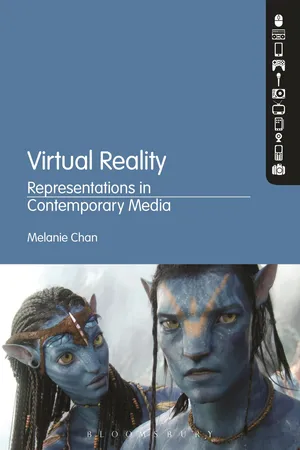
The idea of virtual realities has a long and complex historical trajectory, spanning from Plato's concept of the cave and the simulacrum, to artistic styles such as Trompe L'oeil, and more recently developments in 3D film, television and gaming. However, this book will pay particular attention to the time between the 1980s to the 1990s when virtual reality and cyberspace were represented, particularly in fiction, as a wondrous technology that enabled transcendence from the limitations of physical embodiment. The purpose of this critical historical analysis of representations of virtual reality is to examine how they might deny, repress or overlook embodied experience. Specifically, the author will contend that embodiment is a fundamental aspect of immersion in virtual reality, rather than something which is to be transcended. In this way, the book aims to challenge distorted ideas about transcendence and productively contribute to debates about embodiment and technology.
Information
1
Histories of Virtual Reality
This chapter has two broad aims: firstly, it explores various historical strands surrounding the development of virtual reality, and secondly it critically analyses debates surrounding the virtual and the real. The purpose of this two-fold approach is to contextualize the discussion of contemporary media representations of virtual reality in subsequent chapters. In doing so, I will place the discussion of contemporary representations of virtual reality within a wider historical, social and cultural context. However, there are difficulties with romantic notions of constructing the history of virtual reality through the accumulation of archive materials (Steedman, 2005), for the immense amount of information and interrelations that take place even during a specific historical moment far exceeds the archival process. Therefore, at the outset it is admitted that this chapter presents a highly truncated version of the history surrounding virtual reality. But my main purpose in this chapter is to challenge the idea that virtual reality is a radically new technology by indicating that it has a long, complex and uneven trajectory.
To make the discussion manageable it focuses on two key thematic strands: computation and cyberculture. The first strand, computation, explores the ways in which virtual reality environments are made possible by computerized algorithmic processing. In particular, there will be an exploration of the development of computing as a form of mechanized calculation and how this relates to changes in social production and the displacement of human labour. In this regard, the discussion will illustrate the historical context in which machines became associated with a particular form of intelligence and the ideologies that underpinned this viewpoint. Commenting on this point, Simon Schaffer states that ‘to make machines look intelligent it was necessary that the sources of their power, the labour force which surrounded and ran them, be rendered invisible’ (1994, 204). Following on from this point regarding invisibility, this chapter will indicate that whilst electronic devices such as computers or the software that generate virtual reality environments are often represented in contemporary media as desirable consumables, the ways in which they are produced is largely hidden from view. So the human labour that surrounds the production of technological devices in factories in South East Asia is occluded in favour of alluring advertisements that promote technological devices and services. In this way, the historical discussion of the development of mechanized calculation provides the foundation for the subsequent exploration of the relationships between technology and embodiment and also for the understanding of virtual reality in the present day.
In the second strand of the discussion attention will be given to the ways in which developments in photography, film and computer-generated imagery relate to the emergence of cyberculture and contemporary forms of virtual reality. Specifically, there will be an outline of the work of cinematographer Fred Waller, who produced a three-dimensional cinematic experience, known as Cinerama, and Morton Heilig’s multi-sensory simulator, Sensorama. These cinematic explorations will then provide the backdrop for the understanding of contemporary media representations of virtual reality. In addition, there will be an exploration of computer games since these are now a significant part of the entertainment industry, with revenues that often eclipse the box office revenue of major Hollywood films. Although there is not a long, historical body of academic scholarship on computer games, in recent years dedicated journals on gaming and simulation have been established. At the same time, it is becoming increasingly difficult to precisely define what constitutes a computer game, since there are some simulations and game applications that are open-ended and do not operate according to a pre-defined established set of rules, such as Second Life or The Sims (Corliss, 2011).
In recent years contemporary computer games such as The Sims 3, FIFA 10 and Battlefield: Bad Company 2 (Electronic Arts) and Final Fantasy® and Tomb Raider® (Eidos) have become incredibly popular, often selling millions of units. Additionally, force feedback devices have now become commercially available and increasingly popular. This includes devices such as the Nintendo Wii, which was launched in October 2006, the SideWinder by Microsoft and the Driving Force™ steering wheel by Logitech, which can be used with Sony Playstation games such as Gran Tourismo. With recent developments such as the Kinect, which is used with Microsoft’s X-Box 360, users can now interact with a suite of multimedia forms (games, music and film) through gestures and voice recognition. Therefore, the user’s body becomes the control device, the tool that allows interaction between them and the X-Box device. From these examples, we can see that human–computer interaction with virtual worlds has become popularized through computer games and is now a lucrative commercial area within a global capitalist economy. But to begin with, we will take a step back from contemporary digital technologies and briefly explore some of the historical, social and cultural factors surrounding their development.
Computation
Historically, connections can be drawn between virtual reality technologies, textile production and mechanical forms of computation (or calculation). Joseph Marie Jacquard, a French engineer, first developed an automated machine for weaving thread. Other developments in the silk industry such as the punch card pattern system designed by Basil Bouchon circa 1725 contributed to later developments such as the card machine which was used to tabulate US Census Data. For instance, the card machine developed by Herman Hollerith was first used to process the 1890 Census and this reduced the time taken to process the data from a matter of years to just a few months. By the nineteenth century the introduction of the mechanized loom also had a major impact on the production of textiles. Specifically, small-scale textile production was displaced by large-scale industrial modes of production in mills and factories. In addition, these changes altered the ways in which human skill and intelligence were measured and evaluated.
During the nineteenth century, Charles Babbage (1791–1871) and Ada Lovelace (1815–1852) developed a mechanized system for mathematical processing, which altered social modes of production. However, Herbert Klein points out that ‘most accounts of the development of modern computing deny a straight connection between Babbage’s mechanical device and electronic computers. It is therefore not so much a direct line of descent but rather a common heritage’ (2007, 37). Of note is that in Babbage’s time routine calculations were a form of clerical work that was performed by human labourers known as computers (Schaffer, 1994). So computation is not something that simply concerns digital technology or contemporary forms of computing machines (desktop machines, laptops and tablets) since other methods can be used to perform such calculations (Hayles, 2005).
Babbage aimed to produce a machine that was quicker and more efficient at performing calculations than the mental labour of human beings. According to Klein, ‘Babbage believed that the human mind worked on the same mechanical principles as a machine, so that it could also be emulated by a machine’ (40). Babbage produced the Difference Engine (1820–1822), which performed mathematical operations and could be used for performing the calculations that were required for navigational and astronomical tables. Later he worked on a device called the Analytical Engine (1833–1871), which utilized a series of punched cards, like an early form of computer programming. Klein states that this was ‘an idea which Babbage had taken from Joseph Jacquard, inventor of the automatic loom’ (39). In a similar way to contemporary electronic computers, the Analytical Engine aimed to be a universal machine which could be programmed to execute many different functions. Although Babbage spent many years working on the Analytical Engine, he was not able to produce a fully functioning machine during his lifetime.
At the same time that Babbage was working on replacing mental labour using the Difference Engine, many other parts of the country, especially Manchester and Leeds, were the site of industrial production and gruelling human labour in mills and factories. The operation of machines could be measured and monitored and soon these practices were applied to the human labour that took place in mills and factories. Workers were regarded as machine-like and their endeavours were carefully programmed into a production system that comprised of different components or stages. Schaffer contends that ‘under Babbage’s productive gaze, the powers of the body were rendered mechanical and thus profitable or wasteful and thus consigned to oblivion’ (1994, 227). So Babbage’s vision of replacing mental labour was soon applied to the physical aspects of material production as well, through the mechanization of work and systems of measurement and surveillance. Klein states that during his lifetime few people recognized Babbage’s vision and his accomplishments and that he was the subject of ridicule. Yet Babbage’s vision of a universal machine and the replacement of human labour remain important today. It could be argued that this process has continued into the twenty-first century as the labour force surrounding the production of the computerized components that drive virtual environments in factories in South East Asia is largely hidden from view, a point that will be discussed in more detail as this chapter unfolds.
As discussed, nineteenth-century developments in mechanized calculation paved the way for the production of electronic computers in the twentieth century. However, further developments were also required, such as the electrical transistor, which enabled algorithmic calculations to be performed at greater speeds. With the development of the Soviet Space programme after the end of the Second World War, the American military began to invest heavily into research and development, particularly in the field of computing. Within the context of Cold War relations in the 1950s and 1960s there was a sense of urgency within the US military regarding technological development, which led to experimentation with interactive computing and simulation, often via the funding of university research projects. Moreover, as Howard Rheingold (1991), Benjamin Woolley (1993) and Ken Hillis (1999) have pointed out, the military facility known as the Advanced Research Projects Agency (ARPA) was a major funding source for academic research into virtual reality. Douglas Engelbart, a former radar technician in the Second World War, received ARPA funding to establish the Augmentation Research Center (ARC) at Menlo Park, California, for Stanford University. The remit of ARC was to focus on the development of computer visualization systems. What is significant for the purposes of this study into virtual reality is that the research conducted at Menlo Park indicated the possibilities of human and computer interaction. Indeed, Engelbart envisaged that computers could be used to extend human capabilities and worked on the development of information displays on computer screens, which was a somewhat radical idea during this period (Burnett, 2004).
It was also during the 1960s that a research student named Ivan Sutherland at the Massachusetts Institute of Technology (MIT) produced a rudimentary form of computer graphics called Sketchpad and a head-mounted display device. Sutherland’s prototype graphics system was innovative, exciting and groundbreaking because it indicated the creative potential of computer graphics. Explaining how Sketchpad operated, Howard Rheingold tells us that ‘people could create images in the most natural way possible, by using their hands and eyes and a pen-like device to draw them’ (1991, 90). Sutherland’s early experiments into computer graphics are significant because they provided the foundation for the graphical interfaces that are used for contemporary forms of virtual reality technology. In 1965 Sutherland presented a research paper entitled ‘The Ultimate Display’, which provided an account of his experimental work on head-mounted displays and virtual reality systems. In this paper, Sutherland discusses the ways in which we perceive and interpret the world around us via the sensory motor capabilities of the human body and our prior knowledge of objects. Of note is that Sutherland’s research focused upon the embodied aspects of immersion in virtual reality. His research suggests that in order for a computer-generated environment to be effective it needs to engage as many senses as possible, rather than concentrating solely on sight. According to Sutherland, his Ultimate Display would employ the use of joysticks, stereophonics and force-feedback mechanisms to maximize the immersive experience. The drawback was that the prototype head-mounted display that Sutherland developed was extremely cumbersome and uncomfortable to wear. By the late 1960s Sutherland moved to the University of Utah and after further refinements to his research developed the first operational head-mounted display system.
A further strand to the historical development of virtual reality relates to experimentation with hallucinogenic drugs and alternative states of consciousness in the 1960s. Human beings have attempted to explore other realities throughout the ages, through creative forms, the use of hallucinogenic plants or rituals involving music and dance. In some cases, only certain members of society were considered as worthy of exploring other realities and aspects of consciousness such as shamans or mystics. In the 1960s, however, it was thought that LSD could provide a chemical basis for what were considered mystical or spiritual experiences. In the United States research into LSD was conducted in academic circles, at Harvard and Berkeley, and there is a connection between these experiments and the development of virtual reality environments. Timothy Leary, a major proponent of virtual reality, experimented with hallucinogenic drugs as a means of accessing alternative realities when he was a professor at Harvard.1 In the following statement, Leary outlines the connections between research into LSD and the development of personal computing:
In 1976, the Apple c...
Table of contents
- Cover
- Halftitle Page
- Title Page
- Contents
- Acknowledgements
- Introduction
- 1. Histories of Virtual Reality
- 2. Virtually Real and Really Virtual
- 3. Technological Intimacy and Social Estrangement in Strange Days
- 4. Virtual Identities and Material Bodies
- 5. Virtual Reality, Transcendence and Flights from Embodiment
- 6. Technology, Embodiment and Being-in-the-World
- 7. Virtuality and Simulacra in William Gibson’s Zero History
- Conclusion
- References
- Filmography
- Index
- Imprint
Trusted by 375,005 students
Access to over 1.5 million titles for a fair monthly price.
Study more efficiently using our study tools.
Frequently asked questions
Yes, you can cancel anytime from the Subscription tab in your account settings on the Perlego website. Your subscription will stay active until the end of your current billing period. Learn how to cancel your subscription
No, books cannot be downloaded as external files, such as PDFs, for use outside of Perlego. However, you can download books within the Perlego app for offline reading on mobile or tablet. Learn how to download books offline
Perlego offers two plans: Essential and Complete
- Essential is ideal for learners and professionals who enjoy exploring a wide range of subjects. Access the Essential Library with 800,000+ trusted titles and best-sellers across business, personal growth, and the humanities. Includes unlimited reading time and Standard Read Aloud voice.
- Complete: Perfect for advanced learners and researchers needing full, unrestricted access. Unlock 1.5M+ books across hundreds of subjects, including academic and specialized titles. The Complete Plan also includes advanced features like Premium Read Aloud and Research Assistant.
We are an online textbook subscription service, where you can get access to an entire online library for less than the price of a single book per month. With over 1.5 million books across 990+ topics, we’ve got you covered! Learn about our mission
Look out for the read-aloud symbol on your next book to see if you can listen to it. The read-aloud tool reads text aloud for you, highlighting the text as it is being read. You can pause it, speed it up and slow it down. Learn more about Read Aloud
Yes! You can use the Perlego app on both iOS and Android devices to read anytime, anywhere — even offline. Perfect for commutes or when you’re on the go.
Please note we cannot support devices running on iOS 13 and Android 7 or earlier. Learn more about using the app
Please note we cannot support devices running on iOS 13 and Android 7 or earlier. Learn more about using the app
Yes, you can access Virtual Reality by Melanie Chan in PDF and/or ePUB format, as well as other popular books in Sozialwissenschaften & Medienwissenschaften. We have over 1.5 million books available in our catalogue for you to explore.