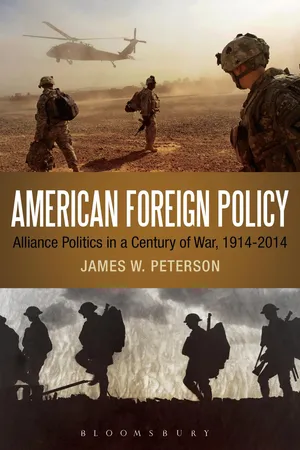
The text aims to uncover the roots of the United States' near perpetual involvement in war since the beginning of WWI in 1914. Using alliance politics as the main framework of analysis, it offers a new interpretation that contrasts with the traditional views that war is an interruption of the American foreign policy emphasis on diplomacy. Instead, it posits that war has been the norm during the past century while peaceful interludes were but a time of respite and preparation for the next conflict.
After a thorough discussion of the concepts of alliance building and the containment doctrine, the work then addresses such themes as the alliance networks used to confront German and Japanese powers during the early 20th century wars, the role of alliances in containing the Soviet Union during the Cold War, the creation of alliances to restrict and defeat rogue state powers, and whether they were useful when dealing with the challenges posed by terrorism in the post-9/11 world.
Each chapter features case studies, a summary, references, and web links. In addition, the book utilizes primary sources, such as U.S. Department of Defense and State documents and presidential statements. An exhaustive study of containment and alliance, this text will be an essential resource for anyone studying U.S. foreign policy, international relations, and national security.
eBook - ePub
American Foreign Policy
Alliance Politics in a Century of War, 1914-2014
- 224 pages
- English
- ePUB (mobile friendly)
- Available on iOS & Android
eBook - ePub
About this book
Information
Part One
Alliance Networks and the Defeat of German and Japanese Power: Early Twentieth-Century Hot Wars, 1914–1945
The earliest involvement on the global stage in a major war occurred after the rise of the European Central Powers and the ensuing World War I. Germany was the strongest and most provocative of that new European coalition, and it was their U-Boats that threatened the Atlantic shipping lanes of the emergent United States. American reluctance to play a role in this European conflict lasted a full three years, and it was consistent with the advice given by President Washington at the end of his terms in office (Jentleson 2007, 62–66). However, the brutal nature of that war, the availability of modern weapons of destruction, and its long stalemate begged for the injection of new power. A generation later, American leaders were similarly resistant to enter the European conflict, even after Hitler’s Munich Pact with Czechoslovakia in 1938 and his invasion of Poland the next year. However, in this case, President Roosevelt did engage American power through the Destroyer for Bases Dean and also through the Lend Lease Program. Subsequently, the allies did benefit from American capabilities if not the presence of its fighting forces.
1
World War I, Temporary Alliance Networks, and American Leadership, 1914–1918
The story of American involvement in the first global war of the century began on a note of pacifism and ended with presumed renewal of isolationism with Senate rejection of American membership in the newly formed League of Nations.
Noninvolvement, 1914–1917
The outbreak of the war in 1914 was in a sense one in which none of the European powers really was singularly at fault. The principal powers had been developing new military capabilities in the first decade of the twentieth century and developed major bilateral alliances to fend off trouble if it ever happened. The trip wire to trouble was the assassination, by the Bosnian Serb Princip, of the nephew of the Habsburg emperor. The Balkans had been brewing with tension for several decades, and “warm-up” wars had already been fought in that region. Four large empires that included the Austro-Hungarian, the Russian, the Ottoman, and the German had been in decay for some time and were ripe for implosion. In fact, all four would disappear by the end of the war. From this perspective, American noninvolvement made sense. This was not a conflict for that nation at this particular time. However, the commonality of culture and values between Europe and America made the war one that was important to everything that nations on both sides of the Atlantic represented.
It is important also to underline that alliances were the key to the outbreak and line-up of nations in 1914. It was an alliance that linked German to Austria-Hungary after the latter declared war on Serbia. Both Russia and France had traditionally been allies of Serbia, and those connections were thereby invoked. Once the German army began to march toward France, they entered and crossed Belgian territory, and that move activated the British, who had given security guarantees to Belgium (Hook 2011, 37). America’s traditional links to both Britain and France assured that they would join an alliance that included both of them, when and if the time came.
In fact, the national interests of the United States became intertwined with those of the allies as early as 1915, and the result was indirect involvement in the war two years before the actual declaration of war. In 1915 the German submarines sunk the Lusitania and Sussex, and on the former there were 128 Americans among the dead. Such German attacks were a major factor in leading President Wilson to the conclusion that major ethical considerations were involved, for freedom of the seas and the rights of neutrals were a traditional protection accorded by international law (McCormick 2005, 25). In “The First Lusitania Note Requests Germany to Halt Submarine Warfare, 1915,” Wilson expresses his moral reasoning by noting that it was persons and ships engaged in commerce that were now jeopardized and hurt by the German attacks. Harm to noncombatants was clearly unacceptable (“The First Lusitania Note … ” 2005, 35–36). Further evidence of America’s involvement in the century of war earlier than 1917 is that American leaders provided economic assistance and exports in order to strengthen the military capabilities of the allies. For instance, in 1916 alone the U.S. exported $2.75 billion worth of war material to Britain and France. Furthermore, in 1914–1917. U.S. banks loaned the allies $2.3 billion, a step that surely involved America in the war effort (Papp et al. 2005, 125–126).
In early 1917, Germany announced the beginning of unrestricted warfare, and that nearly guaranteed that America would become involved. However, it was an additional foray of Germany into America’s own backyard that sealed the deal of U.S. engagement. In the Zimmermann Telegram, the Germans endeavored to persuade Mexico to announce war on their side against the United States (McCormick 2010, 25). In return, Germany would assist Mexico in regaining lost territory during the Mexican War with the United States in 1847–1848 (Papp et al. 2005, 127).
Pivotal role, 1917–1918
When President Wilson described the reasons that justified involvement in the war, he had to couch his message in language that was sensitive to American values and traditions. He noted how the German attacks had finally come to close to the territory of the United States, and this was a drawing card that might appeal in light of the Revolutionary War against the actual presence of a foreign colonial power on American soil. He also told the Congress of his belief that this would be a “war to end all wars.” Thereby, he engaged the utopian stream in the short history of the new land. In addition, he described an involvement that would lead to at least the protection if not the spread of American democratic values. In fact, he saw American involvement as critical in an effort to “make the world safe for democracy.” In his request that Congress declare war, he mentioned how the German attacks had even sunk hospital and relief ships headed toward Belgium. He even welcomed the Russian Revolution as it put the Russian system on the side of democratic values, too. The moral impulse behind American involvement centered on the need to protect small nations and assure their liberation (“President Wilson Asks Congress … ” 2005, 36–38). In the end, American engagement did prove to be the decisive force that led to the defeat of the Central Powers, and as a consequence it was expected that its leaders would have much to say about the shape of the post-war settlement.
The trip wire event for Wilson and America had been the sinking of three American merchant ships, a blow on the homeland that served as the straw that broke the camel’s back (Paterson et al. 2005a, 277). In fact, merchant ships had not always been purely removed from the war effort, for in earlier years America had transported some of its aid in the form of arms and munitions via British merchant vessels (Paterson et al. 2005a, 273). Very quickly the United States mobilized for a war that the American people had come to see as a crusade. Their interest in and patience for discussions of “alliances on the European continent” was quite limited (Stoessinger 1985, 5). In the spring of 1917, American involvement was doubly necessary since Britain and France were “near exhaustion,” while Russia was “tottering” (Stoessinger 1985, 5). Another powerful rationale for involvement by the United States occurred in November 1917. The second and more radical stage of the Russian Revolution occurred with Lenin’s coup. He immediately signed the Peace of Brest-Litovsk with Germany and effectively took Russia out of the war effort (Hook 2011, 37). The Germans could concentrate their entire war effort on the western front, and American assistance to the allies became all the more urgent.
In the end America did get involved in the eastern front in a way that was initially directed at weakening Germany but that ended up engaging Bolshevik forces as well in the ongoing Russian Revolution. There were tens of thousands of Czech soldiers who had defected from the Austro-Hungarian army and joined up with Russia when the latter was still a tsarist system. Their aim had been in part to strike a blow against the Austro-Hungarian empire in a small effort to pave the way for their own political system and country after the war. However, they became trapped in the Russian Revolution after Lenin came to power. There were 70,000 Czech soldiers trapped on the Trans-Siberian Railroad and deeply involved in fighting the Bolsheviks. This led to American participation in the Allied Intervention that had occurred in part to prevent war material that they had sent to their previous ally Russia when it was fighting the common enemy Germany. However, war aims became complex when 10,000 American troops ended up actually supporting Kolchak and the Whites in their battle against Lenin and the Reds (Paterson et al. 2005a, 293–294). Allied forces were supposed to be protecting military supplies but ended up in an apparent effort “to roll back Bolshevik influence” (Paterson et al. 2005a, 293). Soviet leaders would for decades remember this intervention as an early capitalist effort to “strangle the Bolshevik baby in the cradle.” Another more short-range result was that the Czechs and their heroism caught the eye of President Wilson, and he was very supportive of their efforts after the war to found a nation-state. In fact, his statue now stands alongside that of the Czech founding father Thomas Masaryk in front of the main train station in Prague.
Passage of the Selective Service Act in May 1917 was critical in greatly expanding the ranks of the American military. In the previous month there were only 130,000 troops in the American Army, but at the time of the armistice eighteen months later there were 2,000,000 soldiers in Europe alone. At that end point in the war American troops were holding 20% of the allied front lines, clearly a major contribution (Papp et al. 2005, 128). Further, during the Muse-Argonne offensive in the summer of 1918, the involvement of American troops reached 1,000,000 (Paterson et al. 2005a, 283). It was numbers like these that serve as evidence of the pivotal role that America played in sealing the allied victory of the Triple Entente against the Triple Alliance.
President Woodrow Wilson, Fourteen Points, new states in Central Europe, and nonmembership in the League of Nations
In fact, the president went to Europe and participated in a leading way during negotiations that resulted in the Peace of Versailles. He had listed Fourteen Points as key considerations before the war actually ended, and they had an explosive effect in Central Europe. With the above-noted collapse of the four aging empires, new groups came forward with well-hatched plans for nation-states of their own. In particular, Wilson’s strong emphasis on the importance of “self-determination of nations” hit a nerve ending among peoples who had been dreaming of nation-states at least since the ill-fated European revolutions of 1848. As a result, Poland became a nation after having disappeared from the map itself for over a century. Czechoslovakia and Yugoslavia became nations with a complicated ethnic makeup for the first time ever. Austria, Estonia, Finland, Hungary, Latvia, Lithuania, and Romania also received statehood as an outcome of the war. Bulgaria had achieved that status a bit earlier in 1908 and Albania in 1912. Another dream of President Wilson had been a League of Nations that could make peace permanent by establishing a powerful checking force against any future aggressor. That hope ended for America when key members of the Senate Foreign Relations Committee defeated American participation on behalf of a return to traditional noninvolvement in the affairs of Europe (Stoessinger 1985, 21–27).
Intellectually, Wilson’s work after the war was centered on replacing the traditional European-centered balance of power with collective security (Taylor 1963, 181; Stoessinger 1985, 7; Wittkopf et al. 2003, 34; McCormick 2010, 26; Hook 2011, 38). His involvement was clear as he spent the better part of six months in Europe between December 1918 and June 1919. In the end, he had more success bargaining with the allies in Europe than he later would in negotiating with the Senate Foreign Relation Committee back home. The Europeans were not initially interested in a new organization such as the League of Nations. Thus, his pressure and persuasiveness combined with adulation by the European public to make the allies acquiescent (Stoessinger 1985, 22). However, Wilson also had to make concessions to the allies, for Britain, France, Italy, and Japan would not back down on their territorial demands (Stoessinger 1985, 7). As a result of this allied pressure, Germany lost 13% of its territory and 10% of its population (Paterson et al. 2005a, 287). Further, the allies extracted from President Wilson agreement to add a war guilt clause to the armistice and to require that Germany pay $33 billion in war reparations (Paterson et al. 2005a, 286). Of course, the tragedy for Wilson personally was that the Senate ended up defeating the treaty that would have put the United States into the League. A very sick and stubborn president refused to accept any reservations added by the Senate to the treaty, even though evidence indicated that the British at least would have accepted such reservations (Paterson et al. 2005a, 290). Wilson’s moralism and vanity had finally undercut his bargain with the allies and also compromised the values with which he had initially let America into the war. Consequences of the American absence were severe for the allies, as the League was impotent to prevent the conquests of the Nazis in the next generation. Compounding this retreat by America from global politics was its absence as well from the new Permanent Court on International Justice (Chittick 2006, 111).
Wilson’s philosophy about the value of the alliance in the war is apparent in his famous Fourteen Points. In Point # 10, he in effect seeks to extend the alliance by supporting the “freest opportunity of autonomous development” for the peoples of Austria-Hungary. In Point # 13 he specifically calls for recreation of a modern Polish state. Point # 14 is his famous precursor of the League of Nations, for he notes the need for a “general association of nations” (“Wilson Proclaims … ” 2005, 39–40). The actual Covenant of the League of Nations also reflects the beliefs of Wilson about how to be a member of an alliance and about the principles that should guide it. For example, Article 11 affirms that “any threat of war … is a matter of concern” for the whole League. The institutions of the League all had specific assignments. The Council would “advise upon the means” when aggression threatens a member’s “territorial integrity and existing political independence.” Use of the principle of arbitration would be the instrument for dealing with issues that had come up (Article 13). In Article 16, there is included a plan to establish a “Permanent Court of International Justice.” In all of these ways Wilson sought to define a way of participating in and even leading an alliance. This was an enormous change in a short time for a country that had mainly avoided European “entanglements” for over a century.
In spite of the return to partial isolationism after the war, the United States continued to engage in discussions and even agreements with former allied partners, short of the League of Nations. Washington would be the site of two Naval Conferences in 1921 and 1922, and the result was limitation on ship tonnage for the host nation (5), Great Britain (5), Japan (3), France (1.67), and Italy (1.67) (Papp et al. 2005, 135). Had such quotas been enforceable, the exercise of influence by Japan would have been quite different in the 1930s and 1940s. The nation that had opted out of the collective security organization that might have helped to prevent war did seek an international treaty to outlaw war. As a result the Kellogg-Briand Pact became a reality at least on paper in 1928. Thus, America continued to work with allies in an atmosphere in which the fear of war was very real.
There were other concrete and visible signs of America’s capability for resuming a role on the world stage. Emplacement of American marines into selected Latin American countries was one indication of a willingness to inject military power at least in its own hemisphere. For example, there were U.S. marines in t...
Table of contents
- Cover
- Halftitle Page
- Title Page
- Dedication Page
- Contents
- 1914
- Acknowledgments
- Introduction: 1914—An Abrupt End to a Century and a Quarter of Isolationism
- Part One: Alliance Networks and the Defeat of German and Japanese Power: Early Twentieth-Century Hot Wars, 1914–1945
- Part Two: Role of Alliances in Containing the Power of the Soviet Union: Late Twentieth-Century Cold War, 1945–1991
- Part Three: Creation of Alliances to Restrict and Defeat Rogue State Power: Immediate Post–Cold War Period
- Part Four: Utility and Disutility of Alliances in Dealing with Challenges from Terrorist Power, 2001–2014
- Conclusion: 2014—Reflections on a Century of War and an Abrupt Transition to New Conflicts
- “Mazar”
- References
- Index
- Imprint
Trusted by 375,005 students
Access to over 1.5 million titles for a fair monthly price.
Study more efficiently using our study tools.
Frequently asked questions
Yes, you can cancel anytime from the Subscription tab in your account settings on the Perlego website. Your subscription will stay active until the end of your current billing period. Learn how to cancel your subscription
No, books cannot be downloaded as external files, such as PDFs, for use outside of Perlego. However, you can download books within the Perlego app for offline reading on mobile or tablet. Learn how to download books offline
Perlego offers two plans: Essential and Complete
- Essential is ideal for learners and professionals who enjoy exploring a wide range of subjects. Access the Essential Library with 800,000+ trusted titles and best-sellers across business, personal growth, and the humanities. Includes unlimited reading time and Standard Read Aloud voice.
- Complete: Perfect for advanced learners and researchers needing full, unrestricted access. Unlock 1.5M+ books across hundreds of subjects, including academic and specialized titles. The Complete Plan also includes advanced features like Premium Read Aloud and Research Assistant.
We are an online textbook subscription service, where you can get access to an entire online library for less than the price of a single book per month. With over 1.5 million books across 990+ topics, we’ve got you covered! Learn about our mission
Look out for the read-aloud symbol on your next book to see if you can listen to it. The read-aloud tool reads text aloud for you, highlighting the text as it is being read. You can pause it, speed it up and slow it down. Learn more about Read Aloud
Yes! You can use the Perlego app on both iOS and Android devices to read anytime, anywhere — even offline. Perfect for commutes or when you’re on the go.
Please note we cannot support devices running on iOS 13 and Android 7 or earlier. Learn more about using the app
Please note we cannot support devices running on iOS 13 and Android 7 or earlier. Learn more about using the app
Yes, you can access American Foreign Policy by James W. Peterson in PDF and/or ePUB format, as well as other popular books in Politik & Internationale Beziehungen & Militär- & Seefahrtsgeschichte. We have over 1.5 million books available in our catalogue for you to explore.