The book shares Žižek's central problem of how to revitalize the radical political left through theory. It initially follows the argument developed in The Ticklish Subject that contemporary leftist thought is divided by antagonism between a Marxist revolutionary politics founded on Enlightenment philosophy and a politics of identity founded on post-modern post-structuralism.
How Žižek used Lacan's theory of character structures is examined here to describe this theoretical deadlock and explain how the dominant contemporary ideologies of liberal tolerant multiculturalism and reactionary "pseudo-fundamentalism" compete to mobilize the individual subject's unconscious drive to enjoyment. The book thus emphasizes the moments in which Žižek hints that Lacanian theory may describe a practice that facilitates the resolution of antagonisms that placate radical leftist politics. It challenges prevalent interpretations of Lacanian ends of analysis, to ultimately connect the psychoanalytic cure to the leftist project of social and political liberation.
The Subject of Liberation argues that if Lacan is to be useful to leftist politics, then the left has to develop its own definitions of the post-analytic subject, and proposes one such definition developed out of Lacanian and Žižekian theory.
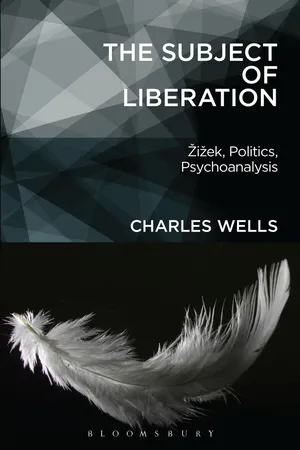
- 240 pages
- English
- ePUB (mobile friendly)
- Available on iOS & Android
eBook - ePub
About this book
Information
Part One
The Problem
1
How to Read the Ticklish Subject
I’m not yet writing a book
One of the most popular contemporary critiques of Žižek’s work is that it lacks a central argument. It may be fun to read, being chalk full of jokes, parables and examples from blockbuster movies. It may be scandalous and titillating, descending equally frequently into obscene humour and intentionally provocative political pronouncements. It may even offer some moments of deep insight, demonstrating a profound grasp of psychoanalytic theory and Enlightenment and postmodern philosophy. But for all this, a general suspicion hovers over Žižek’s oeuvre that he is never quite able to get to the point because there isn’t one. Behind all the sound and fury, beyond the endless series of set-ups and punch lines is … nothing.
There are a number of responses one might make to this critique. Are the rest of us doing any better? Isn’t Žižek’s refusal (or failure) to follow the trend of pretending to have a central argument rather refreshing? Or is Žižek’s central argument perhaps simply too difficult for his critics to follow? Moreover, why do we expect this kind of coherence from Žižek in particular? No one seems to complain about Deleuze and Guattari’s 1000 Plateaus, which is so disjointed it includes a story about Deleuze turning into a lobster. But before rushing to Žižek’s aid in this way, one ought to take a moment to consider the confession he makes in Žižek! regarding his own writing process:
I have a very complicated ritual about writing. It’s psychologically impossible for me to sit down, so I have to trick myself. I elaborate a very simple strategy, which, at least with me, it works. I put down ideas, but I put them down, usually, already in a relatively elaborate way: the line of thought already written, full sentences, and so on. So, up a certain point, I’m telling myself, ‘No. I’m not yet writing the book. I’m just putting down ideas.’ Then, at a certain point, I tell myself, ‘Everything is already there. Now, I just have to edit it.’ So, that’s the idea: to split it into two. I put down notes. I edit it. Writing disappears.1
On the one hand, the least one can say is that this trick works exceedingly well. As someone who is psychologically incapable of writing a book, Žižek is one of the most prolific theorists writing today. On the other hand, anyone who has actually read Žižek’s work will have to acknowledge that it tends to read as precisely this: a series of elaborate and interesting but seemingly unrelated thoughts hammered together into something only vaguely resembling a linear argument. As a self-described Žižekian, I cannot count the number of times I have felt that he was on the verge of reaching a very profound conclusion, only to turn the page and find the chapter finished, and the next picking up on some new, seemingly completely unrelated, topic. What’s more, from one book to the next, Žižek frequently repeats the same relatively elaborate thoughts, even elaborated in exactly the same way, but edited together differently with a few new thoughts thrown in here and there if one is lucky.
As such, it is always tempting for those who take Žižek seriously to dismiss the central arguments that he imposes onto his books after the fact, and to try to directly write the book that he is avoiding writing. Indeed, my own succumbing to this temptation is part of the impetus behind The Subject of Liberation. One of the ways I conceived of my own project at the outset was to assemble Žižek’s thoughts into a coherent linear argument, filling in the blanks along the way. However, this is only half of the story. While the central arguments that structure Žižek’s works may, as it were, arrive too late, this does not mean that they are simply imposed on a random assemblage of parts. Rather, they are attempts to articulate the problem that Žižek was working through when he produced that particular assemblage. That is to say, Žižek’s books should not be read as attempts to provide a coherent linear argument for a particular solution to a given problem. Rather, they should be read as the traces of a series of attempts to formulate the problem as such. And in the case of The Ticklish Subject, I believe that the problem Žižek was grappling with was precisely the problem of subjectivity and liberation.
Look where it comes again, Horatio!
In the introduction to The Ticklish Subject, Žižek presents himself as a Hamlet, the unlikely champion of a much maligned spectre of Cartesian subjectivity. Ranged against him, Žižek finds all of Elsinore: a ‘holy alliance’ of the entirety of Western academia, the members of which include, but are not limited to, ‘the new age obscuranist … the postmodern deconstructionist … the Habermasian theorist of communication … the Heideggerian proponent of the thought of Being … the cognitive scientist … the Deep Ecologist … the critical (post-)Marxist … and the feminist’. In the face of this awesome conspiracy of thought, Žižek announces that his aim is to ‘reassert the Cartesian subject, whose rejection forms the silent pact of all the struggling parties of today’s academia’.2
However, while this pronouncement of fidelity to the spectre of Descartes’ cogito is enough to get The Ticklish Subject started, the time remains out of joint. Žižek seems unable to simply defeat his opponents in deadly combat. Rather, he becomes immediately entangled in a seemingly endless series of theoretical elaborations, monologues and asides. Why? Why does Žižek delay? Because he is clear from the beginning that his aim ‘is not to return to the cogito in the guise in which this notion has dominated modern thought … but to bring to light its forgotten obverse’.3 The problem that Žižek is working through in the course of The Ticklish Subject is not just that of reasserting the Cartesian subject, but of defining exactly what the Cartesian subject is that he wishes to reassert. Žižek faces the difficult task of distinguishing between two sides of the cogito: the failed and guilty side of it that must be put to rest, and the as-yet-unredeemed side of it that must be set free.
Reading The Ticklish Subject as a version of the Danish play produces some interesting results, not least of which is that it indicates that Žižek is in strange company. In Spectres of Marx, Derrida begins his response to the question ‘Whither Marxism?’ by returning, like Žižek, to the opening lines of The Manifesto. And before things even get properly started, he finds himself on the battlements of a certain Danish castle with Bernardo, Horatio and Marcellus, waiting for a certain spectre to return for the first time. Derrida’s own encounter with hauntology is useful here because it introduces the language of différance and inheritance: With help from Marx, Derrida establishes ‘the difference between a spectre and a spirit. It is a diffèrance’, the difference between a thing and itself. ‘The spectre is … the carnal apparition of the spirit, its phenomenal body, its fallen and guilty body, [and] it is also the impatient and nostalgic waiting for [the spirit’s] redemption’.4 For Derrida, the task of the inheritor, the one to whom the spectre speaks, is precisely the work of differentiating between the spectre and the spirit. The call of Hamlet’s spectre, ‘Swear’,5 is a call for this work that will free the spirit from the weight of its fallen and guilty body and allow it to live again. Is it not strange that Derrida, of whose deconstructionist legacy Žižek is frequently so critical, should so accurately describe his own project?
Opposing Derrida’s inheritor in this task are the conjurers: those who deny différance, those who work to keep the spirit bound to its body, either to be rid of it once and for all (conjuring as warding off – ‘Let him stay there and move no more!’6) or to secure it as an object of mastery (conjuring as commanding – ‘Stay, illusion! If thou hast any sound, or use of voice, speak to me’7). And this secret agreement between enemies who are ‘officially involved in a deadly battle’8 is perhaps best described by Michel Foucault in his What Is Enlightenment? Foucault exhorts his readers to refuse ‘the “blackmail” of the Enlightenment’,9 which demands that one ‘either accept the Enlightenment and remain within the tradition of its rationalism … or else … criticize the Enlightenment and then try to escape from its principles of rationality’. This ‘simplistic and authoritarian alternative’,10 he argues, is underpinned by a shared ‘faithfulness to doctrinal elements’.11 Regardless of which side of the battle one chooses, regardless of whether one has chosen to accept or to criticize the Enlightenment, one has always already been blackmailed into submitting to the terms of the alternative: the Enlightenment shall mean this (this body, this tradition, this doctrine, these concepts, these elements, these thinkers and so on) and nothing more nor less! Once again, a theorist whom Žižek frequently rejects out of hand seems to produce exactly his own logic: The various branches of Western academia, officially engaged in deadly battle, are nonetheless bound in a holy conspiracy against the resuscitation of a certain Enlightenment spirit.
In opposition to the faithfulness to doctrinal elements demanded by the blackmail of the Enlightenment, Foucault exhorts his reader to practise ‘the reactivation of an attitude … of a philosophical ethos’.12 This ethos, the spirit present in the Enlightenment project, must be reactivated and redeemed, while the fallen and guilty body is simultaneously put to rest. One must announce, if I may be allowed to push Foucault’s project past what some would call its breaking point, the différance between ‘the “Enlightenment” which discovered the liberties’ and the Enlightenment that ‘developed the disciplines’,13 between the Enlightenment and itself. And in The Ticklish Subject, Žižek sets himself precisely this task in relation to Descartes’ theory of subjectivity. The point is not (only) to reassert the cogito in opposition to those who criticize it, but to refuse to be blackmailed into the act of conjuration that underpins both sides of this alternative. The point is to inherit the spirit of the Enlightenment as part of the contemporary project of radically liberatory leftist politics.
Žižek’s postmodern other
The second useful result of reading The Ticklish Subject as a version of Hamlet is that one may turn to Žižek’s own answer to the classic question concerning the play, ‘Why does Hamlet delay?’ which he attributes in turn to Lacan:
Hamlet recognizes himself as the addressee of the imposed mandate or mission (to revenge his father’s murder); but the father’s ghost enigmatically supplements his command with the request that Hamlet should not in any way harm his mother. And what prevents Hamlet from acting … [what perpetuates the movement of the play] is precisely the confrontation with the … desire of the Other: the key scene in the whole drama is the long dialogue between Hamlet and his mother, in which he is seized with doubt as to his mother’s desire – What does she really want? What if she really enjoys her filthy, promiscuous relationship with his uncle?14
According to this interpretation, it is not Hamlet’s initial swearing of allegiance to the spectre of his father that is the most important scene (although this does manage to get the play started), neither is it the final showdown in which Hamlet at long last accomplishes the bloody deed appointed to him (although this does manage to get the play over with). The most important scene is act III, scene iv, in which Hamlet confronts the enigma of his mother’s desire, the only scene in which the spectre returns again: ‘Look’, it says to Hamlet, ‘amazement on thy mother sits: O, step between her and her fighting soul … Speak to her Hamlet’.15
Here is the conclusion towards which I am inexorably drawn: The truly difficult task is not declaring fidelity to the spectre, neither is it carrying out the mandate that the spectre imposes. The truly difficult task is the risky act of speaking to the living Other about whose desire one is in doubt. It is the attempt to rescue this Other who may not be an enemy, but simply mistaken, misled, confused or seduced. It is an attempt to step between this Other and his or her fighting soul. And this encounter must take the form of speech, of symbolic communication, because the essential task is to describe to the Other the difference between the failed and guilty body, and the spirit that must be redeemed. To Gertrude, who asks ‘How is’t with you, that you do bend your eye on vacancy? … Whereon do you look?’,16 Hamlet must describe ‘the counterfeit presentment of two brothers’, one a spirit ‘where every god did seem to set his seal’, the other, ‘like a mildew’d ear, blasting his wholesome brother’.17
My wager here is that insofar as Žižek is a Hamlet, and Enlightenment thought the spectre that haunts him, postmodern thought is the Other whom he is attempting to rescue. More specifically, insofar as the task that Žižek has set himself in The Ticklish Subject is to inherit the spirit of the Cartesian subject, the ‘postmodern deconstructionist for whom the Cartesian subject is a discursive fiction, an effect of decentred textual mechanisms’,18 is not simply one member among others of the holy alliance that stands between him and his destiny (Ophelia, Polonius, Rosencrantz and Guildenstern and so on). Rather, I believe that postmodern thought, represented for Žižek precisely by Derrida and Foucault among others, occupies the third privileged position in the drama. I believe that Postmodern thought occupies the position of Gertrude, the Other about whose desire this Hamlet is in doubt, and I believe that the fact that these postmodern theorists are so useful in describing Žižek’s own project both signals and occasions this special status.
One need not look very far to discover a strong current of ambivalence in Žižek’s oeuvre in relation to precisely these thinkers. Derrida, for example, is often characterized by Žižek as a kind of waffler. His messianic waiting for a democracy to come appears as a defence against acting – and thus having to take responsibility for acting – in the present. ‘It involves us in the “postmodernist” indefinite oscillation of “how do we know this truly is the [revolutionary] Event [that enjoins us to act], not just another semblance of the Event?” ’19 Nonetheless, in his article for Critical Inquiry entitled ‘A Plea for a Return to Différance (with a Minor pro Domo Sua,)’ Žižek calls for a resuscitation of Derridean concepts in the face of ‘a new barbarism in today’s intellectual life’, in which ‘Derrida… together with Baudrillard and others, [is] thrown into the “postmodern” melting pot that, so the story goes, opens up the way for proto-Fascist irrationalism’.20 Is Derrida a postmodern failure or not? Žižek seems uncertain.
Gilles Deleuze, whom I have not mentioned until now, but who clearly falls into this same postmodernist camp, faces a similar treatment, but to greater extent. In The Ticklish Subject, he is described as ‘a philosopher of globalized perversion if ever there was one’, practising a ‘false subversive radicalization that fits the existing power constellation perfectly’.21 Nonetheless, Žižek devotes an entire book to Deleuze, Organs without Bodies, in which he valorises much of Deleuze’s thinking, separating it ruthlessly from errors that he is tempted to ascribe to the ‘ “bad” influence’22 of Felix Guattari. Is Deleuze a pervert who ought to be discounted, or might his inadequacies be chalked up to some external seduction? Žižek can’t seem to make up his mind.
And one should not forget Foucault, who is shown out precisely the same door as Deleuze: he, also, is ‘a perverse philosopher if ever there was one’.23 Is there not already, even in this strangely unimaginative repetition of the very sentence structure of Žižek’s accusations, something that sticks out symptomatically from the body of the text? Žižek has not (yet) attempted to rescue Foucault as he has Derrida and Deleuze, but one can well imagine that this book or article is o...
Table of contents
- Cover
- Halftitle Page
- Title Page
- Dedication Page
- Contents
- Introduction: The Subject of Liberation
- Part 1: The Problem
- Part 2: The Subject, Ideology and Psychoanalysis
- Part 3: Contemporary Ideologies
- Part 4: Going Through the Deadlock
- Part 5: Post-Analytic Subjects
- Part 6: Liberated Societies
- Conclusion: Go, Bid the Soldiers Shoot!
- Notes
- Bibliography
- Index
- Imprint
Trusted by 375,005 students
Access to over 1.5 million titles for a fair monthly price.
Study more efficiently using our study tools.
Frequently asked questions
Yes, you can cancel anytime from the Subscription tab in your account settings on the Perlego website. Your subscription will stay active until the end of your current billing period. Learn how to cancel your subscription
No, books cannot be downloaded as external files, such as PDFs, for use outside of Perlego. However, you can download books within the Perlego app for offline reading on mobile or tablet. Learn how to download books offline
Perlego offers two plans: Essential and Complete
- Essential is ideal for learners and professionals who enjoy exploring a wide range of subjects. Access the Essential Library with 800,000+ trusted titles and best-sellers across business, personal growth, and the humanities. Includes unlimited reading time and Standard Read Aloud voice.
- Complete: Perfect for advanced learners and researchers needing full, unrestricted access. Unlock 1.5M+ books across hundreds of subjects, including academic and specialized titles. The Complete Plan also includes advanced features like Premium Read Aloud and Research Assistant.
We are an online textbook subscription service, where you can get access to an entire online library for less than the price of a single book per month. With over 1.5 million books across 990+ topics, we’ve got you covered! Learn about our mission
Look out for the read-aloud symbol on your next book to see if you can listen to it. The read-aloud tool reads text aloud for you, highlighting the text as it is being read. You can pause it, speed it up and slow it down. Learn more about Read Aloud
Yes! You can use the Perlego app on both iOS and Android devices to read anytime, anywhere — even offline. Perfect for commutes or when you’re on the go.
Please note we cannot support devices running on iOS 13 and Android 7 or earlier. Learn more about using the app
Please note we cannot support devices running on iOS 13 and Android 7 or earlier. Learn more about using the app
Yes, you can access The Subject of Liberation by Charles Wells in PDF and/or ePUB format, as well as other popular books in Politics & International Relations & Political Philosophy. We have over 1.5 million books available in our catalogue for you to explore.