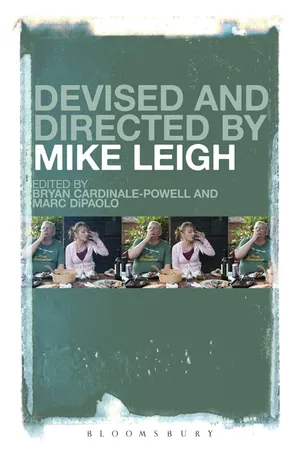
Renowned for making films that are at once sly domestic satires and heartbreaking 'social realist' dramas, British writer-director Mike Leigh confronts his viewers with an un-romanticized dramatization of modern-day society in the hopes of inspiring them to strive for greater self-awareness and compassion for others. This collection features new, interdisciplinary essays that cover all phases of the BAFTA-award-winner's film career, from his early made-for-television film work to his theatrical releases, including Life is Sweet (1990), Naked (1993), Secrets & Lies (1996), Career Girls (1997), Topsy-Turvy (1999), All or Nothing (2002), Vera Drake (2004), Happy-Go-Lucky (2008) and Another Year (2010).
With contributions from international scholars from a variety of fields, the essays in this collection cover individual films and the recurring themes and motifs in several films, such as representations of class and gender, and overt social commentary and political subtexts. Also covered are Leigh's visual stylizations and storytelling techniques ranging from explorations of the costume design to set design to the music and camerawork and editing; the collaborative process of 'devising and directing' a Mike Leigh film that involves character-building, world-construction, plotting, improvisations and script-writing; the process of funding and marketing for these seemingly 'uncommercial' projects, and a survey of Leigh's critical reception and the existing writing on his work.
- 336 pages
- English
- ePUB (mobile friendly)
- Available on iOS & Android
eBook - ePub
Devised and Directed by Mike Leigh
About this book
Information
Part One
Devising Leigh
1
The Industry and/of the Auteur: Producing and Marketing Mike Leigh
Christopher Meir
The paradigm of the auteur has always been one that is implicitly and sometimes explicitly Romantic in nature, tending to see the auteur director as one that stands apart and in isolation from all worldly concerns and contexts. Among other problems, this bent on the part of auteur critics has led to the neglect of important creative collaborators, a tendency to view directors as somehow existing separately from history and culture and a sometimes willful disavowal of the economic realities of film-making. All of these tendencies can be found in the scholarship surrounding Mike Leigh, and they have collectively created gaps and misunderstandings about the film-maker’s career that must be remedied if we are to more fully appreciate the historical realities of Leigh’s film-making and various contexts that surround his work.
This chapter will illuminate the commercial contexts of Mike Leigh’s film-making, aspects of his work that have received surprisingly little attention from critics and scholars. As such, it will first provide an overview of the production contexts for his films and television plays. This section of the chapter will examine the entities that have funded and continue to fund his work – including British subsidy bodies and public service broadcasters – as well as the producers who have worked with Leigh throughout his career and who have often gone unheralded by nearly everyone except – significantly – Leigh himself. This latter concern is particularly of interest following the death in 2009 of Leigh’s long-time producer Simon Channing Williams. This section will also engage with the economics that underpin Leigh’s film-making, including budget, box office performance and business models, all concerns that ultimately fall to film producers. The chapter’s second section explores the marketing of Mike Leigh’s films, which, unsurprisingly, centres on Leigh himself. Here I will elucidate Leigh’s auteur persona as seen across the vast corpus of interviews that the director has given over the years. As such, this section will discuss the ways in which Leigh is branded as an auteur director in a time when the figure of the auteur director has become an accepted staple of popular film culture, even while theorists and historians continue to debate its usefulness for Film Studies.
This exploration of the commercial side of Leigh’s career will shed new light on the director’s work and answer questions that may have puzzled admirers of his films. These questions typically centre around how it is that Leigh continues to get his films made when they seem so patently non-commercial in form and content and when he almost never has a script or even outline to pitch to potential funders. This chapter will take on these questions and in so doing demonstrate that the films are in their own way very commercially viable as long as they are made and marketed in the correct manner. Appreciating the ways in which Leigh’s films have been handled from pre-production through marketing and distribution means starting with the figure of the producer, a figure who typically looms large in both of these spheres of a film’s commercial life.
Producing Mike Leigh
One learned how to produce Mike Leigh.
David Aukin1
My debt to him is massive and my respect is huge.
Mike Leigh on Tony Garnett2
The figure of the producer is one that has been widely neglected in Film Studies, with stars and directors receiving the bulk of the attention from critics and scholars. Auteurism has played a large role in this marginalization, not only by favouring directors but also by habitually pitting the auteur director against avaricious and philistine producers. Film history is thus littered with stories of Hitchcock’s feuds with Selznick, Von Stroheim’s struggles with Thalberg, and others, all of which cast the director as the hero and producer as villain.3 But more often than not, the great auteurs have actually benefitted from producers who have managed the commercial and organizational sides of film-making and thus allowed directors the freedom to bring their visions to the screen.
Though the producers who have worked with auteur directors are vitally important to the films they work on, the scholars who study those films seldom recognize them. In this regard, Mike Leigh scholarship is no exception: Simon Channing Williams, Leigh’s producer for almost 20 years, is not mentioned a single time in Garry Watson’s book on Leigh,4 and he only gets the briefest possible mention in Raymond Carney and Leonard Quart’s book on the director, that being in the authors’ acknowledgements.5 Similarly, Sean O’Sullivan’s recent monograph on the director6 only features one mention of the producer, that being in a chapter-length interview with Leigh himself.7 This latter example is not surprising. The one place Channing Williams is discussed at length is in Leigh’s interviews, where the director pays homage at several points to the important role played not only by Channing Williams but also other important producers and executive producers, including David Rose, David Aukin, Georgina Lowe and others. This is perhaps the best testament to the importance of producers in Leigh’s career.
Like many independent film-makers before and since, Leigh’s career began with an audacious attempt at scraping together whatever money could be begged and/or borrowed from friends to make his debut feature Bleak Moments (1971). Unlike Kevin Smith or John Cassavetes, however, Leigh had an established product in the successfully staged version of his play Bleak Moments and wealthy and famous friends like actors Les Blair and Albert Finney. Finney – who attended Salford Grammar School at around the same time as Leigh – agreed to fund almost all of the film’s budget, save for the paltry £100 provided by the BFI Production Board, the leading subsidy body at the time for new film-makers. The micro-budget feature was made for a total of £18,5008 and, along with his established career in theatre, put Leigh on the radar of the first important producer that would shape his film-making career.
Tony Garnett – one of the most important producers in the history of British television – was then in charge of the BBC’s Play for Today series. In this role he had worked with a virtual who’s who of British auteurs in the making, including Stephen Frears and Ken Loach. In retrospect, the amount of future film-making talent employed by the BBC in the early 1970s supports Leigh’s claims that, ‘the British film industry was alive and well and hiding out in television’.9 Garnett provided Leigh with the break the director needed to move from the unstable footing of maverick independent film-maker to the relatively predictable world of television drama.
As Garnett told Michael Coveney, this decision was made based on his knowledge of Leigh’s now famous working methods and the practical problems the producer knew these would cause:
I could see that [Leigh] was never going to be able to do what he wants to do in the cinema. His conditions were expensive, not for the scale of the thing . . . but for the time required. I knew nothing would happen for him until he got established. So I decided that I would give him one of my last available slots.10
While there is no reason to doubt Leigh’s claims of complete autonomy during his BBC days, the impact of the Play for Today ‘house style’ – a sort of realism infused with Lord Reith’s dictum that public service media should ‘inform, educate and entertain’ – on Leigh’s style, or indeed that of Loach, Frears and other great British auteurs, remains underappreciated.
Once Leigh began working with Play for Today, he entered a period of steady and prolific film production. Despite working in what was for all intents and purposes a studio job, Leigh has spoken favourably of the creative freedom he enjoyed at the BBC. Leigh was allowed to make whatever films fit his interests while seldom if ever worrying about budgets.11 Two of his most popular works were made during this period: Nuts in May (1973) and Abigail’s Party (1978). Leigh enjoyed the free reign offered by the BBC, but he grew increasingly frustrated with the limited scale of television distribution, describing it in one interview as ‘really, really choking’.12 This frustration would ultimately lead Leigh to film-making aimed at theatrical distribution, and his time at the BBC gave him occasion to work with two producers who would play central roles in his later transition to the cinema: David Rose and Simon Channing Williams.
In the early 1970s, David Rose was head of English regions drama at the BBC. In this capacity, he not only commissioned Nuts in May, but also put his personal stamp on the film when he suggested that Leigh shoot on location in Dorset – Rose’s home county – a decision which Leigh still credits as being vital to the film’s satirical project.13 As Coveney points out, Nuts in May ‘marked Leigh’s major breakthrough with the British public’,14 an accomplishment due in no small part to the vision and influence of David Rose. Rose continued to play a major role in Leigh’s development as a film-maker, commissioning and producing The Kiss of Death (1977), set in Lancashire. By this time, the relationship between director and producer was so close that Leigh included an inside joke aimed at Rose in the film itself.15
Rose went on to play a significant role in British film and television history as commissioning editor at Channel 4 which was established in 1982 as an outlet for independent television production by the otherwise neo-liberal and deeply conservative Thatcher regime. Here Rose not only commissioned some of the most important works of the 1980s, including landmarks such as My Beautiful Laundrette (Stephen Frears, 1985) and The Draughtsman’s Contract (Peter Greenaway, 1982), but he also pushed the channel – and consequently all of British television – towards theatrical distribution of its films. This policy reshaped British cinema and ultimately provided Leigh with the scale of distribution he had sought in the 1970s.
Even before greenlighting the channel’s investment in High Hopes (1988), Leigh’s first theatrical film since Bleak Moments, Rose played a vital role in Leigh’s career in the 1980s. Rose commissioned Meantime (1984), which along with Four Days in July (1985) and High Hopes formed what Leigh would later describe as ‘a trilogy of Thatcher-motivated films’.16 The success of these films laid a foundation for Leigh’s eventual move to theatrical distribution. Meantime in particular proved very popular with audiences and had a theatrical run in Australia.17 Rose also stepped in to revive Leigh’s career in the mid-1980s when he commissioned Leigh to make The Short and Curlies (1988). This project was intended to provide Leigh a chance to show potential backers that he was again able to stand the rigors of film-making after suffering a bout of depression after the completion of Four Days.18
Beyond Rose, perhaps the only person who cast a longer shadow over Leigh’s career was Simon Channing Williams. Channing Williams met and worked with Leigh during the director’s time at the BBC on the film Grown-Ups (1980). As first assistant director, Channing Williams demonstrated the unique set of skills needed to produce Leigh’s mode of film-making. At a pivotal moment in the making of the film when Leigh was attempting to formulate its ending – a decision he always makes during shooting – Channing Williams arranged for the cast and crew to take a break from work on the film which allowed Leigh the time he needed to write the necessary scenes.19 According to theatrical producer David Aukin – who would later act...
Table of contents
- Cover
- Title
- Introduction: The Politics and Poetics of Comic-Realist Cinema Marc DiPaolo
- Part One Devising Leigh
- Part Two It’s an Ordinary Life
- Part Three Beyond Verisimilitude
- Part Four Leigh versus the Tories
- About the Contributors
- Index
Trusted by 375,005 students
Access to over 1.5 million titles for a fair monthly price.
Study more efficiently using our study tools.
Frequently asked questions
Yes, you can cancel anytime from the Subscription tab in your account settings on the Perlego website. Your subscription will stay active until the end of your current billing period. Learn how to cancel your subscription
No, books cannot be downloaded as external files, such as PDFs, for use outside of Perlego. However, you can download books within the Perlego app for offline reading on mobile or tablet. Learn how to download books offline
Perlego offers two plans: Essential and Complete
- Essential is ideal for learners and professionals who enjoy exploring a wide range of subjects. Access the Essential Library with 800,000+ trusted titles and best-sellers across business, personal growth, and the humanities. Includes unlimited reading time and Standard Read Aloud voice.
- Complete: Perfect for advanced learners and researchers needing full, unrestricted access. Unlock 1.5M+ books across hundreds of subjects, including academic and specialized titles. The Complete Plan also includes advanced features like Premium Read Aloud and Research Assistant.
We are an online textbook subscription service, where you can get access to an entire online library for less than the price of a single book per month. With over 1.5 million books across 990+ topics, we’ve got you covered! Learn about our mission
Look out for the read-aloud symbol on your next book to see if you can listen to it. The read-aloud tool reads text aloud for you, highlighting the text as it is being read. You can pause it, speed it up and slow it down. Learn more about Read Aloud
Yes! You can use the Perlego app on both iOS and Android devices to read anytime, anywhere — even offline. Perfect for commutes or when you’re on the go.
Please note we cannot support devices running on iOS 13 and Android 7 or earlier. Learn more about using the app
Please note we cannot support devices running on iOS 13 and Android 7 or earlier. Learn more about using the app
Yes, you can access Devised and Directed by Mike Leigh by Bryan Cardinale-Powell,Marc DiPaolo in PDF and/or ePUB format, as well as other popular books in Media & Performing Arts & Film Direction & Production. We have over 1.5 million books available in our catalogue for you to explore.