Jordan Cofer examines the influence of the Bible upon Flannery O'Connor's fiction. While there are many studies exploring how her Catholicism affected her fiction, this book argues that O'Connor is heavily influenced by the Bible itself. Specifically, it explicates the largely undocumented ways in which she used the Bible as source material for her work. It also shows that, rhetorically, many of O'Connor's stories (and/or characters) are based upon biblical models. Furthermore, Cofer explains how O'Connor's stories engage their biblical analogues in unusual, unexpected, and sometimes grotesque ways, as her stories manage to convey essentially the same message as their biblical counterparts.
Throughout O'Connor's work there are significant biblical allusions which have been neglected or previously undiscovered. This book acknowledges her biblical source material so readers can understand the impact it had on her fiction. Cofer argues that readers can better appreciate her work by examining how her stories are often grounded in specific biblical texts, which she similarly distorts, exaggerates, and subverts, in order to shock and teach readers. Simply put, O'Connor doesn't merely reference these biblical stories, she rewrites them.
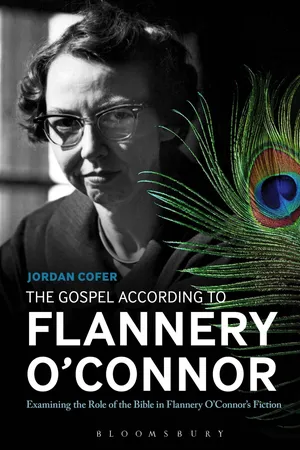
eBook - ePub
The Gospel According to Flannery O'Connor
Examining the Role of the Bible in Flannery O'Connor's Fiction
- 160 pages
- English
- ePUB (mobile friendly)
- Available on iOS & Android
eBook - ePub
The Gospel According to Flannery O'Connor
Examining the Role of the Bible in Flannery O'Connor's Fiction
About this book
Information
1
Towards a New Approach to Flannery O’Connor’s Fiction
An individual story’s full significance may depend upon the reader’s recognition of an allusion.
Driskell & Brittain 11
Regarding Fyodor Dostoevsky’s The Brothers Karamazov, a novel which admittedly influenced Flannery O’Connor, Vladimir Nabokov once commented, “I do not like this trick his characters have of ‘sinning their way to Jesus.’ ”1 However, Nabokov could have very well been speaking about Flannery O’Connor’s fiction since her work is littered with characters like Hazel Motes, who starts a heretical church and commits murder before his conversion, or O. E. Parker, who goes from a life of tattoos and debauchery into prophecy, all of whom sin their way to Jesus. This technique, of which Nabokov complains, however, predates Dostoevsky and can be found in several biblical narratives, the same place where O’Connor herself learned the trick. Throughout the Bible, readers encounter figures such as Paul, who began sinning his way to Jesus as a persecutor of the early Christian church before his conversion at Damascus, or Moses, who murders an Egyptian and flees to Midian before being called by God to free the Israelites. Although Nabokov chides Dostoevsky’s use of this biblical trope, ironically Nabokov’s critique is the hallmark of Flannery O’Connor’s fiction.
As most readers know, O’Connor’s Catholicism was absolutely essential, shaping the development of her writing, yet at the same time, the more apt concern should be avoiding a monologic reading of O’Connor’s work. It is important to avoid assigning O’Connor to a strict master narrative of a Southern writer or a Catholic writer, while also recognizing O’Connor’s own artistic intent. As with any artist, the ultimate fear is that the art, stripped of complexity, becomes reductive—interpretation becomes an epistemological act based on our own interest; however, considering the motive behind her methods adds new dimensions to her work. Readers and critics must always be aware that “interpretation is not isolated act, but takes place within a Homeric battlefield, on which a host of interpretive options are either openly or implicitly in conflict.”2 For any artist the issue of interpretation is fundamental, but it is especially relevant to the work of Flannery O’Connor—an artist whose authorial intentions and techniques have not always been satisfactorily understood. Herein lies the central conflict in reading and interpreting O’Connor’s fiction. Knowing how adamant she was in her own statements on her work, it becomes necessary to keep her theological perspective in mind. In other words, as much as some would like to ignore the religious underpinnings of her work, such a position would miss out on the complexities of her fiction.
This has, of course, happened repeatedly within O’Connor criticism. Early analysis of O’Connor’s work completely misconstrued her aim, believing she was embracing the very same nihilist doctrine she parodied. Yet, some more recent readings have reduced O’Connor to a Christian apologist without understanding the method or approach that she uses. As Hawkins notes, “with both O’Connor’s work and her views quite readily available, it is unusual to find readers so far afield from her intentions.”3 Hawkins, among others, have highlighted the importance of approaching O’Connor’s work on an anagogical level, an approach which O’Connor herself advocated:
The action or gesture I’m talking about would to be on the anagogical level, that is the level which has to do with the Divine life and our participation in it. It would be a gesture that transcended any neat allegory that might have been intended or any pat moral categories a reader could make. (MM 111)
O’Connor understood the complexity of a text as well as the need to consider context as a part of the act of interpretation. In fact, she recommends reading in the spirit of “medieval scriptural exegesis, in which three kinds of meaning were found in the literal level of the sacred text: the moral, the allegorical, and the anagogical.”4
Perhaps this theological approach is what is missing from O’Connor criticism, as readers often misunderstood the grotesqueness and complained of gimmicky repetition throughout her corpus. In fact, Sarah Gordon’s excellent study Flannery O’Connor: The Obedient Imagination includes a flowchart produced by Man Martin, which outlines how to write your own O’Connor story. Martin insinuates that O’Connor’s fiction is so formulaic that it can be predicted or easily replicated. Although I disagree with this assumption, it is by examining her theological and artistic vision that the repeated patterns emerging out of O’Connor’s fiction, beginning with her debut novel, Wise Blood, become clear. These patterns maintain some predictability, yet her approach is not formulaic as much as it is liturgical—that is, in some ways these repetitions match the traditional liturgical layout. The fact that her fiction follows preset patterns should serve as another indicator of the impact her religious inclinations had upon her fiction.5
While there has been much valuable critical scholarship that has helped us to understand her work, those familiar with O’Connor will know that she believed her art and faith were invariably intertwined and hoped that “the resonances of the anagogical will be available to the good reader.”6 This intent explains why her fiction “seizes again and again on biblical metaphors or familiar pious texts and fixes them in her fictional landscape.”7 Although there are many studies of how her beliefs and theology affect her fiction, I argue that O’Connor is heavily influenced by the text itself, noting her intentions and examining her reimagining of biblical narratives. Throughout O’Connor’s work, there are significant biblical allusions which have been overlooked; more importantly, the methodology behind these allusions as a whole has been neglected. While it is necessary to acknowledge her biblical source material, it is critical to understand the impact it has had on her fiction. O’Connor’s stories engage their biblical analogues in unusual, unexpected, and sometimes violent and grotesque manipulations, while conveying essentially the same message as their biblical counterparts. Theologically, her modus operandi was to argue many of the same points about grace that her biblical sources did, but to a modern-day audience.
O’Connor’s unique approach, that is, her attempt to engage her biblical source material in a unique way in order to reach a mass audience, grows out of her frustration over her parish’s “tendency to avoid the intellectual and spiritual problems confronting Catholicism in the twentieth century” since she was opposed to “practiced forms of worship that enabled people to recite ‘readymade’ prayers instead of searching their own souls”; instead O’Connor “frequently encouraged growing interest in Biblical studies.”8 Needless to say, this synthesis of her artistic and religious vision manifested itself within her writing. Instead of attempting to fit into the paradigmatic mainstream Catholic fiction, her subject matter focused on freaks, blind prophets, nymphomaniacs, gorings, homicidal criminals, and all types of grotesque images not often associated with “Christian” fiction. In fact, O’Connor consistently takes both the contemporary Catholic writer and reader to task for this limited vision:
Ever since there have been such things as novels, the world has been flooded with bad fiction for which the religious impulse has been responsible. The sorry religious novel comes about when the writer supposes that because of his belief, he is somehow dispensed from the obligation to penetrate concrete reality. He will think that the eyes of the Church or of the Bible or of his particular theology have already done the seeing for him, and that his business is to rearrange this essential vision into satisfying patterns, getting himself as little dirty in the process as possible. (MM 163)
As Brinkmeyer observes, it comes as no surprise that “O’Connor frequently railed about those she called vapid Catholics, believers who never allowed their faith and its tenets to be challenged or examined in any critical way.”9
Of course, like her literary forbearers, her methods were not divorced from controversy. As Friedman noticed, O’Connor “failed to please only the most rigidly party-line Catholics who find her brand of Catholicism not orthodox enough and the most ‘textual literary critics’ who find her language too bare and experiments with structure not eccentric enough.”10 Meanwhile, several others believed her experiments with the Bible to be sacrilegious. Ironically, like Milton, O’Connor “has been ac...
Table of contents
- Cover
- Halftitle Page
- Title Page
- Dedication Page
- Contents
- Acknowledgments
- List of Abbreviations
- 1. Towards a New Approach to Flannery O’Connor’s Fiction
- 2. Wise Blood as a Primer for O’Connor’s Religious Vision
- 3. From Dishonor to Glory: Biblical Recapitulation in “A Good Man Is Hard to Find” and “Judgment Day”
- 4. The Terrible Speed of Mercy: Flannery O’Connor’s Backwoods Prophets
- 5. So the Last Shall Be First, and the First Last: Biblical Reversals in the Fiction of Flannery O’Connor
- Bibliography
- Index
- Index of Biblical References
- Imprint
Trusted by 375,005 students
Access to over 1.5 million titles for a fair monthly price.
Study more efficiently using our study tools.
Frequently asked questions
Yes, you can cancel anytime from the Subscription tab in your account settings on the Perlego website. Your subscription will stay active until the end of your current billing period. Learn how to cancel your subscription
No, books cannot be downloaded as external files, such as PDFs, for use outside of Perlego. However, you can download books within the Perlego app for offline reading on mobile or tablet. Learn how to download books offline
Perlego offers two plans: Essential and Complete
- Essential is ideal for learners and professionals who enjoy exploring a wide range of subjects. Access the Essential Library with 800,000+ trusted titles and best-sellers across business, personal growth, and the humanities. Includes unlimited reading time and Standard Read Aloud voice.
- Complete: Perfect for advanced learners and researchers needing full, unrestricted access. Unlock 1.5M+ books across hundreds of subjects, including academic and specialized titles. The Complete Plan also includes advanced features like Premium Read Aloud and Research Assistant.
We are an online textbook subscription service, where you can get access to an entire online library for less than the price of a single book per month. With over 1.5 million books across 990+ topics, we’ve got you covered! Learn about our mission
Look out for the read-aloud symbol on your next book to see if you can listen to it. The read-aloud tool reads text aloud for you, highlighting the text as it is being read. You can pause it, speed it up and slow it down. Learn more about Read Aloud
Yes! You can use the Perlego app on both iOS and Android devices to read anytime, anywhere — even offline. Perfect for commutes or when you’re on the go.
Please note we cannot support devices running on iOS 13 and Android 7 or earlier. Learn more about using the app
Please note we cannot support devices running on iOS 13 and Android 7 or earlier. Learn more about using the app
Yes, you can access The Gospel According to Flannery O'Connor by Jordan Cofer in PDF and/or ePUB format, as well as other popular books in Literature & Literary Criticism. We have over 1.5 million books available in our catalogue for you to explore.